Quantum Frontiers
Home | About | Archives
Hamiltonian: An American Musical (without Americana or music)
January 31, 2017 8:51 pm
Author’s note: I intended to post this article three months ago. Other developments delayed the release. Thanks in advance for pardoning the untimeliness.
Critics are raving about it. Barak Obama gave a speech about it. It’s propelled two books onto bestseller lists. Committees have showered more awards on it than clouds have showered rain on California this past decade.
What is it? The Hamiltonian, represented by  . It’s an operator (a mathematical object) that basically represents a system’s energy. Hamiltonians characterize systems classical and quantum, from a brick in a Broadway theater to the photons that form a spotlight. determines how a system evolves, or changes in time.

I lied: Obama didn’t give a speech about the Hamiltonian. He gave a speech about Hamilton. Hamilton: An American Musical spotlights 18th-century revolutionary Alexander Hamilton. Hamilton conceived the United States’s national bank. He nurtured the economy as our first Secretary of the Treasury. The year after Alexander Hamilton died, William Rowan Hamilton was born. Rowan Hamilton conceived four-dimensional numbers called quaternions. He nurtured the style of physics, Hamiltonian mechanics, used to model quantum systems today.
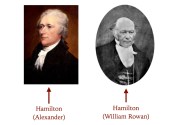
Hamilton has enchanted audiences and critics. Ticket sell out despite costing over $1,000. Tonys, Grammys, and Pulitzers have piled up. Lawmakers, one newspaper reported, ridicule colleagues who haven’t seen the show. One political staff member confessed that “dodging ‘Hamilton’ barbs has affected her work—so much so that she hasn’t returned certain phone calls ‘because I couldn’t handle the anxiety’ of being harangued for her continued failure to see the show.”
Musical-theater fans across the country are applauding Alexander. Hamilton forbid that William Rowan should envy him. Let’s celebrate Hamiltonians.

I’ve been pondering the Hamiltonian

It describes a chain of  sites. ranges from 10 to 30 in most computer simulations. The cast consists of quantum particles. Each site houses one particle or none.
  represents the number of particles at site
  .
.  represents the removal of a particle from site , and
  represents the adding of a particle.
The last term in represents the repulsion between particles that border each other. The “nn” in “ ” stands for “nearest-neighbor.” The
  term encodes particles’ hopping between sites.
  means, “A particle jumps from site
  to site .”
The first term in , we call disorder. Imagine a landscape of random dips and hills. Imagine, for instance, crouching on the dirt and snow in Valley Forge. Boots and hooves have scuffed the ground. Zoom in; crouch lower. Imagine transplanting the row of sites into this landscape.  denotes the height of site .
Say that the dips sink low and the hills rise high. The disorder traps particles like soldiers behind enemy lines. Particles have trouble hopping. We call this system many-body localized.
Imagine flattening the landscape abruptly, as by stamping on the snow. This flattening triggers a phase transition. Phase transitions are drastic changes, as from colony to country. The flattening frees particles to hop from site to site. The particles spread out, in accordance with the Hamiltonian’s term. The particles come to obey thermodynamics, a branch of physics that I’ve effused about.
The Hamiltonian encodes repulsion, hopping, localization, thermalization, and more behaviors. A richer biography you’ll not find amongst the Founding Fathers.

As Hamiltonians constrain particles, politics constrain humans. A play has primed politicians to smile upon the name “Hamilton.” Physicists study Hamiltonians and petition politicians for funding. Would politicians fund us more if we emphasized the Hamiltonians in our science?
Gold star for whoever composes the most rousing lyrics about many-body localization. Or, rather, fifty white stars.
Posted by Nicole Yunger Halpern
Categories: Real science, Reflections, Theoretical highlights
Tags:
« Older Newer »
Leave a Reply
Mobile Site | Full Site
Get a free blog at WordPress.com Theme: WordPress Mobile Edition by Alex King.
The quaternionic number system has far more jewels than most people know. Quaternionic number systems exist in many versions that differ in their ordering. Ordering can occur by applying Cartesian coordinate systems and subsequently by a polar coordinate system. Quaternionic Hilbert spaces exist and they can harbor multiple quaternionic number systems. Operators can use these number spaces or the target spaces of quaternionic functions as eigenspaces. See: A simple model by Hans van Leunen https://doc.co/yvg1Bv
The existence of versions of quaternionic number systems is responsible for the existence of electric charges and color charges.
By hansvanleunen on February 1, 2017 at 1:26 am
You probably saw this, but in case you didn’t or your readers would be interested …
By Pete on February 5, 2017 at 12:50 pm
I had not seen this video. Thanks for the link, Pete!
By Nicole Yunger Halpern on February 5, 2017 at 12:53 pm
Nice post ! Can you recommend me some papers or material about MBL? Thanks a lot!
By Carlos G on February 5, 2017 at 1:26 pm
Thanks for your interest, Carlos. This blog post provides a gentle introduction: https://quantumfrontiers.com/2016/03/13/march-madness-and-quantum-memory/. A review appears here: https://arxiv.org/abs/1404.0686. (And we hope to post our paper soon!)
By Nicole Yunger Halpern on February 5, 2017 at 7:19 pm
[…] quantum computation, Alexei replied. How you simulate Hamiltonians with quantum circuits. Or maybe…well, he was thinking of discussing black holes, information, and […]
By It’s CHAOS! | Quantum Frontiers on February 19, 2017 at 8:25 pm
[…] occupy others. If the system has a different amount of energy, particles occupy different sites. A Hamiltonian, a mathematical object denoted by encodes the energies and the configurations. We represent with […]
By The sign problem(s) | Quantum Frontiers on July 30, 2017 at 8:15 pm
I’m disappointed. I thought you were going to write the play. I sort of figured Caltech would be the place to present a Hamiltonian musical.
By Daniel Dobkin (class of '76, not quite old enough to have known either Hamilton) on December 12, 2017 at 9:05 pm
[…] This shocker came courtesy of Nicole Yunger Halpern, who has written an entertaining piece on the Quantum Frontiers blog about why there should be a musical about the father of the Hamiltonian operator. […]
By 3D neutrinos on your phone, Hamiltonian: an Irish Musical, is a March for Science a good idea? – Physics World on February 15, 2018 at 10:07 am
[…] A Hamiltonian is an observable, a measurable property. Consider a quantum system S, such as a set of particles hopping between atoms. We denote the system’s Hamiltonian by H. H determines how the system’s state changes in time. A musical about H swept Broadway last year. […]
By The Ground Space of Babel | Quantum Frontiers on February 18, 2018 at 8:03 pm
[…] is conjugate to time: Hamiltonians, mathematical objects that represent energy, represent also translations through time. We measure […]
By Rock-paper-scissors, granite-clock-idea | Quantum Frontiers on March 18, 2018 at 8:03 pm
[…] the system’s energy strongly, and call the outcome . Isolate the system from the reservoir. Tune the Hamiltonian, performing the quantum equivalent of propelling the London train up a hill. Measure the energy, […]
By Catching up with the quantum-thermo crowd | Quantum Frontiers on April 15, 2018 at 7:59 pm
[…] experimentalist must perform the quantum analog of inverting particles’ momenta. One must negate the Hamiltonian , the observable that governs how the system evolves: […]
By I get knocked down… | Quantum Frontiers on August 19, 2018 at 5:12 pm
[…] nonlocal operations. Another example is the “MBL-mobile” that I designed with collaborators. Many-body localization (MBL), we found, can enhance an engine’s reliability and […]
By What distinguishes quantum thermodynamics from quantum statistical mechanics? | Quantum Frontiers on July 21, 2019 at 7:29 pm
[…] quantum baked beans that exchange heat with a temperature- environment. Let denote the system’s Hamiltonian, which basically represents the beans’ energy. The beans equilibrate to a quantum Gibbs state, . […]
By The quantum steampunker by Massachusetts Bay | Quantum Frontiers on October 27, 2019 at 5:02 pm
[…] for Quantum Information and Matter. Our engine is a many-particle system ratcheted between two phases accessible to quantum matter, analogous to liquid and solid. The engine can be realized with, e.g., ultracold atoms or trapped […]
By Quantum steampunk invades Scientific American | Quantum Frontiers on April 20, 2020 at 5:21 am
[…] flower. The rest of the qubits form the large system, analogous to the air. I constructed a Hamiltonian—a matrix that dictates how the qubits evolve—that transfers quanta of all the spin’s […]
By Up we go! or From abstract theory to experimental proposal | Quantum Frontiers on May 31, 2020 at 5:22 pm
[…] operation, such as one quantum logical gate. (Experts: The rest of the machine evolves under one Hamiltonian.) When the clock is in another state, the rest of the machine undergoes another operation (evolves […]
By A quantum walk down memory lane | Quantum Frontiers on July 26, 2020 at 5:11 pm
[…] thermodynamics. Caltech bridged my research to the real physical world: condensed matter; atomic molecular, and optical physics; and chemistry. The transformation continued during my […]
By My 100th anniversary with Quantum Frontiers | Quantum Frontiers on September 12, 2021 at 8:30 pm
[…] protocol, one changes a feature of the system quickly. For example, many quantum systems consist of particles hopping across a landscape of hills and valleys. One might flatten a hill during a […]
By Ten lessons I learned from John Preskill | Quantum Frontiers on January 19, 2025 at 7:52 pm