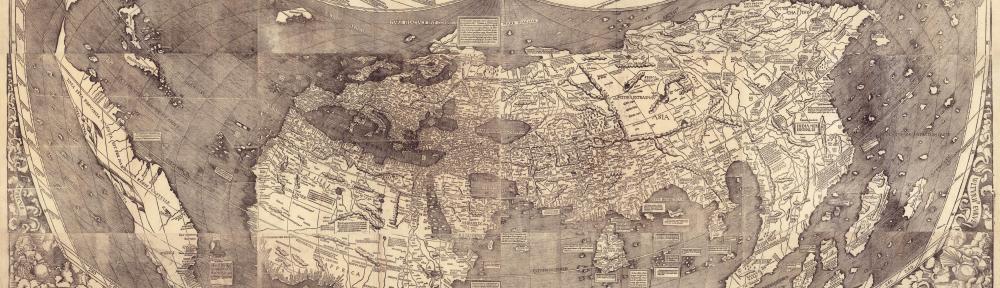
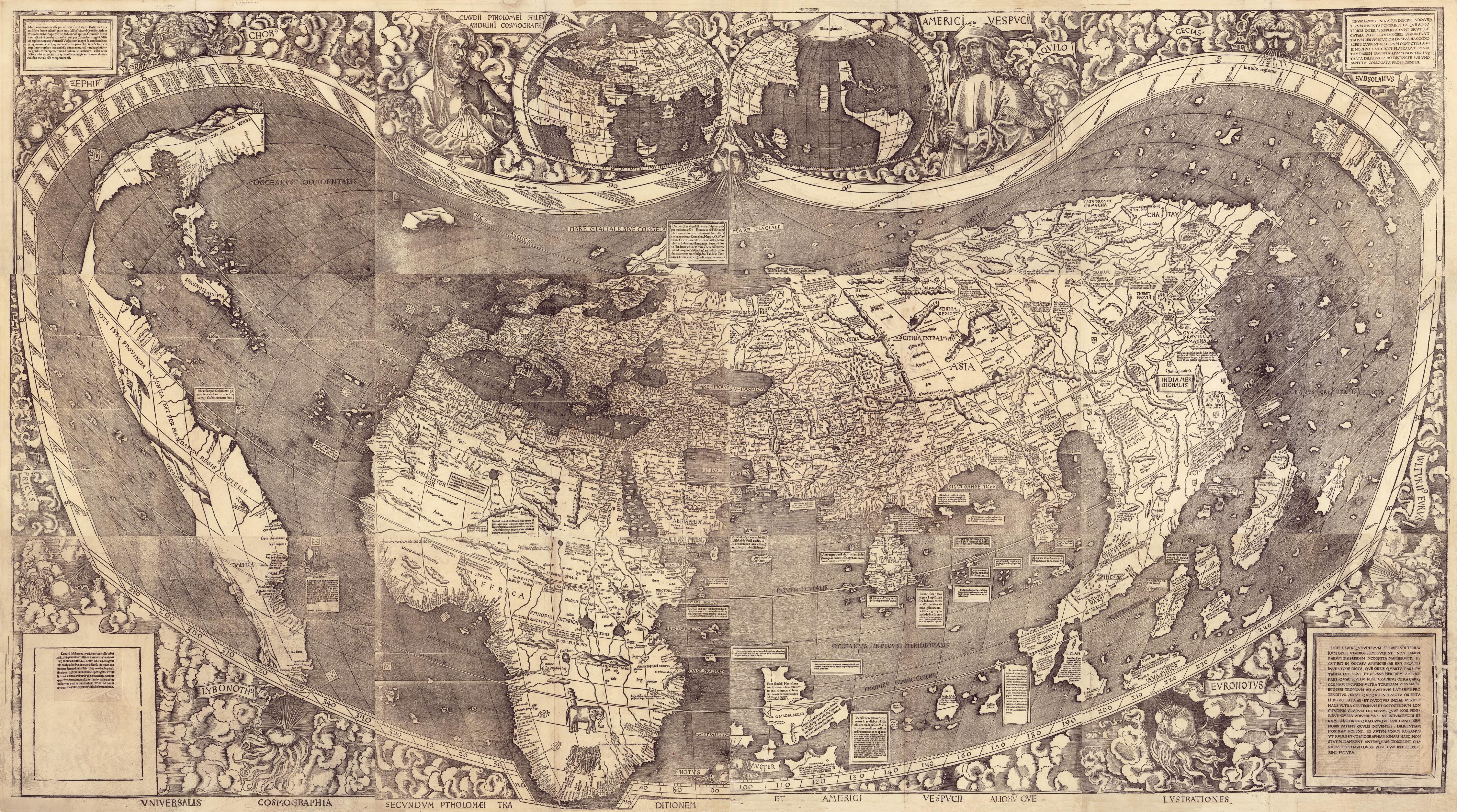
My husband and I visited the Library of Congress on the final day of winter break this year. In a corner, we found a facsimile of a hand-drawn map: the world as viewed by sixteenth-century Europeans. North America looked like it had been dieting, having shed landmass relative to the bulk we knew. Australia didn’t appear. Yet the map’s aesthetics hit home: yellowed parchment, handwritten letters, and symbolism abounded. Never mind street view; I began hungering for an “antique” setting on Google maps.
Approximately four weeks after that trip, I participated in the release of another map: the publication of the review “Roadmap on quantum thermodynamics” in the journal Quantum Science and Technology. The paper contains 24 chapters, each (apart from the introduction) profiling one opportunity within the field of quantum thermodynamics. My erstwhile postdoc Aleks Lasek and I wrote the chapter about the thermodynamics of incompatible conserved quantities, as Quantum Frontiers fans1 might guess from earlier blog posts.
Allow me to confess an ignoble truth: upon agreeing to coauthor the roadmap, I doubted whether it would impact the community enough to merit my time. Colleagues had published the book Thermodynamics in the Quantum Regime seven years earlier. Different authors had contributed different chapters, each about one topic on the rise. Did my community need such a similar review so soon after the book’s publication? If I printed a map of a city the last time I visited, should I print another map this time?
Apparently so. I often tout the swiftness with which quantum thermodynamics is developing, yet not even I predicted the appetite for the roadmap. Approximately thirty papers cited the arXiv version of the paper during the first nine months of its life—before the journal publication. I shouldn’t have likened the book and roadmap to maps of a city; I should have likened them to maps of a terra incognita undergoing exploration. Such maps change constantly, let alone over seven years.
Two trends unite many of the roadmap’s chapters, like a mountain range and a river. First, several chapters focus on experiments. Theorists founded quantum thermodynamics and dominated the field for decades, but experimentalists are turning the tables. Even theory-heavy chapters, like Aleks’s and mine, mention past experiments and experimental opportunities.
Second, several chapters blend quantum thermodynamics with many-body physics. Many-body physicists share interests with quantum thermodynamicists: thermalization and equilibrium, the absence thereof, and temperature. Yet many-body physicists belong to another tribe. They tend to interact with each other differently than quantum thermodynamicists do, write papers differently, adhere to different standards, and deploy different mathematical toolkits. Many-body-physicists use random-matrix theory, mean field theory, Wick transformations, and the like. Quantum thermodynamicists tend to cultivate and apply quantum information theory. Yet the boundary between the communities has blurred, and many scientists (including yours truly) shuttle between the two.
When Quantum Science and Technology published the roadmap, lead editor Steve Campbell announced the event to us coauthors. He’d wrangled the 69 of us into agreeing to contribute, choosing topics, drafting chapters, adhering to limitations on word counts and citations, responding to referee reports, and editing. An idiom refers to the herding of cats, but it would gain in poignancy by referring to the herding of academics. Little wonder Steve wrote in his email, “I’ll leave it to someone else to pick up the mantle and organise Roadmap #2.” I look forward to seeing that roadmap—and, perhaps, contributing to it. Who wants to pencil in Australia with me?
1Hi, Mom and Dad.
 Quantum Frontiers