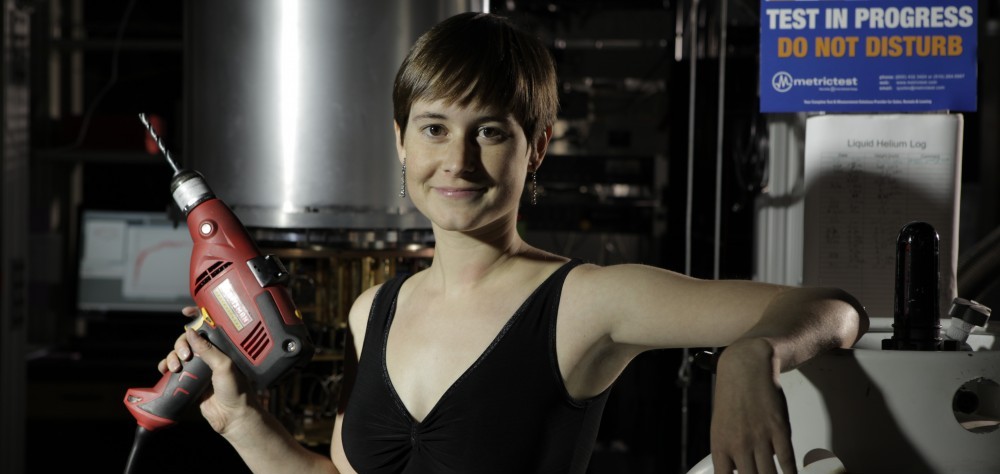
A scientist in Florence can’t avoid bumping into colleagues.
When visiting the Renaissance’s birthplace last summer, I ran into a fellow physicist even on a Saturday morning. I was wandering around the Uffizi Gallery, a museum blessed with some of the greatest hits in western art. A familiar face arrested me on the first floor.

Another colleague cropped up outside the museum. (Some might classify him as an applied physicist or an engineer, but he exhibited a theoretical physicist’s overactive imagination.)

One colleague, I’d been looking forward to meeting for over four years. Jae Dong Noh is a professor of physics at the University of Seoul in South Korea. He’d conducted the first numerical tests (classical-computer simulations) of an idea I’d helped midwife, the non-Abelian eigenstate thermalization hypothesis (NAETH). An earlier blog post described this mouthful, which predicts how certain quantum many-particle systems thermalize, or experience the flow of time. These systems’ dynamics conserve properties, analogous to energy, that are incompatible: one can’t measure the properties simultaneously, as one can’t measure a quantum particle’s position and momentum simultaneously. Because incompatibility helps distinguish quantum from classical physics, such systems’ thermodynamics qualifies as particularly quantum.
Jae Dong modeled such a system and others numerically in a paper. I admired his computational techniques and his grasp of symmetries (for experts: how non-Abelian symmetries affect chaotic quantum systems’ energy-level statistics). My postdoc Aleks Lasek was planning a more thorough numerical test of the NAETH, so I reached out to Jae Dong, and a collaboration crystallized.
Seoul operates thirteen hours ahead of Maryland, but we managed to Zoom because Jae Dong is a night owl and I’m an early bird.1 Zoom introduced me to a man perpetually dressed in a neat button-down shirt and sweater, silver overriding the black in his hair. The neatness extended to Jae Dong’s explanations: if Aleks and I didn’t understand one of his emails, he’d explain it quietly and calmly, untangling the confusion as though pulling a comb through wool.
The collaboration settled into a rhythm: I’d pose a question or propose a goal, Jae Dong would respond with an analytical calculation,2 I’d find holes in the calculation, Jae Dong would plug the holes, I’d re-check the argument’s logic, and we’d repeat the cycle. Had I been in Jae Dong’s shoes, I’d have swallowed the constant objections as I’ve swallowed grape-flavored cough medicine,3 but he always responded with equanimity—sometimes even good cheer—and a possible solution. Meanwhile, Aleks and then-undergraduate Jade LeSchack checked our analytical arguments numerically.

So smoothly did the collaboration hum along that we coauthored two papers before ever meeting in person. One demonstrates numerically that two quantum many-body systems (for experts: nonintegrable Heisenberg models) obey the NAETH.4 In the other paper, we derive a symmetry relation from the NAETH. If the 17-syllable NAETH is a mouthful, the symmetry’s name is half a mouthful: a Kubo–Martin–Schwinger (KMS) relation. It’s important because (i) it enables us to calculate how rapidly a thermodynamic system responds to a stimulus, such as a weak magnetic field, and (ii) physicists go gaga over symmetries generally.
The KMS relation constrains thermal states—essentially, systems that have temperatures. Your typical isolated many-particle quantum system looks thermal if you can observe just a small chunk of it at a time. Accordingly, Jae Dong and collaborators had proved that isolated many-particle quantum systems obey the KMS relation approximately. The larger the system, the more accurate the approximation.
We extended his argument to systems whose dynamics conserve incompatible properties. Such an extension might sound simple, but its proof filled 24 pages of appendices. (For experts: Clebsch–Gordan coefficients are tricky blighters.) We discovered that, under certain conditions, incompatible conserved quantities can reduce the extent to which a quantum system obeys the KMS relation. Quantum incompatibility can augment deviations from conventional thermodynamics.

Jae Dong planned to present about our work at StatPhys, an international statistical-physics conference, which Florence was hosting in 2024. Throughout the two-and-a-half months before the conference, the KMS relation consumed our team. (For experts: Clebsch–Gordan coefficients are very tricky blighters.) I even hid in my hotel room, working and reworking our proofs, during another conference during that time.
The toil paid off. We submitted our KMS manuscript for public scrutiny the day I flew to Florence—because not only Jae Dong would be representing our team at StatPhys. I was looking forward to meeting him there for the first time.

The StatPhys committee outdid itself. The opening ceremony unfolded in Florence’s Palazzo Vecchio, where members of the Medici dynasty once lived. Giorgio Parisi, who won a Nobel Prize for statistical physics in 2021, lectured at the ceremony.

The meat of the conference took place in two other palaces, the Palazzo dei Congressi and the Palazzo degli Affari. In one of them, I met Jae Dong. Although we’d shown that quantum incompatibility can defy thermodynamic predictions, he met my expectations.
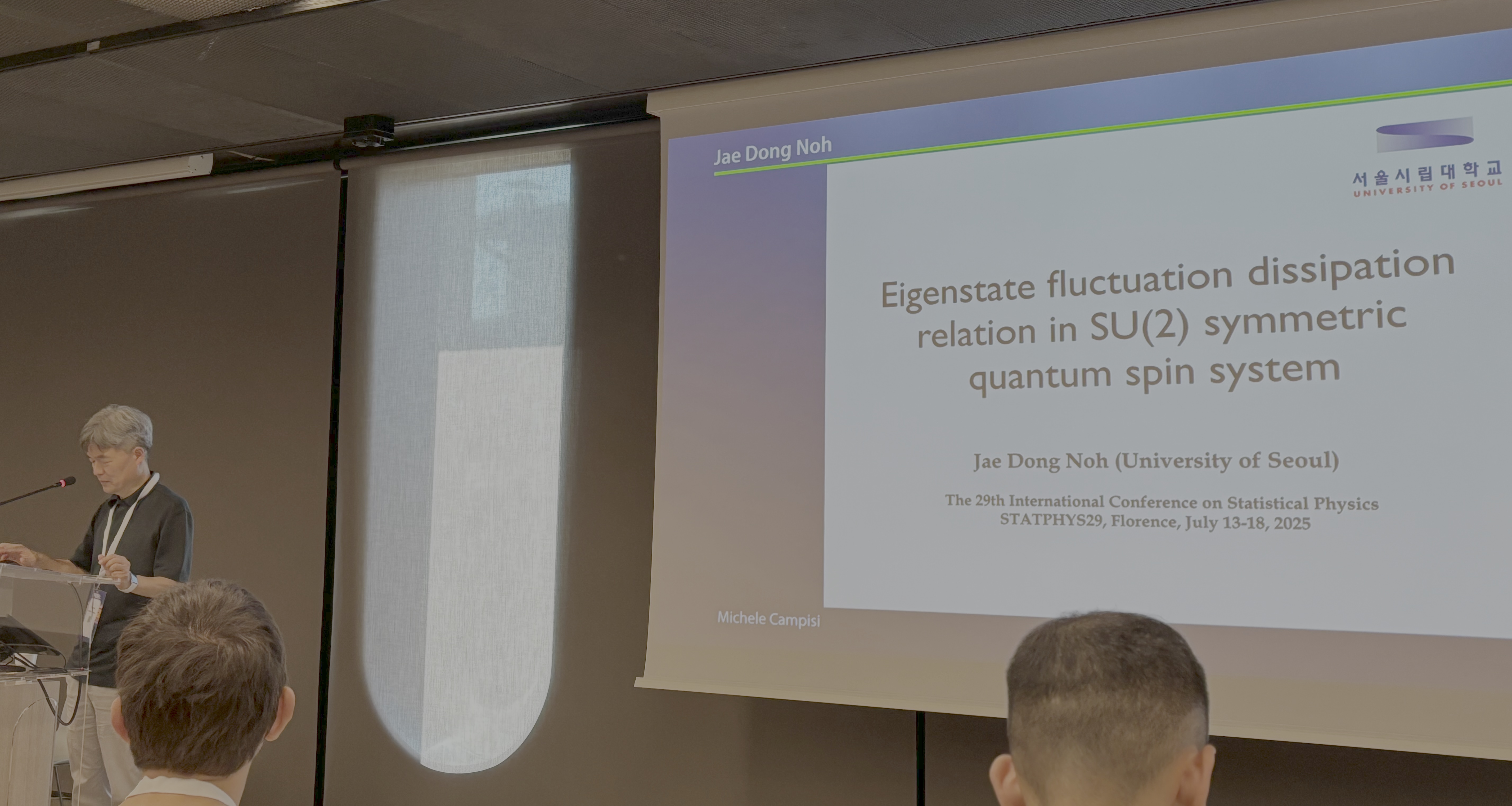
We discovered another thermodynamic phenomenon challenged by incompatible conserved quantities, so stay tuned for another paper and blog post. Some colleagues, one can’t avoid; others are worth engaging with again and again.
1 Aleks has confessed to night-owl habits, but physics motivates him to adapt. Some days, he’s emailed me results before even I’ve woken up. Who needs coffee when the thrill of discovery electrifies one minutes after one hops out of bed?
2 An exact calculation written out on paper, as opposed to a numerical, or approximate, calculation performed by a silicon-based classical computer.
3 Does anyone like the grape flavor? Why do companies bother producing it?
4 Rohit Patil and Marcos Rigol, too, have checked numerically that a system obeys the NAETH.
 Quantum Frontiers

>