Unsolvable

mar-de-plata1

Why go swimming, if you can do math instead inside a room with no windows?

Back in 1997, during my visit to beautiful Mar del Plata in Argentina, I was asked to solve a math problem that I soon realized was close to being unsolvable. The setting was the Banquet for the 38th International Math Olympiad. I was 17 and there was delicious, free food in front of me, so it was pretty impossible to get my attention. Still, the coach of the Romanian team decided to drop by the Greek table to challenge us with the following problem:

Infinite Power: If x^{x^{x^{x^{\dots }}}} = 2, find x.

I was pretty hungry and a bit annoyed at the interruption (it is rude to eat and do math at the same time!), so I looked at the problem for a moment and then challenged him back with this one:

Infiniter Power: If x^{x^{x^{x^{\dots }}}} = 4, find x.

After a few moments, he looked at me with a puzzled look. He knew I had solved his problem within a few seconds, he was annoyed that I had somehow done it in my head and he was even more annoyed that I had challenged him back with a problem that confounded him.

Your mission, if you choose to accept it, is to figure out why the coach of the Romanian IMO team left our table alone for the rest of the competition.

Good luck!

PS: The rest of the Romanian team (the kids) were really cool. In fact, a few years later, I would hang out with a bunch of them at MIT’s Department of Mathematics, or as my older brother put it, The Asylum.

The TV Frontier

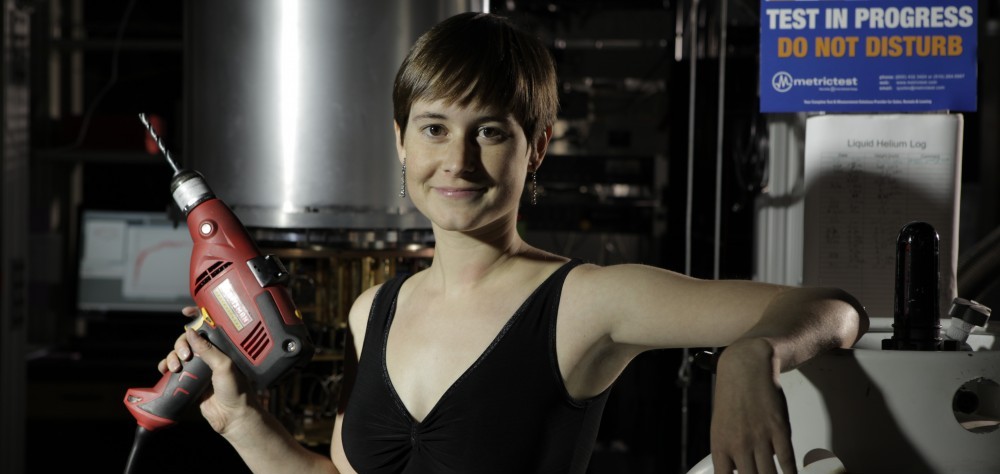
Hello, my name is Tim Blasius and I am a physics graduate student at Caltech.  I recently appeared in a comedy bit on the TV show Conan, where I corrected Conan O’Brien’s physics.  I have been asked to share a few words describing this experience.

As with any story involving unbridled success, it begins as a tale of unnoticed, under-appreciated  and nearly unending hard work – I usually watch the show Conan during dinner with my fiancé.  Accordingly, I have seen many segments called “fan corrections” where Conan viewers submit YouTube videos explaining mistakes that they believe Conan has made on the show.  Some are nerdy and funny like the one where viewers pointed out that Conan used a red-tailed hawk call instead of a bald eagle call.  I was like a crocodile lurking in the water waiting for Conan to make a mistake in my expertise.  Then, like a woefully ignorant antelope sipping from the river Nile, Conan made a physics mistake when mocking Felix Baumgartner’s free fall, and I, being the bloodthirsty physics predator that I am, snapped the jaws of immutable truth around his naïve self.

Continue reading

All those different things called Gauge theories.

Generations of kids had their first encounter with the explanation to the question: What does matter consist of? Atoms -> protons -> quarks. There is a certain pleasure in explaining this, regardless of your physics background. Just like a soldier polishes every new medal he gets, the story about elementary particles gets more exciting with every new ‘magic number’ introduced. Indeed, why 3 colors for quarks? A lay person would think that the inspiration came from the RGB (red-green-blue) colors in a TV tube. However, what physicists really did was try to say a new word in the language of gauge theories. And colored quarks was one of the first words one can say when learning to speak such a language: U(1), SU(2), SU(3)! The very third word.

So why don’t we try to share a scientific excitement about gauge theories?
Continue reading

The allure of elegance

On one of my many short-lived attempts to study for the International Physics Olympiad, I picked up a copy of a well-known textbook by Halliday and Resnick. My high school didn’t offer a course in electricity and magnetism, so I figured I would have to teach myself about the topic if I wanted to solve problems competitively.

I only managed to solve about 3 problems from the book before a friend called me up asking if I wanted to play Frisbee. After that, I don’t think I ever looked at the text again, although for some reason I did bring it to college – maybe to make sure I had enough things gathering dust on my dorm room shelf. That’s not to say it’s a bad book! In fact, I learned quite a bit from the three problems I solved. Here’s one of them:

Continue reading

A promise

During my recent trip back home, I had a chance to talk with friends and family over dinner about the future of Greece. I heard about tales of political corruption and wasted opportunities within Greece, but I noticed also a growing resentment towards the rest of the world, who was mocking us, at best, and was out to get us, at worst. After I had listened for a while to the older generation, I asked them this: “So, what do you plan to do about all this?” They looked at me and an old, wise-looking man said: “There is nothing to be done. If you try to change anything, they will find you and silence you. I tried to change things once…” At this point, the younger generation, some still in high-school, others in college, nodded approvingly. But one young man, a young composer planning to study at the famed Berklee College of Music, was looking at me intently. What was he thinking? Why wasn’t he nodding with the old man? I don’t know. But, it was then that I turned to the old man and said: “There are wise men who see the world as it is. And there are fools who see it as it can be.”
Continue reading

Elementary, my dear Watson

On last week’s “Welcome to the math olympics”, I closed with a problem from the International Math Olympiad of 1981 (a bad year for wine – I would know, I was an avid drinker back then). I would like to take some time to present a solution to this problem, because this is where all the magic happens. What magic? You will see. Here is the problem again:

Problem 6 (IMO 1981, modified): If f(0,y) = y+1, \, f(x+1,0) = f(x,1) and f(x+1,y+1) = f(x, f(x+1,y)), for all non-negative integers x,y, find f(4,2009).

The solution that follows uses solely elementary mathematics. What does that mean? It means that a 15 year-old can figure out the solution, given enough time and an IQ of 300. And, indeed, there are some who can solve this problem in 15 minutes. But, as you will see, it takes clarity of mind that is only attained through relentless effort. Effort to the outside world – to you, it will feel like you are going down the rabbit-hole and you don’t want the journey to end. But you must enter this world with wonder, because it is the world of the imagination – a world where your greatest weapon is your curiosity, prodding your mind to see how far the rabbit-hole goes.
Continue reading

Welcome to the math olympics

It was a beautiful day in the Winter of 1994. I had slept in because it was Saturday, but my older brother, Nikos, was not so lucky. He had just come back from a regional math competition named after the Greek philosopher Θαλής (Thales of Miletus) and he did not look happy. I asked him how he did, but he did not answer; he just reached into his backpack and took out the paper that contained the problems from the competition. Looking back, what I did next defines much of how I approach life since that day: I took the paper and started solving the problems one after the other until I was done. It took me three days – the competition lasted three hours.
Continue reading

Deal or no deal?

You wouldn’t think that scientists get to travel very much, but so far I have visited every continent on Earth but one: Alaska (hmm…) Yet, even before I was a world-renowned Professor at the top university in the universe (or, as I tell my parents “postdoc at Caltech”), I had penpals (when I was half my age – my age is a power of two – the concept of penpal was still alive and strong) from places like Argentina, Cyprus, Germany and Romania (gotta love international math and sports competitions). The friends I made were often local kids that would hang out with the visiting athletes (or mathletes, depending on the nature of the competition), so the reaction I got whenever I mentioned that “Μου αρέσει το volleyball και ο στίβος, αλλά τρελαίνομαι για τα μαθηματικά!” (I love volleyball and track & field, but I am crazy about math!) was pretty uniform: “Eh?”
Continue reading

Geniuses wanted

Cousin Leonidas. He wasn’t always this angry.

Growing up in Spata (no, not Sparta – but feel free to ignore this remark) there was not much to do in the evenings. After school was done and volleyball practice was over (with my two brothers we made up half of the school team) my dad would come pick us up for a fun three hours of track and field practice. Just another lazy evening. Who am I kidding… It was exhausting! But, throwing a javelin with exuberant fury was also therapeutic (it’s a Greek thing). Yet, here lied the problem: The adrenaline high from a good five hours of sports every day would not dissipate simply because of physical exhaustion. I don’t know about my brothers, but my brain was on fire and the two pounds of pasta my mom would put on my plate (almost) every night, could not induce a strong enough food coma. Even working on the next day’s homework did not do the trick of putting me to sleep (though it did help significantly). By then, it was past midnight and I was wide awake.
Continue reading

How I fell in love with teaching and most recently with LIGO

My mom retired as a Principal of High school. I was really inspired by her command over the whole school and involvement with the School Board. I was so inspired and motivated by her achievements in teaching that I always wanted to be a teacher. I had a special interest in science and was very close with my science teachers. I used to participate in science fairs and even won a few prizes along the way.
Continue reading