Congratulations, class of 2025! Words from a new graduate

Editor’s note (Nicole Yunger Halpern): Jade LeSchack, the Quantum Steampunk Laboratory’s first undergraduate, received her bachelor’s degree from the University of Maryland this spring. Kermit the Frog presented the valedictory address, but Jade gave the following speech at the commencement ceremony for the university’s College of Mathematical and Natural Sciences. Jade heads to the University of Southern California for a PhD in physics this fall.

Good afternoon, everyone. My name is Jade, and it is my honor and pleasure to speak before you. 

Today, I’m graduating with my Bachelor of Science, but when I entered UMD, I had no idea what it meant to be a professional scientist or where my passion for quantum science would take me. I want you to picture where you were four years ago. Maybe you were following a long-held passion into college, or maybe you were excited to explore a new technical field. Since then, you’ve spent hours titrating solutions, debugging code, peering through microscopes, working out proofs, and all the other things our disciplines require of us. Now, we’re entering a world of uncertainty, infinite possibility, and lifelong connections. Let me elaborate on each of these.

First, there is uncertainty. Unlike simplified projectile motion, you can never predict the exact trajectory of your life or career. Plans will change, and unexpected opportunities will arise. Sometimes, the best path forward isn’t the one you first imagined. Our experiences at Maryland have prepared us to respond to the challenges and curveballs that life will throw at us. And, we’re going to get through the rough patches.

Second, let’s embrace the infinite possibilities ahead of us. While the concept of the multiverse is best left to the movies, it’s exciting to think about all the paths before us. We’ve each found our own special interests over the past four years here, but there’s always more to explore. Don’t put yourself in a box. You can be an artist and a scientist, an entrepreneur and a humanitarian, an athlete and a scholar. Continue to redefine yourself and be open to your infinite potential.

Third, as we move forward, we are equipped not only with knowledge but with connections. We’ve made lasting relationships with incredible people here. As we go from place to place, the people who we’re close to will change. But we’re lucky that, these days, people are only an email or phone call away. We’ll always have our UMD communities rooting for us.

Now, the people we met here are certainly not the only important ones. We’ve each had supporters along the various stages of our journeys. These are the people who championed us, made sacrifices for us, and gave us a shoulder to cry on. I’d like to take a moment to thank all my mentors, teachers, and friends for believing in me. To my mom, dad, and sister sitting up there, I couldn’t have done this without you. Thank you for your endless love and support. 

To close, I’d like to consider this age-old question that has always fascinated me: Is mathematics discovered or invented? People have made a strong case for each side. If we think about science in general, and our future contributions to our fields, we might ask ourselves: Are we discoverers or inventors? My answer is both! Everyone here with a cap on their head is going to contribute to both. We’re going to unearth new truths about nature and innovate scientific technologies that better society. This uncertain, multitudinous, and interconnected world is waiting for us, the next generation of scientific thinkers! So let’s be bold and stay fearless. 

Congratulations to the class of 2024 and the class of 2025! We did it!

Author’s note: I was deeply grateful for the opportunity to serve as the student speaker at my commencement ceremony. I hope that the science-y references tickle the layman and SME alike. You can view a recording of the speech here. I can’t wait for my next adventures in quantum physics!
Watch out for geese! My summer in Waterloo

It’s the beginning of another summer, and I’m looking forward to outdoor barbecues, swimming in lakes and pools, and sharing my home-made ice cream with friends and family. One thing that I won’t encounter this summer, but I did last year, is a Canadian goose. In summer 2023, I ventured north from the University of Maryland – College Park to Waterloo, Canada, for a position at the University of Waterloo. The university houses the Institute for Quantum Computing (IQC), and the Perimeter Institute (PI) for Theoretical Physics is nearby. I spent my summer at these two institutions because I was accepted into the IQC’s Undergraduate School on Experimental Quantum Information Processing (USEQIP) and received an Undergraduate Research Award. I’ll detail my experiences in the program and the fun social activities I participated in along the way.

For my first two weeks in Waterloo, I participated in USEQIP. This program is an intense boot camp in quantum hardware. I learned about many quantum-computing platforms, including trapped ions, superconducting circuits, and nuclear magnetic resonance systems. There were interactive lab sessions where I built a low-temperature thermometer, assembled a quantum key distribution setup, and designed an experiment of the Quantum Zeno Effect using nuclear magnetic resonance systems. We also toured the IQC’s numerous research labs and their nano-fabrication clean room. I learned a lot from these two weeks, and I settled into life in goose-filled Waterloo, trying to avoid goose poop on my daily walks around campus.

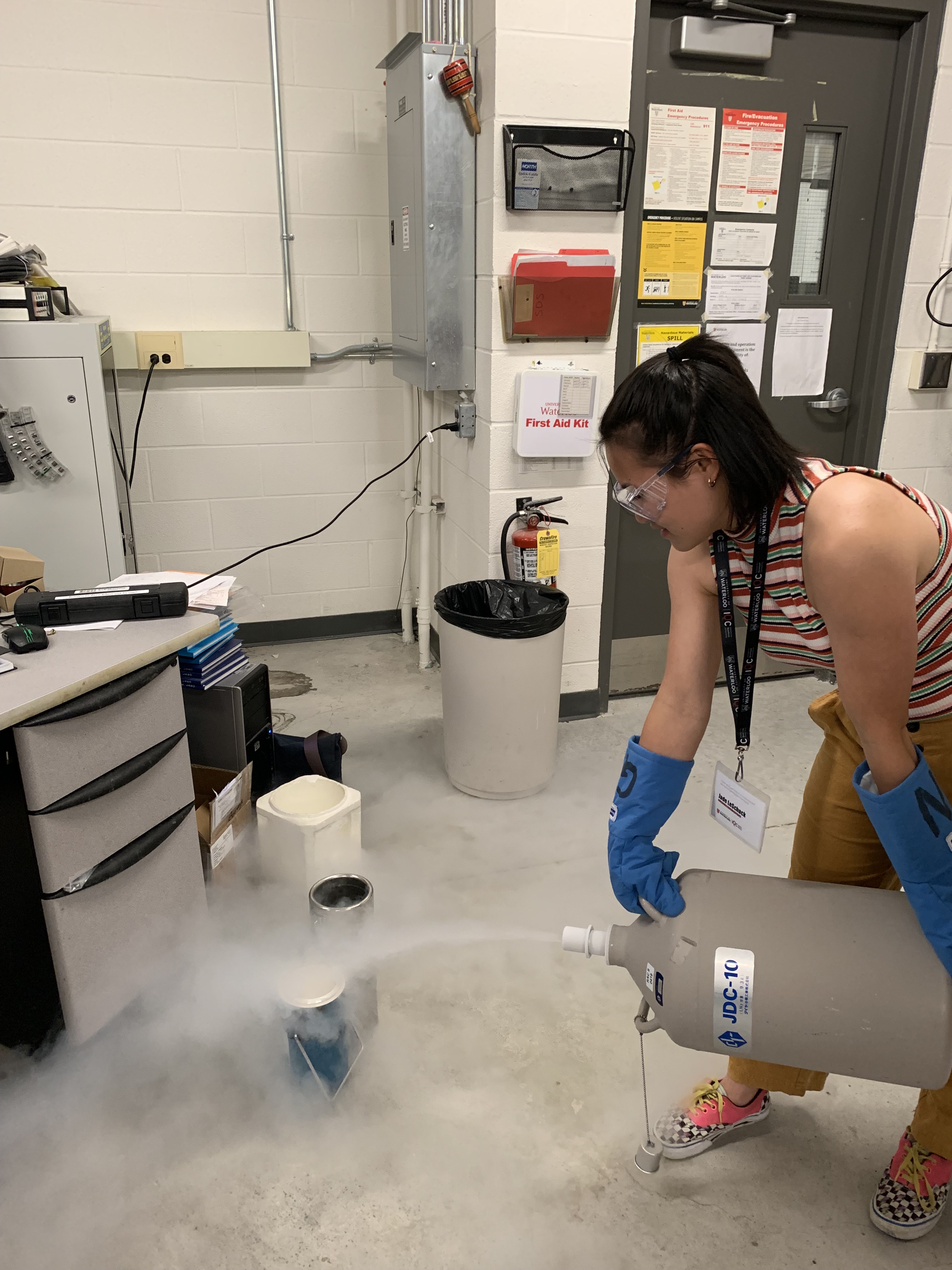
I pour liquid nitrogen into a low-temperature container.

Once USEQIP ended, I began the work for my Undergraduate Research Award, joining Dr. Raymond Laflamme’s group. My job was to read Dr. Laflamme’s soon-to-be-published textbook about quantum hardware, which he co-wrote with graduate student Shayan Majidy and Dr. Chris Wilson. I read through the sections for clarity and equation errors. I also worked through the textbook’s exercises to ensure they were appropriate for the book. Additionally, I contributed figures to the book.

The most challenging part of this work was completing the exercises. I would become frustrated with the complex problems, sometimes toiling over a single problem for over three hours. My frustrations were aggravated when I asked Shayan for help, and my bitter labor was to him a simple trick I had not seen. I had to remind myself that I had been asked to test drive this textbook because I am the target audience for it. I offered an authentic undergraduate perspective on the material that would be valuable to the book’s development. Despite the challenges, I successfully completed my book review, and Shayan sent the textbook for publication at the beginning of August.

After, I moved on to another project. I worked on the quantum thermodynamics research that I conduct with Dr. Nicole Yunger Halpern. My work with Dr. Yunger Halpern concerns systems with noncommuting charges. I run numerical calculations on these systems to understand how they thermalize internally. I enjoyed working at both the IQC and the Perimeter Institute with their wonderful office views and free coffee.

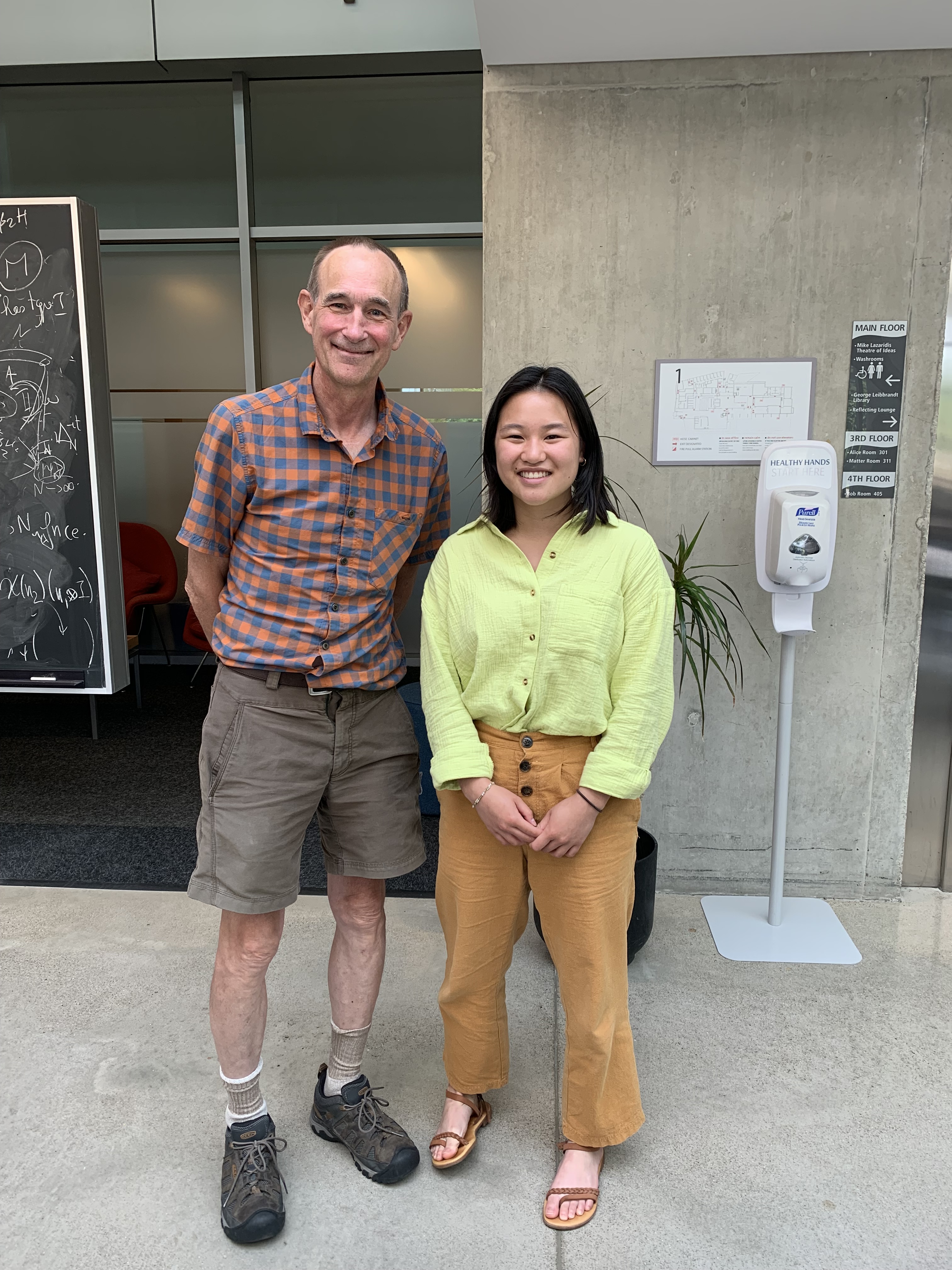
Dr. Laflamme and I at the Perimeter Institute on my last day in Waterloo.

Midway through the summer, Dr. Laflamme’s former and current students celebrated his 60th birthday with a birthday conference. As one of his newest students, I had a wonderful time meeting many of his past students who’ve had exciting careers following their graduation from the group. During the birthday conference, we had six hours of talks daily, but these were not traditional research talks. The talks were on any topic the speaker wanted to share with the audience. I learned about how a senior data scientist at TD Bank uses machine learning, a museum exhibit organized by the University of Waterloo called Quantum: The Exhibition, and photonic quantum science at the Raman Research Institute. For the socializing portion, we played street hockey and enjoyed delicious sushi, sandwiches, and pastries. By coincidence, Dr. Laflamme’s birthday and mine are one day apart!

Outside of my work, I spent almost every weekend exploring Ontario. I beheld the majesty of Niagara Falls for the first time; I visited Canada’s wine country, Niagara on the Lake; I met with friends and family in Toronto; I stargazed with the hope of seeing the aurora borealis (unfortunately, the Northern Lights did not appear). I also joined a women’s ultimate frisbee team, PPF (sorry, we can’t tell you what it stands for), during my stay in Canada. I had a blast getting to play while sharpening my skills for the collegiate ultimate frisbee season. Finally, my summer would not have been great without the friendships that I formed with my fellow USEQIP undergraduates. We shared more than just meals; we shared our hopes and dreams, and I am so lucky to have met such inspiring people.

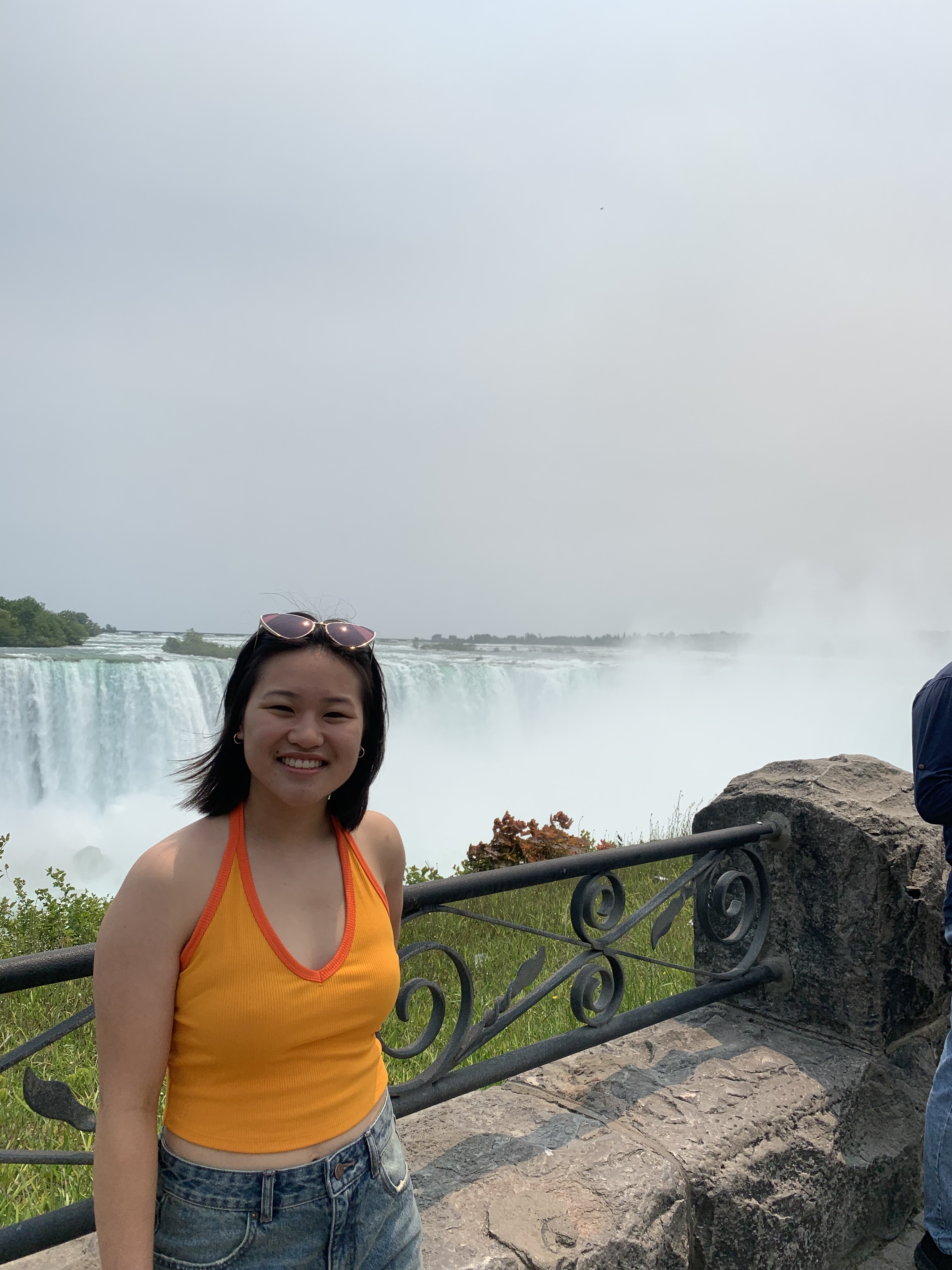
I spent my first weekend in Canada at Niagara Falls.

Though my summer in Waterloo has come to an end now, I’ll never forget the incredible experiences I had. 

A peek inside Northrop Grumman’s subatomic endeavors

As the weather turns colder and we trade outdoor pools for pumpkin spice and then Christmas carols, perhaps you’re longing for summer’s warmth. For me, it is not just warmth I yearn for: This past summer, I worked as a physics intern at Northrop Grumman. With the internship came invaluable lessons and long-lasting friendships formed in a unique environment that leverages quantum computing in industry.

More on that in a bit. First, allow me to introduce myself. My name is Jade LeSchack, and I am an undergraduate physics major at the University of Maryland, College Park. I interact with Dr. Nicole Yunger Halpern’s group and founded the Undergraduate Quantum Association at UMD, a student organization for those interested in quantum science and technology. 

Undergraduate Quantum Association Vice President, Sondos Quqandi (right), and me hosting the quantum track of the Bitcamp hackathon

Back to Northrop Grumman. Northrop Grumman’s work as a defense contractor has led them to join the global effort to harness the power of quantum computing through their transformational-computing department, which is where I worked. Northrop Grumman is approaching quantum computing via proprietary superconducting technology. Superconductors are special types of conductors that can carry electric current with zero resistance when cooled to very low temperatures. We’re talking one hundred times colder than outer space. Superconducting electronics are brought to almost-absolute-zero temperatures using a dilution refrigerator, a machine that, frankly, looks closer to a golden chandelier than an appliance for storing your perishables.

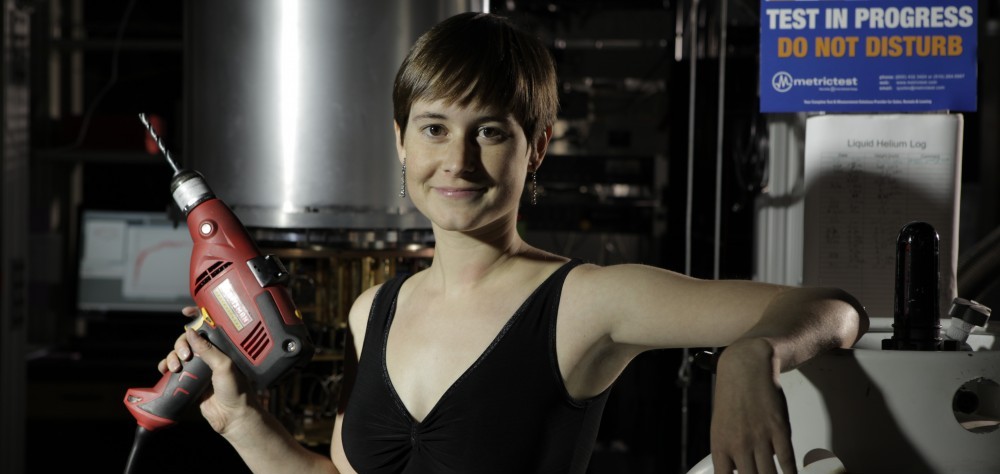
An example of the inside of a dilution refrigerator

I directly worked with these golden chandeliers for one week during my internship. This week entailed shadowing staff physicists and was my favorite week of the internship. I shadowed Dr. Amber McCreary as she ran experiments with the dilution fridges and collected data. Amber explained all the steps of her experiments and answered my numerous questions.

Working in the transformational-computing unit, I had physicists from a variety of backgrounds at my disposal. These physicists hailed from across the country — with quite a few from my university — and were welcoming and willing to show me the ropes. The structure of the transformational-computing department was unlike what I have seen with academia since the department is product-oriented. Some staff manned a dilution fridge, while others managed products stemming from the superconductor research.

Outside this week in the lab, I worked on my chosen, six-week-long project: restructuring part of the transformational-computing codebase. Many transformational-computing experiments require curve fitting which is finding the curve of best fit through a set of data points. Pre-written algorithms can perform curve-fitting for certain equations such as polynomial equations, but it is harder for more-complicated equations. I worked with a fellow intern named Thomas, and our job was to tackle these more-complicated equations. Although I never saw the dilution fridges again, I gained many programming skills and improved programs for the transformation-computing department. 

The internship was not all work and no play. The memories I made and connections I forged will last much longer than the ten weeks in which they were founded. Besides the general laughs, there were three happy surprises I’d like to share. The first was lunch-time ultimate frisbee. I play ultimate frisbee on the University of Maryland women’s club team, and when my manager mentioned there was a group at Northrop Grumman who played during the week, I jumped on the chance to join. 

The second happy surprise involved a frozen treat. On a particularly long day of work, my peers and I scoured a storage closet in the office on an office-supplies raid. What we found instead of supplies was an ice-cream churner. Since the COVID lock-down, a hobby of mine that I have avidly practiced has been ice-cream making. A rediscovered ice-cream churner plus an experienced ice-cream maker brought three ice-cream days for the office. Naturally, they were huge successes! 

And last, I won an Emmy. 

Me winning an Emmy

Well, not quite.

I was shocked when, after a team lunch, my manager turned to the intern team and nonchalantly said, “Let’s go see if the Emmy is available.” I was perplexed but intrigued, and my manager explained that Northrop Grumman had won an Emmy for science in advancing cinematic technology. And it turned out that the Emmy was available for photographs! We were all excited; this was probably the only time we would hold a coveted cinema award reserved for the red carpet.

Not only did I contribute to Northrop Grumman’s quantum efforts, but I also played ultimate frisbee and held an Emmy. Interning at Northrop Grumman was a wonderful opportunity that has left me with new quantum knowledge and fond memories.