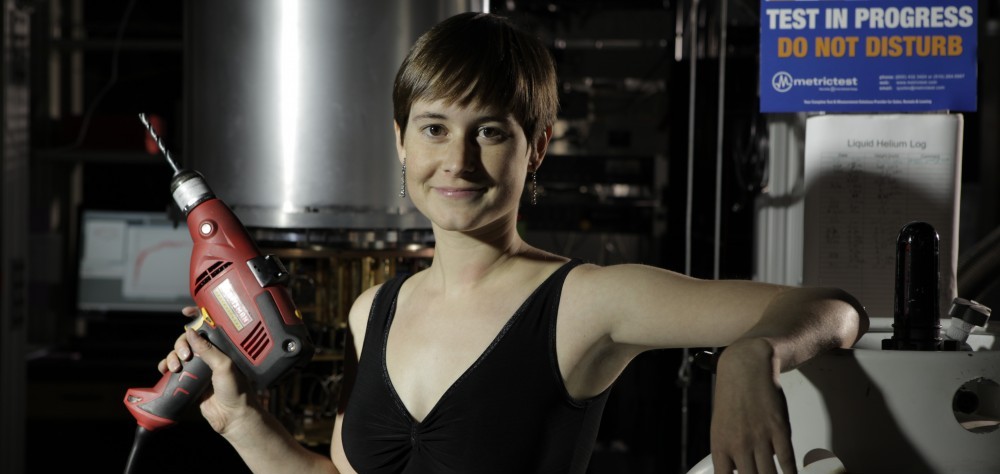

A camel strolled past, yards from our window in the Applied-Sciences Building.
I hadn’t expected to see camels at TU Delft, aka the Delft University of Technology, in Holland. I breathed, “Oh!” and turned to watch until the camel followed its turbaned leader out of sight. Nelly Ng, the PhD student with whom I was talking, followed my gaze and laughed.
Nelly works in Stephanie Wehner’s research group. Stephanie—a quantum cryptographer, information theorist, thermodynamicist, and former Caltech postdoc—was kind enough to host me for half August. I arrived at the same time as TU Delft’s first-year undergrads. My visit coincided with their orientation. The orientation involved coffee hours, team-building exercises, and clogging the cafeteria whenever the Wehner group wanted lunch.
And, as far as I could tell, a camel.
Not even a camel could unseat Nelly’s and my conversation. Nelly, postdoc Mischa Woods, and Stephanie are the Wehner-group members who study quantum and small-scale thermodynamics. I study quantum and small-scale thermodynamics, as Quantum Frontiers stalwarts might have tired of hearing. The four of us exchanged perspectives on our field.
Mischa knew more than Nelly and I about clocks; Nelly knew more about catalysis; and I knew more about fluctuation relations. We’d read different papers. We’d proved different theorems. We explained the same phenomena differently. Nelly and I—with Mischa and Stephanie, when they could join us—questioned and answered each other almost perpetually, those two weeks.
We talked in our offices, over lunch, in the group discussion room, and over tea at TU Delft’s Quantum Café. We emailed. We talked while walking. We talked while waiting for Stephanie to arrive so that she could talk with us.

The site of many a tête-à-tête.
The copiousness of the conversation drained me. I’m an introvert, formerly “the quiet kid” in elementary school. Early some mornings in Delft, I barricaded myself in the visitors’ office. Late some nights, I retreated to my hotel room or to a canal bank. I’d exhausted my supply of communication; I had no more words for anyone. Which troubled me, because I had to finish a paper. But I regret not one discussion, for three reasons.
First, we relished our chats. We laughed together, poked fun at ourselves, commiserated about calculations, and confided about what we didn’t understand.
We helped each other understand, second. As I listened to Mischa or as I revised notes about a meeting, a camel would stroll past a window in my understanding. I’d see what I hadn’t seen before. Mischa might be explaining which quantum states represent high-quality clocks. Nelly might be explaining how a quantum state ξ can enable a state ρ to transform into a state σ. I’d breathe, “Oh!” and watch the mental camel follow my interlocutor through my comprehension.
Nelly’s, Mischa’s, and Stephanie’s names appear in the acknowledgements of the paper I’d worried about finishing. The paper benefited from their explanations and feedback.
Third, I left Delft with more friends than I’d had upon arriving. Nelly, Mischa, and I grew to know each other, to trust each other, to enjoy each other’s company. At the end of my first week, Nelly invited Mischa and me to her apartment for dinner. She provided pasta; I brought apples; and Mischa brought a sweet granola-and-seed mixture. We tasted and enjoyed more than we would have separately.

Dinner with Nelly and Mischa.
I’ve written about how Facebook has enhanced my understanding of, and participation in, science. Research involves communication. Communication can challenge us, especially many of us drawn to science. Let’s shoulder past the barrier. Interlocutors point out camels—and hot-air balloons, and lemmas and theorems, and other sources of information and delight—that I wouldn’t spot alone.
With gratitude to Stephanie, Nelly, Mischa, the rest of the Wehner group (with whom I enjoyed talking), QuTech and TU Delft.
During my visit, Stephanie and Delft colleagues unveiled the “first loophole-free Bell test.” Their paper sent shockwaves (AKA camels) throughout the quantum community. Scott Aaronson explains the experiment here.


 cannot transform into a state
  :
:  . An ancilla
  , called a catalyst, might facilitate the transformation:
  . Catalysts act like engines used to extract work from a pair of heat baths.
 , wherein
  resembles


 .
.
 . Alternatively: Not all states of light correspond to positive expectation values
  of the particle-number operator
  .
.


 “. Imagine turning on a magnetic field, or coupling one electron to another, or letting the superconductor sit untouched. A CPTP map, labeled as
  , represents every such evolution.
 denote the probability that you read out the
  possible number. Because your device outputs some number, the probabilities sum to one:
  . We say that
  . Imagine that, after the process ended, you measured a property of
  denote the probability that you read out the
  possible number. The probabilities sum to one:
  .
.  .
.


