The AdS/MERA correspondence has been making the rounds of the blogosphere with nice posts by Scott Aaronson and Sean Carroll, so let’s take a look at the topic here at Quantum Frontiers.
The question of how to formulate a quantum theory of gravity is a long-standing open problem in theoretical physics. Somewhat recently, an idea that has gained a lot of traction (and that Spiros has blogged about before) is emergence. This is the idea that space and time may emerge from some more fine-grained quantum objects and their interactions. If we could understand how classical spacetime emerges from an underlying quantum system, then it’s not too much of a stretch to hope that this understanding would give us insight into the full quantum nature of spacetime.
One type of emergence is exhibited in holography, which is the idea that certain (D+1)-dimensional systems with gravity are exactly equivalent to D-dimensional quantum theories without gravity. (Note that we’re calling time a dimension here. For example, you would say that on a day-to-day basis we experience D = 4 dimensions.) In this case, that extra +1 dimension and the concomitant gravitational dynamics are emergent phenomena.
A nice aspect of holography is that it is explicitly realized by the AdS/CFT correspondence. This correspondence proposes that a particular class of spacetimes—ones that asymptotically look like anti-de Sitter space, or AdS—are equivalent to states of a particular type of quantum system—a conformal field theory, or CFT. A convenient visualization is to draw the AdS spacetime as a cylinder, where time marches forward as you move up the cylinder and different slices of the cylinder correspond to snapshots of space at different instants of time. Conveniently, in this picture you can think of the corresponding CFT as living on the boundary of the cylinder, which, you should note, has one less dimension than the “bulk” inside the cylinder.

Even within this nice picture of holography that we get from the AdS/CFT correspondence, there is a question of how exactly do CFT, or boundary quantities map onto quantities in the AdS bulk. This is where a certain tool from quantum information theory called tensor networks has recently shown a lot of promise.
A tensor network is a way to efficiently represent certain states of a quantum system. Moreover, they have nice graphical representations which look something like this:

Beni discussed one type of tensor network in his post on holographic codes. In this post, let’s discuss the tensor network shown above, which is known as the Multiscale Entanglement Renormalization Ansatz, or MERA.
The MERA was initially developed by Guifre Vidal and Glen Evenbly as an efficient approximation to the ground state of a CFT. Roughly speaking, in the picture of a MERA above, one starts with a simple state at the centre, and as you move outward through the network, the MERA tells you how to build up a CFT state which lives on the legs at the boundary. The MERA caught the eye of Brian Swingle, who noticed that it looks an awfully lot like a discretization of a slice of the AdS cylinder shown above. As such, it wasn’t a preposterously big leap to suggest a possible “AdS/MERA correspondence.” Namely, perhaps it’s more than a simple coincidence that a MERA both encodes a CFT state and resembles a slice of AdS. Perhaps the MERA gives us the tools that are required to construct a map between the boundary and the bulk!
So, how seriously should one take the possibility of an AdS/MERA correspondence? That’s the question that my colleagues and I addressed in a recent paper. Essentially, there are several properties that a consistent holographic theory should satisfy in both the bulk and the boundary. We asked whether these properties are still simultaneously satisfied in a correspondence where the bulk and boundary are related by a MERA.
What we found was that you invariably run into inconsistencies between bulk and boundary physics, at least in the simplest construals of what an AdS/MERA correspondence might be. This doesn’t mean that there is no hope for an AdS/MERA correspondence. Rather, it says that the simplest approach will not work. For a good correspondence, you would need to augment the MERA with some additional structure, or perhaps consider different tensor networks altogether. For instance, the holographic code features a tensor network which hints at a possible bulk/boundary correspondence, and the consistency conditions that we proposed are a good list of checks for Beni and company as they work out the extent to which the code can describe holographic CFTs. Indeed, a good way to summarize how our work fits into the picture of quantum gravity alongside holography and tensors networks is by saying that it’s nice to have good signposts on the road when you don’t have a map.


 al (direction flow of positively charged ions), then the electrons (negative charge carriers) are traveling in the opposite direction of the green arrow shown in the diagram. Referring to the diagram and using the right hand rule you can conclude a buildup of electrons at the long bottom edge of the Hall element running parallel to the longitudinal current, and an opposing positively charged edge at the long top edge of the Hall element. This separation of charge will produce a transverse potential difference and is labeled on the diagram as Hall voltage (VH). Once the electric force (acting towards the positively charged edge perpendicular to both current and magnetic field) from the charge build up balances with the Lorentz force (opposing the electric force), the result is a negative charge carrier with a straight line trajectory in the opposite direction of the green arrow. Essentially, Hall conductance is the longitudinal current divided by the Hall voltage.
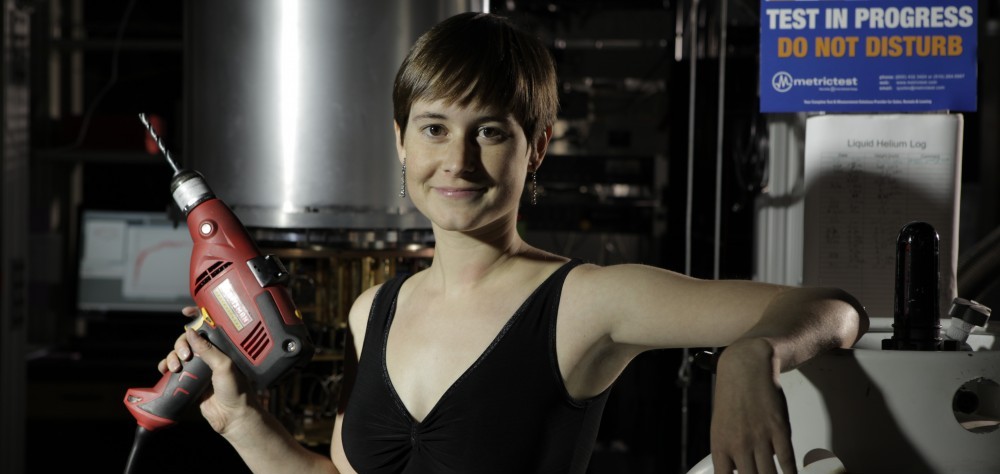
 t that will attempt to grow graphene in a unique way. My contribution included the set-up of the stepper motor (pictured to the right) and its controls, so that it would very slowly travel down the tube in an attempt to grow a long strip of graphene. If Caltech scientist David Boyd and graduate student Chen-Chih Hsu are able to grow the long strips of graphene, this will mark yet another landmark achievement for them and Caltech in graphene research, bringing all of us closer to technologies such as flexible electronics, synthetic nerve cells, 500-mile range Tesla cars and batteries that allow us to stream Netflix on smartphones for weeks on end.


 samples in order better to understand the pairing mechanism that causes Cooper Pairs for superconductivity. In regular metals, the pairing mechanism via phonon lattice vibrations is fairly well understood by physicists. Meanwhile, the pairing mechanism for HTSC is still a mystery. We are also investigating how this pairing changes with doping, as well as how the magnetic field is channeled up vortices within HTSC.
 Bar. Then we “bake” the inner chamber, using a heater to expel any other gas, while the vacuum pump continues until we reach approximately
  Bar. The heater is turned off and the vacuum continues to pump until we reach
  Bar. This entire vacuum process takes approximately 15 hours…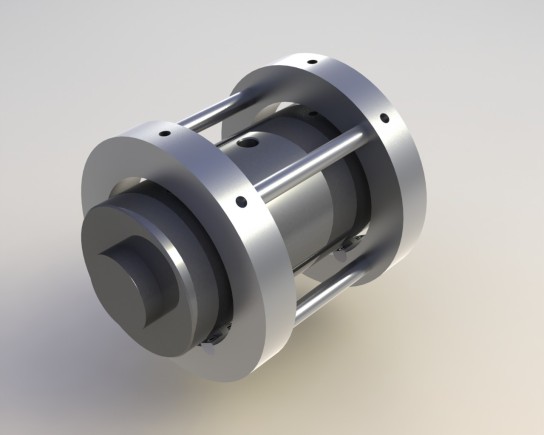
 , of silicon is equal to zero. A zero linear expansion coefficient is of special interest to LIGO researchers because a small change in temperature inside the cryostat, (see Fig. 2, below) will not result in a significant change in length for the silicon cavity shown in Fig. 1.


 Quantum Frontiers