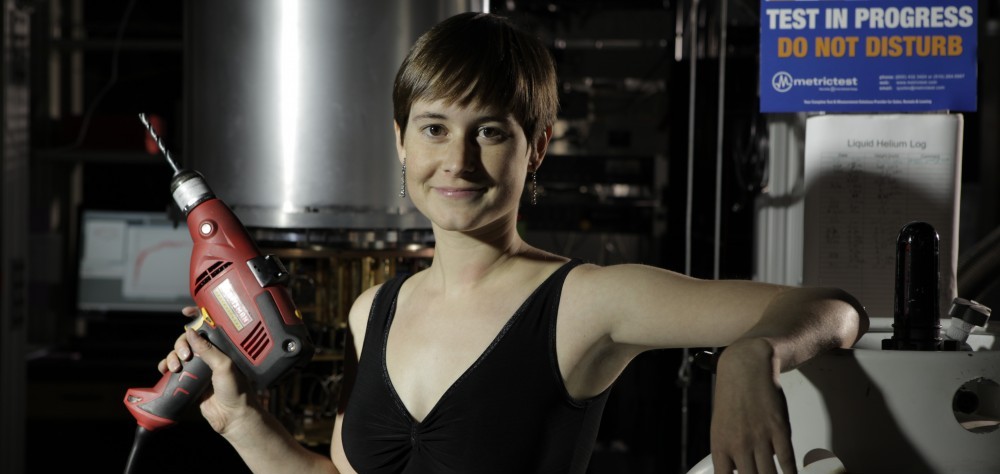
Bringing the heat to Cal State LA

John Baez is a tough act to follow.

The mathematical physicist presented a colloquium at Cal State LA this May.1 The talk’s title: “My Favorite Number.” The advertisement image: A purple “24” superimposed atop two egg cartons.

Baez300px

The colloquium concerned string theory. String theorists attempt to reconcile Einstein’s general relativity with quantum mechanics. Relativity concerns the large and the fast, like the sun and light. Quantum mechanics concerns the small, like atoms. Relativity and with quantum mechanics individually suggest that space-time consists of four dimensions: up-down, left-right, forward-backward, and time. String theory suggests that space-time has more than four dimensions. Counting dimensions leads theorists to John Baez’s favorite number.

His topic struck me as bold, simple, and deep. As an otherworldly window onto the pedestrian. John Baez became, when I saw the colloquium ad, a hero of mine.

And a tough act to follow.

I presented Cal State LA’s physics colloquium the week after John Baez. My title: “Quantum steampunk: Quantum information applied to thermodynamics.” Steampunk is a literary, artistic, and film genre. Stories take place during the 1800s—the Victorian era; the Industrial era; an age of soot, grime, innovation, and adventure. Into the 1800s, steampunkers transplant modern and beyond-modern technologies: automata, airships, time machines, etc. Example steampunk works include Will Smith’s 1999 film Wild Wild West. Steampunk weds the new with the old.

So does quantum information applied to thermodynamics. Thermodynamics budded off from the Industrial Revolution: The steam engine crowned industrial technology. Thinkers wondered how efficiently engines could run. Thinkers continue to wonder. But the steam engine no longer crowns technology; quantum physics (with other discoveries) does. Quantum information scientists study the roles of information, measurement, and correlations in heat, energy, entropy, and time. We wed the new with the old.

Posters

What image could encapsulate my talk? I couldn’t lean on egg cartons. I proposed a steampunk warrior—cravatted, begoggled, and spouting electricity. The proposal met with a polite cough of an email. Not all department members, Milan Mijic pointed out, had heard of steampunk.

Steampunk warrior

Milan is a Cal State LA professor and my erstwhile host. We toured the palm-speckled campus around colloquium time. What, he asked, can quantum information contribute to thermodynamics?

Heat offers an example. Imagine a classical (nonquantum) system of particles. The particles carry kinetic energy, or energy of motion: They jiggle. Particles that bump into each other can exchange energy. We call that energy heat. Heat vexes engineers, breaking transistors and lowering engines’ efficiencies.

Like heat, work consists of energy. Work has more “orderliness” than the heat transferred by random jiggles. Examples of work exertion include the compression of a gas: A piston forces the particles to move in one direction, in concert. Consider, as another example, driving electrons around a circuit with an electric field. The field forces the electrons to move in the same direction. Work and heat account for all the changes in a system’s energy. So states the First Law of Thermodynamics.

Suppose that the system is quantum. It doesn’t necessarily have a well-defined energy. But we can stick the system in an electric field, and the system can exchange motional-type energy with other systems. How should we define “work” and “heat”?

Quantum information offers insights, such as via entropies. Entropies quantify how “mixed” or “disordered” states are. Disorder grows as heat suffuses a system. Entropies help us extend the First Law to quantum theory.

First slide

So I explained during the colloquium. Rarely have I relished engaging with an audience as much as I relished engaging with Cal State LA’s. Attendees made eye contact, posed questions, commented after the talk, and wrote notes. A student in a corner appeared to be writing homework solutions. But a presenter couldn’t have asked for more from the rest. One exclamation arrested me like a coin in the cogs of a grandfather clock.

I’d peppered my slides with steampunk art: paintings, drawings, stills from movies. The peppering had staved off boredom as I’d created the talk. I hoped that the peppering would stave off my audience’s boredom. I apologized about the trimmings.

“No!” cried a woman near the front. “It’s lovely!”

I was about to discuss experiments by Jukka Pekola’s group. Pekola’s group probes quantum thermodynamics using electronic circuits. The group measures heat by counting the electrons that hop from one part of the circuit to another. Single-electron transistors track tunneling (quantum movements) of single particles.

Heat complicates engineering, calculations, and California living. Heat scrambles signals, breaks devices, and lowers efficiencies. Quantum heat can evade definition. Thermodynamicists grind their teeth over heat.

“No!” the woman near the front had cried. “It’s lovely!”

She was referring to steampunk art. But her exclamation applied to my subject. Heat has not only practical importance, but also fundamental: Heat influences every law of thermodynamics. Thermodynamic law underpins much of physics as 24 underpins much of string theory. Lovely, I thought, indeed.

Cal State LA offered a new view of my subfield, an otherworldly window onto the pedestrian. The more pedestrian an idea—the more often the idea surfaces, the more of our world the idea accounts for—the deeper the physics. Heat seems as pedestrian as a Pokémon Go player. But maybe, someday, I’ll present an idea as simple, bold, and deep as the number 24.

Window

A window onto Cal State LA.

With gratitude to Milan Mijic, and to Cal State LA’s Department of Physics and Astronomy, for their hospitality.

1For nonacademics: A typical physics department hosts several presentations per week. A seminar relates research that the speaker has undertaken. The audience consists of department members who specialize in the speaker’s subfield. A department’s astrophysicists might host a Monday seminar; its quantum theorists, a Wednesday seminar; etc. One colloquium happens per week. Listeners gather from across the department. The speaker introduces a subfield, like the correction of errors made by quantum computers. Course lectures target students. Endowed lectures, often named after donors, target researchers.

The physics of Trump?? Election renormalization.

Image

Two things were high in my mind this last quarter: My course on advanced statistical mechanics and phase transitions, and the bizarre general elections that raged all around. It is no wonder then, that I would start to conflate the Ising model, Landau mean field, and renormalization group, with the election process, and just think of each and every one of us as a tiny magnet, that needs to say up or down – Trump or Cruz, Clinton or Sanders (a more appetizing choice, somehow), and .. you get the drift.

Elections and magnetic phase transitions are very much alike. The latter, I will argue, teaches us something very important about the former.

The physics of magnetic phase transitions is amazing. If I hadn’t thought this way, I wouldn’t be a condensed matter physicist. Models of magnets consider a bunch of spins – each one a small magnet – that talk only to their nearest neighbor, as happens in typical magnets. At the onset of magnetic order (the Curie temperature), when the symmetry of the spins becomes broken, it turns out that the spin correlation length diverges. Even though Interaction length = lattice constant, we get correlation length = infinity.

To understand how ridiculous this is, you should understand what a correlation length is. The correlation tells you a simple thing. If you are a spin, trying to make it out in life, and trying to figure out where to point, your pals around you are certainly going to influence you. Their pals will influence them, and therefore you. The correlation length tells you how distant can a spin be, and still manage to nudge you to point up or down. In physics-speak, it is the reduced correlation length. It makes sense that somebody in you neighborhood, or your office, or even your town, will do something that will affect you – after all – you always interact with people that distant. But the analogy to the spins is that there is always a given circumstance where some random person in Incheon, South Korea, could influence your vote. A diverging correlation length is the Butterfly effect for real.

And yet, spins do this. At the critical temperature, just as the spins decide whether they want to point along the north pole or towards Venus, every nonsense of a fluctuation that one of them makes leagues away may galvanize things one way or another. Without ever even remotely directly talking to even their father’s brother’s nephew’s cousin’s former roommate! Every fluctuation, no matter where, factors into the symmetry breaking process.

A bit of physics, before I’m blamed for being crude in my interpretation. The correlation length at the Curie point, and almost all symmetry-breaking continuous transitions, diverges as some inverse power of the temperature difference to the critical point: \frac{1}{|T-T_c|}^{\nu}. The faster it diverges (the higher the power \nu) , actually the more feeble the symmetry breaking is. Why is that? After I argued that this is an amazing phenomenon? Well, if 10^2 voices can shift you one way or another, each voice is worth something. If 10^{20} voices are able to push you around, I’m not really buying influence on you by bribing ten of these. Each voice is worth less. Why? The correlation length is also a measure of the uncertainty before the moment of truth – when the battle starts and we don’t know who wins. Big correlation length – any little element of the battlefield can change something, and many souls are involved and active. Small correlation length – the battle was already decided since one of the sides has a single bomb that will evaporate the world. Who knew that Dr. Strangelove could be a condensed matter physicist?

This lore of correlations led to one of the most breathtaking developments of 20th century physics. I’m a condensed matter guy, so it is natural that Ken Wilson, as well as Ben Widom, Michael Fisher, and Leo Kadanoff are my superheros. They came up with an idea so simple yet profound – scaling. If you have a system (say, of spins) that you can’t figure out – maybe because it is fluctuating, and because it is interacting – regardless, all you need to do is to move away from it. Let averaging (aka, central limit theorem) do the job and suppress fluctuations. Let us just zoom out. If we change the scale by a factor of 2, so that all spins look more crowded, then the correlation length also look half as big. The system looks less critical. It is as if we managed to move away from the critical temperature – either cooling towards T=0 , or heating up towards T=\infty. Both limits are easy to solve. How do we make this into a framework? If the pre-zoom-out volume had 8 spins, we can average them into a representative single spin. This way you’ll end up with a system that looks pretty much like the one you had before – same spin density, same interaction, same physics – but at a different temperature, and further from the phase transition. It turns out you can do this, and you can figure out how much changed in the process. Together, this tells you how the correlation length depends on T-T_c. This is the renormalization group, aka, RG.

Interestingly, this RG procedure informs us that criticality and symmetry breaking are more feeble the lower the dimension. There are no 1d permanent magnets, and magnetism in 2d is very frail. Why? Well, the more dimensions there are, the more nearest neighbors each spin has, and more neighbors your neighbors have. Think about the 6-degrees of separation game. 3d is okay for magnets, as we know. It turns out, however, that in physical systems above 4 dimensions, critical phenomena is the same as that of a fully connected (infinite dimensional) network. The uncertainty stage is very small, correlations length diverge slowly. Even at distance 1 there are enough people or spins to bend your will one way or another. Magnetization is just a question of time elapsed from the beginning of the experiment.

Spins, votes, what’s the difference? You won’t be surprised to find that the term renormalization has permeated every aspect of economics and social science as well. What is voting Republican vs Democrat if not a symmetry breaking? Well, it is not that bad yet – the parties are different. No real symmetry there, you would think. Unless you ask the ‘undecided voter’.

And if elections are affected by such correlated dynamics, what about revolutions? Here the analogy with phase transitions is so much more prevalent even in our language – resistance to a regime solidifies, crystallizes, and aligns – just like solids and magnets. When people are fed up with a regime, the crucial question is – if I would go to the streets, will I be joined by enough people to affect a change?

Revolutions, therefore, seem to rise out of strong fluctuations in the populace. If you wish, think of revolutions as domains where the frustration is so high, which give a political movement the inertia it needs.

Domains-: that’s exactly what the correlation length is about. The correlation length is the size of correlated magnetic domains, i.e.,groups of spins that point in the same direction. And now we remember that close to a phase transition, the correlation length diverges as some power of the distance ot the transition: \frac{1}{|T-T_c|^{\nu}}. Take a magnet just above its Curie temperature. The closer we are to a phase transition, the larger the correlation length is, and the bigger are the fluctuating magnetized domains. The parameter \nu is the correlation-length critical exponent and something of a holy grail for practitioners of statistical mechanics. Everyone wants to calculate it for various phase transition. It is not that easy. That’s partially why I have a job.

The correlation length aside, how many spins are involved in a domain? \left[1/|T-T_c|^d\right]^{\nu} . Actually, we know roughly what \nu is. For systems with dimension $latex  d>4$, it is ½. For systems with a lower dimensionality it is roughly $latex  2/d$. (Comment for the experts: I’m really not kidding – this fits the Ising model for 2 and 3 dimensions, and it fits the xy model for 3d).

So the number of spins in a domain in systems below 4d is 1/|T-T_c|^2, independent of dimension. On the other hand, four d and up it is 1/|T-T_c|^{d/2}. Increasing rapidly with dimension, when we are close to the critical point.

Back to voters. In a climate of undecided elections, analogous to a magnet near its Curie point, the spins are the voters, and domain walls are the crowds supporting this candidate or that policy; domain walls are what becomes large demonstrations in the Washington Mall. And you would think that the world we live in is clearly 2d – a surface of a 3d sphere (and yes – that includes Manhattan!). So a political domain size just diverges as a simple moderate 1/|T-T_c|^2 during times of contested elections.

Something happened, however, in the past two decades: the internet. The connectivity of the world has changed dramatically.

No more 2d. Now, our effective dimension is determined by our web based social network. Facebook perhaps? Roughly speaking, the dimensionality of the Facebook network is that number of friends we have, divided by the number of mutual friends. I venture to say this averages at about 10. With about a 150 friends in tow, out of which 15 are mutual. So our world, for election purposes, is 10 dimensional big!

Let’s simulate what this means for our political system. Any event – a terrorist attack, or a recession, etc. will cause a fluctuation that will involve a large group of people – a domain. Take a time when T-T_c is a healthy 0.1 for instance. In the good old 2d world this would involve 100 friends times 1/0.1^2\sim 10000 people. Now it would be more like 100\cdot 1/0.1^{10/2}\sim 10-millions. So any small perturbation of conditions could make entire states turn one way or another.

When response to slight shifts in prevailing conditions encompasses entire states, rather than entire neighborhoods, polarization follows. Over all, a state where each neighborhood has a slightly different opinion will be rather moderate – extreme opinions will only resonate locally. Single voices could only sway so many people. But nowadays, well – we’ve all seen Trump and the like on the march. Millions. It’s not even their fault – its physics!

Can we do anything about it? It’s up for debate. Maybe cancel the electoral college, to make the selecting unit larger than the typical size of a fluctuating domain. Maybe carry out a time averaged election: make an election year where each month there is a contest for the grand prize. Or maybe just move to Canada.

What matters to me, and why?

Students at my college asked every Tuesday. They gathered in a white, windowed room near the center of campus. “We serve,” read advertisements, “soup, bread, and food for thought.” One professor or visitor would discuss human rights, family,  religion, or another pepper in the chili of life.

I joined occasionally. I listened by the window, in the circle of chairs that ringed the speaker. Then I ventured from college into physics.

The questions “What matters to you, and why?” have chased me through physics. I ask experimentalists and theorists, professors and students: Why do you do science? Which papers catch your eye? Why have you devoted to quantum information more years than many spouses devote to marriages?

One physicist answered with another question. Chris Jarzynski works as a professor at the University of Maryland. He studies statistical mechanics—how particles typically act and how often particles act atypically; how materials shine, how gases push back when we compress them, and more.

“How,” Chris asked, “should we quantify precision?”

Chris had in mind nonequilibrium fluctuation theoremsOut-of-equilibrium systems have large-scale properties, like temperature, that change significantly.1 Examples include white-bean soup cooling at a “What matters” lunch. The soup’s temperature drops to room temperature as the system approaches equilibrium.

Steaming soup

Nonequilibrium. Tasty, tasty nonequilibrium.

Some out-of-equilibrium systems obey fluctuation theorems. Fluctuation theorems are equations derived in statistical mechanics. Imagine a DNA molecule floating in a watery solution. Water molecules buffet the strand, which twitches. But the strand’s shape doesn’t change much. The DNA is in equilibrium.

You can grab the strand’s ends and stretch them apart. The strand will leave equilibrium as its length changes. Imagine pulling the strand to some predetermined length. You’ll have exerted energy.

How much? The amount will vary if you repeat the experiment. Why? This trial began with the DNA curled this way; that trial began with the DNA curled that way. During this trial, the water batters the molecule more; during that trial, less. These discrepancies block us from predicting how much energy you’ll exert. But suppose you pick a number W. We can form predictions about the probability that you’ll have to exert an amount W of energy.

How do we predict? Using nonequilibrium fluctuation theorems.

Fluctuation theorems matter to me, as Quantum Frontiers regulars know. Why? Because I’ve written enough fluctuation-theorem articles to test even a statistical mechanic’s patience. More seriously, why do fluctuation theorems matter to me?

Fluctuation theorems fill a gap in the theory of statistical mechanics. Fluctuation theorems relate nonequilibrium processes (like the cooling of soup) to equilibrium systems (like room-temperature soup). Physicists can model equilibrium. But we know little about nonequilibrium. Fluctuation theorems bridge from the known (equilibrium) to the unknown (nonequilibrium).

Bridge - theory

Experiments take place out of equilibrium. (Stretching a DNA molecule changes the molecule’s length.) So we can measure properties of nonequilibrium processes. We can’t directly measure properties of equilibrium processes, which we can’t perform experimentally. But we can measure an equilibrium property indirectly: We perform nonequilibrium experiments, then plug our data into fluctuation theorems.

Bridge - exprmt

Which equilibrium property can we infer about? A free-energy difference, denoted by ΔF. Every equilibrated system (every room-temperature soup) has a free energy F. F represents the energy that the system can exert, such as the energy available to stretch a DNA molecule. Imagine subtracting one system’s free energy, F1, from another system’s free energy, F2. The subtraction yields a free-energy difference, ΔF = F2 – F1. We can infer the value of a ΔF from experiments.

How should we evaluate those experiments? Which experiments can we trust, and which need repeating?

Those questions mattered little to me, before I met Chris Jarzynski. Bridging equilibrium with nonequilibrium mattered to me, and bridging theory with experiment. Not experimental nitty-gritty.

I deserved a dunking in white-bean soup.

Dunk 2

Suppose you performed infinitely many trials—stretched a DNA molecule infinitely many times. In each trial, you measured the energy exerted. You processed your data, then substituted into a fluctuation theorem. You could infer the exact value of ΔF.

But we can’t perform infinitely many trials. Imprecision mars our inference about ΔF. How does the imprecision relate to the number of trials performed?2

Chris and I adopted an information-theoretic approach. We quantified precision with a parameter \delta. Suppose you want to estimate ΔF with some precision. How many trials should you expect to need to perform? We bounded the number N_\delta of trials, using an entropy. The bound tightens an earlier estimate of Chris’s. If you perform N_\delta trials, you can estimate ΔF with a percent error that we estimated. We illustrated our results by modeling a gas.

I’d never appreciated the texture and richness of precision. But richness precision has: A few decimal places distinguish Albert Einstein’s general theory of relativity from Isaac Newton’s 17th-century mechanics. Particle physicists calculate constants of nature to many decimal places. Such a calculation earned a nod on physicist Julian Schwinger’s headstone. Precision serves as the bread and soup of much physics. I’d sniffed the importance of precision, but not tasted it, until questioned by Chris Jarzynski.

Schwinger headstone

The questioning continues. My college has discontinued its “What matters” series. But I ask scientist after scientist—thoughtful human being after thoughtful human being—“What matters to you, and why?” Asking, listening, reading, calculating, and self-regulating sharpen my answers those questions. My answers often squish beneath the bread knife in my cutlery drawer of criticism. Thank goodness that repeating trials can reduce our errors.

Bread knife

1Or large-scale properties that will change. Imagine connecting the ends of a charged battery with a wire. Charge will flow from terminal to terminal, producing a current. You can measure, every minute, how quickly charge is flowing: You can measure how much current is flowing. The current won’t change much, for a while. But the current will die off as the battery nears depletion. A large-scale property (the current) appears constant but will change. Such a capacity to change characterizes nonequilibrium steady states (NESSes). NESSes form our second example of nonequilibrium states. Many-body localization forms a third, quantum example.

2Readers might object that scientists have tools for quantifying imprecision. Why not apply those tools? Because ΔF equals a logarithm, which is nonlinear. Other authors’ proposals appear in references 1-13 of our paper. Charlie Bennett addressed a related problem with his “acceptance ratio.” (Bennett also blogged about evil on Quantum Frontiers last month.)

Schopenhauer and the Geometry of Evil

Gottfried_Wilhelm_von_LeibnizAt the beginning of the 18th century, Gottfried Leibniz took a break from quarreling with Isaac Newton over which of them had invented calculus to confront a more formidable adversary, Evil.  His landmark 1710 book Théodicée argued that, as creatures of an omnipotent and benevolent God, we live in the best of all possible worlds.  Earthquakes and wars, he said, are compatible with God’s benevolence because they may lead to beneficial consequences in ways we don’t understand.  Moreover, for us as individuals, having the freedom to make bad decisions challenges us to learn from our mistakes and improve our moral characters.

In 1844 another philosopher, Arthur Schopenhauer, came to the opposite conclusion, Schopenhauerthat we live in the worst of all possible worlds.  By this he meant not just a world is full of calamity and suffering, but one that in many respects, both human and natural, functions so badly that if it were only a little worse it could not continue to exist at all.   An atheist, Schopenhauer felt no need to defend God’s benevolence, and could turn his full attention to the mechanics and indeed (though not a mathematician) the geometry of badness.  He argued that if the world’s continued existence depends on many continuous variables such as temperature, composition of the atmosphere, etc., each of which must be within a narrow range, then almost all possible worlds will be just barely possible, lying near the periphery of the possible region.  Here, in his own words, is his refutation of Leibniz’ optimism.
 

To return, then to Leibniz, I cannot ascribe to the Théodicée as a methodical and broad unfolding of optimism, any other merit than this, that it gave occasion later for the immortal “Candide” of the great Voltaire; whereby certainly Leibniz s often-repeated and lame excuse for the evil of the world, that the bad sometimes brings about the good, received a confirmation which was unexpected by him…  But indeed to the palpably sophistical proofs of Leibniz that this is the best of all possible worlds, we may seriously and honestly oppose the proof that it is the worst of all possible worlds. For possible means, not what one may construct in imagination, but what can actually exist and continue. Now this world is so arranged as to be able to maintain itself with great difficulty; but if it were a little worse, it could no longer maintain itself. Consequently a worse world, since it could not continue to exist, is absolutely impossible: thus this world itself is the worst of all possible worlds. For not only if the planets were to run their heads together, but even if any one of the actually appearing perturbations of their course, instead of being gradually balanced by others, continued to increase, the world would soon reach its end. Astronomers know upon what accidental circumstances principally the irrational relation to each other of the periods of revolution this depends, and have carefully calculated that it will always go on well; consequently the world also can continue and go on. We will hope that, although Newton was of an opposite opinion, they have not miscalculated, and consequently that the mechanical perpetual motion realised in such a planetary system will not also, like the rest, ultimately come to a standstill. Again, under the firm crust of the planet dwell the powerful forces of nature which, as soon as some accident affords them free play, must necessarily destroy that crust, with everything living upon it, as has already taken place at least three times upon our planet, and will probably take place oftener still. The earthquake of Lisbon, the earthquake of Haiti, the destruction of Pompeii, are only small, playful hints of what is possible. A small alteration of the atmosphere, which cannot even be chemically proved, causes cholera, yellow fever, black death, &c., which carry off millions of men; a somewhat greater alteration would extinguish all life. A very moderate increase of heat would dry up all the rivers and springs. The brutes have received just barely so much in the way of organs and powers as enables them to procure with the greatest exertion sustenance for their own lives and food for their offspring; therefore if a brute loses a limb, or even the full use of one, it must generally perish. Even of the human race, powerful as are the weapons it possesses in understanding and reason, nine-tenths live in constant conflict with want, always balancing themselves with difficulty and effort upon the brink of destruction. Thus throughout, as for the continuance of the whole, so also for that of each individual being the conditions are barely and scantily given, but nothing over. The individual life is a ceaseless battle for existence itself; while at every step destruction threatens it. Just because this threat is so often fulfilled provision had to be made, by means of the enormous excess of the germs, that the destruction of the individuals should not involve that of the species, for which alone nature really cares. The world is therefore as bad as it possibly can be if it is to continue to be at all. Q. E. D.  The fossils of the entirely different kinds of animal species which formerly inhabited the planet afford us, as a proof of our calculation, the records of worlds the continuance of which was no longer possible, and which consequently were somewhat worse than the worst of possible worlds.* 

Writing at a time when diseases were thought to be caused by poisonous vapors, and when “germ” meant not a pathogen but a seed or embryo, Schopenhauer hints at Darwin and Wallace’s natural selection.  But more importantly, as Alejandro Jenkins pointed out,  Schopenhauer’s distinction between possible and impossible worlds may be the first adequate statement of what in the 20th century came to be called the weak anthropic principle, the thesis that our perspective on the universe is unavoidably biased toward conditions hospitable to the existence and maintenance of complex structures. His examples of orbital instability and lethal atmospheric changes show that by an “impossible” world he meant one that might continue to exist physically, but would extinguish beings able to witness its existence.

In Schopenhauer’s time only seven planets were known, so, given all the ways things might go wrong, and barring divine assistance, it would have required incredible good luck for even one of them to be habitable.  Thus Schopenhauer’s principle, as it might better be called, was less satisfactory as an answer to the problem of existence than to the problem of evil.  The belief that such extreme good luck is less plausible than deliberate creation by some sort of intelligent agent, encapsulated by Schopenhauer’s contemporary William Paley in his  watchmaker analogy, remains popular today, but its cogency has been greatly diminished by two centuries of progress in astronomy.  In place of Schopenhauer’s seven, the universe is now believed to contain about as many planets as there are atoms in a pencil.  And that’s just the observable part, within a Hubble distance of the earth; inflationary cosmology implies that there are many more beyond our cosmological horizon, perhaps infinitely many.  In such a vast universe,  it is no longer surprising that some places should be habitable.  In this setting Schopenhauer’s principle leads to a situation that is locally precarious but globally stable, lying between Leibniz’ unrealistic optimum and what would be a true pessimum, a globally dead universe with no life, civilization, etc. anywhere.  To paraphrase Schopenhauer, modern astronomy has revealed an enormous excess of habitable places, mostly just barely habitable, so that the extinction of life in one does not entail extinction of life in the universe, for which alone nature really cares.

Returning to Schopenhauer’s  refutation of  Leibniz’s optimism, his  qualitative verbal reasoning can easily be recast in terms of high-dimensional geometry.  Let the goodness g  of a possible world   X   be approximated to lowest order as

g(X) = 1-q(X),

where  q  is a positive definite quadratic form in the d-dimensional real variable X. Possible worlds correspond to  X  values where   g  is positive, lying under a paraboloidal cap centered on the optimum,   g(0)=1,  with negative values of   representing impossible worlds.  Leaving out the impossible worlds, simple integration, of the sort Leibniz invented, shows that the average of  g  over possible worlds is  1-d/(d+2).   So if there is one variable, the average world is 2/3 as good as the best possible, while if there are 198 variables the average world is only 1% as good.  Thus, in the limit of many dimensions, the average world approaches  g=0,  the worst possible.   More general versions of this idea can be developed using post-18’th century mathematical tools like Lipschitz continuity.

Earthquakes are an oft-cited  example of senseless evil, hard to fit into a beneficent divine plan, but today we understand them as impersonal consequences of slow convection in the Earth’s mantle, which in turn is driven by the heat of its molten iron core.  Another consequence of the Earth’s molten core is its magnetic field, which deflects solar wind particles and keeps them from blowing away our atmosphere.   Lacking this protection, Mars lost most of its formerly dense atmosphere long ago.

One of my adult children, a surgeon, went to Haiti in 2010 to treat victims of the great earthquake and has returned regularly since. Opiate painkillers, he says, are in short supply there even in normal times, so patients routinely deal with post-operative pain by singing hymns until the pain abates naturally.  When I told him of the connection between earthquakes and atmospheres, he said, “So I’m supposed to tell this guy who just had his leg amputated that he should be grateful for earthquakes because otherwise there wouldn’t be any air to breathe?   No wonder people find scientific explanations less than comforting.”   A few weeks later he added that he was beginning to find such explanations comforting after all, because they show how things can go wrong in the natural world without its being anyone’s fault.  One of his favorite writers, Johnathan Haidt, believes this also holds in human affairs, where some of the most irrational and self-destructive aspects of human nature, traits that if we’re not lucky could make human civilization short-lived on a geologic time scale, may be side effects of other traits that enabled it to reach its present state.

[This version revised April 2017]


*From R.B. Haldane and J. Kemp’s translation of Schopenhauer’s “Die Welt als Wille und Vorstellung”,  supplement to the 4th book  pp 395-397  On the vanity and suffering of life.
Cf German original, pp. 2222-2227 of  Von der Nichtigkeit und dem Leiden des Lebens

Quantum braiding: It’s all in (and on) your head.

Morning sunlight illuminated John Preskill’s lecture notes about Caltech’s quantum-computation course, Ph 219. I’m TAing (the teaching assistant for) Ph 219. I previewed lecture material one sun-kissed Sunday.

Pasadena sunlight spilled through my window. So did the howling of a dog that’s deepened my appreciation for Billy Collins’s poem “Another reason why I don’t keep a gun in the house.” My desk space warmed up, and I unbuttoned my jacket. I underlined a phrase, braided my hair so my neck could cool, and flipped a page.

I flipped back. The phrase concerned a mathematical statement called the Yang-Baxter relation. A sunbeam had winked on in my mind: The Yang-Baxter relation described my hair.

The Yang-Baxter relation belongs to a branch of math called topology. Topology resembles geometry in its focus on shapes. Topologists study spheres, doughnuts, knots, and braids.

Topology describes some quantum physics. Scientists are harnessing this physics to build quantum computers. Alexei Kitaev largely dreamed up the harness. Alexei, a Caltech professor, is teaching Ph 219 this spring.1 His computational scheme works like this.

We can encode information in radio signals, in letters printed on a page, in the pursing of one’s lips as one passes a howling dog’s owner, and in quantum particles. Imagine three particles on a tabletop.

Peas 1

Consider pushing the particles around like peas on a dinner plate. You could push peas 1 and 2 until they swapped places. The swap represents a computation, in Alexei’s scheme.2

The diagram below shows how the peas move. Imagine slicing the figure into horizontal strips. Each strip would show one instant in time. Letting time run amounts to following the diagram from bottom to top.

Peas 2

Arrows copied from John Preskill’s lecture notes. Peas added by the author.

Imagine swapping peas 1 and 3.

Peas 3

Humor me with one more swap, an interchange of 2 and 3.

Peas 4

Congratulations! You’ve modeled a significant quantum computation. You’ve also braided particles.

2 braids

The author models a quantum computation.

Let’s recap: You began with peas 1, 2, and 3. You swapped 1 with 2, then 1 with 3, and then 2 with 3. The peas end up ordered oppositely the way they began—end up ordered as 3, 2, 1.

You could, instead, morph 1-2-3 into 3-2-1 via a different sequence of swaps. That sequence, or braid, appears below.

Peas 5

Congratulations! You’ve begun proving the Yang-Baxter relation. You’ve shown that  each braid turns 1-2-3 into 3-2-1.

The relation states also that 1-2-3 is topologically equivalent to 3-2-1: Imagine standing atop pea 2 during the 1-2-3 braiding. You’d see peas 1 and 3 circle around you counterclockwise. You’d see the same circling if you stood atop pea 2 during the 3-2-1 braiding.

That Sunday morning, I looked at John’s swap diagrams. I looked at the hair draped over my left shoulder. I looked at John’s swap diagrams.

“Yang-Baxter relation” might sound, to nonspecialists, like a mouthful of tweed. It might sound like a sneeze in a musty library. But an eight-year-old could grasp half the relation. When I braid my hair, I pass my left hand over the back of my neck. Then, I pass my right hand over. But I could have passed the right hand first, then the left. The braid would have ended the same way. The braidings would look identical to a beetle hiding atop what had begun as the middle hunk of hair.

Yang-Baxter

The Yang-Baxter relation.

I tried to keep reading John’s lecture notes, but the analogy mushroomed. Imagine spinning one pea atop the table.

Pea 6

A 360° rotation returns the pea to its initial orientation. You can’t distinguish the pea’s final state from its first. But a quantum particle’s state can change during a 360° rotation. Physicists illustrate such rotations with corkscrews.

Pachos corkscrew 2

A quantum corkscrew (“twisted worldribbon,” in technical jargon)

Like the corkscrews formed as I twirled my hair around a finger. I hadn’t realized that I was fidgeting till I found John’s analysis.

Version 2

I gave up on his lecture notes as the analogy sprouted legs.

I’ve never mastered the fishtail braid. What computation might it represent? What about the French braid? You begin French-braiding by selecting a clump of hair. You add strands to the clump while braiding. The addition brings to mind particles created (and annihilated) during a topological quantum computation.

Ancient Greek statues wear elaborate hairstyles, replete with braids and twists.  Could you decode a Greek hairdo? Might it represent the first 18 digits in pi? How long an algorithm could you run on Rapunzel’s hair?

Call me one bobby pin short of a bun. But shouldn’t a scientist find inspiration in every fiber of nature? The sunlight spilling through a window illuminates no less than the hair spilling over a shoulder. What grows on a quantum physicist’s head informs what grows in it.

1Alexei and John trade off on teaching Ph 219. Alexei recommends the notes that John wrote while teaching in previous years.

2When your mother ordered you to quit playing with your food, you could have objected, “I’m modeling computations!”

PR-boxes in Minecraft

As an undergraduate student at RWTH Aachen University, I asked Prof. Barbara Terhal to supervise my bachelor thesis. She told me about qCraft and asked whether I could implement PR-boxes in Minecraft. PR-boxes are named after their inventors Sandu Popescu and Daniel Rohrlich and have a rather simple behavior. Two parties, let’s call them Alice and Bob, find themselves at two different locations. They each have a box in which they can provide an input bit. And as soon as one of them has done this, he/she can obtain an output bit. The outcomes of the boxes are correlated and satisfy the following condition: If both input bits are 1, the output bits will be different, each 0 or 1 with probability 1/2. If at least one of the input bits is 0, the output bits will be the same, 0 or 1 with probability 1/2. Thus, input bits x and y, and output bits a and b of the PR-box satisfy x AND y = a⊕b, where ⊕ denotes addition modulo two. Neither Alice nor Bob can learn anything about the other one’s input from his/her input and output. This means that Alice and Bob cannot use the PR-boxes to signal to each other.

The motivation for PR-boxes arose from the Clauser-Horne-Shimony-Holt (CHSH) inequality. This Bell-like inequality bounds the correlation that can exist between two remote, non-signaling, classical systems described by local hidden variable theories. Experiments have now convincingly shown that quantum entanglement cannot be explained by local hidden variable theories. Furthermore, the CHSH inequality provides a method to distinguish quantum systems from super-quantum correlations. The correlation between the outputs of the PR-box goes beyond any quantum entanglement. If Alice and Bob were to share an entangled state they could only realize the correlation of the PR-box with probability at most cos²(π/8). PR-boxes are therefore, as far as we know, not physically realizable.

But PR-boxes would have impressive consequences. One of the most remarkable was shown by Wim van Dam in his Oxford PhD thesis in 1999. He proved that two parties can use these PR-boxes to compute any Boolean function f(x,y) of Alice´s input bit string x and Bob´s input bit string y, with only one bit of communication. This is fascinating due to the non-signaling condition fulfilled by PR-boxes. For instance, Alice and Bob could compare their two bit strings x and y of arbitrary length and compute whether or not they are the same. Using classical or quantum systems, one can show that there are lower bounds for the number of bits that need to be communicated between Alice and Bob, which grow with the length of the input bit strings. If Alice and Bob share PR-boxes, they only need sufficiently many PR-boxes (unfortunately, for arbitrary Boolean functions this number grows exponentially) and either Alice or Bob only has to send one bit to the other party. Another application is one-out-of-two oblivious transfer. In this scenario, Alice provides two bits and Bob can choose which of them he wants to know. Ideally, Alice does not learn which bit Bob has chosen and Bob does not learn anything about the other bit. One can use a PR-box to obtain this ideal behavior.

An exciting question for theorists is: why does nature allow for quantum correlations and entanglement but not for super-quantum correlations such as the PR-box? Is there a general physical principle at play? Research on PR-boxes could unveil such principle and explain why PR-boxes are not physically realizable but quantum entanglement is.

prboxAfter

But now in the Minecraft world PR-boxes are physically realized! I have built a modification that includes these non-local boxes as an extension of the qCraft modification. Each PR-box is divided into two blocks in order to give the two parties the possibility of spatially partitioning the inputs and outputs. The inputs and outputs are provided by using the in-built Redstone system. This works pretty much like building electrical circuits. The normal PR-boxes function similar as measurements on quantum mechanical states. An input is provided and the corresponding random output is obtained by energizing a block (like measuring the quantum state). This can only be done once. Afterwards, the output is maintained throughout the game. To avoid laborious redistribution and replacement after each usage, I have introduced a timed version of the PR-box in Minecraft. To get a better idea of what this all looks like, visit this demo video.

PR-boxes are interesting in particular in multiplayer scenarios since there are two parties needed to use them appropriately. For example, these new elements could be used to create multiplayer dungeons where the players have to communicate using only a small number of bits or provide a combined password to deactivate a trap. The timed PR-box may be used as a component of a Minecraft computer to simplify circuits using the compatibility with clocks.

I hope that you will try this modification and show how they can enhance gameplay in Minecraft! This mod as well as my thesis can be downloaded here. For me it was much fun to go from the first ideas how to realize PR-boxes in Minecraft to this final implementation. Just as qCraft, this is a playful way of exploring theoretical physics.

little by little and gate by gate

Washington state was drizzling on me. I was dashing from a shuttle to Building 112 on Microsoft’s campus. Microsoft has headquarters near Seattle. The state’s fir trees refreshed me. The campus’s vastness awed me. The conversations planned for the day enthused me. The drizzle dampened me.

Building 112 houses QuArC, one of Microsoft’s research teams. “QuArC” stands for “Quantum Architectures and Computation.” Team members develop quantum algorithms and codes. QuArC members write, as their leader Dr. Krysta Svore says, “software for computers that don’t exist.”

Microsoft 2

Small quantum computers exist. Large ones have eluded us like gold at the end of a Washington rainbow. Large quantum computers could revolutionize cybersecurity, materials engineering, and fundamental physics. Quantum computers are growing, in labs across the world. When they mature, the computers will need software.

Software consists of instructions. Computers follow instructions as we do. Suppose you want to find and read the poem “anyone lived in a pretty how town,” by 20th-century American poet e e cummings. You follow steps—for example:

1) Wake up your computer.
2) Type your password.
3) Hit “Enter.”
4) Kick yourself for entering the wrong password.
5) Type the right password.
6) Hit “Enter.”
7) Open a web browser.
8) Navigate to Google.
9) Type “anyone lived in a pretty how town e e cummings” into the search bar.
10) Hit “Enter.”
11) Click the Academy of American Poets’ link.
12) Exclaim, “Really? April is National Poetry Month?”
13) Read about National Poetry Month for four-and-a-half minutes.
14) Remember that you intended to look up a poem.
15) Return to the Academy of American Poets’ “anyone lived” webpage.
16) Read the poem.

We break tasks into chunks executed sequentially. So do software writers. Microsoft researchers break up tasks intended for quantum computers to perform.

Your computer completes tasks by sending electrons through circuits. Quantum computers will have circuits. A circuit contains wires, which carry information. The wires run through circuit components called gates. Gates manipulate the information in the wires. A gate can, for instance, add the number carried by this wire to the number carried by that wire.

Running a circuit amounts to completing a task, like hunting a poem. Computer engineers break each circuit into wires and gates, as we broke poem-hunting into steps 1-16.1

Circuits hearten me, because decomposing tasks heartens me. Suppose I demanded that you read a textbook in a week, or create a seminar in a day, or crack a cybersecurity system. You’d gape like a visitor to Washington who’s realized that she’s forgotten her umbrella.

Umbrella

Suppose I demanded instead that you read five pages, or create one Powerpoint slide, or design one element of a quantum circuit. You might gape. But you’d have more hope.2 Life looks more manageable when broken into circuit elements.

Circuit decomposition—and life decomposition—brings to mind “anyone lived in a pretty how town.” The poem concerns two characters who revel in everyday events. Laughter, rain, and stars mark their time. The more the characters attune to nature’s rhythm, the more vibrantly they live:3

          little by little and was by was

          all by all and deep by deep
          and more by more they dream their sleep

Those lines play in my mind when a seminar looms, or a trip to Washington coincident with a paper deadline, or a quantum circuit I’ve no idea how to parse. Break down the task, I tell myself. Inch by inch, we advance. Little by little and drop by drop, step by step and gate by gate.

IBM circuit

Not what e e cummings imagined when composing “anyone lived in a pretty how town”

Unless you’re dashing through raindrops to gate designers at Microsoft. I don’t recommend inching through Washington’s rain. But I would have dashed in a drought. What sees us through everyday struggles—the inching of science—if not enthusiasm? We tackle circuits and struggles because, beyond the drizzle, lie ideas and conversations that energize us to run.

cummings

e e cummings

With thanks to QuArC members for their time and hospitality.

1One might object that Steps 4 and 14 don’t belong in the instructions. But software involves error correction.

2Of course you can design a quantum-circuit element. Anyone can quantum.

3Even after the characters die.

Remember to take it slow

“Spiros, can you explain to me this whole business about time being an illusion?”

These were William Shatner’s words to me, minutes after I walked into the green room at Silicon Valley’s Comic Con. The iconic Star Trek actor, best known for his portrayal of James Tiberius Kirk, captain of the starship Enterprise, was chatting with Andy Weir, author of The Martian, when I showed up at the door. I was obviously in the wrong room. I had been looking for the room reserved for science panelists, but had been sent up an elevator to the celebrity green room instead (a special room reserved for VIPs during their appearance at the convention). Realizing quickly that something was off, I did what anyone else would do in my position. I sat down. To my right was Mr. Weir and to my left was Mr. Shatner and his agent, Mr. Gary Hasson. For the first few minutes I was invisible, listening in casually as Mr. Weir revealed juicy details about his upcoming novel. And then, it happened. Mr. Shatner turned to me and asked: “And who are you?” Keep calm young man. You can outrun him if you have to. You are as entitled to the free croissants as any of them. “I am Spiros,” I replied. “And what do you do, Spiros?” he continued. “I am a quantum physicist at Caltech.” Drop the mic. Boom. Now I will see myself out before security…

comic_con_bg

“Spiros, can you explain to me this whole business about time being an illusion?”

Huh, I wonder if he means the… “You know, how there is no past, present or future in quantum mechanics,” Mr. Shatner continued. “Well, yes,” I responded, “that is called the arrow of time, an emergent direction in the time parameter found in the equation describing evolution in quantum physics. By the way, that time parameter itself is also emergent.” And then things got out of hand. “Wait a minute, are you telling me that not just the arrow of time, but time itself as a concept is an illusion?” asked Mr. Shatner with genuine excitement. “Yes. For starters, the arrow of time itself is a consequence of an emergent asymmetry between events that are all equally likely at the microscopic level. Think about flipping a fair coin one hundred times, for example. The probability of getting all heads is astronomically small. Zero point zero zero zero… with thirty zeroes before the one. Same is true if I ask you how likely it is that you flip fifty heads and then fifty tails,” I said and waited. “OK… still following,” Mr. Shatner assured me, so I continued, “but, say that you have trouble keeping track of all the different positions of the heads and tails; all you care about is counting how many times you flipped heads and how many times you flipped tails. What is the probability that you would count one hundred heads?” I asked. Mr. Shatner thought for a second, and so did Mr. Weir, before they answered almost in unison, “Well, it is still astronomically small. Just like before.” Yes! Holy cow, Batman, this is actually happening. I am having a conversation about physics with captain Kirk and the mastermind behind this year’s Golden Globe winner for Best Motion Picture: Musical or Comedy! This makes no sense! And I am not talking about the movie award – The Martian was hilarious.

andy-weir

“Exactly,” I replied. “But what about flipping the coin and counting fifty heads and fifty tails?” I asked. I could see that their wheels were spinning. What was I getting at? How was this different from before? “Does it have to be the first fifty heads, or can it be any which way, as long as it is fifty?” asked Mr. Weir. Bingo. “Any which way. We can only keep track of the number of them, not their position,” I reminded him. “Well, there are many more ways then to get fifty heads,” noted Mr. Shatner. “Yes there are,” I agreed and continued, “In fact, there are about one thousand billion billion billion combinations that all give fifty heads and fifty tails. In other words, one in ten times you flip a coin a hundred times, you will count exactly fifty heads and fifty tails. Think about this for a second. The probability of counting exactly fifty heads the first time you flip a coin a hundred times is thirty orders of magnitude larger than counting one hundred heads. Remember that any particular configuration of heads and tails is equally – astronomically – unlikely. But if you zoom out, then magic happens and an emergent asymmetry appears. A really huge asymmetry, at that.” They were hooked. It was time for the grand finale. “So, which events then are more likely for us to experience in the next second, if all of them are equally likely at some fundamental level?” I asked. Mr. Shatner responded first: “The ones that have billions of microscopic configurations that all look the same when you zoom out. Like the fifty heads thing.” Then, Mr. Weir, turning to Mr. Shatner added, “That’s the arrow of time following the direction of entropy as it increases.” I nodded (maybe a little too eagerly) and looked at my phone to see that it was close to noon. It would take me about five minutes to walk to Room 2 of the San Jose convention center, where Mr. Weir was to headline a panel titled “Let’s Go to Mars!” There was no way I was missing that panel. I knew that by now there would be a very long line of eager attendees waiting to hear Mr. Weir and Mr. Adam Savage (of Mythbusters fame) talk about Mars exploration. With some luck, I could walk there with Mr. Weir and sneak in without being noticed by the door police. I told Mr. Weir that it was time for us to go downstairs. He got up, I got up and…

“Spiros, where do you think you are going? Come here, sit right next to me. You promised to explain how time works. You can’t leave me hanging now!” Mr. Shatner was adamant.

I looked to Mr. Hasson and Mr. Weir, who were caught in the middle of this. “I… I can come back and we can talk more after Andy’s panel… My panel isn’t until 2 o’ clock,” I pleaded. Mr. Shatner did not think so. Science could not wait another second. He was actually interested in what I had to say, so I turned to Mr. Weir apologetically and he nodded with understanding and a “good luck, kid” kind-of-smile. Mr. Hasson seemed pleased with my choice and made some room for me to sit next to the captain.

william-shatner

“Now, where were we? Ah yes, you were going to explain to me how time itself is an illusion. Something about time in quantum evolution being emergent. What do you mean?” asked Mr. Shatner, cutting right to the chase. It was time for me to go all in: “Well, you see, there is this equation in quantum mechanics – Erwin Schrodinger came up with it – that tells us how the state of the universe at the quantum level changes with time. But where does time come from? Is it a fundamental concept, or is there something out there without which time itself cannot exist?” I waited for a second, as Mr. Shatner contemplated my question. He was stumped. What could possibly be more fundamental than time? Hmm… “Change,” I said. “Without change, there is no time and, thus, no quantum evolution. And without quantum evolution there is no classical evolution, no arrow of time. So everything hinges on the ability of the quantum state of the visible universe to change.” I paused to make sure he was following, then continued, “But if there is change, then where does it come from? Wherever it comes from, unless we end up with a timeless, unchanging and featureless entity, we will always be on the hook for explaining why it is changing, how it is changing and why it looks the way it does and not some other way,” I said and waited a second to let this sink in. “Spiros, if you are right, then how the heck can you get something out of nothing? If the whole thing is static, how come we are not frozen in time?” asked pointedly Mr. Shatner. “We are not the whole thing,” I said, maybe a bit too abruptly. “What do you mean we are not the whole thing? What else is there?” questioned Mr. Shatner. At this point I could see a large smile forming on Mr. Hasson’s face. His old friend, Bill Shatner, was having fun. A different kind of fun. A different kind of Comic Con. Sure, Bill still had to sit at a table in the main Exhibit Hall to greet thousands of fans, sign their favorite pictures of him and, for a premium, stand next to them for a picture that they would frame and display in their homes for decades to come. “Spiros, do you have a card?” interjected Mr. Hasson. Hmm, how do I say that this is not a thing among scientists… “I ran out. Sorry, everyone wants one these days, so… Here, I can type my email and number in your phone. Would that work?” I said, stretching the truth 1/slightly. “That would be great, thanks,” replied Mr. Hasson.

IMG_1168

With Mr. Stan Lee at the Silicon Valley Comic Con. At 93, Mr. Lee spent the whole weekend with fans, not once showing up at the green room to take a break. So I hunted him down with help from Mr. Hasson.

“Hey, stop distracting him! We are so close to the good stuff!” blasted Mr. Shatner. “Go on, now, Spiros. How does anything ever change?” asked Mr. Shatner with some urgency in his voice. “Dynamic equilibrium,” I replied. “Like a chemical reaction that is in equilibrium. You look from afar and see nothing happening. No bubbles, nothing. But zoom in a little and you see products and reactants dissolving and recombining like crazy, but always in perfect balance. The whole remains static, while the parts experience dramatic change.” I let this simmer for a moment. “We are not the whole. We are just a part of the whole. We are too big to see the quantum evolution as it happens in all its glory. But we are also too small to remain unchanged. Our visible universe is in dynamic equilibrium with a clock universe with which we are maximally entangled. We change only because the state of the clock universe changes randomly and we have no control over it, but to change along with it so that the whole remains unchanged,” I concluded, hoping that he would be convinced by a theory that had not seen the light of day until that fateful afternoon. He was not convinced yet. “Wait a minute, why would that clock universe change in the first place?” he asked suspiciously. “It doesn’t have to,” I replied, anticipating this excellent question, and went on, “It could remain in the same state for a million years. But we wouldn’t know it, because the state of our visible universe would have to remain in the same state also for a million years. We wouldn’t be able to tell that a million years passed between every microsecond of change, just like a person under anesthesia can’t tell that they are undergoing surgery for hours, only to wake up thinking it was just a moment earlier that they were counting down to zero.” He fell silent for a moment and then a big smile appeared on his face. “Spiros, you have an accent,” he said, as if stating the obvious. “Can I offer you a piece of advise?” he asked, in a calm voice. I nodded. “One day you will be in front of a large crowd talking about this stuff. When you are up there, make sure you talk slow so people can keep up. When you get excited, you start speaking faster and faster. Take breaks in-between,” he offered. I smiled and thanked him for the advise. By then, it was almost one o’ clock and Mr. Weir’s panel was about to end. I needed to go down there for real this time and meet up with my co-panelists, Shaun Maguire and Laetitia Garriott de Cayeux, since our panel was coming up next. I got up and as I was leaving the room, I heard from behind,

“Remember to take it slow, Spiros. When you are back, you will tell me all about how space is also an illusion.”

Aye aye captain!

March madness and quantum memory

Madness seized me this March. It pounced before newspaper and Facebook feeds began buzzing about basketball.1 I haven’t bought tickets or bet on teams. I don’t obsess over jump-shot statistics. But madness infected me two weeks ago. I began talking with condensed-matter physicists.

Condensed-matter physicists study collections of many particles. Example collections include magnets and crystals. And the semiconductors in the iPhones that report NCAA updates.

Caltech professor Gil Refael studies condensed matter. He specializes in many-body localization. By “many-body,” I mean “involving lots of quantum particles.” By “localization,” I mean “each particle anchors itself to one spot.” We’d expect these particles to spread out, like the eau de hotdog that wafts across a basketball court. But Gil’s particles stay put.

Hot-dog smell

How many-body-localized particles don’t behave.

Experts call many-body localization “MBL.” I’ve accidentally been calling many-body localization “MLB.” Hence the madness. You try injecting baseball into quantum discussions without sounding one out short of an inning.2

I wouldn’t have minded if the madness had erupted in October. The World Series began in October. The World Series involves Major League Baseball, what normal people call “the MLB.” The MLB dominates October; the NCAA dominates March. Preoccupation with the MLB during basketball season embarrasses me. I feel like I’ve bet on the last team that I could remember winning the championship, then realized that that team had last won in 2002.

March madness has been infecting my thoughts about many-body localization. I keep envisioning a localized particle as dribbling a basketball in place, opponents circling, fans screaming, “Go for it!” Then I recall that I’m pondering MBL…I mean, MLB…or the other way around. The dribbler gives way to a baseball player who refuses to abandon first base for second. Then I recall that I should be pondering particles, not playbooks.

Baseball diamond

Localized particles.

Recollection holds the key to MBL’s importance. Colleagues of Gil’s want to build quantum computers. Computers store information in memories. Memories must retain their contents; information mustn’t dribble away.

Consider recording halftime scores. You could encode the scores in the locations of the particles that form eau de hotdog. (Imagine you have advanced technology that manipulates scent particles.) If Duke had scored one point, you’d put this particle here; if Florida had scored two, you’d put that particle there. The particles—as smells too often do—would drift. You’d lose the information you’d encoded. Better to paint the scores onto scorecards. Dry paint stays put, preserving information.

The quantum particles studied by Gil stay put. They inspire scientists who develop memories for quantum computers. Quantum computation is gunning for a Most Valuable Player plaque in the technology hall of fame. Many-body localized systems could contain Most Valuable Particles.

MVP medal

Remembering the past, some say, one can help one read the future. I don’t memorize teams’ records. I can’t advise you about whom root for. But prospects for quantum memories are brightening. Bet on quantum information science.

1Non-American readers: University basketball teams compete in a tournament each March. The National Collegiate Athletic Association (NCAA) hosts the tournament. Fans glue themselves to TVs, tweet exaltations and frustrations, and excommunicate friends who support opposing teams.

2Without being John Preskill.

Carbon copy

The anticipatory excitement of summer vacation endures in the teaching profession like no place outside childhood schooldays. Undoubtedly, ranking high on the list that keep teachers teaching. The excitement was high as the summer of 2015 started out the same as it had the three previous years at Caltech. I would show up, find a place to set up, and wait for orders from scientist David Boyd. Upon arrival in Dr. Yeh’s lab, surprisingly, I found all the equipment and my work space very much untouched from last year. I was happy to find it this way, because it likely meant I could continue exactly where I left off last summer. Later, I realized David’s time since I left was devoted to the development of a revolutionary new process for making graphene in large sheets at low temperatures. He did not have time to mess with my stuff, including the stepper-motor I had been working on last summer.

landscape-1426869044-dboyd-ncyeh-0910So, I place my glorified man purse in a bottom drawer, log into my computer, and wait.   After maybe a half hour I hear the footsteps set to a rhythm defined only by someone with purpose, and I’m sure it’s David.  He peeks in the little office where I’m seated and with a brief welcoming phrase informs me that the goal for the summer is to wrap graphene around a thin copper wire using, what he refers to as, “your motor.” The motor is a stepper motor from an experiment David ran several years back. I wired and set up the track and motor last year for a proposed experiment that was never realized involving the growth of graphene strips. Due to the limited time I spend each summer at Caltech (8 weeks), that experiment came to a halt when I left, and was to be continued this year. Instead, the focus veered from growing graphene strips to growing a two to three layer coating of graphene around a copper wire. The procedure remains the same, however, the substrate onto which the graphene grows changes. When growing graphene-strips the substrate is a 25 micron thick copper foil, and after growth the graphene needs to be removed from the copper substrate. In our experiment we used a copper wire with an average thickness of 154 microns, and since the goal is to acquire a copper wire with graphene wrapped around, there’s no need to remove the graphene. 

Noteworthy of mention is the great effort toward research concerning the removal and transfer of graphene from copper to more useful substrates. After graphene growth, the challenge shifts to separating the graphene sheet from the copper substrate without damaging the graphene. Next, the graphene is transferred to various substrates for fabrication and other purposes. Current techniques to remove graphene from copper often damage the graphene, ill-effecting the amazing electrical properties warranting great attention from R&D groups globally. A surprisingly simple new technique employs water to harmlessly remove graphene from copper. This technique has been shown to be effective on plasma-enhanced chemical vapor deposition (PECVD).  PECVD is the technique employed by scientist David Boyd, and is the focus of his paper published in Nature Communications in March of 2015.

So, David wants me to do something that has never been done before; grow graphene around a copper wire using a translation stage. The technique is to attach an Evenson cavity to the stage of a stepper motor/threaded rod apparatus, and very slowly move the plasma along a strip of copper wire. If successful, this could have far reaching implications for use with copper wire including, but certainly not limited to, corrosion prevention and thermal dissipation due to the high thermal conductivity exhibited by graphene. With David granting me free reign in his lab, and Ph.D. candidate Chen-Chih Hsu agreeing to help, I felt I had all the tools to give it a go.

Setting up this experiment is similar to growing graphene on copper foil using PECVD with a couple modifications. First, prior to pumping the quartz tube down to a near vacuum, we place a single copper wire into the tube instead of thin copper foil. Also, special care is taken when setting up the translation stage ensuring the Evenson cavity, attached to the stage, travels perfectly parallel to the quartz tube so as not to create a bind between the cavity and tube during travel. For the first trial we decide to grow along a 5cm long section of copper wire at a translation speed of 25 microns per second, which is a very slow speed made possible by the use of the stepper motor apparatus. Per usual, after growth we check the sample using Raman Spectroscopy. The graph shown here is the actual Raman taken in the lab immediately after growth. As the sample is scanned, the graph develops from right to left.  We’re not expecting to see anything of much interest, however, hope and excitement steadily rise as the computer monitor shows a well defined 2D-peak (right peak), a G-peak (middle peak)Raman of Graphene on Copper Wire 4, and a D-peak (left peak) with a height indicative of high defects.  Not the greatest of Raman spectra if we were shooting for defect-free monolayer graphene, but this is a very strong indication that we have 2-3 layer graphene on the copper wire.  How could this be? Chen-Chih and I looked at each other incredulously.  We quickly checked several locations along the wire and found the same result.  We did it!  Not only did we do it, but we did it on our first try!  OK, now we can party.  Streamers popped up into the air, a DJ with a turn table slid out from one of the walls, a perfectly synchronized kick line of cabaret dancers pranced about…… okay, back to reality, we had a high-five and a back-and-forth “wow, that’s so cool!”

We knew before we even reported our success to David, and eventually Professor Yeh, that they would both, immediately, ask for the exact parameters of the experiment and if the results were reproducible. So, we set off to try and grow again. Unfortunately, the second run did not yield a copper wire coated with graphene. The third trial did not yield graphene, and neither did the fourth or fifth. We were, however, finding that multi-layer graphene was growing at the tips of the copper wire, but not in the middle sections.  Our hypothesis at that point was that the existence of three edges at the tips of the wire aided the growth of graphene, compared to only two edges in the wire’s midsection (we are still not sure if this is the whole story).

In an effort to repeat the experiment and attain the parameters for growth, an issue with the experimental setup needed to be addressed. We lacked control concerning the exact mixture of each gas employed for CVD (Chemical Vapor Deposition). In the initial setup of the experiment, a lack of control was acceptable, because the goal was only to discover if growing graphene around a copper wire was possible. Now that we knew it was possible, attaining reproducible results required a deeper understanding of the process, therefore, more precise control in our setup. Dr. Boyd agreed, and ordered two leak valves, providing greater control over the exact recipe for the mixture of gases used for CVD. With this improved control, the hope is to be able to control and, therefore, detect the exact gas mixture yielding the much needed parameters for reliable graphene growth on a copper wire.

Unfortunately, my last day at Caltech before returning to my regular teaching gig, and the delivery of the leak valves occurred on the same day. Fortunately, I will be returning this summer (2016) to continue the search for the elusive parameters. If we succeed, David Boyd’s and Chen-Chih’s names will, once again, show up in a prestigious journal (Nature, Science, one of those…) and, just maybe, mine will make it there too. For the first time ever.


























