Universal thread

How many miles per gallon?

Thoughts while watching the Olympics …

My car gets about 30 miles per gallon of gasoline. Miles per gallon has the dimensions of inverse length squared, and the reciprocal of 30 miles per gallon is roughly the area of a circle whose diameter is 0.3 mm, or about 1/100 of an inch.

That means that when I drive my car, the fuel I consume has the same volume as a thin thread stretched along the road over the distance I travel, with a thickness just a few times the width of a human hair.*

That skinny little thread of gasoline is enough to keep my car going! Thinking about it reinforces one’s appreciation for the internal combustion engine.
Continue reading

Much more than Lasers and Mirrors

I have been teaching Chemistry, Physics and Earth Science for twenty five years now, the last fourteen at Duarte High School. I have always emphasized laboratories, focusing on the scientific process and have a philosophy of imparting translatable skills along the way. This summer I had the honor of being selected to join the IQIM Summer Research Institute and as part of that program I worked with Rana Adikhari’s research group, seeking to reduce sources of noise (enhance signal quality) for the Laser Interferometer Gravitational Wave Observatory (LIGO) project. Why? To better detect signals which indicate warps in spacetime!

I love being outdoors, even when I commute to Caltech.


Continue reading

Two-trick pony

Steve Flammia wrote a flattering post on The Quantum Pontiff about a game we used to play, in which Steve would ask a question and I would have just a minute or two to prepare a 20 minute mini-lecture answering the question. Steve reports that “these were not easy questions.” But actually most of them were.

Steve gives an example: “Why do neutrinos have a small but nonzero mass?”
Continue reading

Alesha

An excerpt from my notes (including a misspelling of “repetition”) taken at Alexei Kitaev’s seminar during his first visit to Caltech in 1997. That was a very exciting day.

In 1997, I had some disposable funding as part of a quantum computing project, and decided to seize the opportunity to bring an interesting visitor to Caltech. But whom to invite? Chris Fuchs, then a postdoc at Caltech who seemed to know everybody working on quantum computing, reported that Richard Jozsa, while attending a conference in Japan, had met a remarkable Russian from the Landau Institute named Alexei Kitaev.
Continue reading

Kitaev wins $3M Physics Prize

Alexei is thinking of putting some of the award money into education efforts. “My success is in large part due to good education, my teachers and the atmosphere of excitement in science when I grew up,” he is quoted as saying to the New York Times.

Alexei Kitaev, Professor of Physics, Computer Science, and Mathematics at Caltech, has received the Fundamental Physics Prize. This prize, which is being awarded for the first time, was established by Internet billionaire and one-time particle theorist Yuri Milner. The prize citation recognizes Kitaev’s “theoretical idea of implementing robust quantum memories and fault-tolerant quantum computation using topological quantum phases with anyons and unpaired Majorana modes.” As one of nine recipients, he will receive three million dollars.

Kitaev’s 1997 paper on Fault-tolerant quantum computation by anyons proposed exploiting exotic two-dimensional quantum states of matter for robust storage and processing of quantum information. Later, in the 2000 paper Unpaired Majorana fermions in quantum wires, he made a more concrete proposal to store quantum information robustly in suitably configured one-dimensional systems. The key insight behind both proposals is that when a quantum state is distributed non-locally among many elementary objects, it can be well protected from damage due to uncontrolled interactions with its environment. Kitaev’s ideas are now being vigorously pursued by theorists and experimentalists around the world, and in particular by researchers here at the IQIM.

Concerning the monetary value of the award, Milner explained: “I wanted to send a message that fundamental science is important, so the sum had to be significant.”

Congratulations Alexei!

An intellectual tornado

Hello?… The first thing I remember feeling moments later was panic.

Five years before that day, I was a graduating senior at MIT pursuing a Bachelor of Science in Mathematics with Computer Science (18C for all the fellow nerds out there). I had been close to some of the most brilliant people I have ever met, like my undergraduate adviser Michael Sipser and my undergraduate research mentor in bioinformatics, Bonnie Berger. I had applied to several graduate schools to study mathematics, but had been summarily rejected by most of them. It was a humbling experience, which ultimately led me to the day I got the call. I remember clearly what day it was: February 6th, 2008. I was eating breakfast with two friends at a local diner in Davis, CA. Yes, the one place which had enthusiastically accepted me to their Ph.D. program was the Mathematics Department at UC Davis. In fact, being an international student from Greece, and given the tight State budget of California at the time (all the time), it was a miracle that UC Davis said yes. True, I had a good GPA and lots of research experience at MIT, but I did not have any direction. I did not apply to work with any particular Professor, I just applied by school name and reputation. And if it weren’t for Prof. Berger’s suggestion to apply to UC Davis, I would have applied to the top 5 graduate schools in Applied Mathematics and would be trading stocks in New York right now. I was naive.
Continue reading

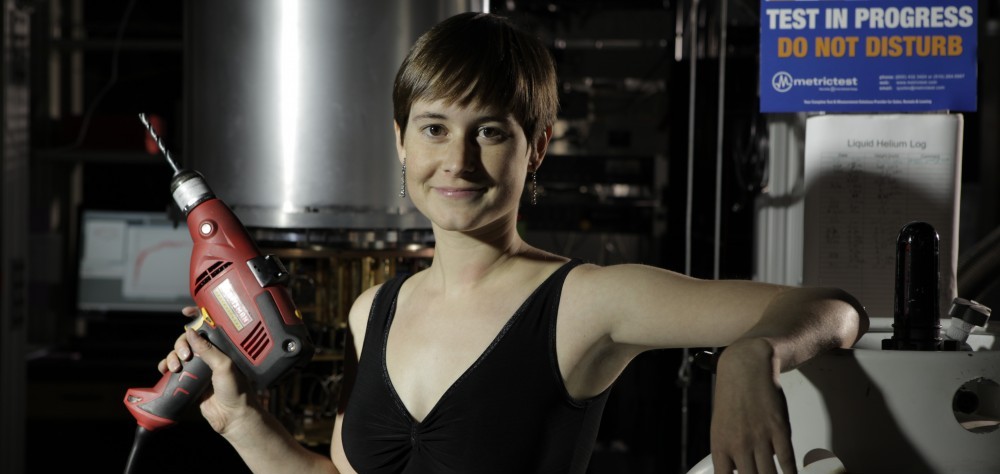
Superconductors in the Summer

As a little girl I would play school with the neighborhood children. Ever since fourth grade I knew I wanted to be a teacher in a classroom full of eager-to-learn nine-year olds, but it wasn’t until my freshman year of college that my plans changed. In Geology for Elementary Teachers, I remember thinking, “This material is great! I need to learn more!” My hunger for a deeper understanding of how the physical world works led me to reflect on what my favorite science in high school was: Physics. Not long after, I changed my major to Physics and I was on the path to becoming a high school Physics teacher. Fast forward a decade, and I have my dream job. I get to explore the exciting world of Physics all day with 150+ adolescents and I wouldn’t change that for the world.

At Caltech after an exciting day at the lab!


Continue reading

Sad about Sally

Sally Ride

I’m really sad about the death of Sally Ride. Aside from all her other achievements, she devoted herself to getting kids, especially girls, excited about math, science and technology. She was 61.

On April 28, 1994 (yes, I really know the date … I keep records), Sally spoke at the Caltech physics colloquium about the future of the US Space Program, and in particular about the case for building the International Space Station. The talk was remarkably frank about how ill suited the Space Station would be for scientific research.

My daughter Carina was 8, and I took her to Caltech after school to meet Sally. Carina brought her copy of Sally’s book To Space and Back, which Sally signed, “To Carina, Reach for the Stars! – Sally Ride”
Continue reading

Supremacy Now?

Martin Zwierlein

In May 1994, Artur Ekert visited Caltech to give a seminar about quantum cryptography. Near the end of the talk, Ekert revealed an exciting new development — just weeks earlier, Peter Shor had announced the discovery of an efficient quantum algorithm for finding the prime factors of large composite integers, a problem for which no efficient classical algorithm is known.

Perhaps I’ve embellished the memory over time, but I recall being awestruck by this news. I spent the next month at the Isaac Newton Institute attending a workshop about quantum black holes, and though it was a very good workshop and I had some great discussions, I spent most of my time there secretly trying to understand Shor’s paper, which Ekert had emailed to me. This took some effort, because I knew little about algorithms or computational complexity at that time (even less than I know now), but by the end of the workshop I felt I understood the ideas behind Shor’s algorithm pretty well. I did not yet realize that I was in the midst of a career transition from particle physics to quantum information science.
Continue reading

How I learned to stop worrying and love graphene

Five years ago, I was staring out one of the few windowed cubicles in a cluttered office full of overambitious salespeople willing to throw their own father under a bus, if it meant a couple more dollars in commission and maybe a few more brownie points from the sweaty, beer-bellied sales manager. What was going through my mind as I stared out that window? Often nothing, sometimes an In-N-Out double-double with whole grilled onions, and every so often I would imagine I had a career with guts… substance. A career that I wouldn’t inaudibly mutter under my breath as an answer when asked the inevitable initial small talk question, “Well, what do you do?” A career that I would proudly proclaim to the world.

In front of the CAPSI House at Caltech, where we play with lasers in the name of enhancing high school education.

Early in life, there was always an attraction towards teaching, and during college I took education courses in route to becoming a high school teacher. However, money, that enticing savage, redirected my path away from education and into the world of sales, where feelings of shame (due to the high cheese-factor associated with the job) and satisfaction (due to the substantial pay check) took turns dominating my feelings regarding my career choice. Eventually, the cheese-factor won out and I needed a way out. So, I left the sales job and fell back on what I initially set out to do – teach.
Continue reading