Frontiers of Quantum Information Science

Just a few years ago, if you wanted to look for recent research articles about quantum entanglement, you would check out the quantum physics [quant-ph] archive at arXiv.org. Since 1994, quant-ph has been the central repository for papers about quantum computing and the broader field of quantum information science. But over the past few years there has been a notable change. Increasingly, exciting papers about quantum entanglement are found at the condensed matter [cond-mat] and high energy physics – theory [hep-th] archives.

I don’t know for sure, but that trend may have had something to do with an invitation I received a few months ago from David Gross, to organize the next Jerusalem Winter School in Theoretical Physics. David has been the General Director of the School for, well, I’m not sure how long, but it must be a long time. In the past, the topic of the school has rotated between particle physics, condensed matter physics, and astrophysics. Every year, a group of world-class scientists gives lectures on cutting-edge research for an enthusiastic audience of postdoctoral scholars and advanced graduate students.

David suggested that a good topic for the next school would be “quantum information, broadly envisaged — from quantum computing to strongly correlated electrons.” After some hesitation for family reasons, I embraced this opportunity to amplify David’s message: quantum information has arrived as a major subfield of physics, and its relevance to other areas of physics is becoming broadly appreciated.

I’m not good at organizing things myself, so I recruited two friends who are very good at it to help me: Michael Ben-Or and Patrick Hayden. As the local organizer at The Hebrew University, Michael has to do a lot of the hard work that I’m glad to avoid. We decided to call the school “Frontiers of Quantum Information Science,” and put together a slate of 10 lecturers, which I’m very excited about. The lectures will cover the core areas of quantum information, as well as some of the important ways in which quantum information relates to quantum matter, quantum field theory, and quantum gravity. Each lecturer will give three or four ninety-minute lectures, on these topics:

Scott Aaronson (MIT), Quantum complexity and quantum optics
David DiVincenzo (Aachen), Quantum computing with superconducting circuits
Daniel Harlow (Princeton), Black holes and quantum information
Michal Horodecki (Gdansk), Quantum information and thermodynamics
Stephen Jordan (NIST), Quantum algorithms
Rob Myers (Perimeter), Entanglement in quantum field theory
Renato Renner (ETH), Quantum foundations
Ady Stern (Weizmann), Topological quantum computing
Barbara Terhal (Aachen), Quantum error correction
Frank Verstraete (Vienna), Quantum information and quantum matter

The school will run from 30 December 2013 to 9 January 2014 at the Israel Institute for Advanced Studies at The Hebrew University in Jerusalem. If you are interested in attending, please visit the website for more information and fill out the registration form by November 1. I hope you can come — it’s going to be a lot of fun.

Rereading the first paragraph of this post, I got slightly nervous about whether the trend I described can be documented, so I have done a little bit of research. Going back to 2005, I plotted the number of papers with the word “entanglement” in the title on quant-ph, cond-mat, hep-th, and also the general relativity and quantum cosmology [gr-qc] archive. For 2013, I rescaled the data for the year up to now, taking into account that Sep. 22 is the 265th day of the year. I didn’t make any adjustment for papers being cross-listed on multiple archives.

Here is the data for quant-ph:quantph-plot-pdfIt’s remarkably flat. Here is the aggregated data for the other three archives:arxiv-plot-pdfIt’s pretty clear that something started to happen around 2010. I realize one could do a much more serious study of this issue, but since I was only willing to spend an hour on it, I feel vindicated.

Free Feynman!

Last Friday the 13th was a lucky day for those who love physics — The online html version of Volume 1 of the Feynman Lectures on Physics (FLP) was released! Now anyone with Internet access and a web browser can enjoy these unique lectures for free. They look beautiful.

Mike Gottlieb at Caltech on 20 September 2013. He's the one on the right.

Mike Gottlieb at Caltech on 20 September 2013. He’s the one on the right.

On the day of release, over 86,000 visitors viewed the website, and the Amazon sales rank of the paperback version of FLP leapt over the weekend from 67,000 to 12,000. My tweet about the release was retweeted over 150 times (my most retweets ever).

Free html versions of Volumes 2 and 3 are in preparation. Soon pdf versions of all three volumes will be offered for sale, each available in both desktop and tablet versions at a price comparable to the cost of the paperback editions. All these happy developments resulted from a lot of effort by many people. You can learn about some of the history and the people involved from Kip Thorne’s 2010 preface to the print edition.

A hero of the story is Mike Gottlieb, who spends most of his time in Costa Rica, but passed through Caltech yesterday for a brief visit. Mike entered the University of Maryland to study mathematics at age 15 and at age 16 began a career as a self-employed computer software consultant. In 1999, when Mike was 39,  a chance meeting with Feynman’s friend and co-author Ralph Leighton changed Mike’s life.

At Ralph’s suggestion, Mike read Feynman’s Lectures on Computation. Impressed by Feynman’s insights and engaging presentation style, Mike became eager to learn more about physics; again following Ralph’s suggestion, he decided to master the Feynman Lectures on Physics. Holed up at a rented farm in Costa Rica without a computer, he pored over the lectures for six months, painstakingly compiling a handwritten list of about 200 errata.

Kip’s preface picks up the story at that stage. I won’t repeat all that, except to note two pivotal developments. Rudi Pfeiffer was a postdoc at the University of Vienna in 2006 when, frustrated by the publisher’s resistance to correcting errata that he and others had found, he (later joined by Gottlieb) began converting FLP to LaTeX, the modern computer system for typesetting mathematics. Eventually, all the figures were redrawn in electronic form as scalable vector graphics, paving the way for a “New Millenium Edition” of FLP (published in 2011), as well as other electronically enhanced editions planned for the future. Except that, before all that could happen, Caltech’s Intellectual Property Counsel Adam Cochran had to untangle a thicket of conflicting publishing rights, which I have never been able to understand in detail and therefore will not attempt to explain.

Rudi Pfeiffer and Mike Gottlieb at Caltech in 2008.

Rudi Pfeiffer and Mike Gottlieb at Caltech in 2008.

The proposal to offer an html version for free has been enthusiastically pursued by Caltech and has received essential financial support from Carver Mead. The task of converting Volume 1 from LaTeX to html was carried out for a fee by Caltech alum Michael Hartl; Gottlieb is doing the conversion himself for the other volumes, which are already far along.

Aside from the pending html editions of Volumes 2 and 3, and the pdf editions of all three volumes, there is another very exciting longer-term project in the works — the html will provide the basis for a Multimedia Edition of FLP. Audio for every one of Feynman’s lectures was recorded, and has been digitally enhanced by Ralph Leighton. In addition, the blackboards were photographed for almost all of the lectures. The audio and photos will be embedded in the Multimedia Edition, possibly accompanied by some additional animations and “Ken Burns style” movies. The audio in particular is great fun, bringing to life Feynman the consummate performer. For the impatient, a multimedia version of six of the lectures is already available as an iBook. To see a quick preview, watch Adam’s TEDxCaltech talk.

Mike Gottlieb has now devoted 13 years of his life to enhancing FLP and bringing the lectures to a broader audience, receiving little monetary compensation. I asked him yesterday about his motivation, and his answer surprised me somewhat. Mike wants to be able to look back at his life feeling that he has made a bigger contribution to the world than merely writing code and making money. He would love to have a role in solving the great open problems in physics, in particular the problem of reconciling general relativity with quantum mechanics, but feels it is beyond his ability to solve those problems himself. Instead, Mike feels he can best facilitate progress in physics by inspiring other very talented young people to become physicists and work on the most important problems. In Mike’s view, there is no better way of inspiring students to pursue physics than broadening access to the Feynman Lectures on Physics!

The complementarity (not incompatibility) of reason and rhyme

Shortly after learning of the Institute for Quantum Information and Matter, I learned of its poetry.

I’d been eating lunch with a fellow QI student at the Perimeter Institute for Theoretical Physics. Perimeter’s faculty includes Daniel Gottesman, who earned his PhD at what became Caltech’s IQIM. Perhaps as Daniel passed our table, I wondered whether a liberal-arts enthusiast like me could fit in at Caltech.

“Have you seen Daniel Gottesman’s website?” my friend replied. “He’s written a sonnet.”

Quill

He could have written equations with that quill.

Digesting this news with my chicken wrap, I found the website after lunch. The sonnet concerned quantum error correction, the fixing of mistakes made during computations by quantum systems. After reading Daniel’s sonnet, I found John Preskill’s verses about Daniel. Then I found more verses of John’s.

To my Perimeter friend: You win. I’ll fit in, no doubt.

Exhibit A: the latest edition of The Quantum Times, the newsletter for the American Physical Society’s QI group. On page 10, my enthusiasm for QI bubbles over into verse. Don’t worry if you haven’t heard all the terms in the poem. Consider them guidebook entries, landmarks to visit during a Wikipedia trek.

If you know the jargon, listen to it with a newcomer’s ear. Does anyone other than me empathize with frustrated lattices? Or describe speeches accidentally as “monotonic” instead of as “monotonous”? Hearing jargon outside its natural habitat highlights how not to explain research to nonexperts. Examining names for mathematical objects can reveal properties that we never realized those objects had. Inviting us to poke fun at ourselves, the confrontation of jargon sprinkles whimsy onto the meringue of physics.

No matter your familiarity with physics or poetry: Enjoy. And fifty points if you persuade Physical Review Letters to publish this poem’s sequel.

Quantum information

By Nicole Yunger Halpern

If “CHSH” rings a bell,
you know QI’s fared, lately, well.
Such promise does this field portend!
In Neumark fashion, let’s extend
this quantum-information spring:
dilation, growth, this taking wing.

We span the space of physics types
from spin to hypersurface hype,
from neutron-beam experiment
to Bohm and Einstein’s discontent,
from records of a photon’s path
to algebra and other math
that’s more abstract and less applied—
of platforms’ details, purified.

We function as a refuge, too,
if lattices can frustrate you.
If gravity has got your goat,
momentum cutoffs cut your throat:
Forget regimes renormalized;
our states are (mostly) unit-sized.
Velocities stay mostly fixed;
results, at worst, look somewhat mixed.

Though factions I do not condone,
the action that most stirs my bones
is more a spook than Popov ghosts; 1
more at-a-distance, less quark-close.

This field’s a tot—cacophonous—
like cosine, not monotonous.
Cacophony enlivens thought:
We’ve learned from noise what discord’s not.

So take a chance on wave collapse;
enthuse about the CP maps;
in place of “part” and “piece,” say “bit”;
employ, as yardstick, Hilbert-Schmidt;
choose quantum as your nesting place,
of all the fields in physics space.

1 With apologies to Ludvig Faddeev.

Graphene gets serious

Imagine one marshmallow, 100 pieces of dried spaghetti, and a roll of masking tape lying on a large table. Next to the supplies are directions that read: “Elevate the marshmallow as high as possible using only the spaghetti and masking tape.” What was the first question that popped into your head? My assumption is your response had a disposition towards either “how can I do this?” or “why should I do this?” More precisely, your response probably could be whittled down to either a “how” or a “why.” If your first instinct was to ask yourself “how”, maybe an argument could be made that you are a natural problem solver, and that you welcome and genuinely are intrigued by challenges. If you asked “why”, then maybe you are someone who needs some good ‘ole fashioned incentive or a good extrinsic motive to perform well. Now imagine you were competing against three other people and the prize for the highest marshmallow was $100,000. Would the money motivate you to create a better structure, or would your relentless ambition towards excellence have been enough incentive for you to have placed your best foot forward from the outset? Undoubtedly, the money will make you think twice about your initial design ensuring your best effort, but my wish is to see more people performing at higher levels, not only due to monetary incentive, but also out of the sake of doing your best.

Chen-Chih Hsu & Benjamin Fackrell

Chen-Chih Hsu & Benjamin Fackrell

As humans, we are all naturally great problem solvers when compared, to say, any other known form of life on our planet. That is not to say, however, all humans choose to exercise those talents. Nonetheless, people do possess the ability to solve extremely complex problems, and I often wonder what makes some individuals face challenges head on with great heroism, while others whimper away with not as much as a grain of genuine interest or desire. I believe the reasons for different responses are connected with the way we individually have been taught to approach problems, and the amount of respect we have learned to award such methods. The attitude individuals possess when faced with a challenge can be shaped with encouragement from teachers and parents alike. When given an opportunity to educate students (of any age) regarding their attitude when faced with a problem, in that moment, we must teach absolute fearlessness. Attack the problem and take no prisoners, metaphorically speaking. Unfortunately, the prevailing attitude from the many students I work with daily is one of apathy and a play-it-safe approach with very little risk of making mistakes. For many students, forfeiting has greater power in protecting one’s reputation with peers and themselves than a courageous attempt that could end, in what they believe to be, an embarrassing mistake. I am always looking to instill a sense of honor, embracing a philosophy that a whole-hearted attempt merits infinitely more respect than a forfeit, and not to plan to fail, but prepare to stay the course in the case of an unfortunate event. My advice? Treat a failure like a fart; understand it’s sure to happen, try to find the humor in it, and keep moving forward. Mistakes can often indicate progress because if you are not making mistakes, per Albert Einstein, you must not be trying something new, consequently, you are not learning.
Continue reading

What’s inside a black hole?

I have a multiple choice question for you.

What’s inside a black hole?

(A) An unlimited amount of stuff.
(B) Nothing at all.
(C) A huge but finite amount of stuff, which is also outside the black hole.
(D) None of the above.

The first three answers all seem absurd, boosting the credibility of (D). Yet … at the “Rapid Response Workshop” on black holes I attended last week at the KITP in Santa Barbara (and which continues this week), most participants were advocating some version of (A), (B), or (C), with varying degrees of conviction.

When physicists get together to talk about black holes, someone is bound to draw a cartoon like this one:
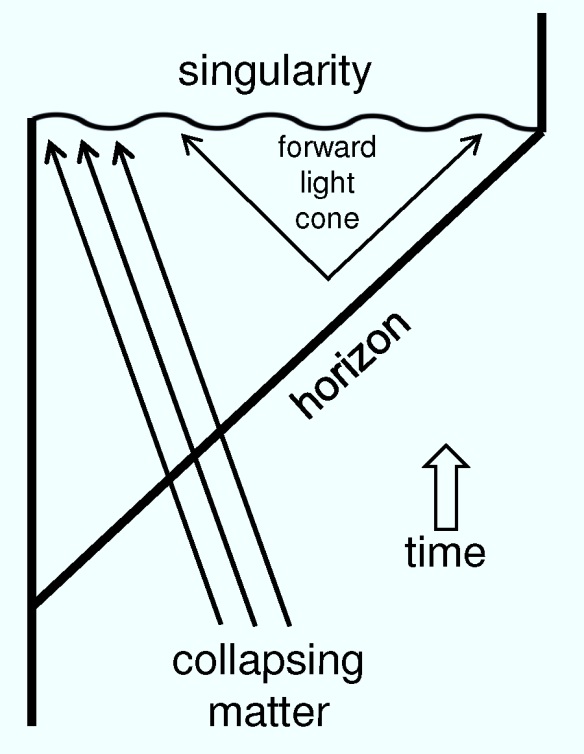
Penrose diagram depicting the causal structure of a black hole spacetime.

Part of a Penrose diagram depicting the causal structure of a black hole spacetime.

I’m sure I’ve drawn and contemplated some version of this diagram hundreds of times over the past 25 years in the privacy of my office, and many times in public discussions (including at least five times during the talk I gave at the KITP). This picture vividly captures the defining property of a black hole, found by solving Einstein’s classical field equations for gravitation: once you go inside there is no way out. Instead you are unavoidably drawn to the dreaded singularity, where known laws of physics break down (and the picture can no longer be trusted). If taken seriously, the picture says that whatever falls into a black hole is gone forever, at least from the perspective of observers who stay outside.

But for nearly 40 years now, we have known that black holes can shed their mass by emitting radiation, and presumably this process continues until the black hole disappears completely. If we choose to, we can maintain the black hole for as long as we please by feeding it new stuff at the same rate that radiation carries energy away. What I mean by option (A) is that  the radiation is completely featureless, carrying no information about what kind of stuff fell in. That means we can hide as much information as we please inside a black hole of a given mass.

On the other hand, the beautiful theory of black hole thermodynamics indicates that the entropy of a black hole is determined by its mass. For all other systems we know of besides black holes, the entropy of the system quantifies how much information we can hide in the system. If (A) is the right answer, then black holes would be fundamentally different in this respect, able to hide an unlimited amount of information even though their entropy is finite. Maybe that’s possible, but it would be rather disgusting, a reason to dislike answer (A).

There is another way to argue that (A) is not the right answer, based on what we call AdS/CFT duality. AdS just describes a consistent way to put a black hole in a “bottle,” so we can regard the black hole together with the radiation outside it as a closed system. Now, in gravitation it is crucial to focus on properties of spacetime that do not depend on the observer’s viewpoint; otherwise we can easily get very confused. The best way to be sure we have a solid way of describing things is to pay attention to what happens at the boundary of the spacetime, the walls of the bottle — that’s what CFT refers to. AdS/CFT provides us with tools for describing what happens when a black hole forms and evaporates, phrased entirely in terms of what happens on the walls of the bottle. If we can describe the physics perfectly by sticking to the walls of the bottle, always staying far away from the black hole, there doesn’t seem to be anyplace to hide an unlimited amount of stuff.

At the KITP, both Bill Unruh and Bob Wald argued forcefully for (A). They acknowledge the challenge of understanding the meaning of black hole entropy and of explaining why the AdS/CFT argument is wrong. But neither is willing to disavow the powerful message conveyed by that telling diagram of the black hole spacetime. As Bill said: “There is all that stuff that fell in and it crashed into the singularity and that’s it. Bye-bye.”

Adherents of (B) and (C) like to think about black hole physics from the perspective of an observer who stays outside the black hole. From that viewpoint, they say, the black hole behaves like any other system with a temperature and a finite entropy. Stuff falling in sticks to the black hole’s outer edge and gets rapidly mixed in with other stuff the black hole absorbed previously. For a black hole of a given mass, though, there is a limit to how much stuff it can hold. Eventually, what fell in comes out again, but in a form so highly scrambled as to be nearly unrecognizable.

Where the (B) and (C) camps differ concerns what happens to a brave observer who falls into a black hole. According to (C), an observer falling in crosses from the outside to the inside of a black hole peacefully, which poses a puzzle I discussed here. The puzzle arises because an uneventful crossing implies strong quantum entanglement between the region A just inside the black hole and region B just outside. On the other hand, as information leaks out of a black hole, region B should be strongly  entangled with the radiation system R emitted by the black hole long ago. Entanglement can’t be shared, so it does not make sense for B to be entangled with both A and R. What’s going on? Answer (C) resolves the puzzle by positing that A and R are not really different systems, but rather two ways to describe the same system, as I discussed here.That seems pretty crazy, because R could be far, far away from the black hole.

Answer (B) resolves the puzzle differently, by positing that region A does not actually exist, because the black hole has no interior. An observer who attempts to fall in gets a very rude surprise, striking a seething “firewall” at the last moment before passing to the inside. That seems pretty crazy, because no firewall is predicted by Einstein’s trusty equations, which are normally very successful at describing spacetime geometry.

At the workshop, Don Marolf and Raphael Bousso gave some new arguments supporting (B). Both acknowledge that we still lack a concrete picture of how firewalls are created as black holes form, but Bousso insisted that “It is time to constrain and construct the dynamics of firewalls.” Joe Polchinski emphasized that, while AdS/CFT provides a very satisfactory description of physics outside a black hole, it has not yet been able to tell us enough about the black hole interior to settle whether there are firewalls or not, at least for generic black holes formed from collapsing matter.

Lenny Susskind, Juan Maldacena, Ted Jacobson, and I all offered different perspectives on how (C) could turn out to be the right answer. We all told different stories, but perhaps each of us had at least part of the right answer. I’m not at KITP this week, but there have been further talks supporting (C) by Raju, Nomura, and the Verlindes.

I had a fun week at the KITP. If you watch the videos of the talks, you might get an occasional glimpse of me typing furiously on my laptop. It looks like I’m doing my email, but actually that’s how I take notes, which helps me to pay attention. Every once in a while I was inspired to tweet.

I have felt for a while that ideas from quantum information can help us to grasp the mysteries of quantum gravity, so I appreciated that quantum information concepts came up in many of the talks. Susskind invoked quantum error-correcting codes in discussing how sensitively the state of the Hawking radiation depends on the information it encodes, and Maldacena used tensor networks to explain how to build spacetime geometry from quantum entanglement. Scott Aaronson proposed the appropriate acronym HARD for HAwking Radiation Decoding, and argued (following Harlow and Hayden) that this task is as hard as inverting an injective one-way function, something we don’t expect quantum computers to be able to do.

In the organizational session that launched the meeting, Polchinski remarked regarding firewalls that “Nobody has the slightest idea what is going on,” and Gary Horowitz commented that “I’m still getting over the shock over how little we’ve learned in the past 30 years.” I guess that’s fair. Understanding what’s inside black holes has turned out to be remarkably subtle, making the problem more and more tantalizing. Maybe the current state of confusion regarding black hole information means that we’re on the verge of important discoveries about quantum gravity, or maybe not. In any case, invigorating discussions like what I heard last week are bound to facilitate progress.
The Most Awesome Animation About Quantum Computers You Will Ever See

by Jorge Cham

You might think the title is a little exaggerated, but if there’s one thing I’ve learned from Theoretical Physicists so far, it’s to be bold with my conjectures about reality.

Welcome to the second installment of our series of animations about Quantum Information! After an auspicious start describing doing the impossible, this week we take a step back to talk in general terms about what makes the Quantum World different and how these differences can be used to build Quantum Computers.

In this video, I interviewed John Preskill and Spiros Michalakis. John is the co-Director of the Institute for Quantum Information and Matter. He’s known for many things, including making (and winning) bets with Stephen Hawking. Spiros hails from Greece, and probably never thought he’d see himself drawn in a Faustian devil outfit in the name of science (although, he’s so motivated about outreach, he’d probably do it).

img_faust

In preparation to make this video, I thought I’d do what any serious writer would do to exhaustively research a complex topic like this: read the Wikipedia page and call it a day. But then, while visiting the local library with my son, I stumbled upon a small section of books about Quantum Physics aimed at a general audience.

I thought, “Great! I’ll read these books and learn that way!” When I opened the books, though, they were mostly all text. I’m not against text, but when you’re a busy* cartoonist on a deadline trying to learn one of the most complex topics humans have ever devised, a few figures would help. On the other hand, fewer graphics mean more job security for busy cartoonists, so I can’t really complain. (*=Not really).

img_god

In particular, I started to read “The Quantum Story: A History in 40 Moments” by Jim Baggott. First, telling a story in 40 moments sounds a lot like telling a story with comics, and second, I thought it would be great to learn about these concepts from the point of view of how they came up with them. So, I eagerly opened the book and here is what it says in the Preface:

“Nobody really understands how Quantum Theory actually works.”

“Niels Bohr claimed that anybody who is not shocked by the theory has not understood it… Richard Feynman went further: he claimed that nobody understands it.”

One page in, and it’s already telling me to give up.

It’s a fascinating read, I highly recommend the book. Baggott makes the claim that,

“The reality of Scientific Endeavor is profoundly messy, often illogical, deeply emotional, and driven by the individual personalities involved as they sleepwalk their way to a temporary scientific truth.”

I’m glad this history was recorded. I hope in a way that these videos help record a quantum of the developing story, as we humans try to create pockets of quantum weirdness that can scale up. As John says in the video, it is very exciting.

Now, if you’ll excuse me, I need to sleepwalk back to bed.

img_leaking

Watch the second installment of this series:

Jorge Cham is the creator of Piled Higher and Deeper (www.phdcomics.com).

CREDITS:

Featuring: John Preskill and Spiros Michalakis

Produced in Partnership with the Institute for Quantum Information and Matter (http://iqim.caltech.edu) at Caltech with funding provided by the National Science Foundation.

Animation Assistance: Meg Rosenburg
Transcription: Noel Dilworth

Steampunk quantum

A dark-haired man leans over a marble balustrade. In the ballroom below, his assistants tinker with animatronic elephants that trumpet and with potions for improving black-and-white photographs. The man is an inventor near the turn of the 20th century. Cape swirling about him, he watches technology wed fantasy.

Welcome to the steampunk genre. A stew of science fiction and Victorianism, steampunk has invaded literature, film, and the Wall Street Journal. A few years after James Watt improved the steam engine, protagonists build animatronics, clone cats, and time-travel. At sci-fi conventions, top hats and blast goggles distinguish steampunkers from superheroes.

Photo

The closest the author has come to dressing steampunk.

I’ve never read steampunk other than H. G. Wells’s The Time Machine—and other than the scene recapped above. The scene features in The Wolsenberg Clock, a novel by Canadian poet Jay Ruzesky. The novel caught my eye at an Ontario library.

In Ontario, I began researching the intersection of QI with thermodynamics. Thermodynamics is the study of energy, efficiency, and entropy. Entropy quantifies uncertainty about a system’s small-scale properties, given large-scale properties. Consider a room of air molecules. Knowing that the room has a temperature of 75°F, you don’t know whether some molecule is skimming the floor, poking you in the eye, or elsewhere. Ambiguities in molecules’ positions and momenta endow the gas with entropy. Whereas entropy suggests lack of control, work is energy that accomplishes tasks.
Continue reading

Squeezing light using mechanical motion

This post is about generating a special type of light, squeezed light, using a mechanical resonator. But perhaps more importantly, it’s about an experiment (Caltech press release can be found here) that is very close to my heart: an experiment that brings to an end my career as a graduate student at Caltech and the IQIM, while paying homage to nearly four decades of work done by those before me at this institute.

The Quantum Noise of Light

First of all, what is squeezed light? It would be silly of me to imagine that I can provide a more clear and thorough explanation than what Jeff Kimble gave twenty years ago in Caltech’s Engineering and Science magazine. Instead, I’ll try to present what squeezing is in the context of optomechanics.

fig1

Quantization of light makes it noisy. Imagine a steady stream of water hitting a plate, and rolling off of it smoothly. The stream would indeed impart a steady force on the plate, but wouldn’t really cause it to “shake” around much. The plate would sense a steady pressure. This is what the classical theory of light, as proposed by James Clerk Maxwell, predicts. The effect is called radiation pressure. In the early 20th century, a few decades after this prediction, quantum theory came along and told us that “light is made of photons”. More or less, this means that a measurement capable of measuring the energy, power, or pressure imparted by light, if sensitive enough, will detect “quanta”, as if light were composed of particles. The force felt by a mirror is exactly this sort of measurement. To make sense of this, we can replace that mental image of a stream hitting a plate with one of the little raindrops hitting it, where each raindrop is a photon. Since the photons are coming in one at a time, and imparting their momentum all at once in little packets, they generate a new type of noise due to their random arrival times. This is called shot-noise (since the photons act as little “shots”). Since shot-noise is being detected here by the sound it generates due to the pressure imparted by light, we call it “Radiation Pressure Shot-Noise” (RPSN).
Continue reading

Frozen children

Kids_watching_GlenA few weeks ago, my friend Amanda, an elementary school teacher who runs a children’s camp during the summer break, suggested that it could be fun for me to come into the camp one day and do some science demonstrations for the kids. I jumped at the opportunity, despite (or perhaps because of) the fact that I am a purely theoretical physicist and my day-to-day work only involves whiteboards and computers at Caltech. Most of the children attending the camp are relatively young (7-9 year-old kids) so, rather than setting out to give a science lesson, I viewed it as a chance to do some fun demonstrations and get these kids excited about science! Besides, I had an ulterior motive; it was a great excuse to acquire, and play with, liquid nitrogen (LN_2) from a Caltech lab (of which most of the IQIM labs have copious supplies). LN_2 is great for demonstrations; this stuff is awesome! At a temperature of -321^{\circ}\,F (for reference, the coldest temperature ever recorded on the surface of the Earth is -128.6^{\circ}\,F), it behaves in ways unlike anything that most people have ever seen. I convinced my friend Carmen, a postdoc in astronomy at Caltech, to come along and help out. Here, I thought I would share my experience, as well as some of the things I learned about handling LN_2.

Carmen watches on as I pour the liquid nitrogen into the beaker, which boils like crazy until the beaker is chilled. The white gas is actually water vapor condensing from the air; nitrogen gas is transparent (think of your ability to see through air). Note, also, my previous assistant in the background - science can be taxing to the body.

Carmen watches on as I pour the liquid nitrogen into the beaker, which boils like crazy until the beaker is chilled. The white gas is actually water vapor condensing from the air; nitrogen gas is transparent (think of your ability to see through air, which is mostly nitrogen gas).

DSC_0201

Liquid nitrogen volcano! All it takes is a little water added to the liquid nitrogen dewar.

Crime and punishment: As anyone who has seen Terminator 2 knows, objects that are pliable at room temperature become brittle and can shatter when reduced to cryogenic temperatures (including robotic assassins from the future). Thus I devoted a significant amount of the demonstration time to freezing and breaking everyday objects, including flowers and rubber toys. The flowers were particularly spectacular, shattering like glass into a multitude of pieces when struck against the table, providing a good deal of entertainment for the audience as well as myself. Hasta la vista, baby. I also froze several pennies, which then became brittle enough such that Carmen was able to shatter them with a few taps from a hammer. Incidentally, destroying US currency is illegal (which is why I had Carmen do it instead of doing it myself). I informed the children of this fact and asked who among them thought that Carmen should go to prison for her crime. A quick vote revealed that the majority of the children thought that she should be behind bars. Sorry Carmen, maybe the next field trip for the camp can be to visit you in prison?

DSC_0110

A flower, freshly pulled from the vat of liquid nitrogen, prepares to make the ultimate sacrifice in the name of science.

After having frozen a variety of objects, one of the children asked me whether you could freeze people with it. I told the kids that this is something that I always wanted to try, but that I had previously lacked a volunteer, to which an enthusiastic boy jumped up and responded, “freeze me, freeze me!” I asked whether he wanted to be frozen 5 years, 10 years, or longer? He said he would like to be frozen until the end of the world. One must admire his dedication! Before attempting to freeze him, I told him that it would be prudent for me to try it on something less likely to have litigious relatives. To this end a strawberry, a peach and a plum were submerged in LN_2, and then removed and allowed to slowly thaw. They ended up melting into gelatinous blobs; clearly some kinks in my cryogenic freezing and revival process need to be resolved before I graduate the approach to small children.
Continue reading

Surviving in Extreme Conditions.

Sometimes in order to do one thing thoroughly you have to first master many other things, even those which may seem very unrelated to your focus. In the end, everything weaves itself together very elegantly and you find yourself wondering how you got through such an incredible sequence of coincidences to where you are now.

I am a rising first-year PhD student in Astrophysics at Caltech. I just completed my Bachelor’s in Physics also from Caltech last June. My Caltech journey has already led me to a number of unexpected places. New in Astrophysics, I am very excited to see as many observatories, labs and manufacturing locations as I can. I just moved out of the dorms and into the first place that is my very own home (which means I pay my own rent now). All of my windows have a very clear view of the radio tower-adorned Mt. Wilson.

This morning I woke up and looked at the Mt. Wilson horizon and decided to drive up there. I left my morning ballet class early to make time for the drive. The road to the observatory is not simple. HWY 2 is a pretty serious mountain road and accidents happen on it regularly. This is the first thing: to have access to observatories, I need to be able to drive there safely and reliably.

Fortunately I love driving, especially athletic mountain driving, so I am looking for almost any excuse to drive to JPL, Mt. Wilson, and so on. I’ll just stop, by saying that driving is a hobby for me and I see it as a sport, a science, and an art.

The first portion of the 2 is like any normal mountain road with speeding locals, terrifying cyclists and daredevil motorcyclists. The views become more and more breathtaking as you gain elevation, but the driver really shouldn’t be getting any of these views except for the portion that fits into the car’s field of view. The road is demanding, with turns and hills, all along a steep and curving mountainside. However, this part is a piece of cake compared to the second portion.

The turnoff to the observatory itself opens onto a less-maintained road speckled with enthusiastic hikers and with nicely sharp 6-inch pebbles scattered around the road. As much as I was enjoying taking smooth turns and avoiding the brakes, I went very slow on this section to drive around the random rocks on the road. I finally got to the top where I could take in the view in peace.

The first thing visitors see is the Cosmic Cafe. It has a balcony going all around the cafe with a fascinating view when there is no smog or fog. Last April, Caltech had its undergraduate student Formal here. We dined at this cafe and had a dance platform nearby. Driving up here, I could not help thinking how risky this was: 11 high-rise buses took a large portion of the Caltech undergraduate student body up to the top of this mountain in fog so dense we could barely see the bus ahead of us. The bus drivers were saints.

Hiking or running shoes are the best shoes to wear here, so I cannot imagine how we came here in suits, dress shoes, tight dresses, and merciless heels. Well, Caltech students have many talents. Second thing: being an active person in the Tech community takes you to some curious places on interesting occasions.

PAZ0101

Some Caltech undergraduates on Mt. Wilson (I’m purple).

I parked at the first available lot, right in front of the cafe and near some large radio towers. When trying to lock my car, I had some trouble. I have an electronic key which operates as a remote outside the car. The car would not react to my key and would not lock. I tried a few more times and finally it locked. I figured the battery in the key was dying, but that didn’t seem right. If any battery were dying, it would be the battery in the spare key that I am not using.
Continue reading