Quantum computing in the second quantum century

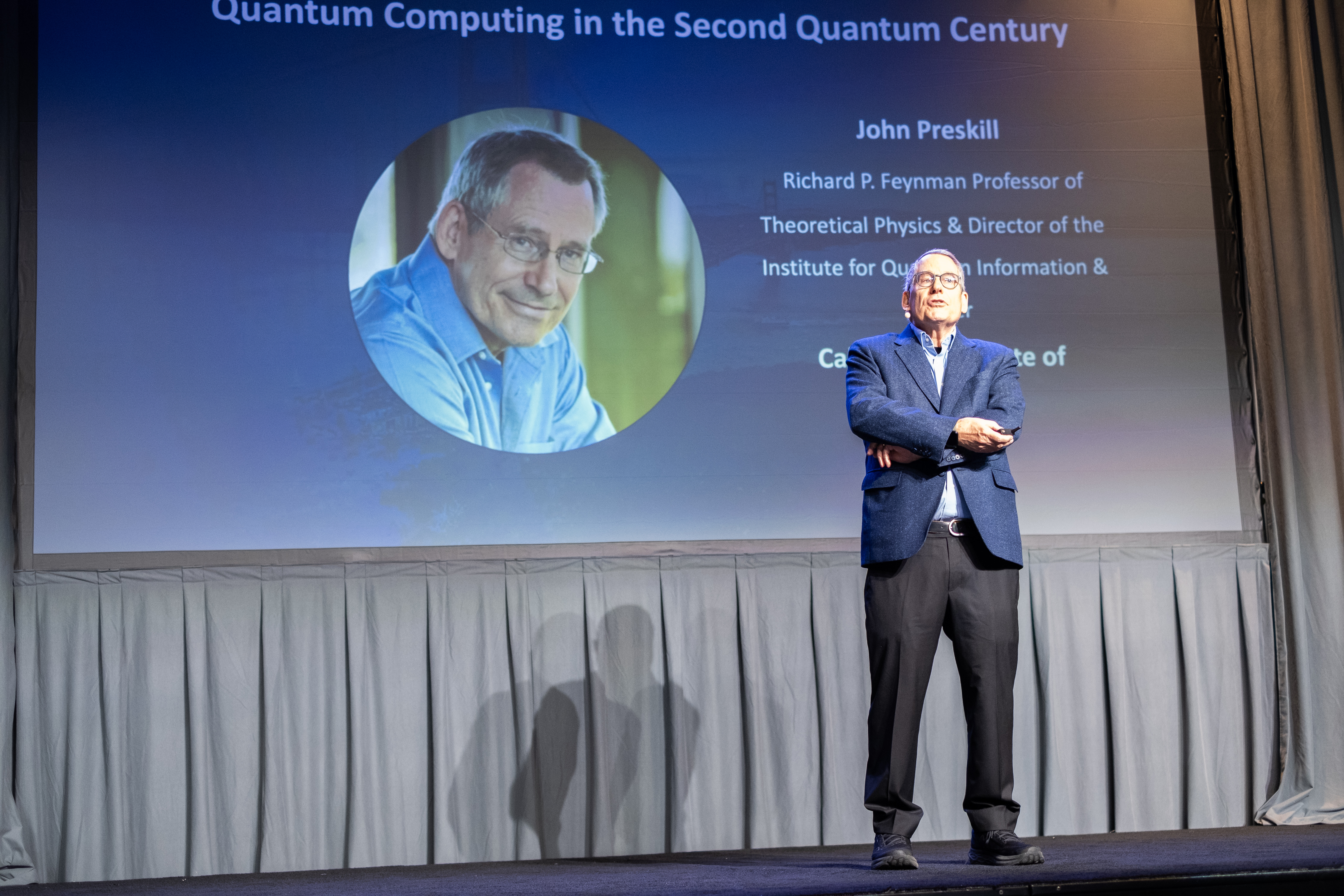
On December 10, I gave a keynote address at the Q2B 2025 Conference in Silicon Valley. This is a transcript of my remarks. The slides I presented are here.

The first century

We are nearing the end of the International Year of Quantum Science and Technology, so designated to commemorate the 100th anniversary of the discovery of quantum mechanics in 1925. The story goes that 23-year-old Werner Heisenberg, seeking relief from severe hay fever, sailed to the remote North Sea Island of Helgoland, where a crucial insight led to his first, and notoriously obscure, paper describing the framework of quantum mechanics.

In the years following, that framework was clarified and extended by Heisenberg and others. Notably among them was Paul Dirac, who emphasized that we have a theory of almost everything that matters in everyday life. It’s the Schrödinger equation, which captures the quantum behavior of many electrons interacting electromagnetically with one another and with atomic nuclei. That describes everything in chemistry and materials science and all that is built on those foundations. But, as Dirac lamented, in general the equation is too complicated to solve for more than a few electrons.

Somehow, over 50 years passed before Richard Feynman proposed that if we want a machine to help us solve quantum problems, it should be a quantum machine, not a classical machine. The quest for such a machine, he observed, is “a wonderful problem because it doesn’t look so easy,” a statement that still rings true.

I was drawn into that quest about 30 years ago. It was an exciting time. Efficient quantum algorithms for the factoring and discrete log problems were discovered, followed rapidly by the first quantum error-correcting codes and the foundations of fault-tolerant quantum computing. By late 1996, it was firmly established that a noisy quantum computer could simulate an ideal quantum computer efficiently if the noise is not too strong or strongly correlated. Many of us were then convinced that powerful fault-tolerant quantum computers could eventually be built and operated.

Three decades later, as we enter the second century of quantum mechanics, how far have we come? Today’s quantum devices can perform some tasks beyond the reach of the most powerful existing conventional supercomputers. Error correction had for decades been a playground for theorists; now informative demonstrations are achievable on quantum platforms. And the world is investing heavily in advancing the technology further.

Current NISQ machines can perform quantum computations with thousands of two-qubit gates, enabling early explorations of highly entangled quantum matter, but still with limited commercial value. To unlock a wide variety of scientific and commercial applications, we need machines capable of performing billions or trillions of two-qubit gates. Quantum error correction is the way to get there.

I’ll highlight some notable developments over the past year—among many others I won’t have time to discuss. (1) We’re seeing intriguing quantum simulations of quantum dynamics in regimes that are arguably beyond the reach of classical simulations. (2) Atomic processors, both ion traps and neutral atoms in optical tweezers, are advancing impressively. (3) We’re acquiring a deeper appreciation of the advantages of nonlocal connectivity in fault-tolerant protocols. (4) And resource estimates for cryptanalytically relevant quantum algorithms have dropped sharply.

Quantum machines for science

A few years ago, I was not particularly excited about running applications on the quantum platforms that were then available; now I’m more interested. We have superconducting devices from IBM and Google with over 100 qubits and two-qubit error rates approaching 10^{-3}. The Quantinuum ion trap device has even better fidelity as well as higher connectivity. Neutral-atom processors have many qubits; they lag behind now in fidelity, but are improving.

Users face tradeoffs: The high connectivity and fidelity of ion traps is an advantage, but their clock speeds are orders of magnitude slower than for superconducting processors. That limits the number of times you can run a given circuit, and therefore the attainable statistical accuracy when estimating expectations of observables.

Verifiable quantum advantage

Much attention has been paid to sampling from the output of random quantum circuits, because this task is provably hard classically under reasonable assumptions. The trouble is that, in the high-complexity regime where a quantum computer can reach far beyond what classical computers can do, the accuracy of the quantum computation cannot be checked efficiently. Therefore, attention is now shifting toward verifiable quantum advantage — tasks where the answer can be checked. If we solved a factoring or discrete log problem, we could easily check the quantum computer’s output with a classical computation, but we’re not yet able to run these quantum algorithms in the classically hard regime. We might settle instead for quantum verification, meaning that we check the result by comparing two quantum computations and verifying the consistency of the results.

A type of classical verification of a quantum circuit was demonstrated recently by BlueQubit on a Quantinuum processor. In this scheme, a designer builds a family of so-called “peaked” quantum circuits such that, for each such circuit and for a specific input, one output string occurs with unusually high probability. An agent with a quantum computer who knows the circuit and the right input can easily identify the preferred output string by running the circuit a few times. But the quantum circuits are cleverly designed to hide the peaked output from a classical agent — one may argue heuristically that the classical agent, who has a description of the circuit and the right input, will find it hard to predict the preferred output. Thus quantum agents, but not classical agents, can convince the circuit designer that they have reliable quantum computers. This observation provides a convenient way to benchmark quantum computers that operate in the classically hard regime.

The notion of quantum verification was explored by the Google team using Willow. One can execute a quantum circuit acting on a specified input, and then measure a specified observable in the output. By repeating the procedure sufficiently many times, one obtains an accurate estimate of the expectation value of that output observable. This value can be checked by any other sufficiently capable quantum computer that runs the same circuit. If the circuit is strategically chosen, then the output value may be very sensitive to many-qubit interference phenomena, in which case one may argue heuristically that accurate estimation of that output observable is a hard task for classical computers. These experiments, too, provide a tool for validating quantum processors in the classical hard regime. The Google team even suggests that such experiments may have practical utility for inferring molecular structure from nuclear magnetic resonance data.

Correlated fermions in two dimensions

Quantum simulations of fermionic systems are especially compelling, since electronic structure underlies chemistry and materials science. These systems can be hard to simulate in more than one dimension, particularly in parameter regimes where fermions are strongly correlated, or in other words profoundly entangled. The two-dimensional Fermi-Hubbard model is a simplified caricature of two-dimensional materials that exhibit high-temperature superconductivity and hence has been much studied in recent decades. Large-scale tensor-network simulations are reasonably successful at capturing static properties of this model, but the dynamical properties are more elusive.

Dynamics in the Fermi-Hubbard model has been simulated recently on both Quantinuum (here and here) and Google processors. Only a 6 x 6 lattice of electrons was simulated, but this is already well beyond the scope of exact classical simulation. Comparing (error-mitigated) quantum circuits with over 4000 two-qubit gates to heuristic classical tensor-network and Majorana path methods, discrepancies were noted, and the Phasecraft team argues that the quantum simulation results are more trustworthy. The Harvard group also simulated models of fermionic dynamics, but were limited to relatively low circuit depths due to atom loss. It’s encouraging that today’s quantum processors have reached this interesting two-dimensional strongly correlated regime, and with improved gate fidelity and noise mitigation we can go somewhat further, but expanding system size substantially in digital quantum simulation will require moving toward fault-tolerant implementations. We should also note that there are analog Fermi-Hubbard simulators with thousands of lattice sites, but digital simulators provide greater flexibility in the initial states we can prepare, the observables we can access, and the Hamiltonians we can reach.

When it comes to many-particle quantum simulation, a nagging question is: “Will AI eat quantum’s lunch?” There is surging interest in using classical artificial intelligence to solve quantum problems, and that seems promising. How will AI impact our quest for quantum advantage in this problem space? This question is part of a broader issue: classical methods for quantum chemistry and materials have been improving rapidly, largely because of better algorithms, not just greater processing power. But for now classical AI applied to strongly correlated matter is hampered by a paucity of training data.  Data from quantum experiments and simulations will likely enhance the power of classical AI to predict properties of new molecules and materials. The practical impact of that predictive power is hard to clearly foresee.

The need for fundamental research

Today is December 10th, the anniversary of Alfred Nobel’s death. The Nobel Prize award ceremony in Stockholm concluded about an hour ago, and the Laureates are about to sit down for a well-deserved sumptuous banquet. That’s a fitting coda to this International Year of Quantum. It’s useful to be reminded that the foundations for today’s superconducting quantum processors were established by fundamental research 40 years ago into macroscopic quantum phenomena. No doubt fundamental curiosity-driven quantum research will continue to uncover unforeseen technological opportunities in the future, just as it has in the past.

I have emphasized superconducting, ion-trap, and neutral atom processors because those are most advanced today, but it’s vital to continue to pursue alternatives that could suddenly leap forward, and to be open to new hardware modalities that are not top-of-mind at present. It is striking that programmable, gate-based quantum circuits in neutral-atom optical-tweezer arrays were first demonstrated only a few years ago, yet that platform now appears especially promising for advancing fault-tolerant quantum computing. Policy makers should take note!

The joy of nonlocal connectivity

As the fault-tolerant era dawns, we increasingly recognize the potential advantages of the nonlocal connectivity resulting from atomic movement in ion traps and tweezer arrays, compared to geometrically local two-dimensional processing in solid-state devices. Over the past few years, many contributions from both industry and academia have clarified how this connectivity can reduce the overhead of fault-tolerant protocols.

Even when using the standard surface code, the ability to implement two-qubit logical gates transversally—rather than through lattice surgery—significantly reduces the number of syndrome-measurement rounds needed for reliable decoding, thereby lowering the time overhead of fault tolerance. Moreover, the global control and flexible qubit layout in tweezer arrays increase the parallelism available to logical circuits.

Nonlocal connectivity also enables the use of quantum low-density parity-check (qLDPC) codes with higher encoding rates, reducing the number of physical qubits needed per logical qubit for a target logical error rate. These codes now have acceptably high accuracy thresholds, practical decoders, and—thanks to rapid theoretical progress this year—emerging constructions for implementing universal logical gate sets. (See for example here, here, here, here.)

A serious drawback of tweezer arrays is their comparatively slow clock speed, limited by the timescales for atom transport and qubit readout. A millisecond-scale syndrome-measurement cycle is a major disadvantage relative to microsecond-scale cycles in some solid-state platforms. Nevertheless, the reductions in logical-gate overhead afforded by atomic movement can partially compensate for this limitation, and neutral-atom arrays with thousands of physical qubits already exist.

To realize the full potential of neutral-atom processors, further improvements are needed in gate fidelity and continuous atom loading to maintain large arrays during deep circuits. Encouragingly, active efforts on both fronts are making steady progress.

Approaching cryptanalytic relevance

Another noteworthy development this year was a significant improvement in the physical qubit count required to run a cryptanalytically relevant quantum algorithm, reduced by Gidney to less than 1 million physical qubits from the 20 million Gidney and Ekerå had estimated earlier. This applies under standard assumptions: a two-qubit error rate of 10^{-3} and 2D geometrically local processing. The improvement was achieved using three main tricks. One was using approximate residue arithmetic to reduce the number of logical qubits. (This also suppresses the success probability and therefore lengthens the time to solution by a factor of a few.) Another was using a more efficient scheme to reduce the number of physical qubits for each logical qubit in cold storage. And the third was a recently formulated scheme for reducing the spacetime cost of non-Clifford gates. Further cost reductions seem possible using advanced fault-tolerant constructions, highlighting the urgency of accelerating migration from vulnerable cryptosystems to post-quantum cryptography.

Looking forward

Over the next 5 years, we anticipate dramatic progress toward scalable fault-tolerant quantum computing, and scientific insights enabled by programmable quantum devices arriving at an accelerated pace. Looking further ahead, what might the future hold? I was intrigued by a 1945 letter from John von Neumann concerning the potential applications of fast electronic computers. After delineating some possible applications, von Neumann added: “Uses which are not, or not easily, predictable now, are likely to be the most important ones … they will … constitute the most surprising extension of our present sphere of action.” Not even a genius like von Neumann could foresee the digital revolution that lay ahead. Predicting the future course of quantum technology is even more hopeless because quantum information processing entails an even larger step beyond past experience.

As we contemplate the long-term trajectory of quantum science and technology, we are hampered by our limited imaginations. But one way to loosely characterize the difference between the past and the future of quantum science is this: For the first hundred years of quantum mechanics, we achieved great success at understanding the behavior of weakly correlated many-particle systems, leading for example to transformative semiconductor and laser technologies. The grand challenge and opportunity we face in the second quantum century is acquiring comparable insight into the complex behavior of highly entangled states of many particles, behavior well beyond the scope of current theory or computation. The wonders we encounter in the second century of quantum mechanics, and their implications for human civilization, may far surpass those of the first century. So we should gratefully acknowledge the quantum pioneers of the past century, and wish good fortune to the quantum explorers of the future.
Credit: Iseult-Line Delfosse LLC, QC Ware

Make use of time, let not advantage slip

During the spring of 2022, I felt as though I kept dashing backward and forward in time. 

At the beginning of the season, hay fever plagued me in Maryland. Then, I left to present talks in southern California. There—closer to the equator—rose season had peaked, and wisteria petals covered the ground near Caltech’s physics building. From California, I flew to Canada to present a colloquium. Time rewound as I traveled northward; allergies struck again. After I returned to Maryland, the spring ripened almost into summer. But the calendar backtracked when I flew to Sweden: tulips and lilacs surrounded me again.

Caltech wisteria in April 2022: Thou art lovely and temperate.

The zigzagging through horticultural time disoriented my nose, but I couldn’t complain: it echoed the quantum information processing that collaborators and I would propose that summer. We showed how to improve quantum metrology—our ability to measure things, using quantum detectors—by simulating closed timelike curves.

Swedish wildflowers in June 2022

A closed timelike curve is a trajectory that loops back on itself in spacetime. If on such a trajectory, you’ll advance forward in time, reverse chronological direction to advance backward, and then reverse again. Author Jasper Fforde illustrates closed timelike curves in his novel The Eyre Affair. A character named Colonel Next buys an edition of Shakespeare’s works, travels to the Elizabethan era, bestows them on a Brit called Will, and then returns to his family. Will copies out the plays and stages them. His colleagues publish the plays after his death, and other editions ensue. Centuries later, Colonel Next purchases one of those editions to take to the Elizabethan era.1 

Closed timelike curves can exist according to Einstein’s general theory of relativity. But do they exist? Nobody knows. Many physicists expect not. But a quantum system can simulate a closed timelike curve, undergoing a process modeled by the same mathematics.

How can one formulate closed timelike curves in quantum theory? Oxford physicist David Deutsch proposed one formulation; a team led by MIT’s Seth Lloyd proposed another. Correlations distinguish the proposals. 

Two entities share correlations if a change in one entity tracks a change in the other. Two classical systems can correlate; for example, your brain is correlated with mine, now that you’ve read writing I’ve produced. Quantum systems can correlate more strongly than classical systems can, as by entangling

Suppose Colonel Next correlates two nuclei and gives one to his daughter before embarking on his closed timelike curve. Once he completes the loop, what relationship does Colonel Next’s nucleus share with his daughter’s? The nuclei retain the correlations they shared before Colonel Next entered the loop, according to Seth and collaborators. When referring to closed timelike curves from now on, I’ll mean ones of Seth’s sort.

Toronto hadn’t bloomed by May 2022.

We can simulate closed timelike curves by subjecting a quantum system to a circuit of the type illustrated below. We read the diagram from bottom to top. Along this direction, time—as measured by a clock at rest with respect to the laboratory—progresses. Each vertical wire represents a qubit—a basic unit of quantum information, encoded in an atom or a photon or the like. Each horizontal slice of the diagram represents one instant. 

At the bottom of the diagram, the two vertical wires sprout from one curved wire. This feature signifies that the experimentalist prepares the qubits in an entangled state, represented by the symbol | \Psi_- \rangle. Farther up, the left-hand wire runs through a box. The box signifies that the corresponding qubit undergoes a transformation (for experts: a unitary evolution). 

At the top of the diagram, the vertical wires fuse again: the experimentalist measures whether the qubits are in the state they began in. The measurement is probabilistic; we (typically) can’t predict the outcome in advance, due to the uncertainty inherent in quantum physics. If the measurement yields the yes outcome, the experimentalist has simulated a closed timelike curve. If the no outcome results, the experimentalist should scrap the trial and try again.

So much for interpreting the diagram above as a quantum circuit. We can reinterpret the illustration as a closed timelike curve. You’ve probably guessed as much, comparing the circuit diagram to the depiction, farther above, of Colonel Next’s journey. According to the second interpretation, the loop represents one particle’s trajectory through spacetime. The bottom and top show the particle reversing chronological direction—resembling me as I flew to or from southern California.

Me in southern California in spring 2022. Photo courtesy of Justin Dressel.

How can we apply closed timelike curves in quantum metrology? In Fforde’s books, Colonel Next has a brother, named Mycroft, who’s an inventor.2 Suppose that Mycroft is studying how two particles interact (e.g., by an electric force). He wants to measure the interaction’s strength. Mycroft should prepare one particle—a sensor—and expose it to the second particle. He should wait for some time, then measure how much the interaction has altered the sensor’s configuration. The degree of alteration implies the interaction’s strength. The particles can be quantum, if Mycroft lives not merely in Sherlock Holmes’s world, but in a quantum-steampunk one.

But how should Mycroft prepare the sensor—in which quantum state? Certain initial states will enable the sensor to acquire ample information about the interaction; and others, no information. Mycroft can’t know which preparation will work best: the optimal preparation depends on the interaction, which he hasn’t measured yet. 

Mycroft, as drawn by Sydney Paget in the 1890s

Mycroft can overcome this dilemma via a strategy published by my collaborator David Arvidsson-Shukur, his recent student Aidan McConnell, and me. According to our protocol, Mycroft entangles the sensor with a third particle. He subjects the sensor to the interaction (coupling the sensor to particle #2) and measures the sensor. 

Then, Mycroft learns about the interaction—learns which state he should have prepared the sensor in earlier. He effectively teleports this state backward in time to the beginning-of-protocol sensor, using particle #3 (which began entangled with the sensor).3 Quantum teleportation is a decades-old information-processing task that relies on entanglement manipulation. The protocol can transmit quantum states over arbitrary distances—or, effectively, across time.

We can view Mycroft’s experiment in two ways. Using several particles, he manipulates entanglement to measure the interaction strength optimally (with the best possible precision). This process is mathematically equivalent to another. In the latter process, Mycroft uses only one sensor. It comes forward in time, reverses chronological direction (after Mycroft learns the optimal initial state’s form), backtracks to an earlier time (to when the sensing protocol began), and returns to progressing forward in time (informing Mycroft about the interaction).

Where I stayed in Stockholm. I swear, I’m not making this up.

In Sweden, I regarded my work with David and Aidan as a lark. But it’s led to an experiment, another experiment, and two papers set to debut this winter. I even pass as a quantum metrologist nowadays. Perhaps I should have anticipated the metamorphosis, as I should have anticipated the extra springtimes that erupted as I traveled between north and south. As the bard says, there’s a time for all things.

More Swedish wildflowers from June 2022

1In the sequel, Fforde adds a twist to Next’s closed timelike curve. I can’t speak for the twist’s plausibility or logic, but it makes for delightful reading, so I commend the novel to you.

2You might recall that Sherlock Holmes has a brother, named Mycroft, who’s an inventor. Why? In Fforde’s novel, an evil corporation pursues Mycroft, who’s built a device that can transport him into the world of a book. Mycroft uses the device to hide from the corporation in Sherlock Holmes’s backstory.

3Experts, Mycroft implements the effective teleportation as follows: He prepares a fourth particle in the ideal initial sensor state. Then, he performs a two-outcome entangling measurement on particles 3 and 4: he asks “Are particles 3 and 4 in the state in which particles 1 and 3 began?” If the measurement yields the yes outcome, Mycroft has effectively teleported the ideal sensor state backward in time. He’s also simulated a closed timelike curve. If the measurement yields the no outcome, Mycroft fails to measure the interaction optimally. Figure 1 in our paper synopsizes the protocol.

Can AI Predict the Quantum Universe?

AI promises to revolutionize the way we do science, which raises a central technological question of our time: Can classical AI understand all natural phenomena, or are some fundamentally beyond its reach? Many proponents of artificial intelligence argue that any pattern that can be generated or found in nature can be efficiently discovered and modeled by a classical learning algorithm, implying that AI is a universal and sufficient tool for science.

The word “classical” is important here to contrast with quantum computation. Nature is quantum mechanical, and the insights of Shor’s algorithm [1] along with quantum error correction [2,3,4] teach us that there are quantum systems, at least ones that have been heavily engineered, that can have trajectories that are fundamentally unpredictable1 by any classical algorithm, including AI. This opens the possibility that there are complex quantum phenomena occurring naturally in our universe where classical AI is insufficient, and we need a quantum computer in order to model them.

This essay uses the perspective of computational complexity to unpack this nuanced question. We begin with quantum sampling, arguing that despite clear quantum supremacy, it does not represent a real hurdle for AI to predict quantum phenomena. We then shift to the major unsolved problems in quantum physics and quantum chemistry, examining how quantum computers could empower AI in these domains. Finally, we’ll consider the possibility of truly complex quantum signals in nature, where quantum computers might prove essential for prediction itself.


Quantum Sampling

In 2019 Google demonstrated quantum supremacy on a digital quantum device [5], and in 2024 their latest chip performed a task in minutes where our best classical computers would take 10^25 years [6]. The task they performed is to prepare a highly entangled many-body quantum state and to sample from the corresponding distribution over classical configurations. Quantum supremacy on such sampling problems is on firm ground, with results in complexity theory backing up the experimental claims [7].2 Moreover, the classical hardness of quantum sampling appears to be generic in quantum physics. A wide range of quantum systems will generate highly entangled many-body states where sampling becomes classically hard.

However, quantum sampling alone does not refute the universality of classical AI. The output of quantum sampling often appears completely featureless, which cannot be verified by any classical or quantum algorithm, or by any process in our universe for that matter. For example, running the exact same sampling task a second time will produce a list of configurations that will appear unrelated to the original. In order for a phenomenon to be subject to scientific prediction, there must be an experiment that can confirm or deny the prediction. So if quantum sampling has no features that can be experimentally verified, there is nothing to predict, and no pattern for the AI to discover and model.

Quantum Chemistry and Condensed Matter Physics

There are many unsolved problems in quantum chemistry and condensed matter physics that are inaccessible using our best classical simulation algorithms and supercomputers. For example, these occur in the strongly correlated regime of electronic structure in quantum chemistry, and around low-temperature phase transitions of condensed matter systems. We do not understand the electronic structure of FeMoco, the molecule responsible for nitrogen fixation in the nitrogenase enzyme, nor do we understand the phase diagram of the 2D Fermi-Hubbard lattice and whether or not it exhibits superconductivity.

It is possible there are no fundamental barriers for a sufficiently advanced AI to solve these problems. Researchers in the field have achieved major breakthroughs using neural networks to predict complex biological structures like protein folding. One could imagine similar specialized AI models that predict the electronic structure of molecules, or that predict quantum phases of matter. Perhaps the main reason it is currently out of reach is a lack of sufficient training data. Here lies a compelling opportunity for quantum computing: The only feasible way to generate an abundance of accurate training data may be to use a quantum computer, since physical experiments are too difficult, too unreliable, and too slow.

How should we view these problems in physics and chemistry from the perspective of computational complexity? Physicists and chemists often consider systems with a fixed number of parameters, or even single instances. Although computing physical quantities may be extremely challenging, single instances cannot form computationally hard problems, since ultimately only a constant amount of resources is required to solve it. Systems with a fixed number of parameters often behave similarly, since physical quantities tend to depend smoothly on the parameters which allows for extrapolation and learning [8]. Here we can recognize a familiar motif from machine learning: Ab initio prediction is challenging, but prediction becomes efficient after learning from data. Quantum computers are useful for generating training data, but then AI is able to learn from this data and perform efficient inference.

Truly Complex Quantum Signals

While AI might be able to learn much of the patterns of physics and chemistry from quantum-generated data, there remains a deeper possibility: The quantum universe may produce patterns that AI cannot compress and understand. If there are quantum systems that display signals that are truly classically complex, then predicting the pattern will require a quantum computer at inference time, not only in training.

We’ll now envision how such a signal could arise. Imagine a family of quantum systems of arbitrary size N, and at each size N there is a number of independent parameters that is polynomial in N, for example the coefficients of a Hamiltonian or the rotation angles of a quantum circuit. Suppose the system has some physical feature whose signal we would like to compute as a function of the parameters, and this signal has the following properties:

  • (Signal) There is a quantum algorithm that efficiently computes the signal. For example, the signal cannot be exponentially small in N.
  • (Verifiable) The signal is verifiable, at least by an ideal quantum computer. For example, the task could be to compute an expectation value.
  • (Typically complex) When the parameters are chosen randomly, the signal is computationally hard to classically compute in the average case.

If these properties hold, then it’s possible that no machine learning model using a polynomial amount of classical compute can perform the task, even with the help of training data.

The requirement of verifiability by a quantum process ensures that the signal being computed is a robust phenomenon where there is some “fact of the matter”, and a prediction can be confirmed or denied by nature. For example, this holds for any task where the output is the expectation value of some observable. The average-case hardness ensures that hard instances really exist and can be easily generated, rather than only existing in some abstract worst-case that cannot be instantiated.

There is a connection between the verifiability of a computation and its utility to us. Suppose we use a computer to help us design a high-temperature superconductor. If our designed material indeed works as a high-temperature superconductor when fabricated, this forms a verification of the predictions made by our computer. Utility implies verifiability, and likewise, unverifiable computations cannot be useful. However, since nature is quantum, a computation need not be classically verifiable in order to be useful, but only quantumly verifiable. In our high-temperature superconductor example, nature has verified our computer by performing a quantum process.

Making progress

John Preskill’s “entanglement frontier” seeks to understand the collective behavior of many interacting quantum particles [10]. In order to shed light on the fundamental limits of classical AI and the utility of quantum computers in this regime, we must understand if the exponential Hilbert space of quantum theory remains mostly hidden, or if it reveals itself in observable phenomena. The search for classically complex signals forms an exciting research program for making progress. Google recently performed the first demonstration of a classically complex signal on a quantum device: The out-of-time-order correlators3 of random quantum circuits [9]. We can seek to find more such examples, first in abstract models, and then in the real world, to understand how abundant they are in nature.

  1. Under widely accepted cryptographic assumptions. ↩︎
  2. Classical computers cannot perform quantum sampling unless the polynomial hierarchy collapses. ↩︎
  3. More precisely, the higher moments of the out-of-time-order correlator. ↩︎

References

[1] Shor, Peter W. “Algorithms for quantum computation: discrete logarithms and factoring.” Proceedings 35th annual symposium on foundations of computer science. Ieee, 1994.

[2] Shor, Peter W. “Scheme for reducing decoherence in quantum computer memory.” Physical review A 52.4 (1995): R2493.

[3] Shor, Peter W. “Fault-tolerant quantum computation.” Proceedings of 37th conference on foundations of computer science. IEEE, 1996.

[4] Kitaev, A. Yu. “Fault-tolerant quantum computation by anyons.” Annals of physics 303.1 (2003): 2-30.

[5] Arute, Frank, et al. “Quantum supremacy using a programmable superconducting processor.” Nature 574.7779 (2019): 505-510.

[6] Morvan, Alexis, et al. “Phase transitions in random circuit sampling.” Nature 634.8033 (2024): 328-333.

[7] Aaronson, Scott, and Alex Arkhipov. “The computational complexity of linear optics.” Proceedings of the forty-third annual ACM symposium on Theory of computing. 2011.

[8] Huang, Hsin-Yuan, et al. “Provably efficient machine learning for quantum many-body problems.” Science 377.6613 (2022): eabk3333.

[9] Abanin, Dmitry A., et al. “Constructive interference at the edge of quantum ergodic dynamics.” arXiv preprint arXiv:2506.10191 (2025).

[10] Preskill, John. “Quantum computing and the entanglement frontier.” arXiv preprint arXiv:1203.5813 (2012).