

Rethinking the electric field
Have you ever wondered what an electric field actually is?
The electric field is the foundation of most technologies that we rely on every day. From power grids and electronic devices to radio communication and the internet, the electric field is extremely relevant to our daily lives. However, despite its importance, I have always felt that the common explanations of the electric field leave something unanswered.
Most textbooks define the electric field as a property of space or a physical entity surrounding electric charges, or with the equation of force per unit charge. These definitions help us understand what the electric field does and its effect on electrically charged particles, but they do not fully answer what an electric field actually is and how it influences charges. Thus, I started thinking about the question: what allows charges to influence each other without touching?
This question led me down a path that began with a simple observation in everyday life, and it eventually pointed toward much deeper ideas in modern physics.
Objects Influenced by Their Surroundings
Before talking about electric fields, let’s consider a more basic question: Does it seem reasonable that objects can be influenced by their surroundings?
Most people would answer yes. We have all seen examples of objects responding to something else nearby, such as the Earth orbiting the Sun, a compass needle reacting to a magnet, and our phones responding to signals from a WiFi router. But what is the mechanism behind these interactions?
A simple physical phenomenon that we can look at is a balloon rubbed on a piece of clothing that can pick up strands of our hair. Many of us have seen this demonstration in kindergarten or first grade of elementary school. This might seem completely ordinary, but if we pause and think about it, something strange is happening – the balloon is influencing the hair without touching it.
How is that possible? One answer is simply that the balloon “pulls” on the hair, but this raises more questions. How does the balloon reach the hair? What is happening in the space between them? These questions suggest that something is missing from the picture of objects pulling on each other directly through contact.

To put this in the context of physics, we might all have learned that “like charges repel, and opposite charges attract”. We might have solved equations on how fast charges would move away from or toward each other. We were always told to just accept it because these motions result from the electric field. But why do these observations happen? What is happening between the charges?
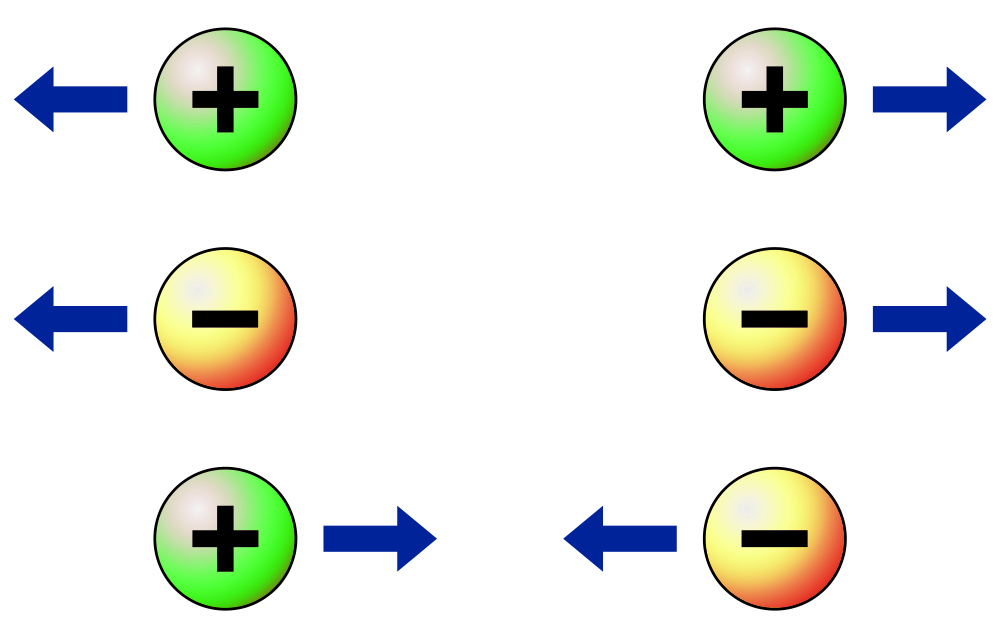
Historically, physics encountered the same problem. If one object can influence another at a distance, it is natural to ask what is happening in the space between them. One guiding principle that physicists often use is the concept of locality. Locality is the idea that an object can only be directly influenced by its immediate surroundings. Thus, an influence should not simply leap across space from one object to another, and changes should propagate through intermediate regions step by step.
At first glance, locality seems reasonable because it matches many of our everyday experiences. If I push a book across a table, my hand influences the book through direct contact. The influence does not appear to jump instantaneously across the table.
However, locality creates a tension when we return to the scenario of the balloon pulling on strands of hair. If locality is true, something must be happening in the space between the balloon and the hair. But from a standard electromagnetic perspective, the space between the balloon and the hair is empty. Therefore, we have encountered a contradiction: if what is between the balloon and the hair is empty space, then what is responsible for transmitting the influence? Neither the usual electromagnetism nor locality tells us the answer to these questions.
The Classical Electric Field
In the usual electromagnetic picture, the answer to the puzzle is the electric field. Rather than allowing charges to influence one another directly across space, the theory assigns an electric field to the space surrounding charges. The field acts as the intermediary through which influence is transmitted.
A useful way to think about the electric field is that it assigns information to every point in space. If we imagine a charged particle that is placed at a particular location, the electric field tells us how that particle would move. This charged particle is what physicists call a test charge. By observing how the test charge behaves, we can infer information about the electric field at that location.
This could seem like a satisfying answer as the electric field tells us how influence is transmitted, but it does not tell us what kind of thing is doing the transmission. Is the electric field a physical substance? Is it a mathematical tool? Or is it something else?
It might be easy to fall back on the idea that the electric field ultimately works through tiny particles physically touching one another. After all, contact interactions are among the most familiar interactions that we experience.
But physics challenges this intuition as well. It is surprisingly difficult to define what it means for two objects to “touch”. We usually think of the balloon attracting hair as an example of action at a distance, whereas pressing a hand on a table feels like direct physical contact. However, at the microscopic level, the two situations are fundamentally similar. If we could zoom in on our fingertip and the table with a microscope, we would find that the atoms in our skin never make contact with the atoms in the table. This is because of the repulsion between the electron clouds surrounding the atoms, which prevents the two atomic nuclei from overlapping. Say if we scale the atom in the table up to be the size of a marble, then the nearest atom in our fingertip would still be separated from it by a few centimeters. In the end, nothing is truly “touching” in the intuitive, physical sense.
Thus, the idea of contact does not solve our problem. We are forced to ask the same question again: what is it that allows these interactions to occur? To answer that question, I turned to a different perspective of thinking about electric fields.
The Electric Field as A Dynamical Structure
From our intuition, it is natural to imagine the electric field as some invisible substance filling space. This is often the picture suggested by the common field line diagrams in physics textbooks, which make the field appear to flow outward or inward from charges, almost like a moving fluid.
A useful analogy is the ocean. A boat floating on water can move because waves pass beneath it. The boat responds to changes in its surrounding waves rather than to some direct push from a distant object. Similarly, charged particles respond to changes in the electric field around them. We can then view the electric field as a dynamical structure that governs how the state of the world can evolve.
However, the ocean analogy can only take us so far. Ocean waves are made of water molecules. Sound waves are made of vibrating air molecules. But what is the electric field made of? When light travels through empty space, it seems that there is no material medium at all.
This brings us back to the mystery: if locality suggests that something must exist in the space between interacting objects, and if the electric field is not made of the ordinary matter that we understand, then what exactly is occupying the space?
To answer this question, we have to rethink what we mean by “empty” space itself.
Empty Space is Not Empty
Conventionally, we have always imagined empty space as exactly what the name suggests—empty. Just like if all the particles were removed and nothing was remaining. But modern physics suggests a very different picture.
In quantum field theory, what we call “empty space” is not truly empty. Empty space is filled with underlying quantum fields that permeate all of space and time, even in the absence of particles. Even when the surface of the ocean looks perfectly still, the water is still there. The ocean is not defined only by visible waves, but by the underlying medium that can support waves in the first place. The waves are patterns of motion of the ocean itself, just like the electric field. These fields are part of the fundamental structure of the universe from which physical phenomena emerge. Quantum field theory suggests that particles are not independent objects moving through an otherwise empty space. Rather, they are localized patterns or excitations of underlying fields that already exist throughout the universe.
From this perspective, the electric field is not something that is added to empty space. It is part of the fundamental dynamical structure of space itself.
Conclusion
At the beginning, I asked a simple question: how can objects influence each other without touching? The straightforward answer is the electric field. Charges create electric fields, and those fields determine how other charges move. But what is an electric field? Is it an invisible material filling space between objects, or is it a dynamical structure that governs how physical systems in the world evolve?
From the perspective of quantum field theory, quantum fields permeate all of space and time. Particles are not separate objects moving through an empty space, but are excitations of these underlying fields; electric fields are not secondary matter surrounding charged particles, but are particular configurations of the underlying electromagnetic quantum fields. What we observe as the motion of a charged particle is the result of its interaction with the electromagnetic field, whose local state determines how the particle evolves.
In the end, our original question may not have a single definitive answer. But asking it revealed a shift in perspective, and physics has repeatedly shown that every explanation opens the door to an even more fundamental question. Stopping at this step, a new mystery emerges: what are these underlying quantum fields themselves? What are they made of, and where do they arise from?

