Lunch with Horace Walpole

Did you know that Horace Walpole invented the Gothic novel? The Englishman spawned a genre by publishing The Castle of Otranto during the 1700s. Walpole’s work featured dark atmospheres, crumbling castles, family secrets, and taboo subjects such as madness and incest. If you’ve enjoyed Oscar Wilde’s novel The Portrait of Dorian Gray or the 2024 film Nosferatu,1 thank Horace Walpole.

I memorized the above information in a high-school English class. My teacher, Mrs. Lukacs, demanded a great deal of her students: we memorized boatloads of facts about literary genres (from Anglo-Saxon epics to elegies), history (the Enlightenment, the Romantic era, etc.), literary devices (enjambment and litote and synecdoche), and authors (Samuel Johnson, Anne Bradstreet, and their ilk.). Thanks to Mrs. Lukacs, I can add that Charles Brockden Brown Americanized the Gothic. He shifted stories’ settings to caves, dark forests, and villages at the edge of civilization. The novels Wieland, Edgar Huntly, and Arthur Mervyn exemplify his style.

Mrs. Lukacs’s curriculum hibernated in me like an educational chipmunk after I’d graduated from high school. Imagine my surprise, during a recent lunchtime, when I lifted my gaze to find Horace Walpole a few feet away.

I was dining at King’s College, Cambridge. The University of Cambridge contains colleges similarly to how Hogwarts contains houses. Each house has students and faculty members from multiple departments. Some departments share their disciplines with institutes. An institute and a college account for my visiting Cambridge most of this autumn: the Isaac Newton Institute for the Mathematical Sciences is hosting a several-month program about quantum many-body physics. I’m grateful to be attending the program while holding a Visiting Fellowship at King’s College.
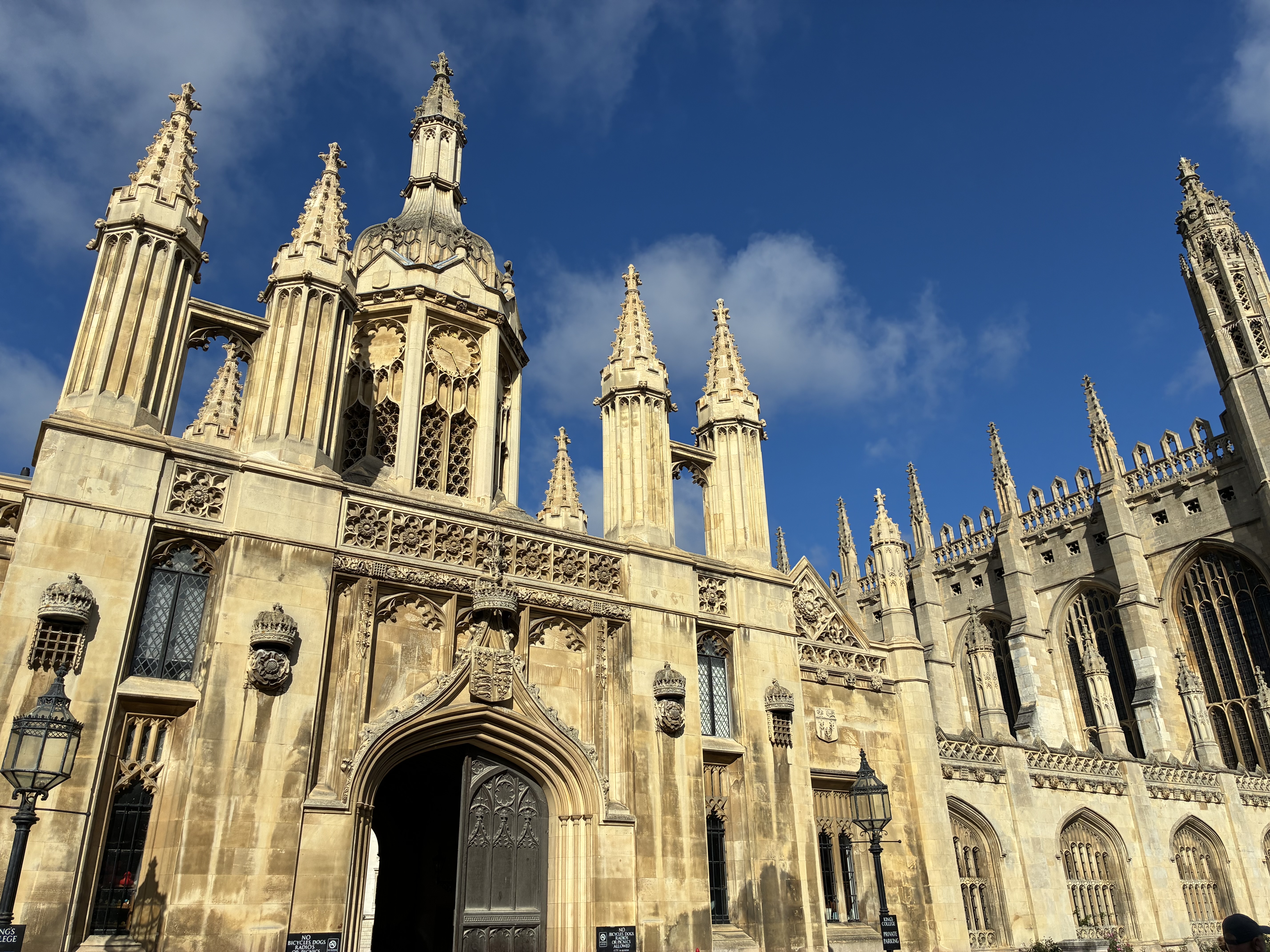
The main entrance to King’s College, Cambridge.

King Henry VI founded King’s College in 1441. (Caltech, where I earned my PhD, precipitated from earlier institutions around the turn of the twentieth century.) The college’s alumni and former Fellows include centuries’ worth of luminaries. Some of their portraits hang in the dining hall, a Gothic confection that could play a cathedral on television.

I sometimes talk with other scholars over meals in the dining hall; but, when dining alone, I examine different facets of the hall over different meals. The room boasts carved wooden walls, a seventeenth-century tapestry, the gold-colored wall sconces. I couldn’t forgive myself if I squandered the opportunity to examine them. Sometimes, I’ve scrutinized a portrait per meal. One portrait depicts Horace Walpole.
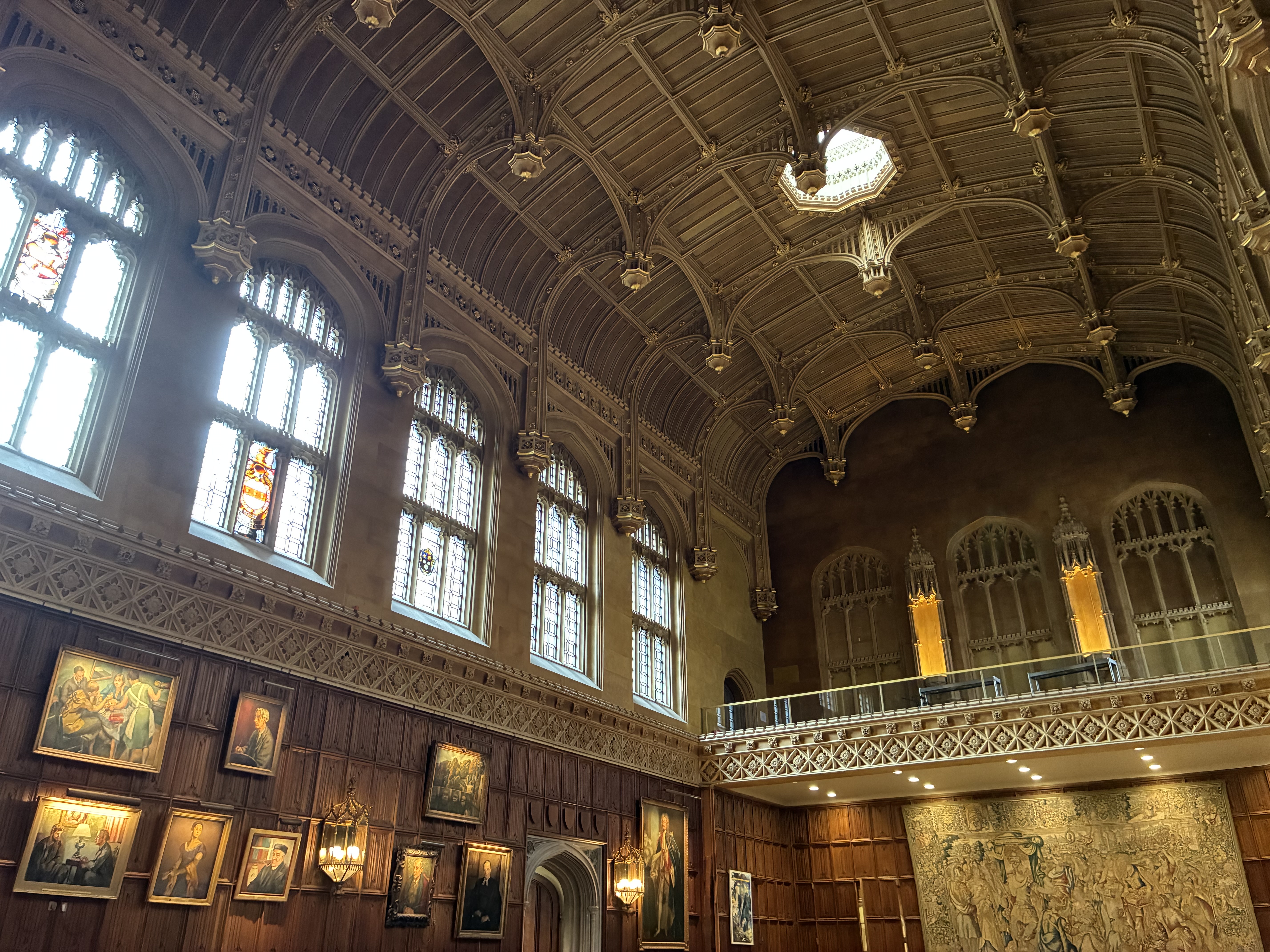
King’s College dining hall

Did I attempt to envision Horace Walpole during high school? Probably not. He lurked in my imagination as the silhouette of an eighteenth-century Englishman—likely as buttoned-up, industrious, and middle-aged.

The portrait shows a youth in his teens or twenties, his skin smooth. A slight smile hints at levity. His clothing’s light coloring buttresses the impression: a white shirt peeps out from a cobalt-blue jacket. The young man’s pose suggests formality, his back straight and one hand tucked inside his jacket. Yet his large, dark eyes seek the viewer’s. I wouldn’t have expected such a plucky-looking youth to have founded the genre that includes Dracula. But I welcomed Horace Walpole as a lunch companion.
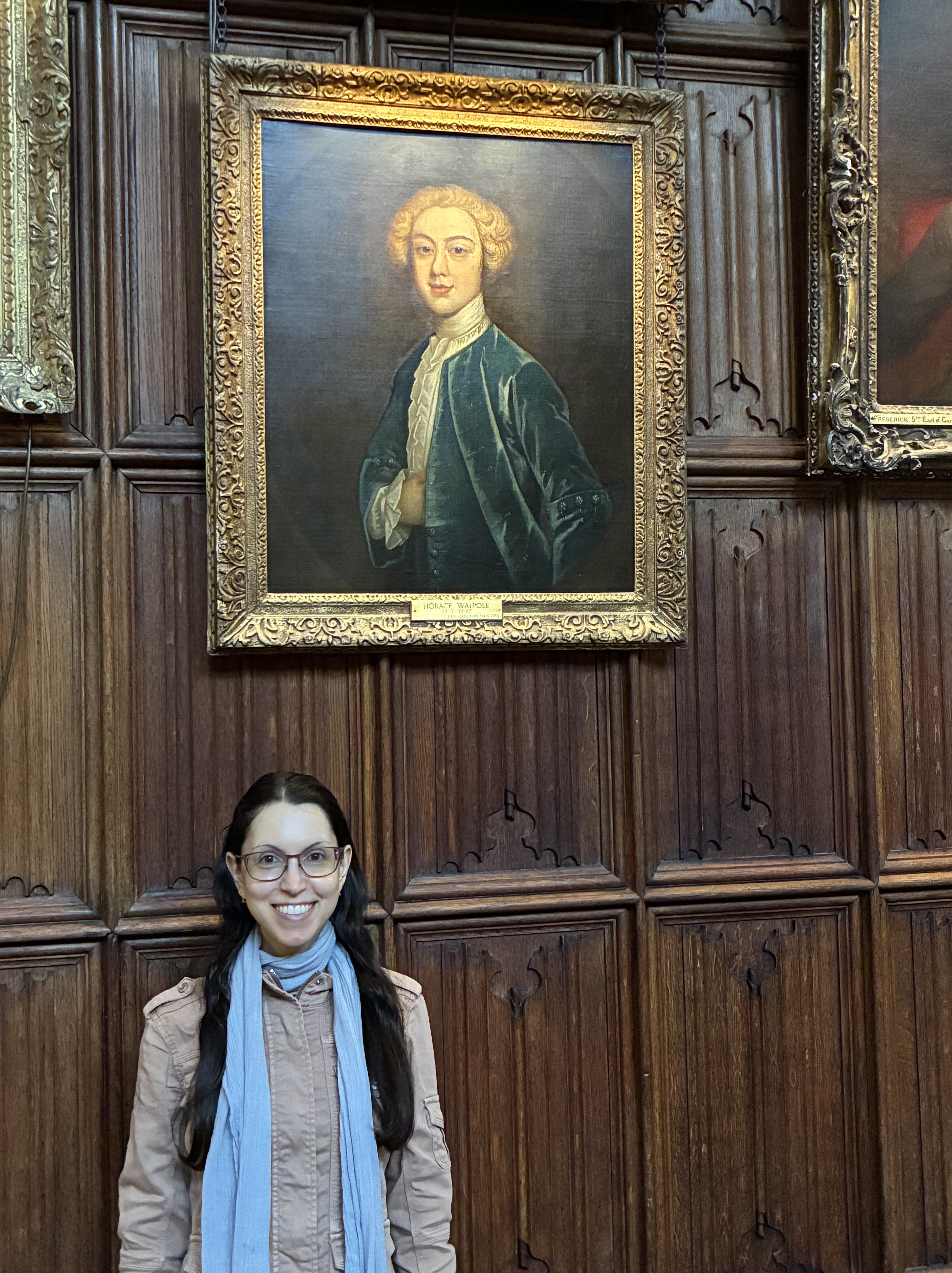
The author with a more illustrious author.

After finishing eating, I walked to one end of the dining hall to drop off my tray. Beside a doorway there hung another portrait whose name leaped out at me: Sir Robert Walpole. Google revealed that Sir Robert had fathered Horace—and served as Great Britain’s first prime minister.
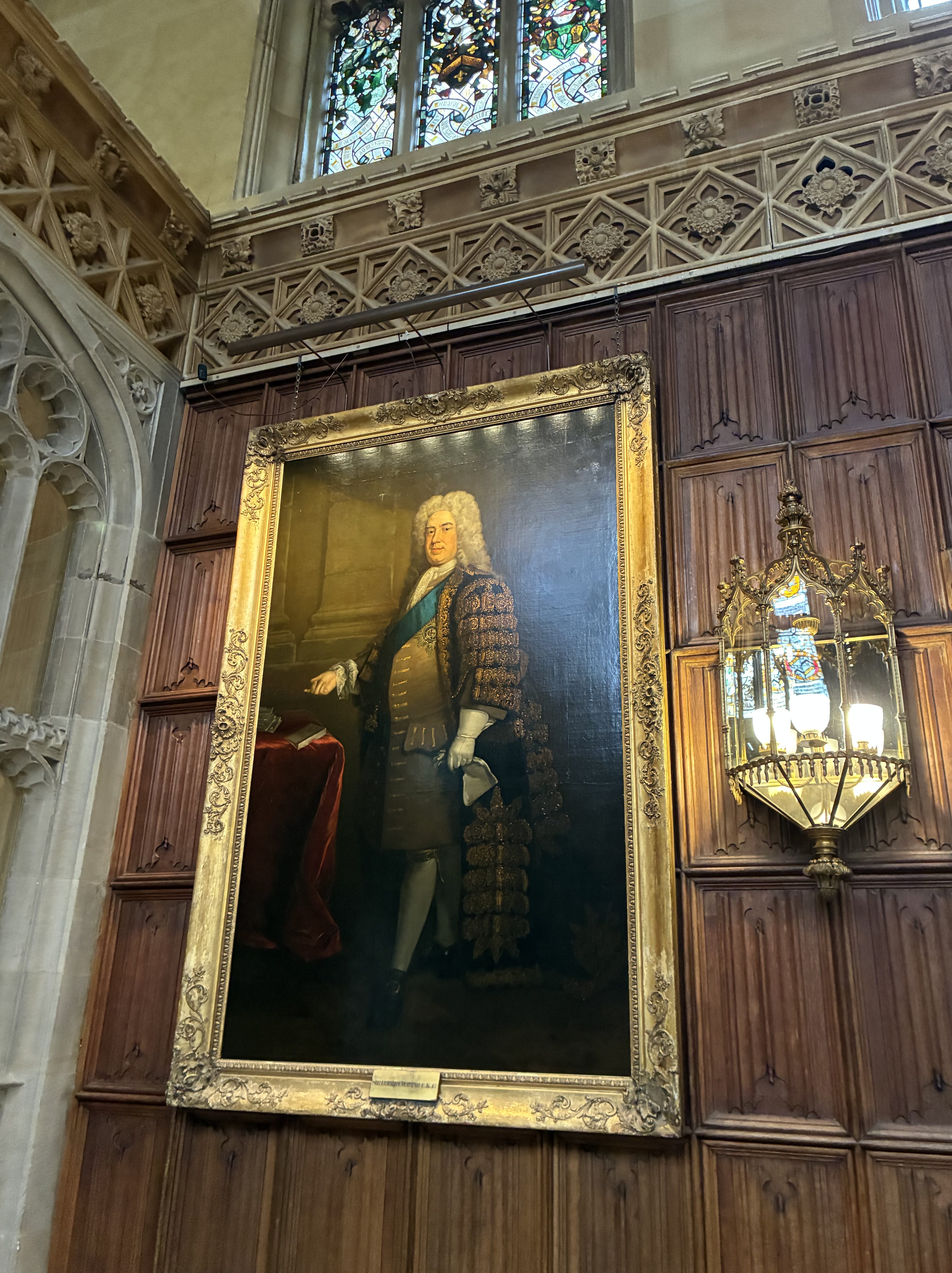
Sir Robert Walpole (en route to the tray-return area).

During another meal, I found myself eyeing a portrait of a man wearing an Elizabethan ruff. He wore no smile, unlike Horace. Little wonder: a label revealed the portrait to be of Sir Francis Walsingham. Walsingham had headed Queen Elizabeth I’s spy network during the 1500s. Catholics across Europe sought—overtly and by cloak and dagger—to dethrone Elizabeth and the Protestantism to which Walsingham subscribed. I could hardly blame her right-hand man for looking as though he’d found a rat in his soup.
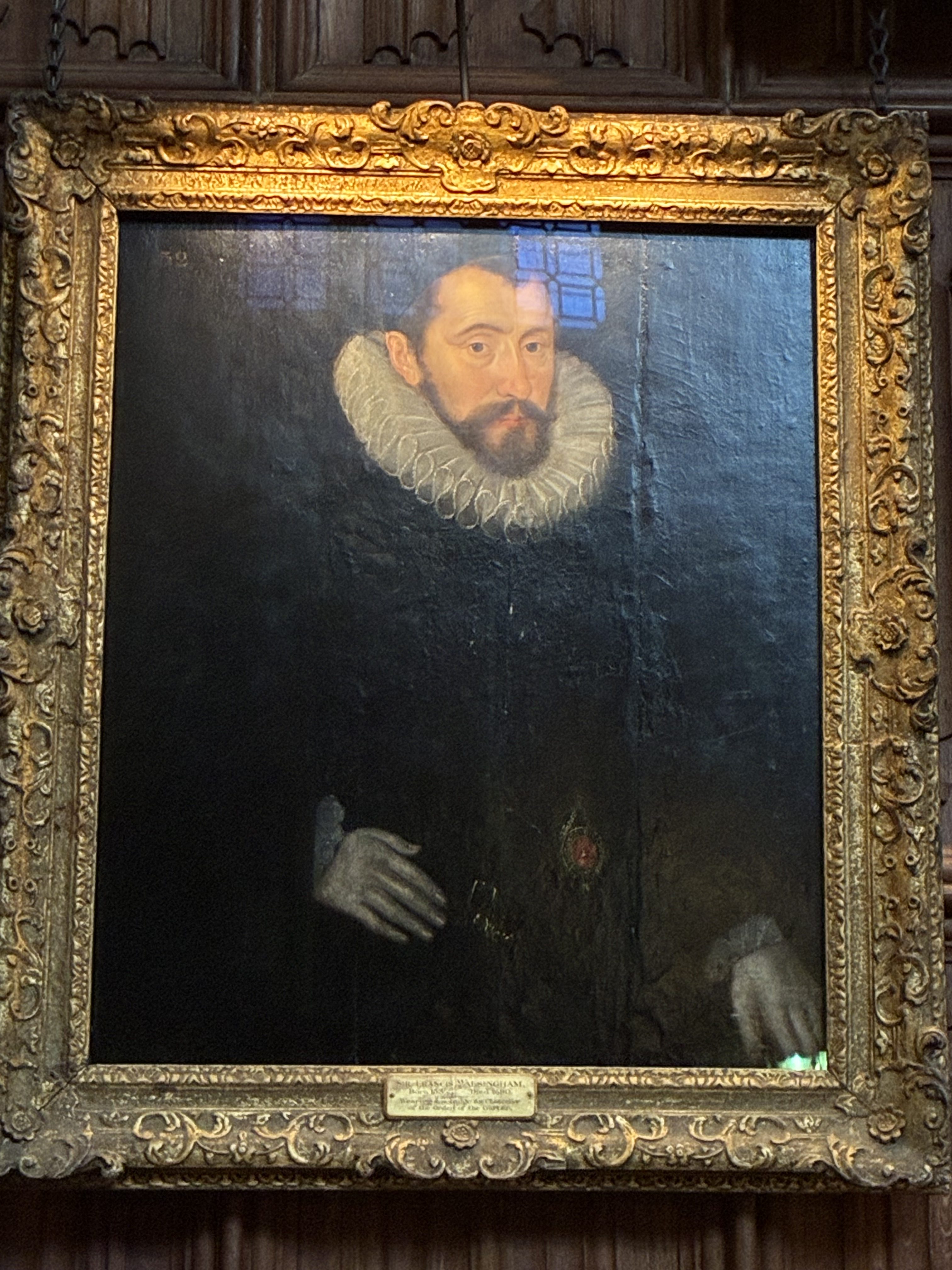
Queen Elizabeth I’s spymaster.

What a crew surrounds me, I keep thinking. What depth and richness it adds to my meals. I eat chicken-tikka sandwiches and minty-pea salads with history.

Studying physics unlocks similar depth and richness. Doing physics, one doesn’t merely pose a problem, translate it into math, and solve the mathematical problem. One interprets the mathematical outcome physically, illuminates it with examples, and applies the results to the world around us.

For instance, odors waft out of the servery into the dining hall, savoring of flatbread pizza or falafel or beef Wellington. Why? Because improperly fed or watered students can cause riots. But why, more fundamentally? Because, by the second law of thermodynamics, every sufficiently large closed, isolated system’s entropy increases or remains constant. Entropy increases as a gas—which can carry an odor—spreads out.

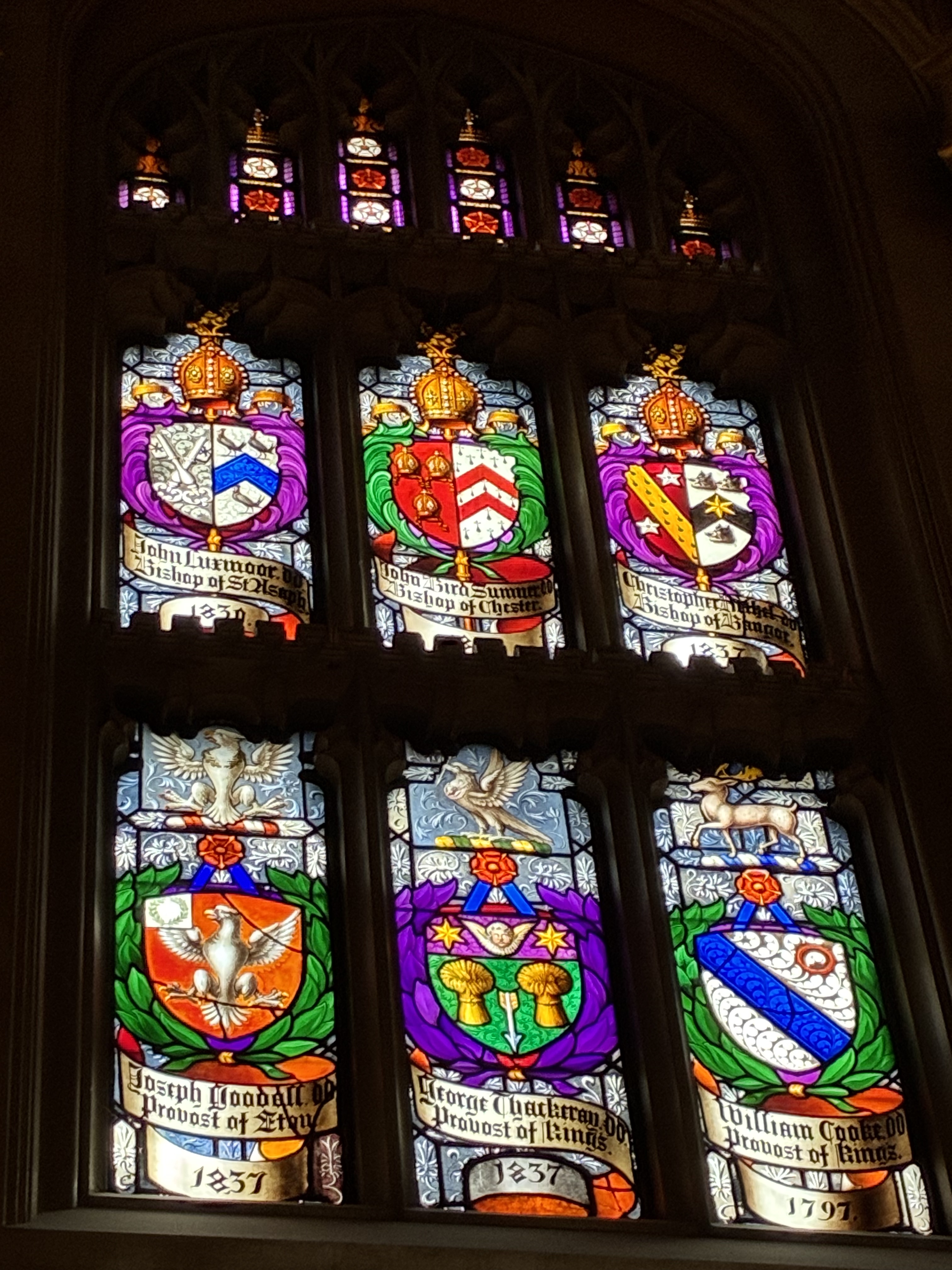
As its entropy grows, the gas approaches equilibrium: large-scale properties of the gas, such as its volume, cease to change. If any energy leaves the gas, an equal amount enters it, on average. The gas takes far less time to equilibrate than glass does. The dining hall’s stained-glass windows depict coats of arms and list college provosts of yore. A glass’s atoms don’t form a crystal, a pattern repeated across space. Diamonds, table salt, and the quartz in wristwatches consist of crystals. A glass’s atoms lie at random distances from each other. This randomness leads to randomness in the interatomic interactions’ strength. 
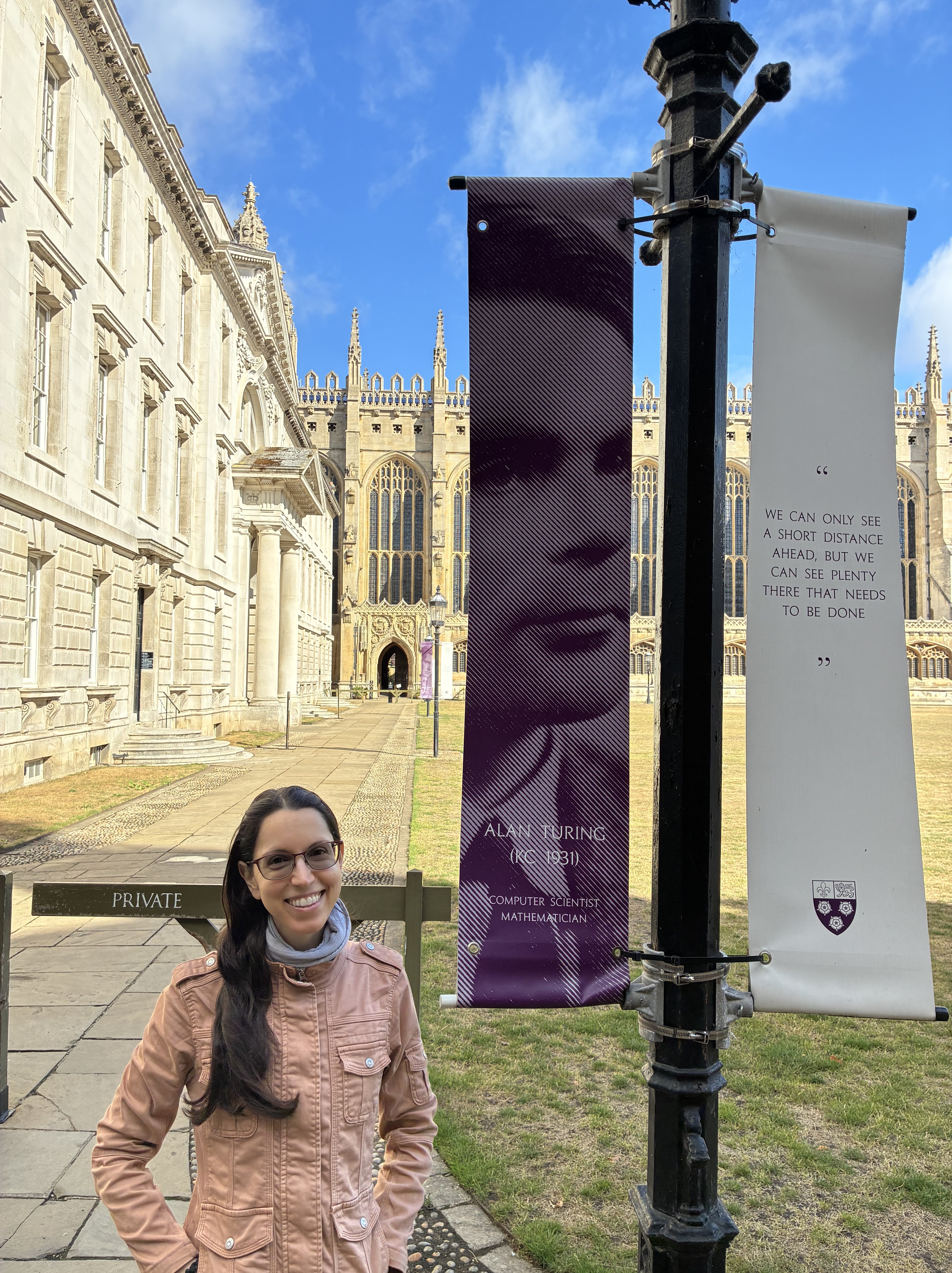
Similar randomness characterizes neural networks, which underlie conversations I’ve overheard and participated in at meals. Neural networks realize artificial intelligence, which has been widening, disrupting, monetizing, speeding up, eroding, and enhancing research. You don’t need for me to tell you that AI has ignited a quest for an understanding of what computers can and can’t accomplish. What better place to undertake such a quest than King’s? Alan Turing, a co-founder of computer science, studied and worked here.
I’ve written about how a liberal-arts education has enhanced my physics. So has a physics education enhanced my life. Physics adds depth and richness—as well as nuance, detail, and significance. I have the opportunity to eat lunch with Horace Walpole this autumn; we have the opportunity to eat our cosmic lunches in this universe for only slightly longer. I couldn’t forgive myself if I squandered the opportunity to examine my surroundings.

With thanks to King’s College, the Isaac Newton Institute, David Arvidsson-Shukur, and many others for my visit.

1Or the 1922 original.
Even sampling from a quantum spin glass may not require a quantum computer (a video abstract, for a change)

First, why a video?

I am part of a generation that was raised on a nourishing diet of science communication videos on YouTube. The likes of MinutePhysics, Veritasium, VSauce, Crash Course, TED-Ed, Physics Girl, 3Blue1Brown — you name it, these channels were my childhood. Had they not existed, I may very well have never considered pursuing a physics PhD here at Caltech.

But you probably already knew about the power of science communication in its ability to inspire the next generation. I am here to convince you that science communication just became a whole lot more important.

Earlier this month, Terence Tao gave a talk at Caltech about the growing use of AI in mathematics. In light of OpenAI’s recent release of hundreds of AI-generated mathematical manuscripts, he argued that our community has transitioned from a long era of proof scarcity to one of proof abundance. As a result, problem-solving may no longer be the central challenge in mathematics and theoretical physics that it once was. What surprised me most, though, was Terence’s claim that problem-solving was never the central goal in the first place. It was only ever a proxy for the actual goal of these disciplines: to elevate human understanding.

I do not think we have fully internalized this maxim as a community yet. The arXiv is seeing a flood of AI-generated submissions that claim to solve problems but offer very little insight. So how do we encourage human understanding?

Perhaps a video recording is one good way. Flagship conferences like STOC 2027 have begun requiring video recordings as part of their submission process to prioritize effective scientific communication and filter out low-insight AI-generated submissions. On one level, requiring authors to explain their work over video establishes a standard that scientific research should remain intelligible to others.

But on another level, a video recording captures something of the humanness of the act of understanding itself. When I understand something, I feel like I can taste it, almost as if it were a sensory experience. I then feel empowered, as if I have been given a new tool to use, and subsequently feel an excitement to share that insight with other human beings. In other words, understanding is an embodied phenomenon. And what better way to embody your work than to stand before a camera and explain it?

Science communication is no longer just about communicating science to people outside the field. It is increasingly about ensuring that the scientific progress we make be accompanied by a corresponding growth in human understanding. So go out there and record yourself geeking out!

About the work

Quantum spin glasses are, in some ways, very quantum systems. Their Hamiltonians contain many non-commuting terms, and their low-energy states can be far from simple product states that are easy to represent classically.

One might therefore expect these systems to be difficult to simulate on a classical computer. Yet, in our recent work, we show strong evidence that there is no exponential quantum advantage for sampling from the thermal states of one such quantum spin glass model.

The key is to reduce sampling to estimating certain quantities related to the model called tilted means, which we expect to be classically easy. I say expect because our results rely on a conjecture from spin-glass physics that is widely believed to hold true, but has yet to be rigorously proven with existing mathematical tools. Such assumptions are quite common in the spin-glass community.

The video above focuses more on why we wanted to study sampling than on how we actually solved the problem in order to make it accessible to a general audience. For those curious, our approach is based on stochastic localization, a sampling technique closely related to diffusion models. More technical details can be found in our arXiv preprint.

Letter to a prospective student

It’s been a long summer here at Caltech, in part due to a super El Niño event which hit late but hard, with temperatures creeping up to the 100s in the first week of October. But in the history books (at least those on the history of science), the end of this summer might forever be marked by the events of last week. I’m referring here to OpenAI’s release of a whopping 722 manuscripts (announced as 372 major results, and further organized into a number of subfields or research areas) [1] which comes less than a month after the announcement of a Navier-Stokes breakthrough from the same group [2].

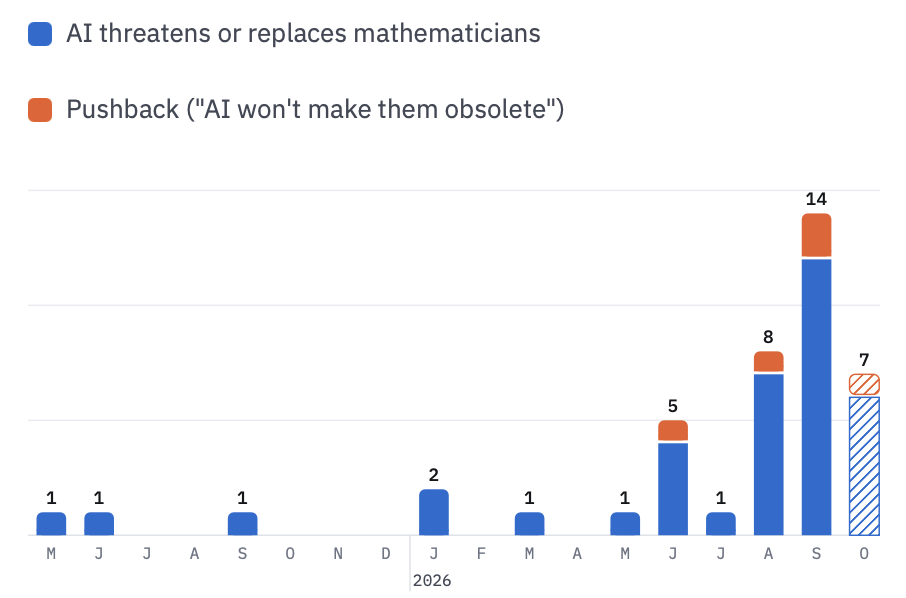
If you’re an undergrad and/or haven’t been closely following discussions within the theory community earlier in the summer, you could be forgiven for feeling like the LLM resolution of a Millennium Prize Problem, a feat which for any individual would be considered a crowning achievement of mathematics, came a bit out of left field. After all, if you go through trending news headlines over time discussing the concerning possibility of AI tools overshadowing and making obsolete human mathematical achievements, the graph looks something like this:

Graph of trending headlines each month on Hacker News up to 2026/10/15 which claim AI either will or won’t end mathematical research as a career; compiled with the help of Opus 5.5

Have we dropped the ball with prospective students?

Aside from the popular news headlines, a lot has already been written by and for mathematicians and theorists at the PhD level and above. But the speed at which all of this has happened makes me worried about how effectively we’ve communicated with younger students, since the end of summer also marks the start of another PhD application season. While it’s normal for pre-PhD students to be missing some context on what the day-to-day of a full-time researcher looks like, this year that also means that they seem to have largely (perhaps inadvertently) been left out of the AI discourse. This isn’t just a hypothetical: based on my recent interactions with undergrads, most of them haven’t caught onto the recent jumps in capabilities, or the consequences for the research community.

The Navier-Stokes announcement dropped on a seemingly random Tuesday in early September, and immediately hit the forefront of conversation in my circles. Later that same week, I braced myself to face the group of around forty wide-eyed undergrads who would travel to Caltech to attend the FUTURE of Physics workshop, where they would learn all about PhD programs and careers in physics. FUTURE selects for students who are bright, often come from underserved communities or nontraditional backgrounds, and are active members of their communities. As the co-chair of the workshop and one of the student science talk presenters, I tried to preempt the questions I might get on current events, like funding or the state of theory research. But while many students were indeed interested in how to approach professors about whether they had funding for next cycle, I was taken aback to learn that few of them were thinking about AI at all. None of them expressed any concerns about the pace of AI development, nor did they even seem aware that nearly all researchers here would soon be using a (supposedly overhauled and better aligned) version of a model that had hacked several real-world entities [3].

(If you’re a more senior academic or researcher who’s surprised to hear about this disconnect, you wouldn’t be alone! And you don’t have to take my word for it either: instructors and recent graduates at other universities in the U.S. discussed similar experiences over the past summer.)

Research in the time of AI theorem provers

For context, all of my PhD work has been theoretical and leans heavily on theorem-proving to push the frontiers of what we understand about physics. However, I also applied specifically to do interdisciplinary research. I’ve always liked taking detours into a wide range of subjects, whether it’s random matrix theory, cryptography, or marine science, and finding the connections between them. My first solo-first-author paper, though unfortunately containing nothing directly relevant to marine biology, was shaped by a number of conversations with colleagues across the quantum, condensed matter, and high energy arXiv categories. To me, the most exciting part of learning about new mathematical frameworks has always been the ways in which they help us bridge and translate between different languages and ways of describing real-world phenomena.

With this in mind, I want to chronicle in broad strokes my own perspective on this past summer. I’m focusing on just this short window of time because my perception is that within the quantum information community, the tone of the discussion has shifted very quickly in the last few months, and for good reason. Prior to this spring, I used LLMs for literature searches and was aware of groups who were working on theorem-proving harnesses, but I didn’t find the output of the readily available consumer models to be very reliable. Around April, rumors started to float around about an internal Anthropic model and the possibility that it might push capabilities into the regime of practical cybersecurity risk; the public version of the model released on June 9 for just three days before Anthropic was forced to take it offline due to an export control directive. Over the next month, the rumors grew louder until finally Fable was rereleased on July 1, followed by GPT 5.6 just over a week later, and with it the scrutiny of the entire mathematical and theoretical research community over the first wave of one-shot papers.

And that could have been it, but last month saw yet another round of new releases. For the sake of telling a complete story, I have to report that as surprising as Fable 5 and GPT 5.6-Sol had been, Opus 5.5 is the first release that’s completely blown my mind, for reasons that seem to have missed the broader discourse but are important for my own learning process. Among my colleagues, the consensus has been that since July, GPT has been superior to Fable for theorem-proving tasks. But many of the challenges I’ve agonized most over have been in deciding how to come up with a well-defined question that formalizes some physical intuition in a reasonable way (e.g. what does it mean for random unitaries to be a good model for chaotic Hamiltonian dynamics?), rather than just the difficulty of finding a proof for one once it’s posed. This process of iterating over feasible and well-defined research questions admittedly seems a bit tricky to formulate as a set of verifiable tasks, despite being a large component of writing a physics paper, as acknowledged in this recent preprint for a new benchmark based on theoretical physics calculations [4]. From my own limited experience, though, Opus 5.5 has been significantly better than any other model I’ve tried at taking problems I’ve been stuck on, for which my initial conjecture and attempt at explaining some numerical phenomenon might be completely wrong, and combing through the many-body physics literature to suggest other relevant frameworks and theories.

Should you apply to do a (theory) PhD in 2026?

The pace of advances in AI capabilities over the past summer came as a surprise to many people in the theory community, to the point that by the time the preprint linked above was posted, their theoretical physics benchmark had already been saturated by models released within the last one-and-a-half months. Given this, it’s reasonable to wonder what kinds of changes will have to be made to PhD training. Although I’m not aware of any of the authors commenting publicly on this aspect, I imagine that the work associated with writing a peer-reviewed paper on any one of the calculations in their benchmark would be worthy of advancing to candidacy.

To be clear, this is a big deal: in undergrad, you may have spent most of your time on coursework that other people could authoritatively grade for correctness. But by the time you present your dissertation topic in your candidacy exam, you might be the only expert in the world on your own research area. The authors of the very same benchmark also acknowledge that they initially had difficulty grading the output of the model, since nine of the solutions originally provided for the fifty problems turned out to be wrong! In addition, while I have no idea how far the current language model paradigm can be pushed, as of writing I think it’s safe to say that there’s still some room for improvement, given their continual progress on seemingly every benchmark that’s been thrown at them.

So what is the value of PhD training, if the machines are now capable of reproducing the kinds of technical output that we’re supposedly evaluated on as grad students?

I don’t think I’m qualified to speak on behalf of all theorists, but in my view, the difference between pursuing a PhD in theoretical physics and accepting a corporate offer isn’t just that it’s hard to get paid to learn about fun math problems with no immediate applications in industry. A large part of PhD training (and probably post-PhD training as well!) is learning what to do with this kind of freedom.

I do want to acknowledge that it’s understandably hard to be in a position in which your job is rapidly changing, and where you might not have reliable access to mentorship, directed practice, and tight feedback loops to learn the relevant skills [5]. And all of this applies even when the field isn’t in crisis. But systems and institutions aren’t static, nor have they ever been. And it’s always been the case that the PhD experience is highly dependent on the quality of mentorship as well as the resourcefulness of the lab when it comes to finding opportunities in the explored and uncharted, or tackling high-risk, long-time-horizon problems with limited public funding. In many ways, then, the most important questions to ask when deciding whether to accept an offer remain the same [6].

Plus, despite how good language models have been for a while now at generating heaps upon heaps of words, rows upon rows of spreadsheets, the PIs and their grant managers who work tirelessly to fundraise, to project manage, and to set high level goals guiding all of this research have managed to hold on to their jobs, and are still being asked to direct the next generation of research proposals. And many of us at Caltech remain excited about budding developments in quantum science, as the next generation of experimental platforms promises to bring us past what theorists can hope to fully predict or simulate.

This post marks the conclusion of my initial voyage into theory research over the past three summers, and the first half of my PhD. Many people have asked me whether I regret my choice to pursue a PhD in theoretical physics in the first place, especially given that so many of my close friends and peers from undergrad decided to work in AI safety or adjacent areas following the original release of ChatGPT. There are two main reasons why, after surfacing to face the real world, I still feel that I made the right decision: first, if anything, AI safety might be one of the most compelling reasons for ensuring that humans remain capable of reviewing evidence and making informed decisions. As long as we value citizen participation in science and decision-making, education and STEM education will continue to have a role in society. Second, as a fresh college graduate, I simply didn’t feel ready to direct an original research program, or to shape an entire field of study. No matter how AI capabilities advance, I’d like to think that the PhD can continue to be a safe space for young people to develop “soft” skills like managing projects with a wide range of collaborators and uncertain timelines, and to grow into the scientific leaders of their generation. Plus, you never know when your random matrix tricks might come in handy for some underwater imaging problem.

Acknowledgements

I’m grateful to the many peers and colleagues, from both the theory and experimental sides of IQIM, who gave their candid opinions and feedback on this topic. In particular, I’d like to thank Dave Hsieh and Jessica Jiang for co-chairing the FUTURE program and for a number of very insightful discussions, Spiros Michalakis for helpful suggestions on a draft of this post, and everyone in the Caltech theory community who’s engaged with the topic during John’s group meetings. I’d also like to thank Jiahai Feng, Vincent Huang, and Alex Gu, some of the friends in question who have worked in AI safety-adjacent areas, for keeping me honest. Opus 5.5 was used for light copyediting of a draft of this article.


[1] See Github repository: https://github.com/openai/math

[2] Press release page: https://openai.com/index/navier-stokes-solution/

[3] See, for example, https://transluce.org/agent-activity

[4] The authors of the manuscript also voice additional thoughts on why AI agents have yet to result in similar breakthroughs on major outstanding problems in physics. The full set of benchmark problems and writeup is available at https://arxiv.org/abs/2610.16733.

[5] The trifecta of learning taken from the excellent https://web.stanford.edu/~aramdas/checklists.html

[6] Although this list was written for students in statistics and machine learning (and includes terms like “HCI”, i.e. human-computer interaction), I think it’s pretty broadly applicable for quantum information too, even if you’re not interested in quantum learning theory. And you might notice that very few points on this list are about learning purely technical skills!

The Quantum Omelette Problem: How Much Energy Belongs to the Yolk?

The National Egg Coordination Committee created one of India’s longest-running ad campaigns. Its jingle was impossibly catchy. Nearly everyone from my parents’ generation onward seems to remember it:

“Sunday or Monday, eat eggs every day.”

My mum took this advice rather seriously. On weekdays, we ate boiled eggs for breakfast. Sundays, however, were omelette days.

Our ritual was always the same. Each of us siblings announced how many eggs we wanted as we streamed into the kitchen. My mum cracked the eggs into a shiny steel bowl, added our chosen mix-ins, and whisked them together. The yolks, whites, salt, and chili powder quickly disappeared into one speckled mixture. She poured it into a hot, oiled pan, where it hissed and sizzled before sliding onto our plates.

The omelettes were soft, spicy, and gone within minutes.

My diet is now plant-based, but the nostalgia of those Sunday-morning breakfasts remains strong—the steel bowl, the sizzling pan, and all of us gathered around the table, waiting eagerly for the omelettes to arrive.

I couldn’t find a painting that resembled my family around the breakfast table, much less one in the style of an old Mughal miniature. So, for once, I felt compelled to enlist generative AI to fill this rather specific gap in art history.

Our weekday boiled eggs and Sunday omelettes offer a useful contrast. In a boiled egg, the yolk and white remain distinguishable. In an omelette, they are mixed and transformed. Some properties—texture, flavor, and structure—belong to the finished mixture rather than to either component separately.

When two parts interact strongly, which properties still belong to the parts, and which belong only to the whole?

This question appears across science whenever interacting parts become difficult to describe independently. In quantum thermodynamics, it becomes a question of energy. Picture a small quantum system, an atom, say, surrounded by a much larger environment. The total energy of the setup comes from three sources: the atom, the environment, and their interaction.

When the atom barely interacts with its surroundings, separating the energy contributions is easy. The interaction energy is small enough to ignore, and we can speak cleanly of the atom’s energy and the environment’s. When the interaction is strong, however, that shared energy can no longer be brushed aside, making it difficult to decide how much belongs to the atom and how much to its surroundings.

For a large object, interactions with the environment typically occur at the surface, while most of its energy is associated with the much larger bulk. As an object grows, the surface becomes less important compared to its volume, so the interaction energy can often be ignored. But this reasoning breaks down for very small objects, where surface effects remain significant, or for systems whose interactions extend through the bulk, allowing interaction energy to scale with volume.

Such strong interactions are not limited to tiny systems; they also appear across condensed matter, nuclear, and high-energy physics. Lattice gauge theories provide one important example: their particles and fields are tied together by interactions and local constraints, making it especially difficult to draw a clean boundary around one part and declare, “This energy belongs here.”

In all these cases, the energy of the whole may be perfectly clear. The challenge, however, is deciding how to divide that energy among pieces that are no longer truly separate.

That brings us to a deceptively simple question: How should we define the internal energy of a strongly interacting system?

Definitions in physics do more than attach names to things. They tell us what counts as a system, which quantities can be measured, and how mathematical ideas connect to experiments. A useful definition must do more than sound reasonable: it should recover familiar results in familiar situations and remain consistent with the laws of physics. When two plausible definitions lead to different conclusions, the choice between them cannot be settled by language alone.

Consider the internal energy of a system. When a system is strongly coupled to its surroundings, some of the total energy is stored in the interaction, and several reasonable ways of assigning that shared energy become possible. But which definition of internal energy is consistent with thermodynamics? This is the question I explored with my collaborators Zohreh Davoudi, Christopher Jarzynski, Niklas Mueller, Connor Powers, and Nicole Yunger Halpern.

Physicists describe a system’s energy using a mathematical object called a Hamiltonian. In our recent paper, we consider three ways of defining the internal energy of a strongly coupled system.

Definition 1: Subtract the environment
Start with the total energy of the system-environment composite, then subtract the energy the environment would have on its own at the same temperature. Whatever remains, including the interaction energy, is assigned to the system.

Definition 2: Include the environment’s influence
Rather than separating the interaction energy by hand, describe the system’s energy using a modified Hamiltonian that captures how the interaction energy affects the system’s energy at equilibrium. Physicists call this the Hamiltonian of mean force.

Definition 3: Account for temperature as well
The Hamiltonian of mean force depends on temperature. The third definition takes this dependence into account when calculating the system’s internal energy.

All three definitions have appeared in the literature on strong-coupling thermodynamics, each offering a seemingly reasonable way to account for the environment’s influence on the system. We wanted to find out whether choosing one definition over another would change how we describe the same physical process.

To test the three definitions, my collaborators and I considered a sudden quench—the physicist’s term for changing something in the setup almost instantaneously. Imagine rapidly turning a knob that controls the system, perhaps by suddenly switching on a magnetic field. We can also suddenly change how strongly the system interacts with its surroundings, effectively turning the interaction between them on or off. Either change happens so quickly that the system and its environment have no time to respond: their states remain constant during that instant. Yet the system’s internal energy can change because the rules governing it have changed. Since this energy change results from deliberate external control, we call it work.

After the quench, the knob is left alone. The system then evolves under the new, fixed conditions and exchanges energy with its environment. This later change in the system’s internal energy is called heat.

Separating the process into two stages makes it easier to tell work and heat apart: work enters during the sudden, controlled change, while heat flows during the evolution that follows. It is a little like whisking an egg first and then placing it on a hot pan, rather than trying to whisk and cook it at the same time.

Once we have chosen a definition of a system’s internal energy, we can ask how that energy changes during any thermodynamic process. The first law of thermodynamics tells us that the change in internal energy (\Delta U) must be accounted for by work (W) and heat (Q) ,

ΔU=W+Q.\Delta U = W + Q \, .

The first law is essentially a statement of energy conservation. It tells us that any change in the system’s internal energy must be accounted for: the energy must have entered as work, as heat, or as some combination of the two.

But here is the catch. Each of the three definitions of internal energy comes with its own corresponding definitions of work and heat. If we change what we mean by U , we also change how we split that energy change into W and Q . For each of the three choices, however, the definitions are constructed so that work and heat add up to the total change in internal energy. All three therefore satisfy the first law.
At first, this seems reassuring. Perhaps any of the three definitions will do.

To decide whether all three internal energy definitions are truly acceptable, we need a stricter test: the second law. The first law tells us that energy must be conserved, but it does not tell us which direction a process will naturally take. The second law supplies that direction. An egg can be whisked and cooked into an omelette, but an omelette left on the plate will not spontaneously uncook itself, separate into a yolk and a white, and return to its shell. Energy conservation alone would not rule out such a reversal, yet nature overwhelmingly favors one direction. Cooking an omelette is therefore an irreversible process. A perfectly reversible process, by contrast, could be undone without leaving any lasting changes to the system or its surroundings.

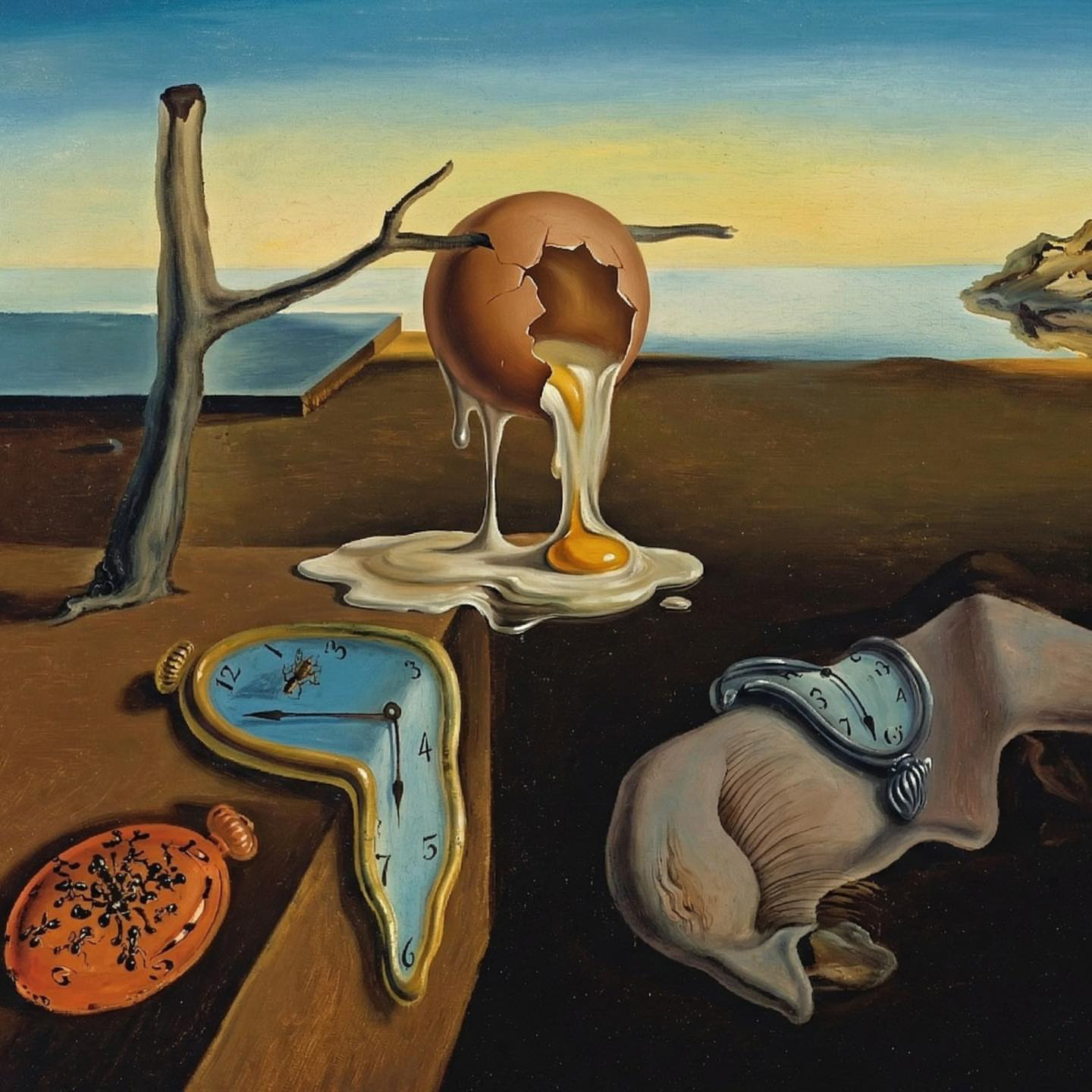
A reinterpretation of Salvador Dalí’s The Persistence of Memory (1931) by the Instagram account @chewscagefreeeggs. A playful take on the second law of thermodynamics, irreversibility, and the arrow of time.

For the sudden changes studied in the paper, we can quantify irreversibility by comparing the work actually performed with the minimum work required in an ideal, perfectly reversible process. Thermodynamics captures this minimum through a quantity called the free-energy change, \Delta F ​. The difference between the actual work and this ideal minimum,

W−ΔF,W−\Delta F \, ,

is called dissipated work. It measures the extra work associated with carrying out the process irreversibly, and the second law says that it cannot be negative.

This is where the three definitions part ways. All three satisfy the first law, but only two satisfy the second law for the processes considered in the paper. The third definition, which accounts for the temperature dependence of the Hamiltonian of mean force, can predict negative dissipated work.

Does this mean that our quantum system has somehow broken the second law? Not at all. Rather, the third definition assigns internal energy, work, and heat in a way that makes a valid process look thermodynamically inconsistent.

The next question is why the three definitions agree in classical physics but separate in the quantum case. The answer lies in one of quantum mechanics’ defining features: observables do not always commute. Roughly speaking, when noncommuting observables describe two quantum properties, they cannot both be measured simultaneously. This has no direct counterpart in classical physics, where two observables describing different properties can be measured simultaneously. When the system’s energy and interaction energy cannot be simultaneously measured, the three definitions of work can give three different values.

To explore this connection, we considered what happens when the system’s Hamiltonian commutes with the interaction Hamiltonian, both before and after the sudden quench. In this classical-like limit, all three expressions for work give the same value, which also obeys the second law. In hindsight, the result may seem obvious. Still, there is something oddly satisfying about pinpointing precisely when the three definitions agree: strong coupling alone does not force them to give different answers. Quantum noncommutativity is what allows them to part ways.

Over the years, our family’s egg repertoire expanded. MasterChef episodes, new cookbooks, and travel brought poached eggs, Scotch eggs, shakshuka, eggs-in-purgatory, Tamagoyaki, and plenty of experiments in between. In some dishes, the yolk and white remain almost perfectly distinct; in others, the boundary between them nearly disappears. A whole spectrum exists between separation and complete mixing.

The same is true of a system and its environment: their interaction can range from barely noticeable to overwhelmingly strong. Our results identify two definitions that remain consistent with the laws of thermodynamics for the processes we studied, even when those interactions become strong.

In praise of questions

Prende y se apaga sola,

sale después de hora.

CHARLY GARCÍA

La máquina de ser feliz1

I’ve learned to tolerate them, and sometimes even like them, but Zoom meetings are weird. Even in familiar contexts: I have weekly check-ins with a close friend/collaborator based in Germany, and despite our familiarity, it still feels weird at times. I joined Nicole Yunger Halpern’s group almost when it was established, during Summer of 2021. The pandemic wasn’t exactly over, and most of us were geographically scattered, as well as complete strangers. To half-palliate this awkwardness, Nicole came up with what’s now sort of a group tradition: icebreaker questions. These are chosen by group members (in a secret order that I believe only Nicole fully knows), and can range from day-to-day stuff (“what’s the best type of pasta?”) to deeper matters. 

A while back, a group member asked something along the lines of: “If you could give your younger self any scientific advice, what would it be?” My response then was: “ask the dumb questions you have as they come.” I had two reasons for this answer. First, dumb questions usually sound dumber in your head and are not as bad as you might think. Second, a dumb matter that doesn’t seem dumb at first, can turn into a really, really dumb question if it’s long unanswered. If I were to be asked this same icebreaker question today, I’d surely reply the same thing, but I believe the reasoning would be more nuanced. 

This text’s epigraph comes from a song in the appropriately named album Random, by Charly García. I’m not sure whether the “happiness machine” in Charly’s random scenario deals with Brownian circuits, but I’d like to think so. 

Over my PhD, I’ve had the opportunity to interact, discuss physics, and even collaborate with truly amazing scientists. I still don’t have a foolproof handbook of criteria detailing what makes a great physicist great,2 but I have observed some patterns. An important one is that great physicists speak their mind: they’re usually  relentless with their own confusion and ask whatever they have to ask to overcome it. Don’t get me wrong here; these people are giants, and I wouldn’t dare call their questions dumb, but asking good questions is a skill more than a gift. It’s like seeing Claudia Poll swim or hearing Hilary Hahn play a cadenza: yes, these people are objectively good, but there’s also a huge amount of practice that goes behind what one sees. And, in the case of asking great questions, practice comes from asking not-great (and sometimes even dumb) questions. 

I got a crash course in asking questions during a recent project. A driving theme of my PhD research has been the study of autonomous quantum machines. These devices execute tasks without classical, time-dependent control, operating under a time-independent Hamiltonian. My first experience with these devices was during an experimental collaboration in which Simone Gasparinetti’s group built an autonomous quantum refrigerator from superconducting qubits. The refrigerator ran on a thermal gradient: as heat flowed from a hot bath to a cold one, a three-qubit interaction carried energy out of a target qubit, cooling it with no external control. The experiment was a success, and its potential usefulness in information-processing devices led us to ask about other contexts in which autonomous quantum machines could shine. 

At the time, we came in close contact with folks at Marcus Huber’s group in Vienna, who were thinking in abstract terms about a fully autonomous quantum processing unit. We had the idea of designing autonomous protocols for logical gates in current-day quantum-technology platforms: Rydberg atoms, trapped ions and superconducting qubits.

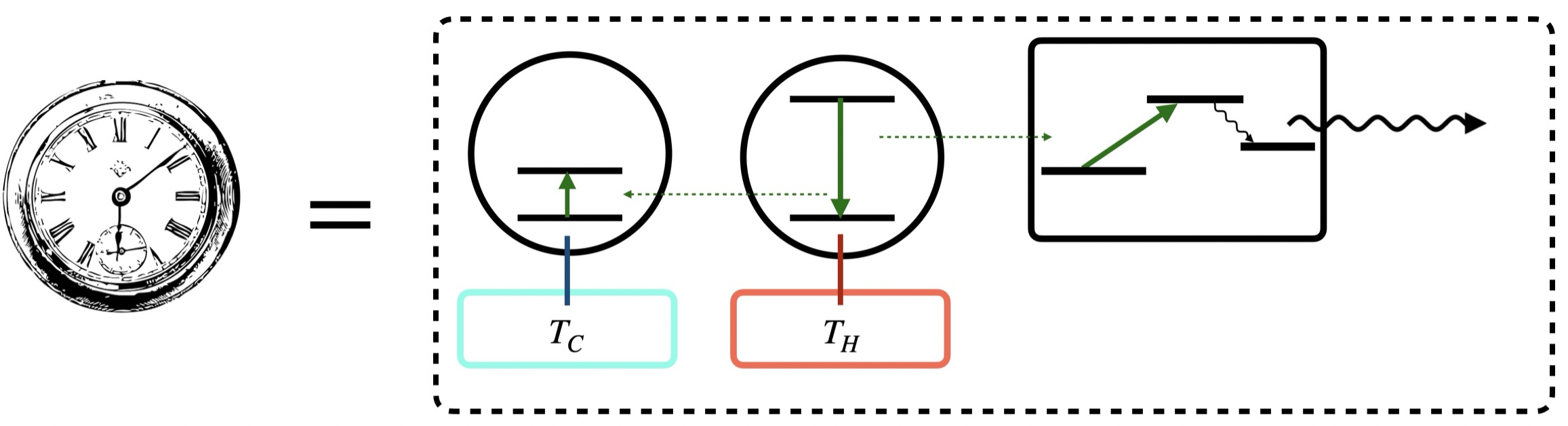
An autonomous heat engine powers a photon-emitting device (which can be thought of as a clock, for compelling reasons). The photons (ticks) trigger quantum-autonomous gates. 

To illustrate this autonomous-gate idea, I’ll briefly describe a gate protocol from our paper. As I mentioned before, an autonomous quantum fridge can be built by exploiting a thermal gradient. The same principle can help build a heat engine. Suppose one has three qubits, with energy gaps \omega_C, \omega_H and \omega_T. Let’s call these qubits the cold, hot and target qubits, respectively. The cold qubit couples to a bath at temperature T_C and the hot qubit to a bath at a temperature T_H, with T_H>T_C. Under the resonance condition \omega_C+\omega_T = \omega_H, the three qubits can swap energy all at once: the hot qubit loses an excitation while the cold and target qubits each gain one, or vice versa. The gradient makes the first direction more likely. The cold qubit can be engineered to quickly decay to its bath, so the exchange can’t run backward, and the target accumulates excitations. The cold qubit’s energy is lost to its bath, while the target could emit into a waveguide that delivers the photon to a chosen destination. The thermal gradient thus powers a device that emits useful photons with no external control.3 

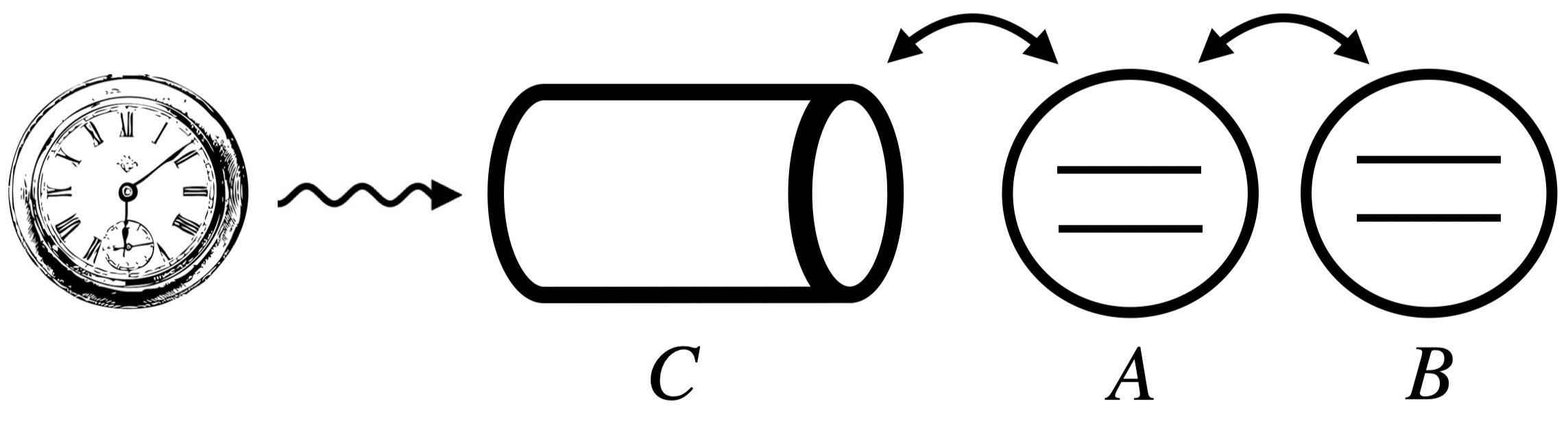
What can we do with this autonomously emitted photon? We can use it to trigger an entangling gate. Two superconducting qubits with matching energy gaps can exchange excitations. Suppose we  have a tunable-frequency transmon qubit capacitively coupled to a cavity. An incoming photon from our autonomous emitter, entering the cavity, can shift the frequency of the transmon. If this effective, shifted frequency matches a nearby qubit’s frequency, the two transmons can interact. The effect of this interaction depends on the cavity’s decay time, rendering our entangling gate random and potentially useful for the implementation of Brownian circuits, for example. A charming instance of a quantum Rube Goldberg machine, if you ask me. 

An autonomous clock’s tick deposits a photon into a cavity. The photon shifts the frequency of a coupled transmon into resonance with a second qubit, triggering a gate.

This example illustrates the spirit behind our autonomous-gate ideas. As mentioned before, we propose  several more instances over different platforms. This all sounds nice and clean after looking at the end product. But the truth is that, when we started the project, I was a theory student with little knowledge about the inner workings of platforms, trying to pitch convincing arguments for novel gate protocols in these well-established technological fields. I had to go through decades of accumulated literature and famous experiments, trying to understand them and hopefully come up with ways to readapt them to the context of autonomy. Naturally, there were many old papers to read, many small details to understand that were obvious to a familiarized experimentalist but not to me, and, of course, many dumb questions to ask. Regarding this, I have to deeply thank Tom Manovitz, Norbert Linke and Simone Gasparinetti, our experimental collaborators, for their patience with these questions and their willingness to chat and clarify to a confused theorist what’s possible and interesting in experimental contexts. 

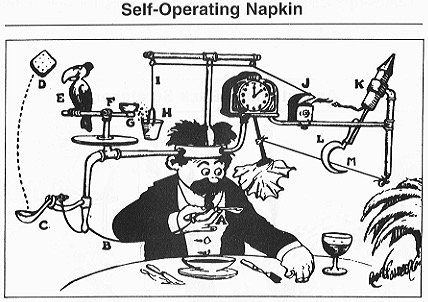
Goldberg devised a classical autonomous napkin from a parrot and a clock. We devised a quantum-autonomous gate from an electromagnetic cavity and a clock. Maybe we’re not so different. 

A special mention, however, to postdoc Yuxin Wang. Earlier in the text I mentioned how being relentless with one’s confusion is helpful; she’s one of the clearest examples I can think of. She came into the project right as I was struggling to model one of our superconducting-qubit gates. I was knee-deep in a convoluted formalism, drowning in inefficient numerical simulations that were leading nowhere. She asked a bunch of questions about our system and my modeling attempts for which I had no good answers for, especially because her expertise in both AMO and open systems really made my explanations look weak. I mean this in the best way I can: polishing my arguments and deeply enquiring about modeling decisions forced us to zoom out and look at simpler, more-efficient ways in which we could model our physical setup. I can’t even begin to quantify Yuxin’s patience and helpfulness in the project, nor how much I learned from working closely with her. 

Research, of course, is about asking questions. Trying to clarify confusion and asking in the most transparent way possible are discomforts I still struggle with (much like with Zoom calls), but I’ve learned to appreciate these convoluted scenarios and sometimes even thrive in them. Not being the smartest or most-experienced person in a room has lots of perks. You can learn a lot, although you might need to ask one or two dumb questions to get there. 

  1. It turns on and off by itself,
    it goes out after hours.
    CHARLY GARCÍA
    The happiness machine
    ↩︎
  2.  I do have, however, a handbook of criteria detailing what makes a useful autonomous quantum machine useful, though. ↩︎
  3.  Quantum thermodynamicists call these photon-emitting devices autonomous quantum clocks.  ↩︎