Project X Squared

Alicia-Dready

Alicia Hardesty: full-time fashion designer, part-time nerd.

Have you seen the movie Frankenweenie? It’s a black and white cartoon (an experiment in itself these days) with a very important message:

Don’t be afraid to do what you love and don’t be afraid to be good at it.

The main character is a smart, sensitive kid who is ostracized for his science experiments. Like the teacher says, people don’t understand science so they are afraid of it. Ironically, artists often deal with the same kind of misunderstandings from the public.

I’m not technically a scientist, but I do love to experiment and try stuff. I’m a fashion designer, which requires it’s own level of scientific conviction. I create, combine unlikely variables, hypothesize, and work within my own scientific method throughout my process.

How does this relate to you?

Project X Squared. Where art, science, and technology meet fashion to create a clothing line, much like an experiment, with the underlying hypothesis being that a quantum physicist, a neuroscientist and a fashion designer can create something tangible together.
Continue reading

Largest prime number found?

Over the past few months, I have been inundated with tweets about the largest prime number ever found. That number, according to Nature News, is 2^{57,885,161}-1. This is certainly a very large prime number and one would think that we would need a supercomputer to find a prime number larger than this one. In fact, Nature mentions that there are infinitely many prime numbers, but the powerful prime number theorem doesn’t tell us how to find them!
nature_news_highlightWell, I am here to tell you of the discovery of the new largest prime number ever found, which I will call P_{euclid}. Here it is:

P_{euclid} = 2\cdot 3\cdot 5\cdot 7\cdot 11 \cdot \cdots \cdot (2^{57,885,161}-1) +1.

This number, the product of all prime numbers known so far plus one, is so large that I can’t even write it down on this blog post. But it is certainly (proof left as an exercise…!) a prime number (see Problem 4 in The allure of elegance) and definitely larger than the one getting all the hype. Finally, I will be getting published in Nature!

In the meantime, if you are looking for a real challenge, calculate how many digits my prime number has in base 10. Whoever gets it right (within an order of magnitude), will be my co-author in the shortest Nature paper ever written.

Update 2: I read somewhere that in order to get attention to your blog posts, you should sprinkle them with grammatical errors and let the commenters do the rest for you. I wish I was mastermind-y enough to engineer this post in this fashion. Instead, I get the feeling that someone will run a primality test on P_{euclid} just to prove me wrong. Well, what are you waiting for? In the meantime, another challenge: What is the smallest number (ballpark it using Prime Number Theorem) of primes we need to multiply together before adding one, in order to have a number with a larger prime factor than 2^{57,885,161}-1?

Update: The number P_{euclid} given above may not be prime itself, as pointed out quickly by Steve Flammia, Georg and Graeme Smith. But, it does contain within it the new largest prime number ever known, which may be the number itself. Now, if only we had a quantum computer to factor numbers quickly…Wait, wasn’t there a polynomial time primality test?

Note: The number mentioned is the largest known Mersenne prime. That Mersenne primes are crazy hard to find is an awesome problem in number theory.

Post-Quantum Cryptography

As an undergraduate, I took Introduction to Algorithms from Ron Rivest. One of the topics he taught was the RSA public-key cryptosystem which he had created with Adi Shamir and Leonard Adleman. At the time, RSA was only about a decade old, yet already one of the banner creations of computer science. Today many of us rely on it routinely for the security of banking transactions. The internet would not be the same without it and its successors (such as elliptic curve cryptography, ECC). However, as you may have heard, quantum computation spells change for cryptography. Today I’ll tell a little of this story and talk about prospects for the future.

Ron Rivest

Ron Rivest

What is public-key cryptography (PKC)? The basic notion is due to Ralph Merkle in 1974 and (in a stronger form) to Whitfield Diffie and Martin Hellman in 1976. Their remarkable proposal was that two parties, “Alice” and “Bob”, could cooperate in cryptographic protocols, even if they had never met before. All prior cryptography, from the ancients up through and after the cryptographic adventures of WWII, had relied on the cooperating parties sharing in advance some “secret key” that gave them an edge over any eavesdropper “Eve”.
Continue reading

Remembering Arthur Wightman

Arthur Wightman

Arthur Wightman

Arthur Wightman passed away this past January, at age 90. He was one of the great mathematical physicists of the past century.

Two of Arthur’s most renowned students, Arthur Jaffe and Barry Simon, wrote an affectionate obituary. I thought I would add some reminiscences of my own — Wightman was my undergraduate thesis advisor at Princeton.

I loved math in high school, and like many high school students before and since, I became convinced that Gödel’s incompleteness theorem is the coolest insight ever produced by the human mind. I resolved to devote my life to set theory and logic, and somehow I also became convinced that Princeton would be the best place in the world to study the subject. So there I went. I had a plan.

As a freshman, I talked my way into a graduate level course on Advanced Logic taught by Dana Scott. (I cleared the biggest obstacle by writing an essay to pass out of the freshman English requirement.) The course was wonderful, but by the end of it I was starting to accept what I had already sensed while in high school — I lack the talent to be a great mathematician.

A door was closing, but meanwhile another was opening. I was also taking a course on Electricity and Magnetism, based on the extraordinary book by Ed Purcell, taught by the charismatic Val Fitch. Chapter 5 contains an unforgettable argument explaining how electrostatic forces combined with special relativity imply magnetic forces. Meanwhile, while learning advanced calculus from the lovely (but challenging) little book by Michael Spivak, I realized that the Maxwell field is actually a two-form! Physics can be almost as cool as logic, so I would be a physics major! I had a new plan.

Continue reading

That’s right, I did say, “A High Fashion Shoot for Geeks”!

Of course they aren’t geeks! That was it…the whole purpose was to crack the image of the so-called “geek”. Having known that, since I was a Caltech alum turned filmmaker, I would get the stereotype and know the culture, Spiros came up to me 6 months ago and asked me if I could create a set of videos for outreach. These would be targeted towards getting high school kids more interested in science. Another facet of the videos would be to celebrate what we do here at Caltech and present it to be as “cool” as it really is. That began the talk of how many American kids these days stereotype science to be nerdy and “uncool”. With the recent advent of shows like Numb3rs and The Big Bang Theory, it is becoming more hip and popular to be a quintessential “nerd” or “geek”, but still a lot more work needs to be done to translate this effect into increasing the numbers of enrollment in science degrees. In a world where cultural slang is spoken more than language, we just can’t escape those titles of “nerd” or “geek”. Those terms often have negative connotations, but if we really look them up in a dictionary, this is what we get for “geek”: an enthusiast, or expert, especially in a technological field or activity. Now that isn’t so bad, is it?

So, we began with touring some of the labs of the agreeing advisors in the IQIM division, who were fine with a huge camera, a dolly track for movement and a couple of non-science strangers, namely our film crew, in their sensitive, experiment-running labs. I started meeting with the postdocs and grad students and not surprisingly, they inspired me. We realized that we wanted to celebrate the people behind the science and not the science, in this video.  The science is known and celebrated in so many other avenues. It was about the scientists and how they did all these amazing things in addition to their scientific pursuits and oh, by the way, they did do some serious science too. To me, it was about making a more 3-D vision of the “nerdspace” out there in media for science and engineers. Breaking the identity that if you are a scientist, you are boring and all you do is work in the lab. What could have been the most risqué representation I thought… bingo: High Fashion! And then came the convincing…

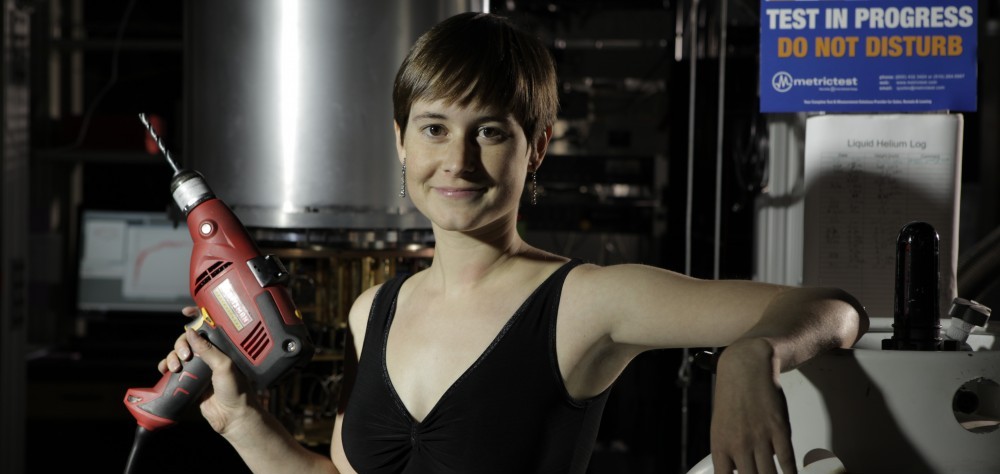
Emma Wollman, with her drill and black gown.

Emma Wollman, with her drill and black gown.

We had a meeting where we asked people to wear tuxes and gowns and pick the one item that they would take with them if Earth was to be evacuated; the one hobby, the one piece of identity. Initially there was paranoia, nerves and resistance, but then I cut a pitch tape to give an idea of my theme and style. They were getting convinced, but still not too sold on being so high fashion. So we met halfway. It was not the initial black, formal event attire, but it was still clean cut whilst being real, and frankly, a lot more personal in the end. People came up with very interesting stuff, whether it was Emma Wollman who held a drill and wore a gorgeous draped black gown she made herself (!), or Chen-Lung Hung, who played a violin in the Kimble lab, or Erik Henriksen with his long, lightsaber-looking device, or John Preskill with his baseball glove!

Image

John Preskill really likes baseball.

By putting them in the labs and their environments of science, but having a fashionable look, where they were lit especially to create distance from their environment thanks to the talented cinematography of Anthony C. Kuhnz, the shots became about the person more than the science in the labs, without completely separating them. It was their identity, but not all of it.

Another segment of the video that celebrates the power of “imagination and inspiration” is the inter-cutting of archival imagery of nature and science. Whether it is a ballerina’s spin bringing to life the spin of an atom, the probabilistic nature of the casino roulette metaphorizing the inherent indeterminism of nature, or water waves moving like a sine wave display in an oscilloscope, making the viewer aware that Physics is around us in ways that we might not even notice, is important. These juxtapositions with work that is being done here at Caltech may capture the eye of a new viewer who would initially react and say, “wait a minute…what does this have to do with science?” The video is supposed to be the hook, to  intrigue and confuse and question and answer and I hope it does all this and, maybe, a little more.

Image

A ballerina swiftly turns, hinting at quantum “spin”.

Of course, the punch to it all is the incredibly exciting and goose-bumping score by British composer, Andrew T. Mackay, part of the award-winning duo of Bombay Dub Orchestra, who, within a week, scored the video remotely from his Sunshine Desserts studio in London. Having worked with him on my feature film, we had developed a short-hand of what I like and it worked, within 9 days.

And all this crazy coordination and handling was thanks to Mrs. Marcia Brown who was always far too understanding and giving. She knows how to get us absent minded scientists and artists with our quirky moods and creative withdrawals, in line and on time to get the job done.

Lastly, I leave you with a few highlights of the video to urge you to click and watch and share. My favorite part of the video now, apart from Emma Wollman’s unbelievably attractive drill shot, is the beginning text that was a complete collaboration between me, Spiros and John Preskill with emails back and forth over a Wednesday in sunny Pasadena. Preskill’s genius tagline “nature is subtle” completely summarized my vision and the vision of IQIM and its scientists. The genius, the inspiration, the movement is all too important, yet subtle…and just purely “hot” in whatever sense of the word you want to take it!

Violinist

Chen-Lung Hung with his violin. The text written in collaboration with John Preskill.

Here is the intro text in the video:

There is mind
There is matter
There is motion
There is interaction
There is the universe
To understand
To change
There is you…and your imagination.

IQIM

Nature is subtle.

And now, without further ado, I present to you, the IQIM Promotional Film. Sit back, relax, enjoy and share!

Editor’s Note: Pakistani filmmaker, Iram Parveen Bilal is the CEO and Founder of Parveen Shah Productions, a film production company with offices in Pakistan and Los Angeles. Having made and distributed a few short films, she is currently touring with her noted first feature length film, JOSH (English title: Against the Grain). Bilal is a Caltech alum, BS ’04 with honors, in Environmental Science Engineering and has an MFA from the USC School of Cinematic Arts in Filmmaking. Recent awards and fellowships include the 2012 Women In Film Award, the USC Stark Special Project Award, the Thomas J. Watson Fellowship, the Paul Studenski Fellowship, the Caltech Mabel Beckman Leadership Award and the Caltech Dean’s Cup. 

De divina proportione

As a mathematician, I often wonder if life would have been easier were I born 2,400 years ago. Back then, all you had to do to become eternally famous was to show that 3^2+4^2=5^2 ( I am looking at you Πυθαγόρα!) OK, maybe I am not giving the Ancients enough credit. I mean, they didn’t have an iPhone back then, so they probably had to do 3^2+4^2 by hand. All kidding aside, they did generalize the previous equality to other large numbers like 12^2+5^2=13^2 (I am feeling a little sassy today, I guess.) Still, back then, mathematics did not start as an abstract subject about relations between numbers. It grew from a naive attempt to control elements of design that were essential to living, like building airplanes and plasma TVs. The Greeks didn’t succeed then and, if I am not mistaken, they still haven’t succeeded in making either airplanes, or plasma TVs. But, back then at least, my ancestors made some beautiful buildings. Like the Parthenon.

The Acropolis in Athens, GreeceThe temple of Athina (the Goddess of Wisdom, which gave her name to the city we now call Athens after a fierce contest with Poseidon – imagine flying into Poseidonia every time you visited Greece had she lost) was designed to be seen from far away and inspire awe in those who wished to conquer the city-state of Athens. But, those who were granted access to the space behind the doric columns, came face to face with the second divine woman to ever make Zeus stand in attention, whenever she met her dad on legendary Mt. Olympus: Αθηνά. And so, Φειδίας (Phidias), that most famous of ancient Greek sculptors, decided to immortalize Athina’s power with a magnificent statue, a tribute to the effortless grace with which she personified the wisdom of an ancient culture in harmony with the earth’s most precious gift – feta cheese.

Here she is, playing an invisible electric cello next to Yo-Yo Ma (also invisible).

Here she is, playing an invisible electric cello next to Yo-Yo Ma (also invisible). And yes, she liked to work out.

OK, I may be biased on this one. For Greeks, virgin olive oil and φέτα cheese go like peanut butter and jelly (I didn’t even know the last two went so well together, until I left Greece for the country of America!) Oh yeah, you are probably wondering what feta cheese and olive oil have to do with the Goddess of Wisdom. Well, how do you think she won over the Athenians, against Zeus’ almighty brother, Poseidon? The olive branch, of course. The sea is good and all (actually, the sea is pretty freakin’ amazing in Greece), but you can’t eat it with feta – you can preserve feta in brine (salt water), which is why Poseidon had a fighting chance in the first place – but, yeah, not good enough. Which brings us to the greatest rival, nay – nemesis, of the first letter with an identity crisis, \pi: The letter \phi. You are most likely familiar with the letter-number \pi = 3.1415925123\ldots (you may have even seen the modern classic, American Pie, a tour-de-force, honest look at the life of Pi. No pun intended.) But, what about the number 1.618033\ldots? Well, I could tell you all about this number, \phi, named after the sculptor dude above, but I ‘d rather you figure out its history on your own through this simple math problem:

The divine proportion: Does there exist a function f: \mathbb{N} \rightarrow \mathbb{N}, such that f(1)=2, f(f(n)) = f(n)+n and f(n) < f(n+1) for all n \in \mathbb{N}?

Καλή τύχη, μικροί μου Φιμπονάτσι!

QIP 2013 from the perspective of a greenhorn (grad student)

caltechCrew_qip2013

Most of Caltech’s contingent during QIP’s banquet. Not pictured: sword dancers, jug balancers and Gorjan.

A couple of weeks ago, about half of IQI (now part of IQIM) flew from Pasadena to Beijing in order to attend QIP 2013, the 16th annual workshop on quantum information processing. I wish I could report that the quantum information community solved the world’s problems over the past year, or at least built a 2^10 qubit universal quantum computer, but unfortunately, we’re not quite there yet. As a substitute, I’ll mention a few of the talks that I particularly enjoyed and the really hard open problems that they left us with.

The emphases of the talks mainly bifurcated towards computer science versus physics. I was better prepared to understand the talks emphasizing the latter, so my comments will mainly describe those talks. Patrick Hayden’s talk: “summoning information in spacetime: or where and when can a qubit be?” was one of my favorites. To the extent that I understood things, the goal of this work is to better understand how quantum information can propagate forward in time. If a qubit were created at spacetime location S, and then if it were forced to remain localized, the no-cloning theorem would give strict bounds regarding how it could move forward in time. The qubit would follow a worldline and that would be the end of things. However, qubits don’t need to remain localized, as teleportation experiments have pretty clearly demonstrated, and it therefore seems like qubits can propagate into the future in more subtle ways–ways that at face value appear to violate the no-cloning theorem. Patrick and the undergraduate that he worked with on this project, Alex May, came up with a pictorial approach to better understand these subtleties. The really hard open problems that these ideas could potentially be applied to include: firewalls, position-dependent quantum cryptography and to paradoxes concerning the apparent no-cloning violations near black hole event horizons.
Continue reading

Grad student life: high highs and low lows

Conference for Undergraduate Women in Physics, Caltech, 19 January 2013

Conference for Undergraduate Women in Physics, Caltech, 19 January 2013.

On January 18-20, Caltech was one of the host campuses for the annual Conference for Undergraduate Women in Physics. Nearly 200 women attended here, mostly physics majors from the western US. It was an exciting and fun event, packed with talks, panel discussions, lab tours, a poster session, and other activities.

One highlight was a screening of The PhD Movie, followed by a discussion with director Jorge Cham and the cast (real-life Caltech grad students Alex Lockwood and Crystal Dilworth, and undergrad Raj Katti). The movie, filmed on location at Caltech, provides a very funny look at the misery of graduate student life. You can get a pretty accurate impression of the movie’s tone by viewing the trailer. The discussion afterward featured poignant warnings about the pitfalls of graduate school, and emphasized the importance of having the right mentor.

I found myself reflecting on my own experience. Graduate school will sometimes deal grave blows to your self confidence, but it can also be a time of exhilarating intellectual growth. The highs are high but the lows are low.

One thing we try to do at Quantum Frontiers is provide a variety of perspectives on the graduate student experience by featuring our students as contributors. Today we’ll try something a bit different: a profile of grad student Debaleena Nandi from Caltech writer Ann Wendland.

Of Bravery, Support, and Breakthroughs
By Ann Wendland

Debaleena Nandi, in the lab as usual.

Debaleena Nandi, in the lab as usual.

In March 2008, a graduate student at the Indian Institute of Science (IISc) named Debaleena Nandi heard Caltech physics professor Jim Eisenstein give a series of lectures on two-dimensional systems of quantum electronic matter. “I was very keen to take a peek into his lab,” she says—so keen that, with a friend by her side for moral support, she walked up to Eisenstein and asked if she could join his group for the summer. Eisenstein had noted her smart questions during his talks and said he was open to the idea. Still, he was surprised when he returned to Caltech and found she’d e-mailed him. A few months later, Nandi rented an apartment in Pasadena and left India for the first time.

Continue reading

Unsolvable

mar-de-plata1

Why go swimming, if you can do math instead inside a room with no windows?

Back in 1997, during my visit to beautiful Mar del Plata in Argentina, I was asked to solve a math problem that I soon realized was close to being unsolvable. The setting was the Banquet for the 38th International Math Olympiad. I was 17 and there was delicious, free food in front of me, so it was pretty impossible to get my attention. Still, the coach of the Romanian team decided to drop by the Greek table to challenge us with the following problem:

Infinite Power: If x^{x^{x^{x^{\dots }}}} = 2, find x.

I was pretty hungry and a bit annoyed at the interruption (it is rude to eat and do math at the same time!), so I looked at the problem for a moment and then challenged him back with this one:

Infiniter Power: If x^{x^{x^{x^{\dots }}}} = 4, find x.

After a few moments, he looked at me with a puzzled look. He knew I had solved his problem within a few seconds, he was annoyed that I had somehow done it in my head and he was even more annoyed that I had challenged him back with a problem that confounded him.

Your mission, if you choose to accept it, is to figure out why the coach of the Romanian IMO team left our table alone for the rest of the competition.

Good luck!

PS: The rest of the Romanian team (the kids) were really cool. In fact, a few years later, I would hang out with a bunch of them at MIT’s Department of Mathematics, or as my older brother put it, The Asylum.

Science Magazine’s Breakthrough of 2012

A few nights ago, I attended Dr. Harvey B. Newman’s public lecture at Caltech titled: “Physics at the Large Hadron Collider: A New Window on Matter, Spacetime and the Universe.” The weekly quantum information group meeting finished early so that we could attend the lecture (Dr. Preskill’s group meeting lasted slightly longer than two hours: record brevity during the seven months that I’ve been a member!) We weren’t alone in deciding to attend this lecture. Seating on the ground floor of Beckman Auditorium was filled, so there were at least 800 people in attendance. Judging by the age of the audience, and from a few comments that I overheard, I estimate that a majority of the audience was unaffiliated with Caltech. Anyways, Dr. Newman’s inspiring lecture reminded me how lucky I am to be a graduate student at Caltech and it also clarified misconceptions surrounding the Large Hadron Collider (LHC), and the discovery of the Higgs, in particular.

Before mentioning some of the highlights of Dr. Newman’s lecture, I want to describe the atmosphere in the room leading up to the talk. A few minutes before the lecture began, I overheard a conversation between three women. It came up that one of the ladies is a Caltech physics graduate student. When I glanced over my shoulder, I recognized that the girl, Emily, is a friend of mine. She was talking to a mother and her high school-aged daughter who loves physics. It’s hard to describe the admiration that oozed from the mother’s face as she spoke with Emily–it was as if Emily provided a window into a future where her daughter’s dreams had come true. It brought back memories, from when I was in the high schooler’s position. As a scientifically-minded child growing up in Southern California, I dreamed of studying at Caltech, but it seemed like an impossible goal. I empathized with the high schooler and also with her mother, who reminded me of my own mom. Mom’s have a hopeless job: they’re genetically programmed to want the best for their children, but they oftentimes don’t have the means to make these dreams a reality. Especially when the child’s dream is to become a scientist. It’s a rare parent who understands the textbooks that an aspiring scientist consumes themselves with, and an even rarer parent, who can give their child an advantage when they enter the crapshoot that is undergraduate admissions. The angst of the conversation reminded me that I’m one of the lucky few whose childhood dreams have come true–it’s an opportunity that I don’t want to squander.

The conversation between two elderly men sitting next to me also brought back uncomfortable memories. They were trying to prove their intelligence to each other through an endless proceeding of anecdotes and physics observations. I empathized with them as well. Being at a place like Caltech is intimidating. As an outsider, you don’t have explicit credentials signaling that you belong, so you walk on eggshells, trying to prove how smart you are. I’ve seen this countless times, such as when I give tours to high schoolers, but it’s especially pronounced amongst incoming graduate students. However, it quickly fades as they become comfortable with their position. But to outsiders, every time they re-enter a hallowed place, their insecurities flood back. I know this because I was guilty of this! I spoke with the gentlemen for a while and they were incredibly nice, but smart as they were, they were momentarily insecure. Putting on my ambassador hat for a moment, if there are any ‘outsiders’ reading this blog, I want to say that I, for one, am glad that you attend events like this.
Continue reading