What does it mean for something to be Quantum? I have to confess, I don’t know. My Ph.D was in Robotics and Kinematics, so my neurons are deeply trained to think in terms of classical dynamics. I asked my siblings (two engineers and one architect) what comes to mind for them when they hear the word Quantum, what they remember from college physics, and here is what they said:
– “Quantum of Solace!” (the James Bond movie which, incidentally, was filmed in my home country of Panama, even though the movie was set in Bolivia)
– “I don’t remember anything I learned in college”
– “Light acting as a particle instead of a wave?”
The third answer came from my sister, who went to MIT. The fourth came from my brother, who went to Stanford (+1 point for Stanford!).
I also asked my spouse what comes to mind for her. She said, “Quantum Computing: it’s the next big advance in computers. Transistors the size of atoms.” Clearly, I married someone smarter than me (she also went to Stanford). When I asked if she knew how they worked, she said, “I don’t know how it works.” She also said, “Quantum is related to how time moves more slowly as you approach the speed of light, right?” Nice try, but that’s Relativity (-1 point for Stanford!).
I think the word Quantum has a special power in our collective consciousness. It’s used to convey science-iness, technology, the weirdness of the Physical world. If you Google “Quantum”, most of the top hits are for technology companies that have nothing to do with Quantum Physics (including Quantum Fishing Tackles. I suppose that half the time, you pull up a dead fish).
It’s one of those words that a lot of people have heard of, but very few really understand what it means. Which is why I was excited when Spiros Michalakis and IQIM approached me to produce a series of animations that explore and explain Quantum Information and Matter. Like my previous videos (The Higgs Boson, Dark Matter, Exoplanets), I’d have the chance to interview experts in this field and use their expertise and their voices to learn and to help others learn what amazing things lie just around the corner, beyond our classical understanding of the Universe.
This will be a big Leap for me (I’m trying to avoid the obvious pun), and a journey of exploration. The first installment goes live today, and you can watch it below. Like Schrödinger’s box, I don’t know what we’ll discover with these videos, but I know there are exciting possibilities inside. This is also going to be a BIG challenge. Understanding and putting Quantum concepts in visual form will be hard. I mean, Hair-pulling hard. Fortunately, I’ve discovered there’s a remedy for that.
Produced in Partnership with the Institute for Quantum Information and Matter (http://iqim.caltech.edu) at Caltech with funding provided by the National Science Foundation.
Transcription: Noel Dilworth
Thanks to: Spiros Michalakis, John Preskill and Bert Painter
Alone in his workroom, a student contemplates his future. Piles of books teeter next to him. Boxes line the walls; and glass vials, the boxes. Sunbeams that struggle through the stained-glass window illuminate dust.
The student’s name is Faust. I met him during my last winter in college, while complementing Physics 42: Introductory Quantum Mechanics with German 44: The Faust Tradition. A medieval German alchemist, Faust has inspired plays, novels, operas, the short story “The Devil and Daniel Webster” about an American Congressman, and the film “Bedazzled” starring Brendan Frasier.
The Faust tradition in popular culture. Mephistopheles is the demon who buys Faust’s soul. (http://xkcd.com/501/)
As I wondered what to pursue a PhD in, so (roughly speaking) did Faust. In plays by Christopher Marlowe and Johann Wolfgang von Goethe, Faust wavers among law, theology, philosophy, and medicine. You’ve probably heard what happens next: Faust chooses sorcery, conjures a demon, and bargains away his soul. Hardly the role model for a college student. I preferred to keep my soul, though Maxwell’s demon had stolen my heart.
A few decades after Goethe penned Faust, English physicist James Maxwell proposed a thought experiment. Consider a box divided into two rooms, he wrote, and a demon controlling the door between the rooms. Since others have explained Maxwell’s paradox, I won’t parrot them. Suffice to say, the demon helps clarify why time flows, what knowledge is, and how information relates to matter. Quantum-information physicists, I learned in a seminar after German 44, study Maxwell’s demon. Via the demon, experiment, and math, QI physicists study the whole world. I wanted to contemplate the whole world, like Goethe’s Faust. By studying QI, I might approximate my goal. Faust, almost as much as my QI seminar, convinced me to pursue a PhD in physics.
Fast forward two years. Someone must have misread my application, because Caltech let me sign my soul to its PhD program. I am the newest Preskillite. Or Preskillnik. Whichever term, if either, irks my supervisor more.
For five years, I will haunt this blog. (Spiros will haunt me if I don’t haunt it.) I’ll try to post one article per month. Pure quantum information occupies me usually: abstract math that encodes physical effects, like entropy (a key to why time flows), decoherence (a system’s transformation from quantum to ordinary), and entanglement (one particle’s ability to affect another, instantaneously, from across a room).
In case I wax poetic about algebra, I apologize in advance. Apologies if I write too many stories about particles in boxes. In addition to training a scientist’s lens on atoms, I enjoy training it on science, culture, and communities. Tune in for scientists’ uses (and abuses) of language, why physics captivates us, and the bittersweetness of representing half our species in a roomful of male physicists (advantage: I rarely wait in line to use a physics department’s bathroom).
As I prepare to move to Caltech, a Faust line keeps replaying in my mind. It encapsulates my impression of a PhD, though written 200 years ago: “Nothing I had; and yet, enough for youth—/ delight in fiction, and the thirst for truth.”
Pleasure to meet you, Quantum Frontiers. Drink with me.
Since I met Sean Carroll about a year ago, my life has changed for the better. In particular, I started following his wife @JenLucPiquant on Twitter and began reading her Scientific American blog, Cocktail Party Physics, a great place to get the latest news on physics – with a twist. Today, through one of Mrs. Ouellette’s RTs (re-tweets), I came across a fascinating article on Feynman, titled `Richard Feynman: Life, the universe and everything.‘
The article goes into some detail about the unusual life Feynman led, describing some of its high points without shying away from the idiosyncratic aspects of the master physicist’s life. Described in the article is this colorful animation that a graphic designer made of a brief excerpt from the now famous BBC interview of Feynman (The pleasure of finding things out):
As the Telegraph article describes, the little animation has gone viral, spreading the message that science actually adds to our ability to appreciate beauty in the world: Unlike popular belief would have us think, science is not dry, it is not cold, not clinical, or simply analytical, devoid of emotional impact on the ones that have devoted their lives to pursue it. Science is the one honest, brave (and obviously awesome) answer humanity has come up with to the burning question:
What just happened here?
The truth is that science always begins with the following answer: I don’t know. That is the honest part. Then comes the desire to know, otherwise known as curiosity. Whereas many of us will say of certain things: We can’t possibly know this, the scientist will say: I will try anyways. That is the brave part. Because some questions lead to answers that we don’t really want to accept – we are afraid that the answer may break something inside of us, something we invested time to construct, something we cherish, something important like the feeling of accomplishment for effortlessly appreciating the sublime beauty of a flower.
And then, of course, there is that thing about science being hard to do. It is. You can try to bs your way through science, and some do try, but then you might as well be a car salesman and make some good money in the process (actually, I met an honest car salesman just three weeks ago and I am still not sure what to make of it – he works for a Mini Cooper dealership in L.A. and that is all I am allowed to say in order to protect him and his family.)
But this is only half of the story…
The question that (too many) scientists are afraid to ask themselves is the following: What if my science doesn’t speak for itself? What if my science seems super-boring to others, or simply pointless (like studying fruit flies)? What if I actually need to go out into the unknown (the world that lies outside the Ivy Tower) in order to engage the public, to get the world excited about my discoveries?
Aristotle, the grandaddy of analytical thinking, wrote the most influential treatise on Rhetoric (the art of persuasion) for good reason. So here is my thesis: Every other Sunday morning, every church hosts a scientist to give a public lecture (no boring, arcane jargon allowed) on subjects ranging from the Big Bang Theory to the Theory of Evolution and Stem Cell research. No need to try to reconcile science with religion during the lecture, or be combative – just a good story based on scientific findings – let the audience decide if they want more. All I am saying is: Give it a try. Like pastors, there are scientists out there who love to tell a good story and provide some food for thought (and maybe raise some money from the parish for their good work). We can even use animations like the one above, or this one from PhD Comics.
Most readers of this blog already know that when it comes to physics, I am faking it. I am a mathematician, after all, and even that is a bit of a stretch. So, what force of nature could convince me to take graduate level Quantum Mechanics during my years of pursuing a doctorate in Applied Mathematics?
After graduating from MIT with a degree in Mathematics with Computer Science (18C), I found myself in the following predicament: I was about to start doing research on Quantum Computation as a PhD candidate at UC Davis’ Department of Mathematics, but I had taken exactly two physics courses since 9th grade (instead of Chemistry, Biology and Physics, I had no choice but to take Anthropology, Sociology and Philosophy throughout high school; which I blame for starting a fashion line…) The courses are well-known to MIT undergraduates – 8.01 (Classical Mechanics) and 8.02 (Electromagnetism) – since they are part of MIT’s General Institute Requirements (GIRs). Modesty and common sense should force me to say that I found the two MIT courses hard, but it would not be true. I remember getting back my 8.01 midterm exam on rocket dynamics with a score of 101%. I didn’t even know there was a bonus question, but I remember the look on my friend’s face when he saw my score and Prof. Walter Lewin announced that the average was 45%. It doesn’t take much more than that to make you cocky. So when my PhD adviser suggested years later that I take graduate Quantum Mechanics with no background in anything quantum, I accepted without worrying about the details too much – until the first day of class…
Prof. Ching-Yao Fong (Distinguished Professor of Physics at UC Davis) walked in with a stack of tests that were supposed to assess how much we had learned in our undergraduate quantum mechanics courses. I wrote my name and enjoyed 40 minutes of terror as it dawned on me that I would have to take years of physics to catch up with the requirements needed for any advanced quantum mechanics course. But out-of-state (worse, out-of-country) PhD students don’t have the luxury of time given the fact that we cost three times as much as in-state students to support (every UC is a public university). So I stayed in class and slowly learned to avoid the horrified looks of others (all Physics PhD candidates), whenever I asked an interesting question (thanks Dr. Fong), or made a non-sense remark during class. And then the miracle happened again. I aced the class. I have already discussed my superpower of super-stubbornness, but this was different. I actually had to learn stuff in order to do well in advanced quantum mechanics. I learned about particles in boxes, wavefunctions, equations governing the evolution of everything in the universe – the usual stuff. It was exhilarating, a whole new world, a dazzling place I never knew! In all my years at MIT, I never took notes on any of my classes and I continued the same “brilliant” tactic throughout my PhD, except for one class: Quantum Mechanics. I even used highlighters for the first time in my life!
It was a bonafide love affair.
Thinking about it years later, comfortable in my poly-amorous relationship with Paul Dirac (British), Werner Heisenberg (German), Erwin Schrödinger (Austrian) and Niels Bohr (Danish), I realize that some people may consider this love one-sided. Not true. Here is proof: Dirac himself teaching quantum mechanics like only he could.
Note: The intrepid Quantum Cardinal, Steve Flammia, scooped us again! Check out his post on the Dirac lectures and virtual hangouts for quantum computation lectures on Google+.
Last week was the final week of classes, and I brought my ph12b class, aka baby-quantum, to conclusion. Just like the last time I taught the class, I concluded with what should make the students honor the quantum gods – the EPR paradox and Bell’s inequality. Even before these common conundrums of quantum mechanics, the students had already picked up on the trouble with measurement theory and had started hammering me with questions on the “many-worlds interpretation”. The many-worlds interpretation, pioneered by Everett, stipulates that whenever a quantum measurement is made of a state in a quantum superposition, the universe will split into several copies where each possible result will be realized in one of the copies. All results come to pass, but if we are cats, in some universes, we won’t survive to meaow about it.
Questions on the many-worlds interpretation always make me think back to my early student days, when I also obsessed over these issues. In fact, I got so frustrated with the question, that I started having heretic thoughts: What if it is all in our minds? What if the quantum superposition is always there, but maybe evolution had consciousness always zoom in on one possible outcome. Maybe hunting a duck is just easier if the duck is not in a superposition of flying south and swimming in a pond. Of course, this requires that at least you and the duck, and probably other bystanders, all agree on which quantum reality it is that you are operating in. No problem – maybe evolution equipped all of our consciousnesses with the ability to zoom in on a common reality where all of us agree on the results of experiments, but there are other possibilities for this reality, which still live side by side to ‘our’ reality, since – hey – it’s all in our minds! Continue reading →
Have you seen the movie Frankenweenie? It’s a black and white cartoon (an experiment in itself these days) with a very important message:
Don’t be afraid to do what you love and don’t be afraid to be good at it.
The main character is a smart, sensitive kid who is ostracized for his science experiments. Like the teacher says, people don’t understand science so they are afraid of it. Ironically, artists often deal with the same kind of misunderstandings from the public.
I’m not technically a scientist, but I do love to experiment and try stuff. I’m a fashion designer, which requires it’s own level of scientific conviction. I create, combine unlikely variables, hypothesize, and work within my own scientific method throughout my process.
How does this relate to you?
Project X Squared. Where art, science, and technology meet fashion to create a clothing line, much like an experiment, with the underlying hypothesis being that a quantum physicist, a neuroscientist and a fashion designer can create something tangible together. Continue reading →
As an undergraduate, I took Introduction to Algorithms from Ron Rivest. One of the topics he taught was the RSA public-key cryptosystem which he had created with Adi Shamir and Leonard Adleman. At the time, RSA was only about a decade old, yet already one of the banner creations of computer science. Today many of us rely on it routinely for the security of banking transactions. The internet would not be the same without it and its successors (such as elliptic curve cryptography, ECC). However, as you may have heard, quantum computation spells change for cryptography. Today I’ll tell a little of this story and talk about prospects for the future.
Ron Rivest
What is public-key cryptography (PKC)? The basic notion is due to Ralph Merkle in 1974 and (in a stronger form) to Whitfield Diffie and Martin Hellman in 1976. Their remarkable proposal was that two parties, “Alice” and “Bob”, could cooperate in cryptographic protocols, even if they had never met before. All prior cryptography, from the ancients up through and after the cryptographic adventures of WWII, had relied on the cooperating parties sharing in advance some “secret key” that gave them an edge over any eavesdropper “Eve”. Continue reading →
Arthur Wightman passed away this past January, at age 90. He was one of the great mathematical physicists of the past century.
Two of Arthur’s most renowned students, Arthur Jaffe and Barry Simon, wrote an affectionate obituary. I thought I would add some reminiscences of my own — Wightman was my undergraduate thesis advisor at Princeton.
I loved math in high school, and like many high school students before and since, I became convinced that Gödel’s incompleteness theorem is the coolest insight ever produced by the human mind. I resolved to devote my life to set theory and logic, and somehow I also became convinced that Princeton would be the best place in the world to study the subject. So there I went. I had a plan.
As a freshman, I talked my way into a graduate level course on Advanced Logic taught by Dana Scott. (I cleared the biggest obstacle by writing an essay to pass out of the freshman English requirement.) The course was wonderful, but by the end of it I was starting to accept what I had already sensed while in high school — I lack the talent to be a great mathematician.
A door was closing, but meanwhile another was opening. I was also taking a course on Electricity and Magnetism, based on the extraordinary book by Ed Purcell, taught by the charismatic Val Fitch. Chapter 5 contains an unforgettable argument explaining how electrostatic forces combined with special relativity imply magnetic forces. Meanwhile, while learning advanced calculus from the lovely (but challenging) little book by Michael Spivak, I realized that the Maxwell field is actually a two-form! Physics can be almost as cool as logic, so I would be a physics major! I had a new plan.
Of course they aren’t geeks! That was it…the whole purpose was to crack the image of the so-called “geek”. Having known that, since I was a Caltech alum turned filmmaker, I would get the stereotype and know the culture, Spiros came up to me 6 months ago and asked me if I could create a set of videos for outreach. These would be targeted towards getting high school kids more interested in science. Another facet of the videos would be to celebrate what we do here at Caltech and present it to be as “cool” as it really is. That began the talk of how many American kids these days stereotype science to be nerdy and “uncool”. With the recent advent of shows like Numb3rs and The Big Bang Theory, it is becoming more hip and popular to be a quintessential “nerd” or “geek”, but still a lot more work needs to be done to translate this effect into increasing the numbers of enrollment in science degrees. In a world where cultural slang is spoken more than language, we just can’t escape those titles of “nerd” or “geek”. Those terms often have negative connotations, but if we really look them up in a dictionary, this is what we get for “geek”: an enthusiast, or expert, especially in a technological field or activity. Now that isn’t so bad, is it?
So, we began with touring some of the labs of the agreeing advisors in the IQIM division, who were fine with a huge camera, a dolly track for movement and a couple of non-science strangers, namely our film crew, in their sensitive, experiment-running labs. I started meeting with the postdocs and grad students and not surprisingly, they inspired me. We realized that we wanted to celebrate the people behind the science and not the science, in this video. The science is known and celebrated in so many other avenues. It was about the scientists and how they did all these amazing things in addition to their scientific pursuits and oh, by the way, they did do some serious science too. To me, it was about making a more 3-D vision of the “nerdspace” out there in media for science and engineers. Breaking the identity that if you are a scientist, you are boring and all you do is work in the lab. What could have been the most risqué representation I thought… bingo: High Fashion! And then came the convincing…
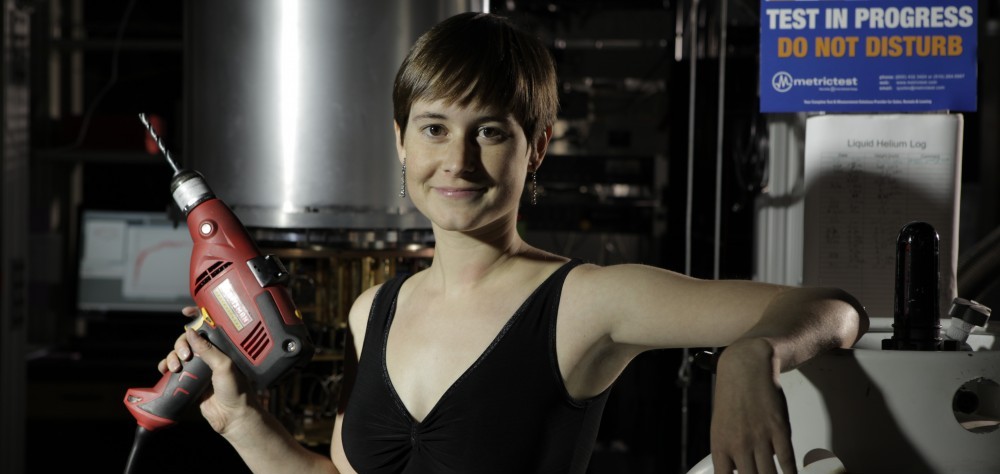
Emma Wollman, with her drill and black gown.
We had a meeting where we asked people to wear tuxes and gowns and pick the one item that they would take with them if Earth was to be evacuated; the one hobby, the one piece of identity. Initially there was paranoia, nerves and resistance, but then I cut a pitch tape to give an idea of my theme and style. They were getting convinced, but still not too sold on being so high fashion. So we met halfway. It was not the initial black, formal event attire, but it was still clean cut whilst being real, and frankly, a lot more personal in the end. People came up with very interesting stuff, whether it was Emma Wollman who held a drill and wore a gorgeous draped black gown she made herself (!), or Chen-Lung Hung, who played a violin in the Kimble lab, or Erik Henriksen with his long, lightsaber-looking device, or John Preskill with his baseball glove!
John Preskill really likes baseball.
By putting them in the labs and their environments of science, but having a fashionable look, where they were lit especially to create distance from their environment thanks to the talented cinematography of Anthony C. Kuhnz, the shots became about the person more than the science in the labs, without completely separating them. It was their identity, but not all of it.
Another segment of the video that celebrates the power of “imagination and inspiration” is the inter-cutting of archival imagery of nature and science. Whether it is a ballerina’s spin bringing to life the spin of an atom, the probabilistic nature of the casino roulette metaphorizing the inherent indeterminism of nature, or water waves moving like a sine wave display in an oscilloscope, making the viewer aware that Physics is around us in ways that we might not even notice, is important. These juxtapositions with work that is being done here at Caltech may capture the eye of a new viewer who would initially react and say, “wait a minute…what does this have to do with science?” The video is supposed to be the hook, to intrigue and confuse and question and answer and I hope it does all this and, maybe, a little more.
A ballerina swiftly turns, hinting at quantum “spin”.
Of course, the punch to it all is the incredibly exciting and goose-bumping score by British composer, Andrew T. Mackay, part of the award-winning duo of Bombay Dub Orchestra, who, within a week, scored the video remotely from his Sunshine Desserts studio in London. Having worked with him on my feature film, we had developed a short-hand of what I like and it worked, within 9 days.
And all this crazy coordination and handling was thanks to Mrs. Marcia Brown who was always far too understanding and giving. She knows how to get us absent minded scientists and artists with our quirky moods and creative withdrawals, in line and on time to get the job done.
Lastly, I leave you with a few highlights of the video to urge you to click and watch and share. My favorite part of the video now, apart from Emma Wollman’s unbelievably attractive drill shot, is the beginning text that was a complete collaboration between me, Spiros and John Preskill with emails back and forth over a Wednesday in sunny Pasadena. Preskill’s genius tagline “nature is subtle” completely summarized my vision and the vision of IQIM and its scientists. The genius, the inspiration, the movement is all too important, yet subtle…and just purely “hot” in whatever sense of the word you want to take it!
Chen-Lung Hung with his violin. The text written in collaboration with John Preskill.
Here is the intro text in the video:
There is mind
There is matter
There is motion
There is interaction
There is the universe
To understand
To change
There is you…and your imagination.
IQIM
Nature is subtle.
And now, without further ado, I present to you, the IQIM Promotional Film. Sit back, relax, enjoy and share!
Editor’s Note:Pakistani filmmaker, Iram Parveen Bilal is the CEO and Founder of Parveen Shah Productions, a film production company with offices in Pakistan and Los Angeles. Having made and distributed a few short films, she is currently touring with her noted first feature length film, JOSH (English title: Against the Grain). Bilal is a Caltech alum, BS ’04 with honors, in Environmental Science Engineering and has an MFA from the USC School of Cinematic Arts in Filmmaking. Recent awards and fellowships include the 2012 Women In Film Award, the USC Stark Special Project Award, the Thomas J. Watson Fellowship, the Paul Studenski Fellowship, the Caltech Mabel Beckman Leadership Award and the Caltech Dean’s Cup.
As a mathematician, I often wonder if life would have been easier were I born 2,400 years ago. Back then, all you had to do to become eternally famous was to show that ( I am looking at you Πυθαγόρα!) OK, maybe I am not giving the Ancients enough credit. I mean, they didn’t have an iPhone back then, so they probably had to do by hand. All kidding aside, they did generalize the previous equality to other large numbers like (I am feeling a little sassy today, I guess.) Still, back then, mathematics did not start as an abstract subject about relations between numbers. It grew from a naive attempt to control elements of design that were essential to living, like building airplanes and plasma TVs. The Greeks didn’t succeed then and, if I am not mistaken, they still haven’t succeeded in making either airplanes, or plasma TVs. But, back then at least, my ancestors made some beautiful buildings. Like the Parthenon.
The temple of Athina (the Goddess of Wisdom, which gave her name to the city we now call Athens after a fierce contest with Poseidon – imagine flying into Poseidonia every time you visited Greece had she lost) was designed to be seen from far away and inspire awe in those who wished to conquer the city-state of Athens. But, those who were granted access to the space behind the doric columns, came face to face with the second divine woman to ever make Zeus stand in attention, whenever she met her dad on legendary Mt. Olympus: Αθηνά. And so, Φειδίας (Phidias), that most famous of ancient Greek sculptors, decided to immortalize Athina’s power with a magnificent statue, a tribute to the effortless grace with which she personified the wisdom of an ancient culture in harmony with the earth’s most precious gift – feta cheese.
Here she is, playing an invisible electric cello next to Yo-Yo Ma (also invisible). And yes, she liked to work out.
OK, I may be biased on this one. For Greeks, virgin olive oil and φέτα cheese go like peanut butter and jelly (I didn’t even know the last two went so well together, until I left Greece for the country of America!) Oh yeah, you are probably wondering what feta cheese and olive oil have to do with the Goddess of Wisdom. Well, how do you think she won over the Athenians, against Zeus’ almighty brother, Poseidon? The olive branch, of course. The sea is good and all (actually, the sea is pretty freakin’ amazing in Greece), but you can’t eat it with feta – you can preserve feta in brine (salt water), which is why Poseidon had a fighting chance in the first place – but, yeah, not good enough. Which brings us to the greatest rival, nay – nemesis, of the first letter with an identity crisis, : The letter . You are most likely familiar with the letter-number (you may have even seen the modern classic, American Pie, a tour-de-force, honest look at the life of Pi. No pun intended.) But, what about the number ? Well, I could tell you all about this number, , named after the sculptor dude above, but I ‘d rather you figure out its history on your own through this simple math problem:
The divine proportion: Does there exist a function , such that , and for all ?