We are all Wilsonians now

Ken Wilson

Ken Wilson

Ken Wilson passed away on June 15 at age 77. He changed how we think about physics.

Renormalization theory, first formulated systematically by Freeman Dyson in 1949, cured the flaws of quantum electrodynamics and turned it into a precise computational tool. But the subject seemed magical and mysterious. Many physicists, Dirac prominently among them, questioned whether renormalization rests on a sound foundation.

Wilson changed that.

The renormalization group concept arose in an extraordinary paper by Gell-Mann and Low in 1954. It was embraced by Soviet physicists like Bogoliubov and Landau, and invoked by Landau to challenge the consistency of quantum electrodynamics. But it was an abstruse and inaccessible topic, as is well illustrated by the baffling discussion at the very end of the two-volume textbook by Bjorken and Drell.

Wilson changed that, too.

Ken Wilson turned renormalization upside down. Dyson and others had worried about the “ultraviolet divergences” occurring in Feynman diagrams. They introduced an artificial cutoff on integrations over the momenta of virtual particles, then tried to show that all the dependence on the cutoff can be eliminated by expressing the results of computations in terms of experimentally accessible quantities. It required great combinatoric agility to show this trick works in electrodynamics. In other theories, notably including general relativity, it doesn’t work.

Wilson adopted an alternative viewpoint. Take the short-distance cutoff seriously, he said, regarding it as part of the physical formulation of the field theory. Now ask what physics looks like at distances much larger than the cutoff. Wilson imagined letting the short-distance cutoff grow, while simultaneously adjusting the theory to preserve its low-energy predictions. This procedure sounds complicated, but Wilson discovered something wonderful — for the purpose of computing low-energy processes the theory becomes remarkably simple, completely characterized by just a few (renormalized) parameters. One recovers Dyson’s results plus much more, while also acquiring a rich and visually arresting physical picture of what is going on.

When I started graduate school in 1975, Wilson, not yet 40, was already a legend. Even Sidney Coleman, for me the paragon of razor sharp intellect, seemed to regard Wilson with awe. (They had been contemporaries at Caltech, both students of Murray Gell-Mann.) It enhanced the legend that Wilson had been notoriously slow to publish. He spent years pondering the foundations of quantum field theory before finally unleashing a torrent of revolutionary papers in the early 70s. Cornell had the wisdom to grant tenure despite Wilson’s unusually low productivity during the 60s.

As a student, I spent countless hours struggling through Wilson’s great papers, some of which were quite difficult. One introduced me to the operator product expansion, which became a workhorse of high-energy scattering theory and the foundation of conformal field theory. Another considered all the possible ways that renormalization group fixed points could control the high-energy behavior of the strong interactions. Conspicuously missing from the discussion was what turned out to be the correct idea — asymptotic freedom. Wilson had not overlooked this possibility; instead he “proved” it to be impossible. The proof contains a subtle error. Wilson analyzed charge renormalization invoking both Lorentz covariance and positivity of the Hilbert space metric, forgetting that gauge theories admit no gauge choice with both properties. Even Ken Wilson made mistakes.

Wilson also formulated the strong-coupling expansion of lattice gauge theory, and soon after pioneered the Euclidean Monte Carlo method for computing the quantitative non-perturbative predictions of quantum chromodynamics, which remains today an extremely active and successful program. But of the papers by Wilson I read while in graduate school, the most exciting by far was this one about the renormalization group. Toward the end of the paper Wilson discussed how to formulate the notion of the “continuum limit” of a field theory with a cutoff. Removing the short-distance cutoff is equivalent to taking the limit in which the correlation length (the inverse of the renormalized mass) is infinitely long compared to the cutoff — the continuum limit is a second-order phase transition. Wilson had finally found the right answer to the decades-old question, “What is quantum field theory?” And after reading his paper, I knew the answer, too! This Wilsonian viewpoint led to further deep insights mentioned in the paper, for example that an interacting self-coupled scalar field theory is unlikely to exist (i.e. have a continuum limit) in four spacetime dimensions.

Wilson’s mastery of quantum field theory led him to another crucial insight in the 1970s which has profoundly influenced physics in the decades since — he denigrated elementary scalar fields as unnatural. I learned about this powerful idea from an inspiring 1979 paper not by Wilson, but by Lenny Susskind. That paper includes a telltale acknowledgment: “I would like to thank K. Wilson for explaining the reasons why scalar fields require unnatural adjustments of bare constants.”

Susskind, channeling Wilson, clearly explains a glaring flaw in the standard model of particle physics — ensuring that the Higgs boson mass is much lighter than the Planck (i.e., cutoff) scale requires an exquisitely careful tuning of the theory’s bare parameters. Susskind proposed to banish the Higgs boson in favor of Technicolor, a new strong interaction responsible for breaking the electroweak gauge symmetry, an idea I found compelling at the time. Technicolor fell into disfavor because it turned out to be hard to build fully realistic models, but Wilson’s complaint about elementary scalars continued to drive the quest for new physics beyond the standard model, and in particular bolstered the hope that low-energy supersymmetry (which eases the fine tuning problem) will be discovered at the Large Hadron Collider. Both dark energy (another fine tuning problem) and the absence so far of new physics beyond the HIggs boson at the LHC are prompting some soul searching about whether naturalness is really a reliable criterion for evaluating success in physical theories. Could Wilson have steered us wrong?

Wilson’s great legacy is that we now regard nearly every quantum field theory as an effective field theory. We don’t demand or expect that the theory will continue working at arbitrarily short distances. At some stage it will break down and be replaced by a more fundamental description. This viewpoint is now so deeply ingrained in how we do physics that today’s students may be surprised to hear it was not always so. More than anyone else, we have Ken Wilson to thank for this indispensable wisdom. Few ideas have changed physics so much.

Don’t sweat the epsilons…and it’s all epsilons

I’d come to Barnes and Noble to study and to submerse in the bustle. I needed reminding that humans other than those on my history exam existed. When I ran out of tea and of names to review, I stood, stretched, and browsed the shelves. A blue-bound book caught my eye: Don’t Sweat the Small Stuff…and it’s all small stuff.

Richard Carlson wrote that book for people like me. We have packing lists, grocery lists, and laundry lists of to-do lists. We transcribe lectures. We try to rederive equations that we should just use. Call us “detail-oriented”; call us “conscientious”; we’re boring as toast, and we have earlier bedtimes. When urged to relax, we try. We might not succeed, but we try hard.

For example, I do physics instead of math. Mathematicians agonize over what-ifs: “What if this bit of the fraction reaches one while that bit goes negative and the other goes loop-the-loop? We’d be dividing by zero!” Divisions by zero atom-bomb calculations. Since dividing by a tiny number amounts to multiplying by a large number, dividing by zero amounts to multiplying by infinity. While mathematicians chew their nails over infinities, physicists often assume we needn’t. We use math to represent physical systems like pendulums and ponytails.1 Ponytails have properties, like lacking infinite masses, that don’t smack of the apocalypse. Since those properties don’t, neither does the math that represents those properties. To justify assumptions that our math “behaves nicely,” we use the jargon, “the field goes to zero at the boundary,” “the coupling’s renormalized,” and “it worked last time.”

I tried not to sweat the small stuff. I tried to shrug off the question marks at calculations’ edges. Sometimes, I succeeded. Then I began a Masters thesis about epsilons.

Self-help for calculus addicts.

In many physics problems, the Greek letter epsilon (ε) means “-ish.” The butcher sold you epsilon-close to a pound of beef? He tipped the scale a tad in your favor. Your temperature dropped from 103 to epsilon-close to normal? Stay in bed this afternoon, and you should recover by tomorrow.

For half a year, I’ve used epsilons to describe transformations between quantum states. To visualize the transformations, say you have a fistful of coins. Each coin consists of gold and aluminum. The portion of the coin that’s gold varies from coin to coin. I want a differently-sized fistful of coins, each with a certain gold content. After melting down your fistful, can you cast the fistful I want? Can you cast a fistful that’s epsilon-close to the fistful I want? I calculated answers to those questions, after substituting “quantum states” for “fistfuls” and a property called “purity” for “gold.”2

You might expect epsilon-close conversions to require less effort than exact conversions: Butchers weigh out approximately a pound of beef more quickly than they weigh a pound. But epsilon-close math requires more effort than exact math. Introducing epsilons into calculations, you introduce another number to keep track of. As that number approaches zero, approximate conversions become exact. If that number approaches zero while in a denominator, you atom-bomb calculations with infinities. The infinities remind me of geysers in a water park of quantum theory.

Have you visited a water park where geysers erupt every few minutes? Have you found a geyser head that looks dead, and crouched to check it? Epsilons resemble dead-looking geyser heads. Just as geyser heads rise only inches from the ground, epsilons have values close to zero. Say you’ve divided by epsilon, and you’re lowering its value to naught. Hitch up your swimsuit, lower your head, and squint at the faucet. Farther you crouch, and farther, till SPLAT! Water shoots up your left nostril.

Infinities have been shooting up my left nostril for months.

Rocking back on your heels, you need a towel. Dividing by an epsilon that approaches zero, I need an advisor. An advisor who knows mounds of calculus, who corrects without crushing, and who doesn’t mind my bombarding him with questions once a week. I have one, thank goodness—an advisor, not a towel.3 I wouldn’t trade him for fifty fistfuls of gold coins.

Towel in hand, I tiptoed through the water park of epsilons. I learned how quickly geysers erupt, where they appear, and how to disable some. I learned about smoothed distributions, limits superior, and Asymptotic Equipartition Properties. Though soaked after crossing the park, I survived. I submitted my thesis last week. And I have the right—should I find the chutzpah—to toss off the word “epsilonification” like a spelling-bee champ.

Had I not sweated the epsilons, I wouldn’t have finished the thesis. Should I discard Richard Carlson’s advice? I can’t say, having returned to my history review instead of reading his book. But I don’t view epsilons as troubles to sweat or not. Why not view epsilons as geysers in the water park of quantum theory? Who doesn’t work up a sweat in a park? But I wouldn’t rather leave. And maybe—if enough geysers shoot up our left nostrils—we’ll learn a smidgeon about Old Faithful.

1 I’m not kidding about ponytails.

2 Quantum whizzes: I explored a resource theory like that of pure bipartite entanglement (e.g., http://arxiv.org/abs/quant-ph/9811053). Instead of entanglement or gold, nonuniformity (distance from the maximally mixed state) is a scarce resource. The uniform (maximally mixed state) has no worth, like aluminum. This “resource theory of nonuniformity” models thermodynamic systems whose Hamiltonians are trivial (H = 0).

3 Actually, I have two advisors, and I’m grateful for both. But one helped cure my epsilons. N.B. I have not begun working at Caltech.

Quantum Matter Animated!

by Jorge Cham

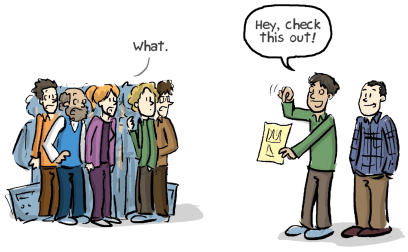
What does it mean for something to be Quantum? I have to confess, I don’t know. My Ph.D was in Robotics and Kinematics, so my neurons are deeply trained to think in terms of classical dynamics. I asked my siblings (two engineers and one architect) what comes to mind for them when they hear the word Quantum, what they remember from college physics, and here is what they said:

– “Quantum Leap!” (the late 80’s TV show)

– “Quantum of Solace!” (the James Bond movie which, incidentally, was filmed in my home country of Panama, even though the movie was set in Bolivia)

– “I don’t remember anything I learned in college”

– “Light acting as a particle instead of a wave?”

The third answer came from my sister, who went to MIT. The fourth came from my brother, who went to Stanford (+1 point for Stanford!).

Screen Shot 2013-06-11 at 12.15.21 AM

I also asked my spouse what comes to mind for her. She said, “Quantum Computing: it’s the next big advance in computers. Transistors the size of atoms.” Clearly, I married someone smarter than me (she also went to Stanford). When I asked if she knew how they worked, she said, “I don’t know how it works.” She also said, “Quantum is related to how time moves more slowly as you approach the speed of light, right?” Nice try, but that’s Relativity (-1 point for Stanford!).

I think the word Quantum has a special power in our collective consciousness. It’s used to convey science-iness, technology, the weirdness of the Physical world. If you Google “Quantum”, most of the top hits are for technology companies that have nothing to do with Quantum Physics (including Quantum Fishing Tackles. I suppose that half the time, you pull up a dead fish).

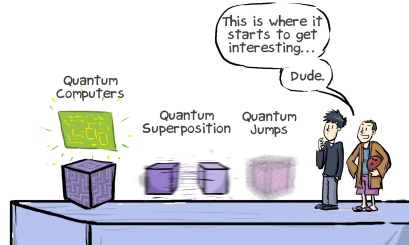
It’s one of those words that a lot of people have heard of, but very few really understand what it means. Which is why I was excited when Spiros Michalakis and IQIM approached me to produce a series of animations that explore and explain Quantum Information and Matter. Like my previous videos (The Higgs Boson, Dark Matter, Exoplanets), I’d have the chance to interview experts in this field and use their expertise and their voices to learn and to help others learn what amazing things lie just around the corner, beyond our classical understanding of the Universe.

Screen Shot 2013-06-11 at 12.16.55 AM

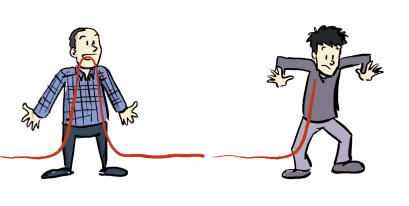
This will be a big Leap for me (I’m trying to avoid the obvious pun), and a journey of exploration. The first installment goes live today, and you can watch it below. Like Schrödinger’s box, I don’t know what we’ll discover with these videos, but I know there are exciting possibilities inside. This is also going to be a BIG challenge. Understanding and putting Quantum concepts in visual form will be hard. I mean, Hair-pulling hard. Fortunately, I’ve discovered there’s a remedy for that.

Screen Shot 2013-06-11 at 12.17.20 AM

Watch the first installment of this series:

Jorge Cham is the creator of Piled Higher and Deeper (www.phdcomics.com).

CREDITS:

Featuring: Amir Safavi-Naeini and Oskar Painter http://copilot.caltech.edu/

Produced in Partnership with the Institute for Quantum Information and Matter (http://iqim.caltech.edu) at Caltech with funding provided by the National Science Foundation.

Transcription: Noel Dilworth
Thanks to: Spiros Michalakis, John Preskill and Bert Painter

“Nature, you instruct me.”

“Settle thy studies.”

Alone in his workroom, a student contemplates his future. Piles of books teeter next to him. Boxes line the walls; and glass vials, the boxes. Sunbeams that struggle through the stained-glass window illuminate dust.

The student’s name is Faust. I met him during my last winter in college, while complementing Physics 42: Introductory Quantum Mechanics with German 44: The Faust Tradition. A medieval German alchemist, Faust has inspired plays, novels, operas, the short story “The Devil and Daniel Webster” about an American Congressman, and the film “Bedazzled” starring Brendan Frasier.

Image

The Faust tradition in popular culture. Mephistopheles is the demon who buys Faust’s soul. (http://xkcd.com/501/)

As I wondered what to pursue a PhD in, so (roughly speaking) did Faust. In plays by Christopher Marlowe and Johann Wolfgang von Goethe, Faust wavers among law, theology, philosophy, and medicine. You’ve probably heard what happens next: Faust chooses sorcery, conjures a demon, and bargains away his soul. Hardly the role model for a college student. I preferred to keep my soul, though Maxwell’s demon had stolen my heart.

A few decades after Goethe penned Faust, English physicist James Maxwell proposed a thought experiment. Consider a box divided into two rooms, he wrote, and a demon controlling the door between the rooms. Since others have explained Maxwell’s paradox, I won’t parrot them. Suffice to say, the demon helps clarify why time flows, what knowledge is, and how information relates to matter. Quantum-information physicists, I learned in a seminar after German 44, study Maxwell’s demon. Via the demon, experiment, and math, QI physicists study the whole world. I wanted to contemplate the whole world, like Goethe’s Faust. By studying QI, I might approximate my goal. Faust, almost as much as my QI seminar, convinced me to pursue a PhD in physics.

Fast forward two years. Someone must have misread my application, because Caltech let me sign my soul to its PhD program. I am the newest Preskillite. Or Preskillnik. Whichever term, if either, irks my supervisor more.

For five years, I will haunt this blog. (Spiros will haunt me if I don’t haunt it.) I’ll try to post one article per month. Pure quantum information occupies me usually: abstract math that encodes physical effects, like entropy (a key to why time flows), decoherence (a system’s transformation from quantum to ordinary), and entanglement (one particle’s ability to affect another, instantaneously, from across a room).

In case I wax poetic about algebra, I apologize in advance. Apologies if I write too many stories about particles in boxes. In addition to training a scientist’s lens on atoms, I enjoy training it on science, culture, and communities. Tune in for scientists’ uses (and abuses) of language, why physics captivates us, and the bittersweetness of representing half our species in a roomful of male physicists (advantage: I rarely wait in line to use a physics department’s bathroom).

As I prepare to move to Caltech, a Faust line keeps replaying in my mind. It encapsulates my impression of a PhD, though written 200 years ago: “Nothing I had; and yet, enough for youth—/ delight in fiction, and the thirst for truth.”

Pleasure to meet you, Quantum Frontiers. Drink with me.

The Feynman flower

Since I met Sean Carroll about a year ago, my life has changed for the better. In particular, I started following his wife @JenLucPiquant on Twitter and began reading her Scientific American blog, Cocktail Party Physics, a great place to get the latest news on physics – with a twist. Today, through one of Mrs. Ouellette’s RTs (re-tweets), I came across a fascinating article on Feynman, titled `Richard Feynman: Life, the universe and everything.

The article goes into some detail about the unusual life Feynman led, describing some of its high points without shying away from the idiosyncratic aspects of the master physicist’s life. Described in the article is this colorful animation that a graphic designer made of a brief excerpt from the now famous BBC interview of Feynman (The pleasure of finding things out):

As the Telegraph article describes, the little animation has gone viral, spreading the message that science actually adds to our ability to appreciate beauty in the world: Unlike popular belief would have us think, science is not dry, it is not cold, not clinical, or simply analytical, devoid of emotional impact on the ones that have devoted their lives to pursue it. Science is the one honest, brave (and obviously awesome) answer humanity has come up with to the burning question:

What just happened here?

The truth is that science always begins with the following answer: I don’t know. That is the honest part. Then comes the desire to know, otherwise known as curiosity. Whereas many of us will say of certain things: We can’t possibly know this, the scientist will say: I will try anyways. That is the brave part. Because some questions lead to answers that we don’t really want to accept – we are afraid that the answer may break something inside of us, something we invested time to construct, something we cherish, something important like the feeling of accomplishment for effortlessly appreciating the sublime beauty of a flower.

And then, of course, there is that thing about science being hard to do. It is. You can try to bs your way through science, and some do try, but then you might as well be a car salesman and make some good money in the process (actually, I met an honest car salesman just three weeks ago and I am still not sure what to make of it – he works for a Mini Cooper dealership in L.A. and that is all I am allowed to say in order to protect him and his family.)

But this is only half of the story…

The question that (too many) scientists are afraid to ask themselves is the following: What if my science doesn’t speak for itself? What if my science seems super-boring to others, or simply pointless (like studying fruit flies)? What if I actually need to go out into the unknown (the world that lies outside the Ivy Tower) in order to engage the public, to get the world excited about my discoveries?

Aristotle, the grandaddy of analytical thinking, wrote the most influential treatise on Rhetoric (the art of persuasion) for good reason. So here is my thesis: Every other Sunday morning, every church hosts a scientist to give a public lecture (no boring, arcane jargon allowed) on subjects ranging from the Big Bang Theory to the Theory of Evolution and Stem Cell research. No need to try to reconcile science with religion during the lecture, or be combative – just a good story based on scientific findings – let the audience decide if they want more. All I am saying is: Give it a try. Like pastors, there are scientists out there who love to tell a good story and provide some food for thought (and maybe raise some money from the parish for their good work). We can even use animations like the one above, or this one from PhD Comics.

What do you think?

An unlikely love affair

Most readers of this blog already know that when it comes to physics, I am faking it. I am a mathematician, after all, and even that is a bit of a stretch. So, what force of nature could convince me to take graduate level Quantum Mechanics during my years of pursuing a doctorate in Applied Mathematics?

After graduating from MIT with a degree in Mathematics with Computer Science (18C), I found myself in the following predicament: I was about to start doing research on Quantum Computation as a PhD candidate at UC Davis’ Department of Mathematics, but I had taken exactly two physics courses since 9th grade (instead of Chemistry, Biology and Physics, I had no choice but to take Anthropology, Sociology and Philosophy throughout high school; which I blame for starting a fashion line…) The courses are well-known to MIT undergraduates – 8.01 (Classical Mechanics) and 8.02 (Electromagnetism) – since they are part of MIT’s General Institute Requirements (GIRs). Modesty and common sense should force me to say that I found the two MIT courses hard, but it would not be true. I remember getting back my 8.01 midterm exam on rocket dynamics with a score of 101%. I didn’t even know there was a bonus question, but I remember the look on my friend’s face when he saw my score and Prof. Walter Lewin announced that the average was 45%. It doesn’t take much more than that to make you cocky. So when my PhD adviser suggested years later that I take graduate Quantum Mechanics with no background in anything quantum, I accepted without worrying about the details too much – until the first day of class…

Prof. Ching-Yao Fong (Distinguished Professor of Physics at UC Davis) walked in with a stack of tests that were supposed to assess how much we had learned in our undergraduate quantum mechanics courses. I wrote my name and enjoyed 40 minutes of terror as it dawned on me that I would have to take years of physics to catch up with the requirements needed for any advanced quantum mechanics course. But out-of-state (worse, out-of-country) PhD students don’t have the luxury of time given the fact that we cost three times as much as in-state students to support (every UC is a public university). So I stayed in class and slowly learned to avoid the horrified looks of others (all Physics PhD candidates), whenever I asked an interesting question (thanks Dr. Fong), or made a non-sense remark during class. And then the miracle happened again. I aced the class. I have already discussed my superpower of super-stubbornness, but this was different. I actually had to learn stuff in order to do well in advanced quantum mechanics. I learned about particles in boxes, wavefunctions, equations governing the evolution of everything in the universe – the usual stuff. It was exhilarating, a whole new world, a dazzling place I never knew! In all my years at MIT, I never took notes on any of my classes and I continued the same “brilliant” tactic throughout my PhD, except for one class: Quantum Mechanics. I even used highlighters for the first time in my life!

It was a bonafide love affair.

Thinking about it years later, comfortable in my poly-amorous relationship with Paul Dirac (British), Werner Heisenberg (German), Erwin Schrödinger (Austrian) and Niels Bohr (Danish), I realize that some people may consider this love one-sided. Not true. Here is proof: Dirac himself teaching quantum mechanics like only he could.

Note: The intrepid Quantum Cardinal, Steve Flammia, scooped us again! Check out his post on the Dirac lectures and virtual hangouts for quantum computation lectures on Google+.

Quantum mechanics – it’s all in our mind!

Last week was the final week of classes, and I brought my ph12b class, aka baby-quantum, to conclusion. Just like the last time I taught the class, I concluded with what should make the students honor the quantum gods – the EPR paradox and Bell’s inequality. Even before these common conundrums of quantum mechanics, the students had already picked up on the trouble with measurement theory and had started hammering me with questions on the “many-worlds interpretation”. The many-worlds interpretation, pioneered by Everett, stipulates that whenever a quantum measurement is made of a state in a quantum superposition, the universe will split into several copies where each possible result will be realized in one of the copies. All results come to pass, but if we are cats, in some universes, we won’t survive to meaow about it.

Questions on the many-worlds interpretation always make me think back to my early student days, when I also obsessed over these issues. In fact, I got so frustrated with the question, that I started having heretic thoughts: What if it is all in our minds? What if the quantum superposition is always there, but maybe evolution had consciousness always zoom in on one possible outcome. Maybe hunting a duck is just easier if the duck is not in a superposition of flying south and swimming in a pond. Of course, this requires that at least you and the duck, and probably other bystanders, all agree on which quantum reality it is that you are operating in. No problem – maybe evolution equipped all of our consciousnesses with the ability to zoom in on a common reality where all of us agree on the results of experiments, but there are other possibilities for this reality, which still live side by side to ‘our’ reality, since – hey – it’s all in our minds!
Continue reading

Project X Squared

Alicia-Dready

Alicia Hardesty: full-time fashion designer, part-time nerd.

Have you seen the movie Frankenweenie? It’s a black and white cartoon (an experiment in itself these days) with a very important message:

Don’t be afraid to do what you love and don’t be afraid to be good at it.

The main character is a smart, sensitive kid who is ostracized for his science experiments. Like the teacher says, people don’t understand science so they are afraid of it. Ironically, artists often deal with the same kind of misunderstandings from the public.

I’m not technically a scientist, but I do love to experiment and try stuff. I’m a fashion designer, which requires it’s own level of scientific conviction. I create, combine unlikely variables, hypothesize, and work within my own scientific method throughout my process.

How does this relate to you?

Project X Squared. Where art, science, and technology meet fashion to create a clothing line, much like an experiment, with the underlying hypothesis being that a quantum physicist, a neuroscientist and a fashion designer can create something tangible together.
Continue reading

Post-Quantum Cryptography

As an undergraduate, I took Introduction to Algorithms from Ron Rivest. One of the topics he taught was the RSA public-key cryptosystem which he had created with Adi Shamir and Leonard Adleman. At the time, RSA was only about a decade old, yet already one of the banner creations of computer science. Today many of us rely on it routinely for the security of banking transactions. The internet would not be the same without it and its successors (such as elliptic curve cryptography, ECC). However, as you may have heard, quantum computation spells change for cryptography. Today I’ll tell a little of this story and talk about prospects for the future.

Ron Rivest

Ron Rivest

What is public-key cryptography (PKC)? The basic notion is due to Ralph Merkle in 1974 and (in a stronger form) to Whitfield Diffie and Martin Hellman in 1976. Their remarkable proposal was that two parties, “Alice” and “Bob”, could cooperate in cryptographic protocols, even if they had never met before. All prior cryptography, from the ancients up through and after the cryptographic adventures of WWII, had relied on the cooperating parties sharing in advance some “secret key” that gave them an edge over any eavesdropper “Eve”.
Continue reading

Remembering Arthur Wightman

Arthur Wightman

Arthur Wightman

Arthur Wightman passed away this past January, at age 90. He was one of the great mathematical physicists of the past century.

Two of Arthur’s most renowned students, Arthur Jaffe and Barry Simon, wrote an affectionate obituary. I thought I would add some reminiscences of my own — Wightman was my undergraduate thesis advisor at Princeton.

I loved math in high school, and like many high school students before and since, I became convinced that Gödel’s incompleteness theorem is the coolest insight ever produced by the human mind. I resolved to devote my life to set theory and logic, and somehow I also became convinced that Princeton would be the best place in the world to study the subject. So there I went. I had a plan.

As a freshman, I talked my way into a graduate level course on Advanced Logic taught by Dana Scott. (I cleared the biggest obstacle by writing an essay to pass out of the freshman English requirement.) The course was wonderful, but by the end of it I was starting to accept what I had already sensed while in high school — I lack the talent to be a great mathematician.

A door was closing, but meanwhile another was opening. I was also taking a course on Electricity and Magnetism, based on the extraordinary book by Ed Purcell, taught by the charismatic Val Fitch. Chapter 5 contains an unforgettable argument explaining how electrostatic forces combined with special relativity imply magnetic forces. Meanwhile, while learning advanced calculus from the lovely (but challenging) little book by Michael Spivak, I realized that the Maxwell field is actually a two-form! Physics can be almost as cool as logic, so I would be a physics major! I had a new plan.

Continue reading