Grad student life: high highs and low lows

Conference for Undergraduate Women in Physics, Caltech, 19 January 2013

Conference for Undergraduate Women in Physics, Caltech, 19 January 2013.

On January 18-20, Caltech was one of the host campuses for the annual Conference for Undergraduate Women in Physics. Nearly 200 women attended here, mostly physics majors from the western US. It was an exciting and fun event, packed with talks, panel discussions, lab tours, a poster session, and other activities.

One highlight was a screening of The PhD Movie, followed by a discussion with director Jorge Cham and the cast (real-life Caltech grad students Alex Lockwood and Crystal Dilworth, and undergrad Raj Katti). The movie, filmed on location at Caltech, provides a very funny look at the misery of graduate student life. You can get a pretty accurate impression of the movie’s tone by viewing the trailer. The discussion afterward featured poignant warnings about the pitfalls of graduate school, and emphasized the importance of having the right mentor.

I found myself reflecting on my own experience. Graduate school will sometimes deal grave blows to your self confidence, but it can also be a time of exhilarating intellectual growth. The highs are high but the lows are low.

One thing we try to do at Quantum Frontiers is provide a variety of perspectives on the graduate student experience by featuring our students as contributors. Today we’ll try something a bit different: a profile of grad student Debaleena Nandi from Caltech writer Ann Wendland.

Of Bravery, Support, and Breakthroughs
By Ann Wendland

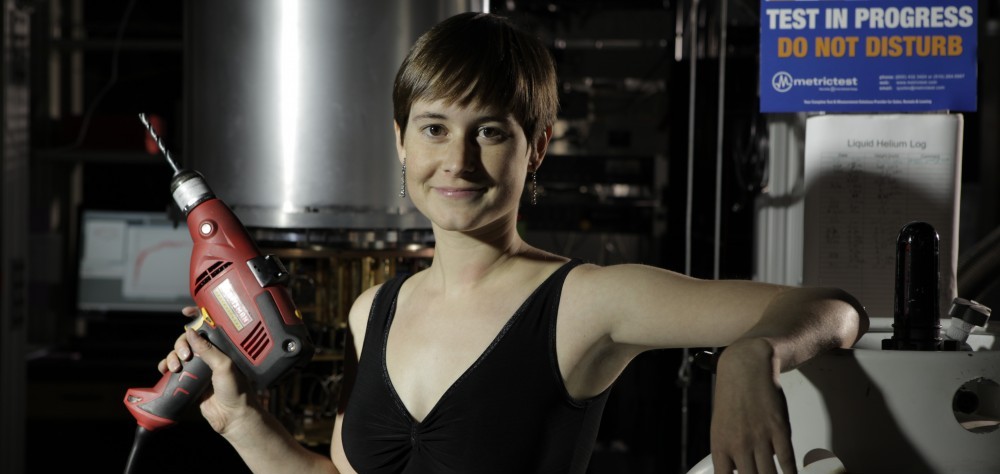
Debaleena Nandi, in the lab as usual.

Debaleena Nandi, in the lab as usual.

In March 2008, a graduate student at the Indian Institute of Science (IISc) named Debaleena Nandi heard Caltech physics professor Jim Eisenstein give a series of lectures on two-dimensional systems of quantum electronic matter. “I was very keen to take a peek into his lab,” she says—so keen that, with a friend by her side for moral support, she walked up to Eisenstein and asked if she could join his group for the summer. Eisenstein had noted her smart questions during his talks and said he was open to the idea. Still, he was surprised when he returned to Caltech and found she’d e-mailed him. A few months later, Nandi rented an apartment in Pasadena and left India for the first time.

Continue reading

Science Magazine’s Breakthrough of 2012

A few nights ago, I attended Dr. Harvey B. Newman’s public lecture at Caltech titled: “Physics at the Large Hadron Collider: A New Window on Matter, Spacetime and the Universe.” The weekly quantum information group meeting finished early so that we could attend the lecture (Dr. Preskill’s group meeting lasted slightly longer than two hours: record brevity during the seven months that I’ve been a member!) We weren’t alone in deciding to attend this lecture. Seating on the ground floor of Beckman Auditorium was filled, so there were at least 800 people in attendance. Judging by the age of the audience, and from a few comments that I overheard, I estimate that a majority of the audience was unaffiliated with Caltech. Anyways, Dr. Newman’s inspiring lecture reminded me how lucky I am to be a graduate student at Caltech and it also clarified misconceptions surrounding the Large Hadron Collider (LHC), and the discovery of the Higgs, in particular.

Before mentioning some of the highlights of Dr. Newman’s lecture, I want to describe the atmosphere in the room leading up to the talk. A few minutes before the lecture began, I overheard a conversation between three women. It came up that one of the ladies is a Caltech physics graduate student. When I glanced over my shoulder, I recognized that the girl, Emily, is a friend of mine. She was talking to a mother and her high school-aged daughter who loves physics. It’s hard to describe the admiration that oozed from the mother’s face as she spoke with Emily–it was as if Emily provided a window into a future where her daughter’s dreams had come true. It brought back memories, from when I was in the high schooler’s position. As a scientifically-minded child growing up in Southern California, I dreamed of studying at Caltech, but it seemed like an impossible goal. I empathized with the high schooler and also with her mother, who reminded me of my own mom. Mom’s have a hopeless job: they’re genetically programmed to want the best for their children, but they oftentimes don’t have the means to make these dreams a reality. Especially when the child’s dream is to become a scientist. It’s a rare parent who understands the textbooks that an aspiring scientist consumes themselves with, and an even rarer parent, who can give their child an advantage when they enter the crapshoot that is undergraduate admissions. The angst of the conversation reminded me that I’m one of the lucky few whose childhood dreams have come true–it’s an opportunity that I don’t want to squander.

The conversation between two elderly men sitting next to me also brought back uncomfortable memories. They were trying to prove their intelligence to each other through an endless proceeding of anecdotes and physics observations. I empathized with them as well. Being at a place like Caltech is intimidating. As an outsider, you don’t have explicit credentials signaling that you belong, so you walk on eggshells, trying to prove how smart you are. I’ve seen this countless times, such as when I give tours to high schoolers, but it’s especially pronounced amongst incoming graduate students. However, it quickly fades as they become comfortable with their position. But to outsiders, every time they re-enter a hallowed place, their insecurities flood back. I know this because I was guilty of this! I spoke with the gentlemen for a while and they were incredibly nice, but smart as they were, they were momentarily insecure. Putting on my ambassador hat for a moment, if there are any ‘outsiders’ reading this blog, I want to say that I, for one, am glad that you attend events like this.
Continue reading

Topological insulator trio recognized by 2013 Physics Frontiers Prize

I was excited to hear that Charlie Kane, Laurens Molenkamp and Shoucheng Zhang were among the recipients of the 2013 Physics Frontiers Prize. Their seminal works both theoretically predicting and experimentally discovering the topological insulator have profoundly influenced the direction of condensed matter physics over the past few years and have shaped my own research agenda at Caltech.

I first learned about the topological insulator from a talk Charlie Kane delivered at the 2006 American Physical Society March Meeting. It was around this time that graphene was exploding onto the scene following Andre Geim and Konstantin Novoselov’s demonstration that single sheets of it could be peeled from graphite using Scotch tape. Inspired by the highly unconventional charge transport properties that were being measured from graphene, Charlie had begun to think about whether its spin transport properties might also yield surprises. The huge surprise, as Charlie would reveal in his talk, was that graphene could theoretically exhibit a quantum spin Hall effect in which spin-polarized charge carriers flow without dissipation along the edges of an electrically insulating material. Such quantum spin Hall insulators (later renamed the 2D topological insulator), as Charlie and his colleague Eugene Mele proved, are a phase of matter distinct from ordinary electrical insulators by virtue of a quantum entanglement of its electrons.
Continue reading

A poll on the foundations of quantum theory

Erwin Schrödinger. Discussions of quantum foundations often seem to involve this fellow's much abused cat.

Erwin Schrödinger. Discussions of quantum foundations often seem to involve his much abused cat.

The group of physicists seriously engaged in studies of the “foundations” or “interpretation” of quantum theory is a small sliver of the broader physics community (perhaps a few hundred scientists among tens of thousands). Yet in my experience most scientists doing research in other areas of physics enjoy discussing foundational questions over coffee or beer.

The central question concerns quantum measurement. As often expressed, the axioms of quantum mechanics (see Sec. 2.1 of my notes here) distinguish two different ways for a quantum state to change. When the system is not being measured its state vector rotates continuously, as described by the Schrödinger equation. But when the system is measured its state “collapses” discontinuously. The Measurement Problem (or at least one version of it) is the challenge to explain why the mathematical description of measurement is different from the description of other physical processes.

My own views on such questions are rather unsophisticated and perhaps a bit muddled:

1) I know no good reason to disbelieve that all physical processes, including measurements, can be described by the Schrödinger equation.

2) But to describe measurement this way, we must include the observer as part of the evolving quantum system.

3) This formalism does not provide us observers with deterministic predictions for the outcomes of the measurements we perform. Therefore, we are forced to use probability theory to describe these outcomes.

4) Once we accept this role for probability (admittedly a big step), then the Born rule (the probability is proportional to the modulus squared of the wave function) follows from simple and elegant symmetry arguments. (These are described for example by Zurek – see also my class notes here. As a technical aside, what is special about the L2 norm is its rotational invariance, implying that the probability measure picks out no preferred basis in the Hilbert space.)

5) The “classical” world arises due to decoherence, that is, pervasive entanglement of an observed quantum system with its unobserved environment. Decoherence picks out a preferred basis in the Hilbert space, and this choice of basis is determined by properties of the Hamiltonian, in particular its spatial locality.
Continue reading

Science books for kids matter (or used to)

The elementary school I attended hosted an annual book fair, and every year I went with my mother to browse. I would check out the sports books first, to see whether there were any books about baseball I had not already read (typically, no). There was also a small table of science books, and in 1962 when I was in the 4th grade, one of them caught my eye: a lavishly illustrated oversized “Deluxe Golden Book” entitled The World of Science.

My copy of The World of Science by Jane Werner Watson, purchased in 1962 when I was in the 4th grade.

My copy of The World of Science by Jane Werner Watson, purchased in 1962 when I was in the 4th grade.

As I started leafing through it, I noticed one of the cutest girls in my class regarding me with what I interpreted as interest. Right then I resolved to buy the book, or more accurately, to persuade my mother to buy it, as the price tag was pretty steep. Impressing girls is a great motivator.

The title page.

The title page.

Continue reading

How did I come to know Jeff Kimble

I heard of Jeff Kimble long before I met him in person. Legend had it that he was extremely rigorous with research and very tough on nonsense. So when I decided to approach him in October of 1996, at the annual OSA meeting in Rochester for a possible postdoc position, I was as nervous as I was excited. As a graduate student, I had learned theory of quantum optics from Marlan Scully, and learned advanced experimental techniques from Jan Hall. The experiences working with Jan laid a critical foundation for my scientific work. Likewise, Jeff had spent a sabbatical with Jan in 1985 that enabled their work on squeezing, as well as Jeff’s subsequent research in cavity QED, which provided me some comfort with this tall stranger. But, here was a guy who dealt with the annihilation operator as deftly in the lab as on paper; so I was hesitant. Then I listened to Jeff’s lecture on flying qubits and single-photon quantum logic gates – his speech for the Max Born Award. Armed with courage after surviving my own very first invited talk at OSA, I decided to give it a try.

I still remember most of our discussions from that first meeting, but none is as clear as my recollection of the pain from Jeff’s handshake. His grip was more than just firm; it actually squeezed the bones of my hand. So naturally, I took the handshake as a sign that he really wanted me to join his group. When an offer of a Caltech fellowship arrived three months later, I accepted it without hesitation. In 1997, I had no way of knowing that Jeff’s way of doing science would leave a profound mark on my career and that his deep friendship would continue to enrich my life and that of my family for many years.

Continue reading

The X Windows Solution

A Sun 3/60 Workstation in the late 1980s.

I recently did an interview for an educational video about quantum physics. The filmmaker, who needed some cutaway shots to stitch the interview segments together, suggested a shot of me walking through the server room in my building. I complied, gazing with interest and concern as I strolled past the machines. But I felt very uncomfortable about the phoniness of this scene, because I had never been in the server room before and had no idea what I was looking at.

The experience reminded me, though, of the one time in my life when I felt like I was near the cutting edge of the digital revolution, nearly 20 years ago, as the World Wide Web was just emerging as the Next Big Thing.

Continue reading

The Future Of Education

I’m a senior software engineer at Knewton, a company that aims to personalize education through adaptive learning technology. Also, in my free time I write stories and design games to teach kids about computer science as DrTechniko. My How To Train Your Robot game, for example, lets kids “program” their parents to do tasks for them. It’s intuitive and fun for kids because they get to “command” their parents. At the same time the parents get a good workout by the end of the class.

But, why do I care about kids and computer science education?

  • Computer science combines problem solving with practical outcomes for a society that is increasingly high-tech.
  • Creative problem solving needs to become the no.1 skill that schools teach today. Information is already available everywhere. Kids need to know how to put this together and solve real, challenging problems.
  • We need to feel comfortable with technology and control it. If we don’t teach this culture to our five-year-olds, then we can’t grow as a society and civilization. We have to “learn to drive a car and let go of the horse”. The lawyer of 2034 needs to know how to program. Everything around her will be programmable.

All of us working to revolutionize education have such goals in mind and we want to break the current educational stereotypes, because they won’t get us there. Instead, every kid becomes a “copy” coming out of a factory-like assembly line called the school. Only recently have we began to develop the tools that allow students to personalize the way they learn new things. The next step is to give kids the tools they need to learn how to learn the things they need in order to unleash their creative potential.

Continue reading

Showtime for Sophomores

Exciting a square Chladni plate with a violin bow.

One of the many unique features of Caltech is our core curriculum. All of our undergraduates are required to take five terms of physics and five terms of math (all three terms freshman year and the fall and winter terms sophomore year) — though this will change for the class entering in the fall of 2013.

Each fall, about 170 sophomores take Physics 2a, a course on vibrations, waves, and quantum mechanics, while the remaining 60 or so sophomores take Physics 12a, a souped up course covering similar material at a level more appropriate for physics concentrators.

This term I am teaching Physics 2a. While 170 students is a lot more than in most courses I teach at Caltech, the workload is manageable, in part because I share the lecturing duties with another professor, and in part because we have a staff of capable and hard working Teaching Assistants who handle recitation sections and grade the homework and quizzes.

Continue reading

Quantum = Pink

Need we say more?

What color do you imagine when you close your eyes and think “Quantum”? If you are to buy a case for your quantum computer, have you already picked your favorite color? (Okay, maybe it’s too early for that.)
Below I argue that the collective unconscious has already made the choice for you: it is going to be pink.

Excited?

Fear not. We will easily differentiate ourselves from warm and fluffy pink slippers. Our color is pink on black. Closer to purple, actually. We have good heritage: purple with white was the color of kings. But kings are no more, so let’s admit it: People think that “spooky” quantum phenomena have a purple glow around them. The disaster movie “Quantum Apocalypse” has a mysterious purple vortex approach Earth. Sci-fi now has “quantum cannons” shooting pink aura at the enemies, unleashing the chaos of uncertainty. You can’t fly your battlecruiser if you’re no longer certain you still have a battlecruiser.
Continue reading