Showtime for Sophomores

Exciting a square Chladni plate with a violin bow.

One of the many unique features of Caltech is our core curriculum. All of our undergraduates are required to take five terms of physics and five terms of math (all three terms freshman year and the fall and winter terms sophomore year) — though this will change for the class entering in the fall of 2013.

Each fall, about 170 sophomores take Physics 2a, a course on vibrations, waves, and quantum mechanics, while the remaining 60 or so sophomores take Physics 12a, a souped up course covering similar material at a level more appropriate for physics concentrators.

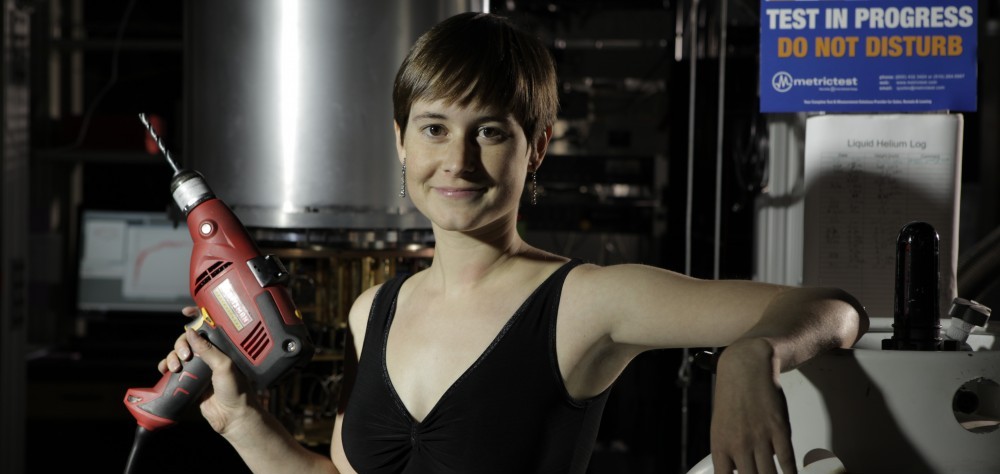
This term I am teaching Physics 2a. While 170 students is a lot more than in most courses I teach at Caltech, the workload is manageable, in part because I share the lecturing duties with another professor, and in part because we have a staff of capable and hard working Teaching Assistants who handle recitation sections and grade the homework and quizzes.

Continue reading

Quantum = Pink

Need we say more?

What color do you imagine when you close your eyes and think “Quantum”? If you are to buy a case for your quantum computer, have you already picked your favorite color? (Okay, maybe it’s too early for that.)
Below I argue that the collective unconscious has already made the choice for you: it is going to be pink.

Excited?

Fear not. We will easily differentiate ourselves from warm and fluffy pink slippers. Our color is pink on black. Closer to purple, actually. We have good heritage: purple with white was the color of kings. But kings are no more, so let’s admit it: People think that “spooky” quantum phenomena have a purple glow around them. The disaster movie “Quantum Apocalypse” has a mysterious purple vortex approach Earth. Sci-fi now has “quantum cannons” shooting pink aura at the enemies, unleashing the chaos of uncertainty. You can’t fly your battlecruiser if you’re no longer certain you still have a battlecruiser.
Continue reading

Individual quantum systems

When I went to school in the 20th century, “quantum measurements” in the laboratory were typically performed on ensembles of similarly prepared systems. In the 21st century, it is becoming increasingly routine to perform quantum measurements on single atoms, photons, electrons, or phonons. The 2012 Nobel Prize in Physics recognizes two of the heros who led these revolutionary advances, Serge Haroche and Dave Wineland. Good summaries of their outstanding achievements can be found at the Nobel Prize site, and at Physics Today.

Serge Haroche developed cavity quantum electrodynamics in the microwave regime. Among other impressive accomplishments, his group has performed “nondemolition” measurements of the number of photons stored in a cavity (that is, the photons can be counted without any of the photons being absorbed). The measurement is done by preparing a Rubidium atom in a superposition of two quantum states. As the Rb atom traverses the cavity, the energy splitting of these two states is slightly perturbed by the cavity’s quantized electromagnetic field, resulting in a detectable phase shift that depends on the number of photons present. (Caltech’s Jeff Kimble, the Director of IQIM, has pioneered the development of analogous capabilities for optical photons.)
Continue reading

Redemption: Part II

Last week, a journey began to find the solution to a problem I could not solve as a seventeen year-old boy. That problem became an obsession of mine during the last days of the International Math Olympiad of 1997, the days when I also met the first girl I ever kissed. At the time, I did not have the heart to tell the girl that I had traveled across the Atlantic to compete with the best and brightest and had come up short. I told her that I had solved the problem, but that the page with my answer had been lost. I told my parents the same thing and to everyone at school who would ask me why I did not return with a medal from the Math Olympics. The lie became so powerful that I did not look at that problem again until now. So, you may be wondering why a blog about Quantum Information Science at Caltech includes posts on problems from Math Olympiads. And why I would open the book on the page with that one problem after fifteen years… Continue reading

Geniuses wanted

Cousin Leonidas. He wasn’t always this angry.

Growing up in Spata (no, not Sparta – but feel free to ignore this remark) there was not much to do in the evenings. After school was done and volleyball practice was over (with my two brothers we made up half of the school team) my dad would come pick us up for a fun three hours of track and field practice. Just another lazy evening. Who am I kidding… It was exhausting! But, throwing a javelin with exuberant fury was also therapeutic (it’s a Greek thing). Yet, here lied the problem: The adrenaline high from a good five hours of sports every day would not dissipate simply because of physical exhaustion. I don’t know about my brothers, but my brain was on fire and the two pounds of pasta my mom would put on my plate (almost) every night, could not induce a strong enough food coma. Even working on the next day’s homework did not do the trick of putting me to sleep (though it did help significantly). By then, it was past midnight and I was wide awake.
Continue reading

Apollo

Neil Armstrong (1930-2012)

I was an eight-year-old second grader on April 12, 1961, when my father showed me a screaming headline with two-inch-high lettering in the afternoon newspaper: RUSSIAN 1ST SPACEMAN. Sensing a historic moment, I saved the front page and pasted it into a scrapbook. That was the first of many headlines I saved through the years of the “space race.”
Continue reading

The Eiger et al.

When I was a graduate student, on my second year I was put in an office that was shared with two postdocs – Arne Brataas and Stefan Kehrein. It made me really feel like I was being initiated into this community of theoretical physicists – something I had been dreaming of since I was a teenager. The most conspicuous thing in the office (Harvard’s Lyman 332 if I recall correctly), was a big three or four panel poster of an astounding mountain range, craggy peaks, glaciers, steep drops. There was a small note on the corner: “The Eiger et al. – the amazing history of this poster is recounted in the book ‘Who Got Polchinski’s Office’ ”*
Continue reading

Universal thread

How many miles per gallon?

Thoughts while watching the Olympics …

My car gets about 30 miles per gallon of gasoline. Miles per gallon has the dimensions of inverse length squared, and the reciprocal of 30 miles per gallon is roughly the area of a circle whose diameter is 0.3 mm, or about 1/100 of an inch.

That means that when I drive my car, the fuel I consume has the same volume as a thin thread stretched along the road over the distance I travel, with a thickness just a few times the width of a human hair.*

That skinny little thread of gasoline is enough to keep my car going! Thinking about it reinforces one’s appreciation for the internal combustion engine.
Continue reading

Two-trick pony

Steve Flammia wrote a flattering post on The Quantum Pontiff about a game we used to play, in which Steve would ask a question and I would have just a minute or two to prepare a 20 minute mini-lecture answering the question. Steve reports that “these were not easy questions.” But actually most of them were.

Steve gives an example: “Why do neutrinos have a small but nonzero mass?”
Continue reading

Alesha

An excerpt from my notes (including a misspelling of “repetition”) taken at Alexei Kitaev’s seminar during his first visit to Caltech in 1997. That was a very exciting day.

In 1997, I had some disposable funding as part of a quantum computing project, and decided to seize the opportunity to bring an interesting visitor to Caltech. But whom to invite? Chris Fuchs, then a postdoc at Caltech who seemed to know everybody working on quantum computing, reported that Richard Jozsa, while attending a conference in Japan, had met a remarkable Russian from the Landau Institute named Alexei Kitaev.
Continue reading