Apply to join IQIM!

Editor’s Note: Dr. Chandni Usha is an IQIM postdoctoral scholar working with Prof. Eisenstein. We asked her to describe her experience as an IQIM fellow.

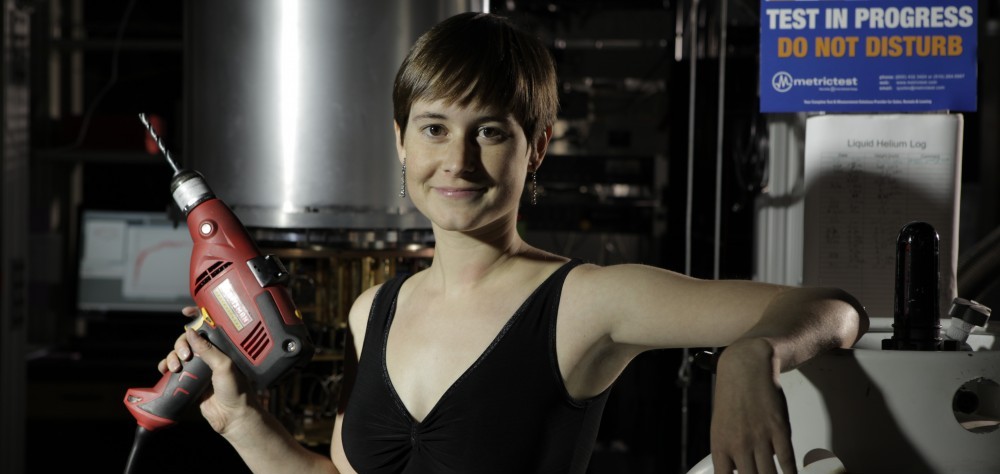
Just another day at work!

Just another day at work!

When I look back at how I ended up here, I find myself in a couple of metastable states. Every state pushed me to newer avenues of knowledge. Interestingly, growing up I never really knew what it was like to be a scientist. I had not watched any of those sci-fi movies or related TV series as a kid. No outreach program ever reached me in my years of schooling! My first career choice was to be a lawyer. But a casual comment by a friend that lawyers are ‘liars’ was strong enough to change my mind. Strangely enough, now the quest is for the truth, in a lab down at the sub-basement of one of the world’s best research institutes.

I did my masters in Physics at this beautiful place called the Indian Institute of Science in Bangalore. I realized that I like doing things with my hands. Fixing broken instruments seemed fun. Every new data point on a plot amused me. It was more than obvious that experimental physics is where my heart was and hence I went on to do a Ph.D. in condensed matter physics. When I decided to apply for postdoctoral positions, an old friend of mine, Debaleena Nandi, told me to look up the IQIM website. That was in November 2012, and I applied for the IQIM postdoctoral fellowship. My stars were probably aligned to be here. Coincidentally, Jim Eisenstein, my adviser, was in India on a sabbatical and I happened to hear him give a talk. It left such a strong impression in my mind that I was willing to give up on a trip to Europe for an interview the next day had he offered me a position. We spoke about possible problems, but no offer was in sight and hence I did travel to Europe with my mind already at Caltech. IQIM saved me from my dilemma when they offered me the fellowship a few days later.

Now, why choose IQIM! Reason number one was Jim. And reason number two was this blog which brought in this feeling that there exists a community here; where experimentalists and theorists could share their ideas and grow together in a symbiotic manner. My first project was with an earlier postdoc, Erik Henriksen, who is now a faculty at Washington University in St. Louis. It was based on a proposal by fellow IQIM professor Jason Alicea which involved decorating a film of graphene with a certain heavy metal adatom. Jason’s prediction was that if you choose the right adatom, it could endow some of its unique properties such as strong spin-orbit coupling to the underlying graphene sheet. One can thus engineer graphene to what is called a topological insulator where only the edges of the graphene sheet conduct. Erik had taken on this task and I tagged along. Working in a very small campus with a close-knit community helps bounce your ideas around others and that’s how this experiment came into being. I found it particularly interesting that Jason and his colleagues often ask us, the experimentalists, whether some of the ideas they have are actually feasible to be performed in a lab!

The IQIM fellowship allows you to work on a variety of fields that come under the common theme of quantum information and matter. In addition to providing an independent funding and research grant, the fellowship offers the flexibility to work with any mentor and even multiple mentors, especially in the theory group. In experimental groups however, that flexibility is limited but not impossible. The fellowship gives you a lot of freedom and encourages collaborations. IQIM theory folks have a very strong and friendly group with a lot of collaborations, to the extent that it is often hard to distinguish the faculty from the postdocs and students.

Apart from a yearly retreat to a beautiful resort in Lake Arrowhead, the social life at IQIM is further enhanced through the Friday seminars where you get to hear about the work from postdocs and graduate students from IQIM, as well as other universities. IQIM’s outreach activities have been outstanding. A quick look at this blog will take you from the PhD Comics animations, to teaching kids quantum mechanics through Miinecraft, to hosting middle school students at the InnoWorks academy and a host of other activities. This note will not be complete without mentioning about our repeated efforts to attract women candidates. My husband lives in India, and I live right across the globe, all for the love of science. I am not alone in this respect as we have two more women postdocs at IQIM who have similar stories to tell. So, if you are a woman and wish to pursue a quality research program, this is the place to be, for together we can bring change.

Now that I have convinced you that IQIM is something not to be missed, kindly spread the word. And if you are looking for an awesome opportunity to work at Caltech, get your CV and research statement and apply for the fellowships before Dec 5, 2014!

Science at Burning Man: Say What?

Burning Man… what a controversial topic these days. The annual festival received quite a bit of media attention this year, with a particular emphasis on how the ‘tech elite’ do burning man. Now that we are no longer in the early September Black Rock City news deluge I wanted to forever out myself as a raging hippie and describe why I keep going back to the festival: for the science of course!

This is a view of my camp, the Phage, as viewed from the main street in Black Rock City.

This is a view of my camp, the Phage, as viewed from the main street in Black Rock City. I have no idea why the CH-47 is doing a flyover… everything else is completely standard for Burning Man. Notice the 3 million Volt Tesla coil which my roommates built.

I suspect that at this point, this motivation may seem counter-intuitive or even implausible, but let me elaborate. First, we should start with a question: what is Burning Man? Answer: this question is impossible to answer. The difficulty of answering this question is why I’m writing this post. Most people oversimplify and describe the event as a ‘bunch of hippies doing drugs in the desert’ or as ‘a music festival with a dash of art’ or as ‘my favorite time of the year’ and on and on. There are nuggets of truth in all of these answers but none of them convey the diversity of the event. With upwards of 65,000 people gathered for a week, my friends and I like to describe it as a “choose your own adventure” sort of experience. I choose science.

My goal for this post is to give you a sense of the sciency activities which take place in my camp. Coupling this with the fact that science is a tiny subset of the Burning Man ethos, you should come away convinced that there’s much more to the festival than just ‘a bunch of hippies doing drugs in the desert and listening to music.’

I camp with The Phage, as in bacteriophage, the incredibly abundant virus which afflicts bacteria. There are about 200 people in our camp, most of whom are scientists, with a median age of over 30. Only about 100 people camp with the Phage in any given year. The camp also houses some hackers, entrepreneurs and artists but scientific passion is unequivocally our unifying trait. Some of the things we assembled this year include:

3 million Volt musical Tesla coil at night and during assembly

Dr. F and Dr. B’s 3 million Volt musical Tesla coil. Humans were inserted for scale.

Musical Tesla coil: two of my roommates built a 3 million Volt musical Tesla coil. Think about this… it’s insane. The project started while they were writing their Caltech PhD theses (EE and Applied Physics) and in my opinion, the Tesla coil’s scale is a testament to the power of procrastination! Thankfully, they both finished their PhDs. After doing so, they spent the months between their defenses and Burning Man building the coil in earnest. Not only was the coil massive–with the entire structure standing well over 20 feet tall–but it was connected through MIDI to a keyboard. Sound is just pressure waves moving through air, and lightning moves lots of air, so this was one of the loudest platforms on the playa. I manned the coil one evening and one professional musician told me it was “by far the coolest instrument he has ever played.” Take a brief break from reading this and watch this video!

Dr. Brainlove

Dr. Brainlove getting ready for a midnight stroll and then getting a brainlift.

Dr. Brainlove: we built a colossal climbable “art car” in the shape of a brain which was covered in LEDs and controlled from a wireless EEG device. Our previous art car (Dr. Strangelove) died at the 2013 festival, so last winter our community rallied and ‘brainstormed’ the theme for this vehicle. After settling on a neuroscience theme, one of my campmates in Berkeley scanned her brain and sent a CAD file to Arcology Now in Austin, TX who created an anatomically correct steel frame. We procured a yellow school bus which had been converted to bio diesel. We raised over $30k (there were donations beyond indiegogo.) About 20 of my campmates volunteered their weekends to work at the Nimby in Oakland: hacking apart the bus, building additional structures, covering the bus with LEDs, installing a sound system, etc. One of the finishing touches was that one of my campmates who is a neurosurgeon at UCSD procured some wireless EEG devices and then he and some friends wrote software to control Dr. Brainlove’s LEDs–thus displaying someone’s live brain activity on a 30′ long by 20′ tall climbable musical art car for the entire playa to see! We already have plans to increase the LED density and therefore put on a more impressive interactive neural light show next year.

Sugarcubes: in 2013, some campmates built an epic LED sculpture dubbed “the sugarcubes”. Just watch this video and you’ll be blown away. The cubes weren’t close to operational when they arrived so there was 48 hours of hacking madness by Dan Kaminsky, Alexander Green and many brilliant others before our “Tuesday night” party. The ethos is similar to the Caltech undergrad’s party culture–the fun is in the building–don’t tell my friends but I slept through the actual party.

Ask a scientist on the left. Science class on the right. Science everywhere!

Ask a scientist on the left (I’m in there somewhere and so is one of my current roommates– another Caltech PhD ’13.) Science class on the right. Science everywhere!

Ask a scientist: there’s no question that this is my favorite on playa activity. This photo doesn’t do the act justice. Imagine a rotating cast of 7-8 phagelings braving dust storms and donning lab coats all FOR SCIENCE! The diversity of questions is incredible and I always learn a tremendous amount (evidenced by losing my voice three years running.) For example, this year, a senior executive at Autodesk approached and asked me a trick question related to the Sun’s magnetic field. Fear not–I was prepared! This has happened before.. and he was wearing a “space” t-shirt so my guard was up. A nuclear physicist from UCLA asked me to explain Bell test experiments (and he didn’t even know my background.) Someone asked how swamp coolers work? To be honest, I didn’t have a clear answer off the top of my head so I called over one of my friends (who was one of the earliest pioneers of optogenetics) and he nailed it immediately. Not having a clear answer to this question was particularly embarrassing because I’ve spent most of the past year thinking about something akin to quantum thermodynamics… if you can call black hole physics and holographic entanglement that.

Make/hack sessions: I didn’t participate in any of these this year but some of my campmates teach soldering/microscopy/LED programming/etc classes straight out of our camp. See photo above.

EEG and LED hacking.

Science talks: we had 4-5 science talks in a carpeted 40ft geodesic dome every evening. This is pretty self explanatory and by this point in my post, the Phage may have enough credibility that you’d believe the caliber is exceptional.

Impromptu conversations: this is another indescribable aspect. I’ll risk undermining the beauty of these conversations by using a cheap word: the ‘networking’ at Burning Man is unrivaled. I don’t mean in the for-dollar-profit sense, I mean in the intellectual and social sense. For example, one of my campmates’ brother is a string theory postdoc at Stanford. He came by our camp one evening, we were introduced, and then we met up again in the default world when I visited Stanford the following week. Burning Man is the type of place where you’ll start talking about MPEG/EFF/optogenetics/companyX/etc and then someone will say: “you know that the inventor/spokesperson/pioneer/founder/etc is at the next table over right?”

Yup, Burning Man is just a bunch of hippies doing drugs in the desert. You shouldn’t come. You definitely wouldn’t enjoy it. No fun is had and no ideas are shared. Or in other words, Burning Man: where exceptionally capable people prepare themselves for the zombie apocalypse.

Check out my friend Peretz Partensky’s Flickr feed if you want to see more photos (and credit goes to him for the photos in this post.)

Making sci-fi teleportation sound less crazy

laser_refraction

Laser beam bending due to a change in the speed of light in water.

If you ever wanted to see a sci-fi plot that expertly applied advanced physical concepts so that with a bit of imagination teleporting a human was not as unbelievable as most of the teleportation scenarios we see in the movies, keep reading.

Years ago, when I was still in Russia, I was working on a back-story for a sci-fi game I was playing with friends. In the game, players were given stones (from Mars!) that could change the fundamental constants of nature: electron charge e, speed of light c and Planck constant h. I had already worked out the effects these stones would produce on the space around them (I suggest it as an exercise to the nerdy reader – once you are done thinking about it, see my answer below), so my next task was to envision a big scientific project centered around those stones, with a solid foundation on real physics and a portal to Mars as a final goal. As it turned out, some unforeseen consequences included blowing up the whole lab and scattering the stones in the nearby forest. That’s the back-story.

It all worked beautifully on paper. I imagined that materials could be programmed to obey different values of fundamental constants. These Martian stones were supposed to be the first encounter humanity had with matter where such effects could be observed and studied. The effects extended to a region around the stone, with weird things happening on the boundary of that region. For one thing, energy was not conserved in the vicinity of these stones.

Now having control over e, c and h, the scientists would leverage this new-found power to try to move the fine structure constant e^2/(\hbar c) to what is known as the Landau pole. Such a feat would result in infinitely strong interactions between particles, so that the energetic content of space-time would jump through the roof and a black hole would form. If one was lucky, even a traversable wormhole would form, which is what the scientists were hoping for, because back on Mars these things could have formed naturally, and the lab wormhole would connect to the Martian network.

If you’ve read all this and are asking yourself “What just happened?”, see all the physical concepts explained below: Continue reading

The dance of the electrons

On the day I returned to the lab, Marcus Teague, a post-doc leader in the Yeh Group, was orienting two summer undergraduate interns. As he asked the students questions regarding superconductors and scanning tunneling microscopes (STM) I was happy with the amount of information I readily recalled from previous years. It was a good sign that I was ready to build on the content and skills I had already mastered. This may be expected of a graduate student at Caltech, but I am not a graduate student at Caltech. I am a High School physics teacher.

One of the first tasks assigned to me this summer, as I returned for my third year as an IQIM research intern, was to build and solder a connecting cord for the cryocooler in which we stored superconductors. That’s right – I have been working on cutting edge research involving high temperature superconductivity. But back to the soldering. This cord would communicate information, such as temperature and voltage, from the sensor. It had been years since my undergraduate soldering days at UCLA, but it turned out I was not so rusty. I was able to solder the tiny connecting pieces and show the undergraduate research students how to solder.

This summer I made additional tips for STM. Again, we chemically etched the tips using a Calcium Chloride solution in order to reach an ideal thickness of 1 atom across. We also employed the physical stretch and clip approach to make tips. Each person in the lab has their own philosophy on the best method to make tips. It’s amusing and interesting to compare the different techniques for attempting to make sharp, symmetric tips. Whether chemical or physical, the process to make sharp tips is tedious and time consuming, but imperative for a scan with good resolution.

I also worked with Kyle Chen again for certain projects, one of which involved making a low pass filter which would cut out signals above 2 GHz. We wrapped copper wire around a skewer in order to make a tiny solenoid. Care was taken to ensure the number of loops in one direction was matched in the other to avoid creating a net magnetic field. My first attempt was pathetic, but with each trial and error, I was able to construct decent solenoids. The completed solenoids were soldered to a SMA connector (like the one used for coaxial cable) which became one end of the RF filter. In order to connect the copper tube and SMA electrically, a silver epoxy is used. The solenoids were slid carefully into a small copper tube and then filled with the epoxy, a mixture of copper powder and Stycast A and B at a ratio of 100:28. Silver apoxy needs high temperature baking, above 100 degrees Celsius, in order to set, so the system was then baked in order to solidify our new low pass filter to be placed alongside the sample for STM testing.

This summer we also continued testing the YBCO superconducting samples I helped to make two summers ago with Professor Feng. After etching, the procedure to load the sample into the long, cylindrical, central tube required detailed planning. As with last year, the hood was flushed with Argon gas and then vacuum pumped in order to reduce contaminants. Using gloves in the hood, the sample is daintily set into place. Lifting the giant cylinder with the sample took four of us: two for lifting, one for holding it from the base within the hood and one person adjusting the gas levels.

Next we took the cylinder with the sample downstairs to the subbasement to be vacuum pumped and baked in order to expel all gaseous particles. Finally the central tube was loaded into the STM central chamber and the cooling process began, first with liquid nitrogen and then with liquid helium. Finally, it was time to scan the superconducting samples.

Last summer’s scans of the superconductor were in the 500 mV range. However, this summer’s scans are within 150 mV which will lead to much better resolution of the image and possibly valuable enough data to publish.

Each Friday Nai-Chung Yeh has a group meeting with everyone working in the lab. She thoughtfully discusses each persons’ progress, contributions, and questions from the past week. Her genuine curiosity and passion to discuss the best methods for experimentation are inspirational. She is expressive with her hands as she explains a concept, such as how she thinks the polymer doping is affecting the graphene samples. Each week she inevitably goes to the whiteboard and draws a picture of the hypothesized phenomenon observed in the data for that week. She gives insights from her vast wealth of background knowledge and suggests applicable equations, troubleshooting techniques, and information found in the current literature. It is fascinating to watch her warmly lead this group to a deeper understanding of the research topics at hand. I am moved by her work ethic and ability to balance oversight of the graphene projects, topological insulators, superconductors, and possible new solar cell technology. She supervises each sub-projects’ progress while writing papers, traveling the world over to present, as well as secure funding for research.

It is difficult to believe yet another year has passed. Again it is time to return to my classroom to meet my new 150 students, to get them fired up for learning about the exciting world of Physics. I am eager to share my learning experiences from the last three summers at Caltech.

The experimentalist next door

At 9:10 AM, the lab next door was blasting “Born to Be Wild.”

I was at Oxford, moonlighting as a visiting researcher during fall 2013. My hosts included quantum theorists in Townsend Laboratory, a craggy great-uncle of a building. Poke your head out of the theory office, and Experiment would flood your vision. Our neighbors included laser wielders, ion trappers, atom freezers, and yellow signs that warned, “DANGER OF DEATH.”

P1040564

Down the corridor in Townsend Laboratory.

Hardly the neighborhood Mr. Rogers had in mind.

The lab that shared a wall with our office blasted music. To clear my head of calculations and of Steppenwolf, I would roam the halls. Some of the halls, that is. Other halls had hazmat warnings instead of welcome mats. I ran into “RADIATION,” “FIRE HAZARD,” “STRONG MAGNETIC FIELDS,” “HIGH VOLTAGE,” and “KEEP THIS TOILET NEAT AND TIDY.” Repelled from half a dozen doors, I would retreat to the office. Kelly Clarkson would be cooing through the wall.

“We can hear them,” a theorist observed about the experimentalists, “but they can’t hear us.”

P1040552

Dangers lurked even in the bathroom.

Experiment should test, disprove, and motivate theories; and theory should galvanize and (according to some thinkers) explain experiments. But some theorists stray from experiment like North America from Pangaea.

The theoretical physics I’ve enjoyed is abstract. I rarely address platforms, particular physical systems in which theory might incarnate. Quantum-information platforms include electrons in magnetic fields, photons (particles of light), ion trapsquantum dots, and nuclei such as the ones that image internal organs in MRI machines.

Instead of addressing electrons and photons, I address mathematics and abstract physical concepts. Each of these concepts can incarnate in different forms in different platforms. Examples of such concepts include preparation procedures, evolutions, measurements, and memories. One preparation procedure defined by one piece of math can result from a constant magnetic field in one platform and from a laser in another. Abstractness has power, enabling one idea to describe diverse systems.

I’ve enjoyed wandering the hills and sampling the vistas of Theory Land. Yet the experimentalist next door cranked up the radio of reality in my mind. “We can hear them,” a theorist said. In Townsend Laboratory, I began listening. My Oxford collaborators and I interwove two theoretical frameworks that describe heat transferred and work performed on small scales. One framework, one-shot statistical mechanics, has guest-starred on this blog.

The other framework consists of fluctuation relations, which describe deviations from average behaviors by small physical systems. A quantum particle on one side of a wall has a tiny probability of tunneling through without boring any hole. Since the probability is tiny, the average particle doesn’t tunnel (during any reasonably short amount of time). When analyzing macroscopic systems—say, the roughly 1024 atoms that form your left thumbnail—we assume that every particle behaves like the average particle. We can’t when analyzing minuscule systems such as one short strand of DNA. Deviations from average behaviors appear in experimental data about small systems as they do not appear in data about large systems. Fluctuation relations help us understand those deviations.

My colleagues and I addressed “information,” “systems,” and “interactions.” We deployed abstract ideas, referencing platforms only when motivating our work. Then a collaborator challenged me to listen through the wall.

Experimentalists have tested fluctuation relations. Why not check whether their data supports our theory? At my friend’s urging, I contacted experimentalists who’d shown that DNA obeys a fluctuation relation. The experimentalists had unzipped and re-zipped single DNA molecules using optical tweezers, which resemble ordinary tweezers but involve lasers. Whenever the experimentalists pulled the DNA, they measured the force they applied. They concluded that their platform obeyed an abstract fluctuation theorem. The experimentalists generously shared their data, which supported our results.

http://www.europhysicsnews.org/articles/epn/abs/2010/02/epn20102p27/epn20102p27.html

Experimentalists unzipped and rezipped DNA to test fluctuation relations. This depiction of the set-up comes from this article.

My colleagues and I didn’t propose experiments. We didn’t explain why platforms had behaved in unexpected ways. We checked calculations with recycled data. But we ventured outside Theory Land. We learned that one-shot theory models systems modeled also by fluctuation relations, which govern experiments. This link from one-shot theory to experiment, like the forbidden corridors in Townsend Laboratory, invite exploration.

In Townsend, I didn’t suffer the electric shocks or the explosions advertised on the doors (though the hot water in the bathroom nearly burned me). I turned out not to need those shocks. Blasting rock music at 9:10 AM can wake even a theorist up to reality.

Where are you, Dr. Frank Baxter?

This year marks the 50th anniversary of my first publication. In 1964, when we were eleven-year-old fifth graders, my best friend Mace Rosenstein and I launched The Pres-stein Gazette, a not-for-profit monthly. Though the first issue sold well, the second issue never appeared.

Front page of the inaugural issue of the Pres-stein Gazette

Front page of the inaugural issue of the Pres-stein Gazette. Faded but still legible, it was produced using a mimeograph machine, a low-cost printing press which was popular in the pre-Xerox era.

One of my contributions to the inaugural  issue was a feature article on solar energy, which concluded that fossil fuel “isn’t of such terrific abundance and it cannot support the world for very long. We must come up with some other source of energy. Solar energy is that source …  when developed solar energy will be a cheap powerful “fuel” serving the entire world generously forever.”

This statement holds up reasonably well 50 years later. You might wonder how an eleven-year-old in 1964 would know something like that. I can explain …

In the 1950s and early 1960s, AT&T and the Bell Telephone System produced nine films about science, which were broadcast on prime-time network television and attracted a substantial audience. After broadcast, the films were distributed to schools as 16 mm prints and frequently shown to students for many years afterward. I don’t remember seeing any of the films on TV, but I eventually saw all nine in school. It was always a treat to watch one of the “Bell Telephone Movies” instead of hearing another boring lecture.

For educational films, the production values were uncommonly high. Remarkably, the first four were all written and directed by the legendary Frank Capra (a Caltech alum), in consultation with a scientific advisory board provided by Bell Labs.  Those four (Our Mr. Sun, Hemo the Magnificent, The Strange Case of the Cosmic Rays, and Unchained Goddess, originally broadcast in 1956-58) are the ones I remember most vividly. DVDs of these films exist, but I have not watched any of them since I was a kid.

The star of the first eight films was Dr. Frank Baxter, who played Dr. Research, the science expert. Baxter was actually an English professor at USC who had previous television experience as the popular host of a show about Shakespeare, but he made a convincing and pleasingly avuncular scientist. (The ninth film, Restless Sea, was produced by Disney, and Walt Disney himself served as host.) The other lead role was Mr. Writer, a skeptical and likeable Everyman who learned from Dr. Research’s clear explanations and sometimes translated them into vernacular.

The first film, Our Mr. Sun, debuted in 1956 (broadcast in color, a rarity at that time) and was seen by 24 million prime-time viewers. Mr. Writer was Eddie Albert, a well-known screen actor who later achieved greater fame as the lead on the 1960s TV situation comedy Green Acres. Lionel Barrymore appeared in a supporting role.

Dr. Frank Baxter and Eddie Albert in Our Mr. Sun.

Dr. Frank Baxter and Eddie Albert in Our Mr. Sun. (Source: Wikipedia)

Our Mr. Sun must have been the primary (unacknowledged) source for my article in the Pres-stein Gazette.  Though I learned from Wikipedia that Capra insisted (to the chagrin of some of his scientific advisers) on injecting some religious themes into the film, I don’t remember that aspect at all. The scientific content was remarkably sophisticated for a film that could be readily enjoyed by elementary school students, and I remember (or think I do) clever animations teaching me about the carbon cycle in stellar nuclear furnaces and photosynthesis as the ultimate source of all food sustaining life on earth. But I was especially struck by Dr. Baxter’s dire warning that, as the earth’s population grows, our planet will face shortages of food and fuel. On a more upbeat note he suggested that advanced technologies for harnessing the power of the sun would be the key to our survival, which inspired the optimistic conclusion of my article.

A lavishly produced prime-time show about science was a real novelty in 1956, many years before NOVA or the Discovery Channel. I wonder how many readers remember seeing the Dr. Frank Baxter movies when you were kids, either on TV or in school. Or was there another show that inspired you like Our Mr. Sun inspired me? I hope some of you will describe your experiences in the comments.

And I also wonder what resource could have a comparable impact on an eleven-year-old in today’s very different media environment. The obvious comparison is with Neil deGrasse Tyson’s revival of Cosmos, which aired on Fox in 2014. The premiere episode of Cosmos drew 8.5 million viewers on the night it was broadcast, but that is a poor measure of impact nowadays. Each episode has been rebroadcast many times, not just in the US and Canada but internationally as well, and the whole series is now available in DVD and Blu-ray. Will lots of kids in the coming years own it and watch it? Is Cosmos likely to be shown in classrooms as well?

Science is accessible to the curious through many other avenues today, particularly on YouTube. One can watch TED talks, or Minute Physics, or Veritasium, or Khan Academy, or Lenny Susskind’s lectures, not to mention our own IQIM videos on PHD Comics. And there are many other options. Maybe too many?

But do kids watch this stuff? If not, what online sources inspire them? Do they get as excited as I did when I watched Dr. Frank Baxter at age 11?

I don’t know. What do you think?

The Graphene Effect

Spyridon Michalakis, Eryn Walsh, Benjamin Fackrell, Jackie O'Sullivan

Lunch with Spiros, Eryn, and Jackie at the Athenaeum (left to right).

Sitting and eating lunch in the room where Einstein and many others of turbo charged, ultra-powered acumen sat and ate lunch excites me. So, I was thrilled when lunch was arranged for the teachers participating in IQIM’s Summer Research Internship at the famed Athenaeum on Caltech’s campus. Spyridon Michalakis (Spiros), Jackie O’Sullivan, Eryn Walsh and I were having lunch when I asked Spiros about one of the renowned “Millennium” problems in Mathematical Physics I heard he had solved. He told me about his 18 month epic journey (surely an extremely condensed version) to solve a problem pertaining to the Quantum Hall effect. Understandably, within this journey lied many trials and tribulations ranging from feelings of self loathing and pessimistic resignation to dealing with tragic disappointment that comes from the realization that a victory celebration was much ado about nothing because the solution wasn’t correct. An unveiling of your true humanity and the lengths one can push themselves to find a solution. Three points struck me from this conversation. First, there’s a necessity for a love of the pain that tends to accompany a dogged determinism for a solution. Secondly, the idea that a person’s humanity is exposed, at least to some degree, when accepting a challenge of this caliber and then refusing to accept failure with an almost supernatural steadfastness towards a solution. Lastly, the Quantum Hall effect. The first two on the list are ideas I often ponder as a teacher and student, and probably lends itself to more of a philosophical discussion, which I do find very interesting, however, will not be the focus of this posting.

The Yeh research group, which I gratefully have been allowed to join the last three summers, researches (among other things) different applications of graphene encompassing the growth of graphene, high efficiency graphene solar cells, graphene component fabrication and strain engineering of graphene where, coincidentally for the latter, the quantum Hall effect takes center stage. The quantum Hall effect now had my attention and I felt it necessary to learn something, anything, about this recently recurring topic. The quantum Hall effect is something I had put very little thought into and if you are like I was, you’ve heard about it, but surely couldn’t explain even the basics to someone. I now know something on the subject and, hopefully, after reading this post you too will know something about the very basics of both the classical and the quantum Hall effect, and maybe experience a spark of interest regarding graphene’s fascinating ability to display the quantum Hall effect in a magnetic field-free environment.

Let’s start at the beginning with the Hall effect. Edwin Herbert Hall discovered the appropriately named effect in 1879. The Hall element in the diagram is a flat piece of conducting metal with a longitudinal current running through. When a magnetic field is introduced normal to the Hall element the charge carriers moving through the Hall element experience a Lorentz force. If we think of the current as being conventionHallEffectal (direction flow of positively charged ions), then the electrons (negative charge carriers) are traveling in the opposite direction of the green arrow shown in the diagram. Referring to the diagram and using the right hand rule you can conclude a buildup of electrons at the long bottom edge of the Hall element running parallel to the longitudinal current, and an opposing positively charged edge at the long top edge of the Hall element. This separation of charge will produce a transverse potential difference and is labeled on the diagram as Hall voltage (VH). Once the electric force (acting towards the positively charged edge perpendicular to both current and magnetic field) from the charge build up balances with the Lorentz force (opposing the electric force), the result is a negative charge carrier with a straight line trajectory in the opposite direction of the green arrow. Essentially, Hall conductance is the longitudinal current divided by the Hall voltage.

Now, let’s take a look at the quantum Hall effect. On February 5th, 1980 Klaus von Klitzing was investigating the Hall effect, in particular, the Hall conductance of a two-dimensional electron gas plane (2DEG) at very low temperatures around 4 Kelvin (- 4520 Fahrenheit). von Klitzing found when a magnetic field is applied normal to the 2DEG, and Hall conductance is graphed as a function of magnetic field strength, a staircase looking graph emerges. The discovery that earned von Klitzing’s Nobel Prize in 1985 was as unexpected as it is intriguing. For each step in the staircase the value of the function was an integer multiple of e2/h, where e is the elementary charge and h is Planck’s constant. Since conductance is the reciprocal of resistance we can view this data as h/ie2. When i (integer that describes each plateau) equals one, h/ie2 is approximately 26,000 ohms and serves as a superior standard of electrical resistance used worldwide to maintain and compare the unit of resistance.

Before discussing where graphene and the quantum Hall effect cross paths, let’s examine some extraordinary characteristics of graphene. Graphene is truly an amazing material for many reasons. We’ll look at size and scale things up a bit for fun. Graphene is one carbon atom thick, that’s 0.345 nanometers (0.000000000345 meters). Envision a one square centimeter sized graphene sheet, which is now regularly grown. Imagine, somehow, we could thicken the monolayer graphene sheet equal to that of a piece of printer paper (0.1 mm) while appropriately scaling up the area coverage. The graphene sheet that originally covered only one square centimeter would now cover an area of about 2900 meters by 2900 meters or roughly 1.8 miles by 1.8 miles. A paper thin sheet covering about 4 square miles. The Royal Swedish Academy of Sciences at nobelprize.org has an interesting way of scaling the tiny up to every day experience. They want you to picture a one square meter hammock made of graphene suspending a 4 kg cat, which represents the maximum weight such a sheet of graphene could support. The hammock would be nearly invisible, would weigh as much as one of the cat’s whiskers, and incredibly, would possess the strength to keep the cat suspended. If it were possible to make the exact hammock out of steel, its maximum load would be less than 1/100 the weight of the cat. Graphene is more than 100 times stronger than the strongest steel!

Graphene sheets possess many fascinating characteristics certainly not limited to mere size and strength. Experiments are being conducted at Caltech to study the electrical properties of graphene when draped over a field of gold nanoparticles; a discipline appropriately termed “strain engineering.” The peaks and valleys that form create strain in the graphene sheet, changing its electrical properties. The greater the curvature of the graphene over the peaks, the greater the strain. The electrons in graphene in regions experiencing strain behave as if they are in a magnetic field despite the fact that they are not. The electrons in regions experiencing the greatest strain behave as they would in extremely strong magnetic fields exceeding 300 tesla. For some perspective, the largest magnetic field ever created has been near 100 tesla and it only lasted for a few milliseconds. Additionally, graphene sheets under strain experience conductance plateaus very similar to those observed in the quantum Hall effect. This allows for great control of electrical properties by simply deforming the graphene sheet, effectively changing the amount of strain. The pseudo-magnetic field generated at room temperature by mere deformation of graphene is an extremely promising and exotic property that is bound to make graphene a key component in a plethora of future technologies.

Graphene and its incredibly fascinating properties make it very difficult to think of an area of technology where it won’t have a huge impact once incorporated. Caltech is at the forefront in research and development for graphene component fabrication, as well as the many aspects involved in the growth of high quality graphene. This summer I was involved in the latter and contributed a bit in setting up an experimenKodak_Camera 1326t that will attempt to grow graphene in a unique way. My contribution included the set-up of the stepper motor (pictured to the right) and its controls, so that it would very slowly travel down the tube in an attempt to grow a long strip of graphene. If Caltech scientist David Boyd and graduate student Chen-Chih Hsu are able to grow the long strips of graphene, this will mark yet another landmark achievement for them and Caltech in graphene research, bringing all of us closer to technologies such as flexible electronics, synthetic nerve cells, 500-mile range Tesla cars and batteries that allow us to stream Netflix on smartphones for weeks on end.

Macroscopic quantum teleportation: the story of my chair

In the summer of 2000, a miracle occurred: The National Science Foundation decided to fund a new Institute for Quantum Information at Caltech with a 5 million dollar award from their Information Technology Research program. I was to be the founding director of the IQI.

Jeff Kimble explained to me why we should propose establishing the IQI. He knew I had used my slice of our shared DARPA grant to bring Alexei Kitaev to Caltech as a visiting professor, which had been wonderful. Recalling how much we had both benefited from Kitaev’s visit, Jeff remarked emphatically that “This stuff’s not free.” He had a point. To have more fun we’d need more money. Jeff took the lead in recruiting a large team of Caltech theorists and experimentalists to join the proposal we submitted, but the NSF was primarily interested in supporting the theory of quantum computation rather than the experimental part of the proposal. That was how I wound up in charge, though I continued to rely on Jeff’s advice and support.

This was a new experience for me and I worried a lot about how directing an institute would change my life. But I had one worry above all: space. We envisioned a thriving institute brimming over with talented and enthusiastic young scientists and visitors drawn from the physics, computer science, and engineering communities. But how could we carve out a place on the Caltech campus where they could work and interact?

To my surprise and delight, Jeff and I soon discovered that someone else at Caltech shared our excitement over the potential of IQI — Richard Murray, who was then the Chair of Caltech’s Division of Engineering and Applied Science. Richard arranged for the IQI to occupy office space in Steele Laboratory and some space we could configure as we pleased in Jorgensen Laboratory. The hub of the IQI became the lounge in Jorgensen, which we used for our seminar receptions, group meetings, and innumerable informal discussions, until our move to the beautiful Annenberg Center when it opened in 2009.

I sketched a rough plan for the Jorgensen layout, including furniture for the lounge. The furniture, I was told, was “NIC”. Though I was too embarrassed to ask, I eventually inferred this meant “Not in Contract” — I would need to go furniture shopping, one of my many burgeoning responsibilities as Director.

By this time, Ann Harvey was in place as IQI administrator, a huge relief. But furniture was something I thought I knew about, because I had designed and furnished a common area for the particle theory group a couple of years earlier. As we had done on that previous occasion, my wife Roberta and I went to Krause’s Sofa Factory to order a custom-made couch, love seat, and lounge chair, in a grayish green leather which we thought would blend well with the carpeting.

Directing an institute is not as simple as it sounds, though. Before the furniture was delivered, Krause’s declared bankruptcy! We had paid in full, but I had some anxious moments wondering whether there would be a place to sit down in the IQI lounge. In the end, after some delay, our furniture was delivered in time for the grand opening of the new space in September 2001. A happy ending, but not really the end of the story.

Before the move to Annenberg in 2009, I ordered furniture to fill our (much smaller) studio space, which became the new IQI common area. The Jorgensen furniture was retired, and everything was new! It was nice … But every once in a while I felt a twinge of sadness. I missed my old leather chair, from which I had pontificated at eight years worth of group meetings. That chair and I had been through a lot together, and I couldn’t help but feel that my chair’s career had been cut short before its time.

I don’t recall mentioning these feelings to anyone, but someone must have sensed my regrets. Because one day not long after the move another miracle occurred … my chair was baaack! Sitting in it again felt … good. For five years now I’ve been pontificating from my old chair in our new studio, just like I used to. No one told me how my chair had been returned to me, and I knew better than to ask.

My chair today. Like me, a bit worn but still far from retirement.

My chair today. Like me, a bit worn but still far from retirement.

Eventually the truth comes out. At my 60th birthday celebration last year, Stephanie Wehner and Darrick Chang admitted to being the perpetrators, and revealed the whole amazing story in their article on “Macroscopic Quantum Teleportation” in a special issue of Nature Relocations. Their breakthrough article was enhanced by Stephanie’s extraordinary artwork, which you really have to see to believe. So if your curiosity is piqued, please follow this link to find out more.

Me and my chair at our original location in 156 Jorgensen (2009 photo).

Me and my chair at our original location in 156 Jorgensen (2009 photo).

Why, you may wonder, am I reminiscing today about the story of my chair? Well, is an excuse really necessary? But if you must know, it may be because, after two renewals and 14 years of operation, I submitted the IQI Final Report to the NSF this week. Don’t worry — the Report is not really Final, because the IQI has become part of an even grander vision, the IQIM (which has given birth to this blog among other good things). Like my chair, the IQI is not quite what it was, yet it lives on.

The nostalgic feelings aroused by filing the Final Report led me to reread the wonderful volume my colleagues put together for my birthday celebration, which recounts not only the unforgettable exploits of Stephanie and Darrick, but many other stories and testimonials that deeply touched me.

Browsing through that book today, one thing that struck me is the ways we sometimes have impact on others without even being aware of it. For example, Aram Harrow, Debbie Leung, Joe Renes and Stephanie all remember lectures I gave when they were undergraduate students (before I knew them), which might have influenced their later research careers. Knowing this will make it a little harder to say no the next time I’m invited to give a talk. Yaoyun Shi has vivid memories of the time I wore my gorilla mask to the IQI seminar on Halloween, which inspired him to dress up as “a butcher threatening to cut off the ears of my students with a bloody machete if they were not listening,” thus boosting his teaching evaluations. And Alexios Polychronakos, upon hearing that I had left particle theory to pursue quantum computing, felt it “was a bit like watching your father move to Las Vegas and marry a young dancer after you leave for college,” while at the same time he appreciated “that such reinventions are within the spectrum of possibilities for physicists who still have a pulse.”

I’m proud of what the IQI(M) has accomplished, but we’re just getting started. After 14 years, I still have a pulse, and my chair has plenty of wear left. Together we look forward to many more years of pontification.

Caltech InnoWorks 2014, More Than Just a Summer Camp

“More, we need more!”

Adding more fuel to “Red October”, I presented the final product to my teammates. With a communal nod of approval, we rushed over to the crowd.

“1, 2, 3, GO!”

It was the semi-finals. Teams Heil Hydra! and The Archimedean Hawks ignited their engines and set their vehicles onto the starting line. Nascar? F1? Nope, even better. Homemade steamboat races! Throughout the cheers and yelling, we discovered that more isn’t better. Flames were devouring Team Heil Hydra!’s Red October. Down went the ship. Despite the loss, the kids learned about steam as a source of energy, experimentation, and teamwork. Although it may have been hard to tell the first day, by the end of this fourth day of the camp, all students were visibly excited for another day of the InnoWorks summer program at Caltech.

photo (1)

What is InnoWorks? An engaging summer program aimed for middle school students with disadvantaged backgrounds, InnoWorks offers a free of charge opportunity to dig into the worlds of science, technology, engineering, mathematics, and medicine (STEM^2). In his own life experience, William Hwang (founder of InnoWorks) was blessed with the opportunities to attend several summer camps throughout his childhood, but he had a friend who did not share the same opportunities. Sparked with the desire to start something, Hwang founded the non-profit organization, United InnoWorks Academy. With the first program to begin in 2004, the InnoWorks Academy developed these summer programs to help provide underprivileged kids with hands-on activities, team-building activities, and fast-paced competitive missions. Starting with just 34 students and 17 volunteers in a single chapter, InnoWorks has now grown to more than a dozen university chapters that have hosted above 60 summer programs for 2,200 middle school students, all done with the help of over 1000 volunteers.

Monday, August 11th, 2014 marked the first day of Caltech’s 3rd annual summer InnoWorks program. Last year, my younger brother participated in the program and had such a great experience that he wanted to become a junior mentor this year. After researching the program and listening to my brother’s past experiences, I was ecstatic to accept this journey as a mentor for Caltech’s InnoWorks program. Allow me to take you on a ride through my team’s and my own experience of InnoWorks.

First Day of Caltech InnoWorks 2014. My first team member that I checked in was Elliot. “Are you ready for InnoWorks!?” Perhaps I was a little overly excited. I received a shrug and “What’re we eating for breakfast?” Not the response I was hoping for, but that was going to change. As the rest of my team, which included Frank, Megan, Ethan, and my junior mentor, Elan, arrived, I began peppering them with icebreakers left and right. Soon enough, we dubbed ourselves Heil Hydra! and by the end of the second day, I couldn’t get them to be quiet.

“What are we doing next?”

“Guys, GUYS! Let’s use the green pom-poms as chloroplasts.”

“Hey, the soap actually smells good.”

“Hm. If you add another rubber band, the cup won’t vibrate as much, and it makes a lower sound.”

Sometimes they would have endless questions, which was great! Isn’t that what science is all about?

InnoWorks-35

Most of the days during camp were themed with a specific subject, including biology, chemistry, physics, and engineering. Before each activity, both mentors and junior mentors gave a brief, prepared introduction to the science used during the experimentation. Here’s a quick synopsis of some of the activities and the students’ experiences:

Camera Obscura. After a short explanation of light, and how a lens works, we split the room up into 3 groups to build their very own camera obscura, which is an optical device that projects an image of its surroundings onto a screen (or in our case, the ground). Using a mirror, a magnifying glass, some PVC piping, and a black tarp, the kids constructed a camera obscura. I was impressed by how many students encumbered the heat of the black tarp and concrete all in the name of science.

Build Your Own Instrument. The title says all. I let my junior mentor, Elan, lead the group in this activity. Tasked with creating an instrument based on accurate pitch of 3 whole note tones, creativity, efficiency, and performance, the students went straight to work. Children have endless imaginations. Give kids PVC pipes, rubber bands, balloons, cups, and paper clips, and they’ll make everything! Working together, the groups created an instrument (often more than one) to present in front of everyone. Teams were required to explain how their instrument created sound (vibrations), and attempt to play “Mary Had a Little Lamb” (which most succeeded). I came across paperclip rain sticks, PVC didgeridoos, test tube pan flutes, red solo cup drums, and even PVC balloon catapults and rubber band ballistas!

photo

Liquid Nitrogen. One of the highlights of the camp was liquid nitrogen! We were very honored to have Glen Evenbly and Olivier Landon-Cardinal, IQIM postdocs, join us. After pouring the liquid into a bowl, Glen showed the kids how nitrogen gas enveloped the area. Liquid nitrogen’s efficiency as a coolant is limited by the fact that it boils immediately upon contact with a warmer object, surrounding the object with nitrogen gas on which the liquid surfs. This effect is known as the Leidenfrost effect, which applies to any liquid in contact with an object significantly hotter than its boiling point. 

InnoWorks-38InnoWorks-40 

However, liquid nitrogen is still extremely cold, and when roses were placed into the bowl with liquid nitrogen, the pedals froze right before everyone’s eyes.

Lego Mindstorms. The last activity of the camp was building a lego robot and programming it to track and follow a black tape trail using its light sensor. Since each of my team members had experience with these lego kits, they went to work right away. Two of my students worked on building the robot, while the other two retrieved the pieces. After awhile, they prompted each other to switch roles.

InnoWorks-3

Programming the robot was a struggle, but manipulating the code and watching the aftermath was all part of the experiment. After many attempted tries, the group was unable to accurately get the robot to follow the black line (some groups were successful!). However, without any outside help (including myself), Team Heil Hydra! programmed the robot to move and sing (can you guess?) “Mary Had a Little Lamb”. Teamwork for the win! Team spirit bloomed in my group – each day of camp my InnoWorkers agreed on a matching t-shirt color. As a mentor, I could not have been more proud.

InnoWorks-49

I know that I am not only speaking for myself when I say that the InnoWorks family, the students, and the program itself has burrowed its way into my heart. I have watched these students develop teamwork skills, enthusiasm for learning new things, and friendships. I have heard these students speak the minimal amount on their first day, only to find that their chatterboxes won’t stop the last day. To overlook InnoWorks as just a science camp where students come to learn about science is an understatement. InnoWorks is where students experience, engage, and conduct science, where they learn not just about science, but also about collaboration, leadership, and innovation. 

I must end on this last note: Heil Hydra! 

Editor’s Note: Ms. Rebekah Zhou is majoring in mathematics at CSU Fresno. In her spare time, she enjoys teaching piano and tutoring.

How Physics for Poets can boost your Physics GRE score

As summer fades to autumn, prospective grad students are eyeing applications. Professors are suggesting courses, and seniors are preparing for Graduate Record Exams (GREs). American physics programs  (and a few programs abroad) require or encourage applicants to take the Physics GRE. If you’ve sighted physics grad school in your crosshairs, consider adding Physics for Poets (PFP) to your course list. Many colleges develop this light-on-the-math tour of physics history for non-majors. But Physics for Poets can boost your Physics GRE score while reinforcing the knowledge gained from your physics major.

My senior spring in college, PFP manifested as “PHYS 001/002: Understanding the Universe: From Atoms to the Big Bang.” The tallness of this order failed to daunt Marcelo Gleiser, a cosmologist whose lectures swayed with a rhythm like a Foucault pendulum. From creation myths and Greek philosophers, we proceeded via Copernicus and Kepler to Newton and the Enlightenment, Maxwell and electromagnetism, the Industrial Revolution and thermodynamics, Einstein’s relativity, and WWII and the first quantum revolution, ending with particle physics and cosmology. The course provided a history credit I needed. It offered a breather from problem sets, sandwiching my biophysics and quantum-computation lectures. Pragmatism aside, PHYS 2 showcased the grandness of the physicist’s legacy—of my legacy. PHYS 2 sharpened my determination to do that legacy justice. To do it justice, most of us must pass tests. Here’s how PFP can help.

http://ask.dartmouth.edu/categories/misc/55.html

(1) A Foucault pendulum, invented during the 19th century to demonstrate that the Earth rotates. (2) An excuse to review noninertial reference frames.

Reviewing basic physics can improve GRE scores. If thermodynamics has faded from memory, good luck calculating a Carnot engine’s efficiency. Several guides (and I) recommend reviewing notes and textbooks, working practice problems, simulating exams, and discussing material with peers.

Taking PFP, you will review for the GRE. A list of the topics on the Physics GRE appears here. Of the 14 mechanics topics, eight surfaced in PHYS 2. Taking PFP will force you to review GRE topics that lack of time (or that procrastination) might force you to skip. Earning credit for GRE prep, you won’t have to shoehorn that prep into your schedule at the expense of research. The Physics GRE covers basic physics developed during the past 500 years; so do many PFP courses.

The GRE, you might protest, involves more math than PFP. But GRE questions probe less deeply, and PFP can galvanize more reviews of math, than you might expect. According to Stanford’s Society of Physics Students, “Each [Physics GRE] question shouldn’t require much more than a minute’s worth of thought and computation.” Expect to use the Wave Equation and Maxwell’s Equations, not to derive the former from the latter. Some PFP instructors require students to memorize formulae needed on the GRE. PFP can verify whether your memory has interchanged the exponents in Kepler’s Third Law, or dropped the negative sign from the kinetic-energy term in Schrödinger’s Equation.

Even formulae excluded from PFP exams appear in PFP classes. In a PHYS 2 Powerpoint, Marcelo included Planck’s blackbody formula. Though he never asked me to regurgitate it, his review benefited me. Given such a Powerpoint, you can re-memorize the formula. Derive the Stefan-Boltzmann and Wien Displacement Laws. Do you remember how a blackbody’s energy density varies with frequency in the low-energy limit? PFP can catalyze your review of math used on the GRE.

xkcd - Science

Physics for Poets: It can work for applicants to physics grad programs.

While recapitulating basic physics, PFP can introduce “specialized” GRE topics. Examples include particle physics, astrophysics, and nuclear physics. Covered in advanced classes, these subjects might have evaded mention in your courses. Signing up for biophysics, I had to drop particle theory. PHYS 2 helped compensate for the drop. I learned enough about neutrinos and quarks to answer GRE questions about them. In addition to improving your score, surveying advanced topics in PFP can enhance your understanding of physics seminars and conversations. The tour can help you identify which research you should undertake. If you’ve tried condensed-matter and atmospheric research without finding your niche, tasting cosmology in PFP might point toward your next project. Sampling advanced topics in PFP, you can not only prepare for the GRE, but also enrich your research.

I am not encouraging you to replace advanced physics courses with PFP. I encourage you to complement advanced courses with PFP. If particle physics suits your schedule and intrigues you, enjoy. If you need to fulfill a history or social-sciences distribution requirement, check whether PFP can count. Consider PFP if you’ve committed to a thesis and three problem-set courses, you haven’t signed up for the minimum number of courses required by your college, and more problem sets would strangle you. Sleep deprivation improves neither exam scores nor understanding. Not that I sailed through PHYS 2 without working. I worked my rear off—fortunately for my science. Switching mindsets—pausing frustrating calculations to study Kepler—can refresh us. Stretch your calculational toolkit in advanced courses, and reinforce that toolkit with PFP.

In addition to reviewing basic physics and surveying specialized topics, you can seek study help from experts in PFP. When your questions about GRE topics overlap with PFP material, ask your instructor and TA. They’ll probably enjoy answering: Imagine teaching physics with little math, with one hand tied behind your back. Some students take your class not because they want to, but because they need science credits. Wouldn’t you enjoy directing a student who cares? While seeking answers, you can get to know your professor or TA. You can learn about his or her research. Maybe PFP will lead you to join that research. PFP not only may connect you to experts able to answer questions as no study guide can. PFP offers opportunities to enhance a course as few non-physics students can and to develop relationships with role models.

Science class

Instructors’ expertise has benefited science students throughout much of history.

Those relationships illustrate the benefits that PFP extends beyond GREs. As mentioned earlier, surveying advanced topics can diversify the research conversations you understand. The survey can direct you toward research you’ll pursue. Further exposure to research can follow from discussions with instructors. Intermissions from problem sets can promote efficiency. Other benefits of PFP include enhancement of explanatory skills and a bird’s-eye view of the scientific process to which you’re pledging several years. What a privilege we enjoy, PFP shows. We physicists explore questions asked for millennia. We wear mantles donned by Faraday, Bernoulli, and Pauli. When integrals pour out our ears and experiments break down, PFP can remind us why we bother. And that we’re in fine company.

Physics for Poets can improve your Physics GRE score and reinforce your physics major. Surveying basic physics, PFP will force you to review GRE topics. PFP may introduce specialized GRE topics absent from most physics majors. Opportunities abound to re-memorize equations and to complement lectures with math. Questioning instructors, you can deepen your understanding as with no study guide. Beyond boosting your GRE score, PFP can broaden your research repertoire, energize your calculations, improve your explanatory skills, and inspire.

Good luck with the academic year, and see you in grad school!