Of course they aren’t geeks! That was it…the whole purpose was to crack the image of the so-called “geek”. Having known that, since I was a Caltech alum turned filmmaker, I would get the stereotype and know the culture, Spiros came up to me 6 months ago and asked me if I could create a set of videos for outreach. These would be targeted towards getting high school kids more interested in science. Another facet of the videos would be to celebrate what we do here at Caltech and present it to be as “cool” as it really is. That began the talk of how many American kids these days stereotype science to be nerdy and “uncool”. With the recent advent of shows like Numb3rs and The Big Bang Theory, it is becoming more hip and popular to be a quintessential “nerd” or “geek”, but still a lot more work needs to be done to translate this effect into increasing the numbers of enrollment in science degrees. In a world where cultural slang is spoken more than language, we just can’t escape those titles of “nerd” or “geek”. Those terms often have negative connotations, but if we really look them up in a dictionary, this is what we get for “geek”: an enthusiast, or expert, especially in a technological field or activity. Now that isn’t so bad, is it?
So, we began with touring some of the labs of the agreeing advisors in the IQIM division, who were fine with a huge camera, a dolly track for movement and a couple of non-science strangers, namely our film crew, in their sensitive, experiment-running labs. I started meeting with the postdocs and grad students and not surprisingly, they inspired me. We realized that we wanted to celebrate the people behind the science and not the science, in this video. The science is known and celebrated in so many other avenues. It was about the scientists and how they did all these amazing things in addition to their scientific pursuits and oh, by the way, they did do some serious science too. To me, it was about making a more 3-D vision of the “nerdspace” out there in media for science and engineers. Breaking the identity that if you are a scientist, you are boring and all you do is work in the lab. What could have been the most risqué representation I thought… bingo: High Fashion! And then came the convincing…

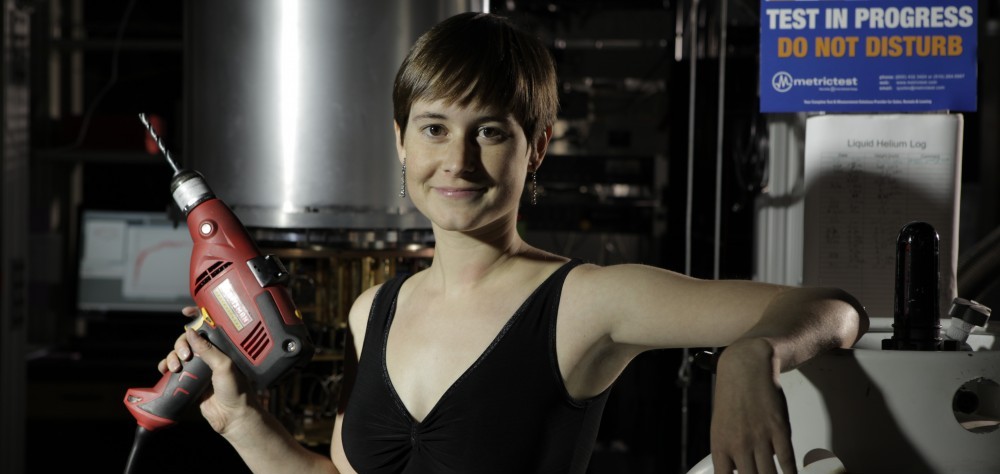
Emma Wollman, with her drill and black gown.
We had a meeting where we asked people to wear tuxes and gowns and pick the one item that they would take with them if Earth was to be evacuated; the one hobby, the one piece of identity. Initially there was paranoia, nerves and resistance, but then I cut a pitch tape to give an idea of my theme and style. They were getting convinced, but still not too sold on being so high fashion. So we met halfway. It was not the initial black, formal event attire, but it was still clean cut whilst being real, and frankly, a lot more personal in the end. People came up with very interesting stuff, whether it was Emma Wollman who held a drill and wore a gorgeous draped black gown she made herself (!), or Chen-Lung Hung, who played a violin in the Kimble lab, or Erik Henriksen with his long, lightsaber-looking device, or John Preskill with his baseball glove!

John Preskill really likes baseball.
By putting them in the labs and their environments of science, but having a fashionable look, where they were lit especially to create distance from their environment thanks to the talented cinematography of Anthony C. Kuhnz, the shots became about the person more than the science in the labs, without completely separating them. It was their identity, but not all of it.
Another segment of the video that celebrates the power of “imagination and inspiration” is the inter-cutting of archival imagery of nature and science. Whether it is a ballerina’s spin bringing to life the spin of an atom, the probabilistic nature of the casino roulette metaphorizing the inherent indeterminism of nature, or water waves moving like a sine wave display in an oscilloscope, making the viewer aware that Physics is around us in ways that we might not even notice, is important. These juxtapositions with work that is being done here at Caltech may capture the eye of a new viewer who would initially react and say, “wait a minute…what does this have to do with science?” The video is supposed to be the hook, to intrigue and confuse and question and answer and I hope it does all this and, maybe, a little more.

A ballerina swiftly turns, hinting at quantum “spin”.
Of course, the punch to it all is the incredibly exciting and goose-bumping score by British composer, Andrew T. Mackay, part of the award-winning duo of Bombay Dub Orchestra, who, within a week, scored the video remotely from his Sunshine Desserts studio in London. Having worked with him on my feature film, we had developed a short-hand of what I like and it worked, within 9 days.
And all this crazy coordination and handling was thanks to Mrs. Marcia Brown who was always far too understanding and giving. She knows how to get us absent minded scientists and artists with our quirky moods and creative withdrawals, in line and on time to get the job done.
Lastly, I leave you with a few highlights of the video to urge you to click and watch and share. My favorite part of the video now, apart from Emma Wollman’s unbelievably attractive drill shot, is the beginning text that was a complete collaboration between me, Spiros and John Preskill with emails back and forth over a Wednesday in sunny Pasadena. Preskill’s genius tagline “nature is subtle” completely summarized my vision and the vision of IQIM and its scientists. The genius, the inspiration, the movement is all too important, yet subtle…and just purely “hot” in whatever sense of the word you want to take it!

Chen-Lung Hung with his violin. The text written in collaboration with John Preskill.
Here is the intro text in the video:
There is mind
There is matter
There is motion
There is interaction
There is the universe
To understand
To change
There is you…and your imagination.
IQIM
Nature is subtle.
And now, without further ado, I present to you, the IQIM Promotional Film. Sit back, relax, enjoy and share!
Editor’s Note: Pakistani filmmaker, Iram Parveen Bilal is the CEO and Founder of Parveen Shah Productions, a film production company with offices in Pakistan and Los Angeles. Having made and distributed a few short films, she is currently touring with her noted first feature length film, JOSH (English title: Against the Grain). Bilal is a Caltech alum, BS ’04 with honors, in Environmental Science Engineering and has an MFA from the USC School of Cinematic Arts in Filmmaking. Recent awards and fellowships include the 2012 Women In Film Award, the USC Stark Special Project Award, the Thomas J. Watson Fellowship, the Paul Studenski Fellowship, the Caltech Mabel Beckman Leadership Award and the Caltech Dean’s Cup.
 ( I am looking at you Πυθαγόρα!) OK, maybe I am not giving the Ancients enough credit. I mean, they didn’t have an iPhone back then, so they probably had to do
  by hand. All kidding aside, they did generalize the previous equality to other large numbers like
  (I am feeling a little sassy today, I guess.) Still, back then, mathematics did not start as an abstract subject about relations between numbers. It grew from a naive attempt to control elements of design that were essential to living, like building airplanes and plasma TVs. The Greeks didn’t succeed then and, if I am not mistaken, they still haven’t succeeded in making either airplanes, or plasma TVs. But, back then at least, my ancestors made some beautiful buildings. Like the

 : The letter
  . You are most likely familiar with the letter-number
  (you may have even seen the modern classic, American Pie, a tour-de-force, honest look at the life of Pi. No pun intended.) But, what about the number
  ? Well, I could tell you all about this number,
  , such that
  ,
,  and
and  for all
  ?
?


 , find
  .
. , find


 Quantum Frontiers