Interacting collaborators reveal noninteracting fermions

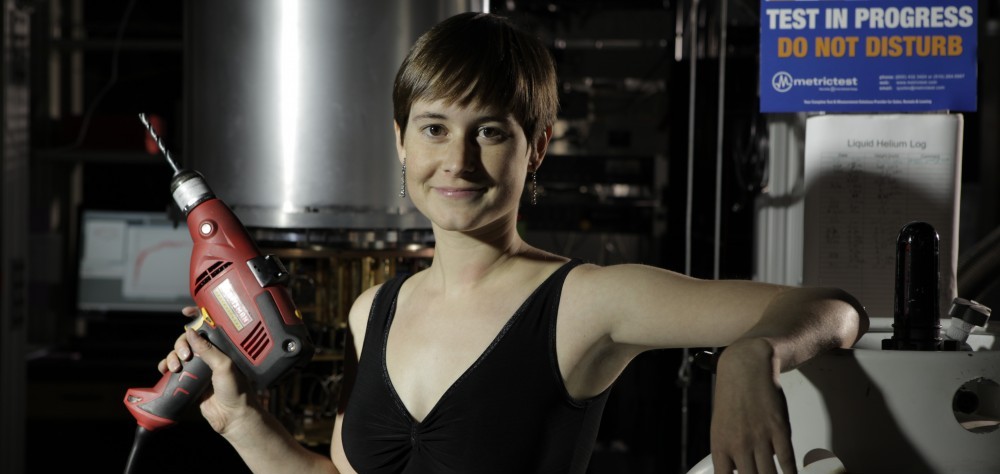
By day, I work as an experimentalist on laser-cooling molecules1, but I’ve never fully surrendered my theoretical-physics license. I started as an undergraduate in Lincoln Carr’s group at the Colorado School of Mines in Golden, CO. I learned from his expertise in simulations and complex systems. Since then I’ve moonlighted as a theorist while also pursuing an unrelated PhD and, now, an unrelated postdoc position. With Nicole Yunger Halpern and other collaborators, we devised a quantum circuit whose dynamics looked complex when run on a quantum computer. It took six years and five collaborators across four countries to discover that, for the right settings, these complex dynamics could be understood when viewed from the right angle.

Some time ago, I told you about quantum cellular automata (QCA). These quantum machines are built from one-dimensional strings of qubits. A qubit changes its state depending on the state of its two nearest neighbors. Different rules are encoded into three-qubit gates that change a central qubit based on the state of its left and right neighbors. Some rules induce change for many combinations of neighbor states. Others, less. We apply this neighborhood-constrained update in two waves, first to every other qubit, then to the ones skipped in the first wave. This is a common quantum circuit structure called a brickwork pattern. We call one rule the Goldilocks QCA: A qubit is updated if one of its neighbors is a 0 while the other is a 1 (activity); otherwise the qubit does not change its state (inactivity).
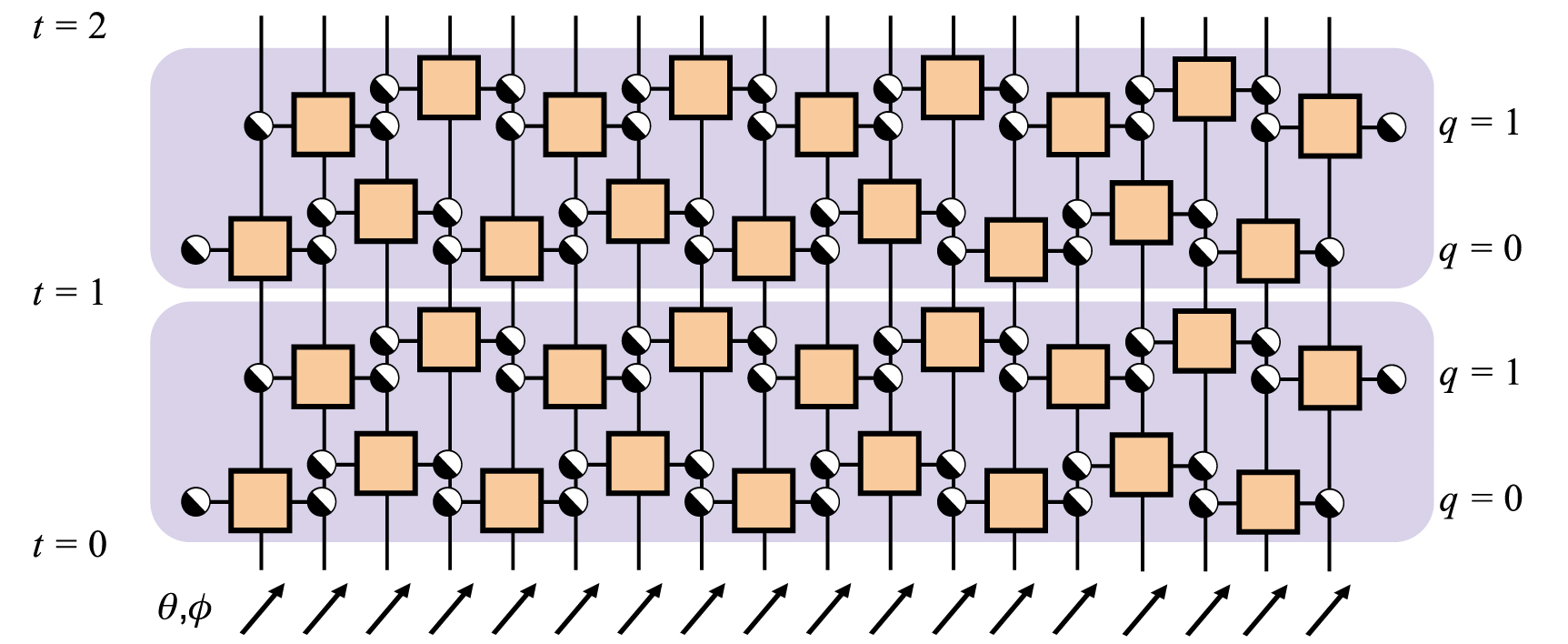
The first figure from our recent paper illustrating the Goldilocks QCA brickwork circuit. Orange boxes represent unitary gates. Half-white-half-black circles represent the Goldilocks neighborhood constraint. Some choices for the unitary gate result in free fermion dynamics. Most choices are consistent with chaos.

Repeating brickwork layers of the Goldilocks rule, we found, balances activity and inactivity to be “just right,” as Goldilocks might say. Striking this balance produced surprisingly rich patterns of quantum correlation. The same type of network structure is found in complex classical systems like metabolic pathways, social networks, and brain activity. What’s more, the observed patterns of connectivity persist through thousands of circuit layers while other QCA tend towards uniformity.
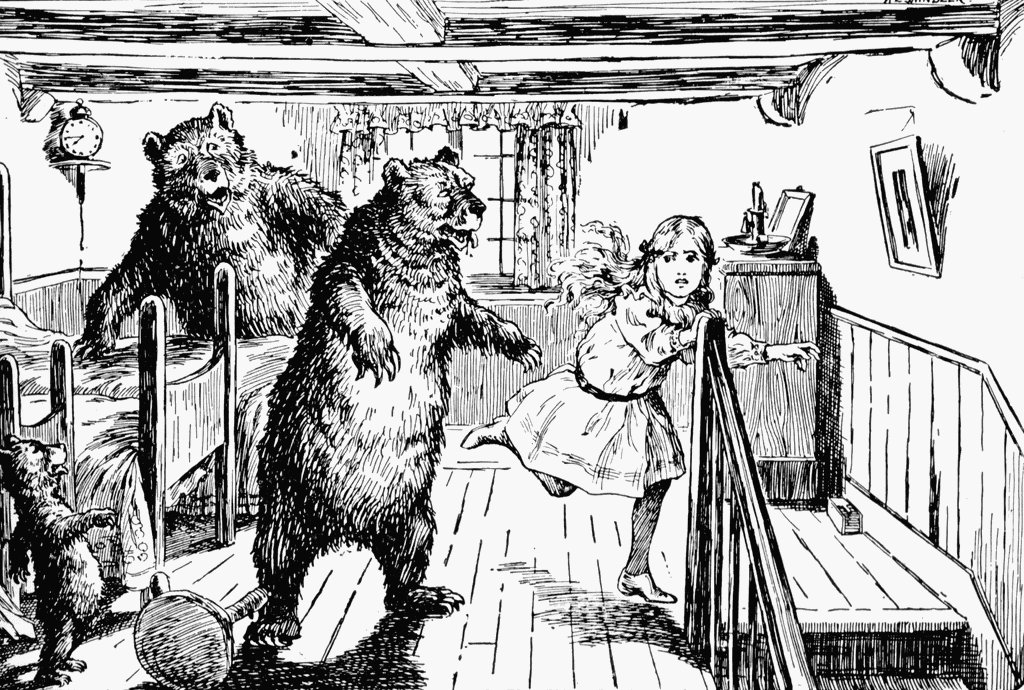
Goldilocks in a state of activity. Published by The Grolier Society, 1912

Our new paper, Integrability of Goldilocks quantum cellular automata, answers a question that’s been lurking underneath that first result for the last several years. Why does this balance produce such rich and persistent structure? Some Goldilocks QCA, we prove, map onto free fermions, one of the simplest examples of exactly solvable quantum dynamics. How does uncovering this simplification explain the persistent complex patterns? The answer follows from the concept of conservation laws. Piecing together this understanding required assembling an international team of experts who generously shared their knowledge and time. I’ll tell a bit of this scientific story through the lens of our collaboration’s history.

A key inspiration for this work started with a May 2020 video call with Norman Margolus, an MIT-affiliated researcher and pioneer of using cellular automata to model real systems. In the 1980s he worked on a custom computer chip called CAM-6, and later CAM-8, that was dedicated to simulating massive arrays of cellular automata with the limited computational resources of the era2. He proudly showed us beautiful pictures of cellular automata simulating phenomena like optical refraction and chemical reactions.
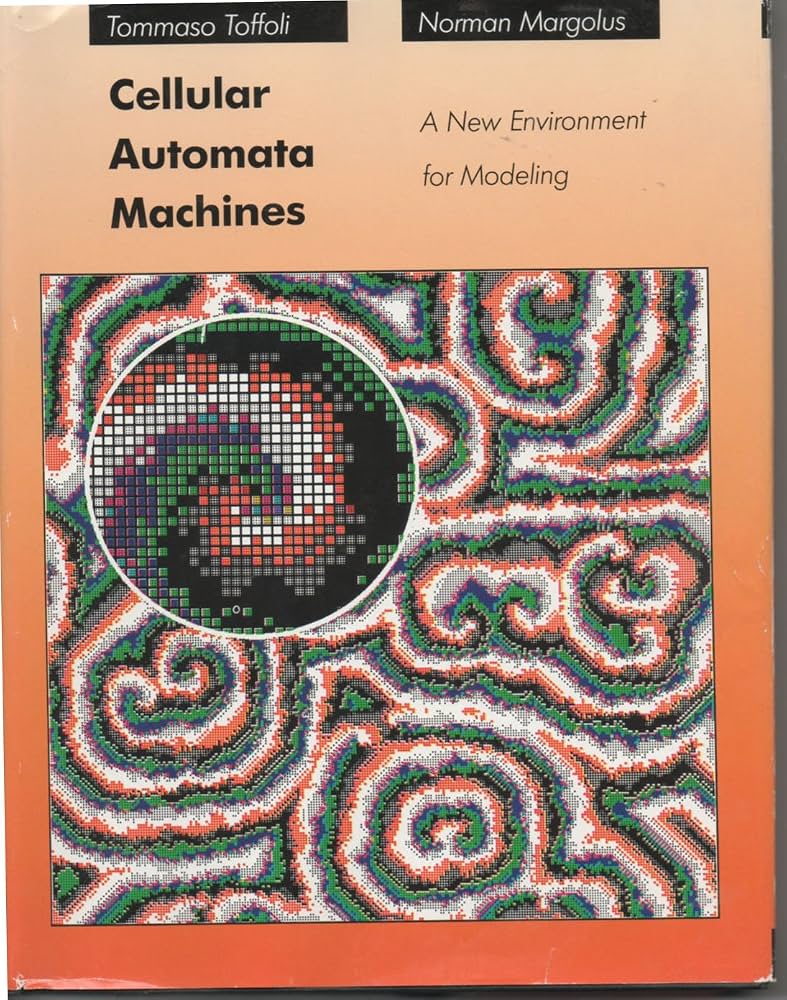
Cellular automata book by Norman Margolus. His coauthor’s name may also be familiar to those with quantum-circuit experience. Published by MIT Press, 1987.

He told us a story about trying to mimic fluid flow with the simple local rules of classical cellular automata. These models, called lattice gas automata, were first defined on a square lattice. While they did show fluid-like behavior, these models did not quite correctly conserve momentum3. Moving to a hexagonal lattice fixed up these problems and the community was able to devise cellular automata that quantitatively modeled continuum fluid flow.
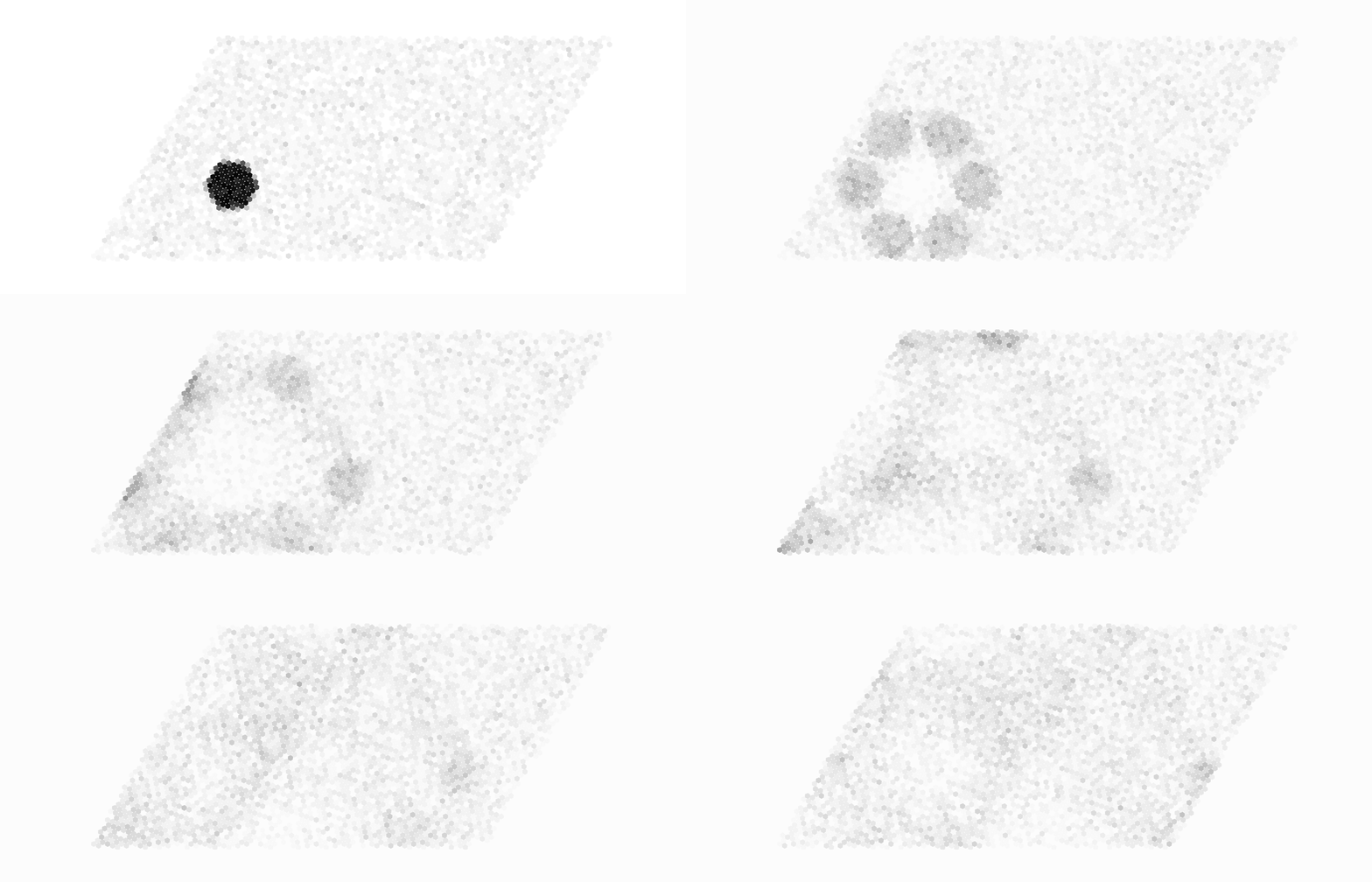
The author’s primitive lattice-gas cellular automaton showing an initial high-density region displaying wave-like propagation, reflection, and diffusion into a low-density background.

Part of that story stuck with me: conservation laws are fundamental ingredients of a physical model. Our Goldilocks quantum cellular automata, we observe, exhibit persistent complex structures. Could some conservation law be behind these observations? If found, could these conservation laws be harnessed for more efficient simulations? Going even further, could there be enough conservation laws to exactly solve the dynamics (at least in principle)? This property would buy the system membership in a special class called integrable systems.

An integrable system conserves enough quantities, often called charges in the quantum setting, that you can compute its future state from its conservation laws and its initial conditions. Two-body gravitational orbits are a classic example. The initial positions and velocities set the orbital energy and angular momentum in the center-of-mass reference frame. Those two conserved quantities let you write down an exact equation for the orbit’s shape.
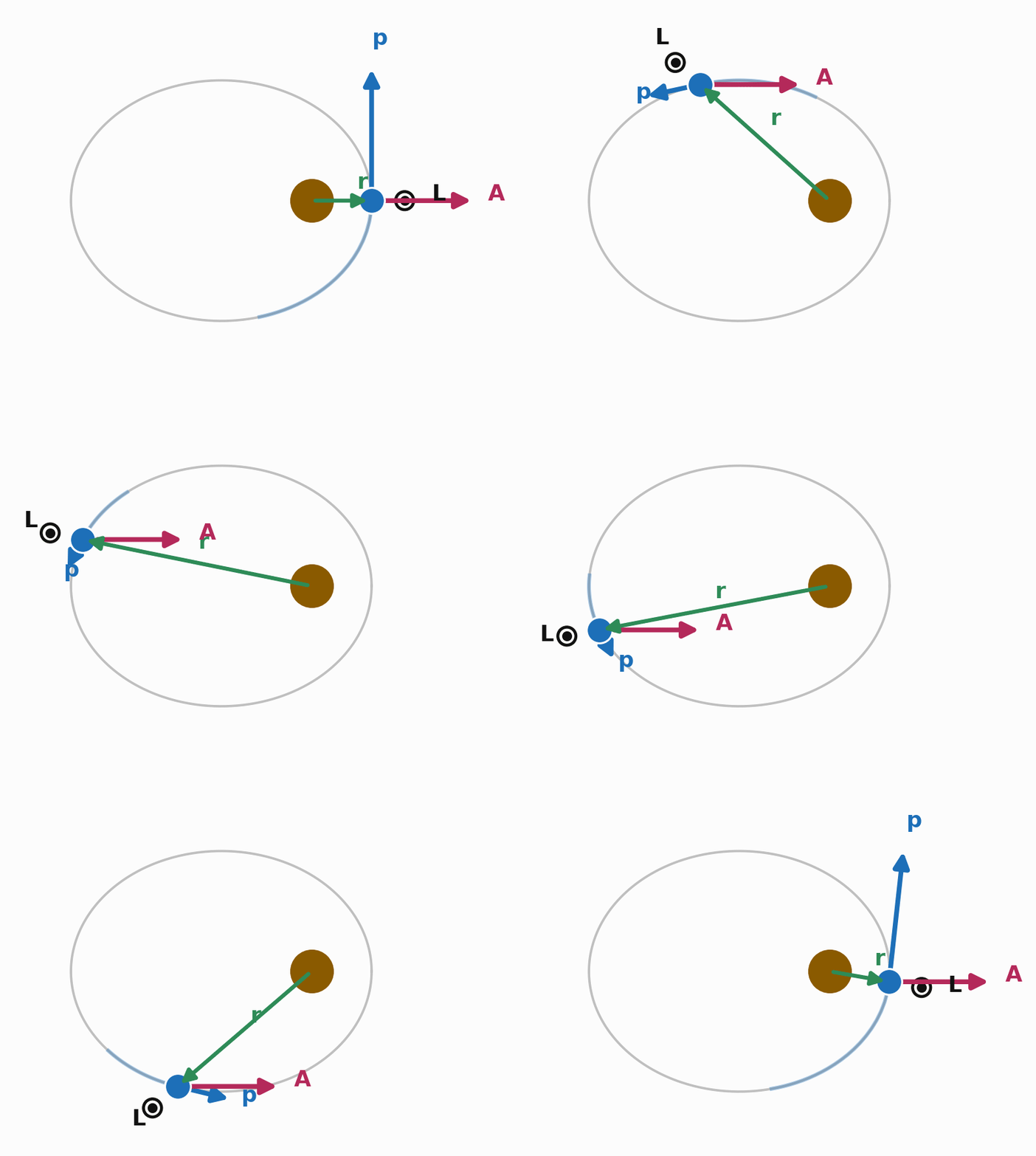
A familiar integrable system from classical mechanics: the two-body gravitational orbit. Angular momentum L=r x p is conserved. So are the total energy and the Runge-Lenz vector A.

A chaotic system, by contrast, may conserve energy and even a few other quantities, but not enough for us to solve for the state arbitrarily far in the future. To find out what a chaotic system does, you have to evolve the equations of motion approximately—one small time step at a time. Chaotic systems are the norm in nature; integrable ones are rare. To illustrate their qualitative differences, compare the regularity of the above orbit to the trend towards uniformity in the above lattice-gas simulation. In the quantum regime, physicists still don’t fully agree on the precise definition of integrability, though conservation of many independent quantities is a strong indicator.

In August 2020, Nicole emailed Lorenzo Piroli about his preprint on QCA, now published as Phys. Rev. Lett. 125, 190402. Lorenzo was a postdoc at the Max Planck Institute for Quantum Optics in Garching, Germany when we first met. He is now an associate professor at the University of Bologna and expert in many-body quantum dynamics. The correspondence that unfolded set the blueprint for the research effort that followed. One of us would ask a question, and Lorenzo would respond incredibly fast with accurate and useful detail. He started working with us to understand why the Goldilocks QCA dynamics appeared so unique. Lorenzo would suggest computations, I would implement them, and we would discuss what the results meant.

Then came an echo of the collaboration’s inception. In May 2021, Nicole pointed out a relevant preprint from Tomaž Prosen, now published in Chaos 31, 093101. Tomaž is a Slovenian physicist at the University of Ljubljana and a leading researcher in the fields of quantum chaos and integrability. I sent an email about the connections between our work and his. He responded with enthusiasm. He shared some code that would, through exhaustive search, find quantities conserved by our QCA.

The code’s brute-force approach meant the algorithm could only find conservation laws defined over, at most, a 5-qubit subsystem. A tantalizing signal emerged: the number of conserved quantities supported by 5 qubits exceeded the number supported by 3 qubits. Having more and more conserved quantities as you look at larger neighborhoods is a signature of integrability. Soon after, Tomaž proved one of our Goldilocks QCA is integrable using a well-established toolkit from statistical mechanics called Yang-Baxter integrability. He built a parametric transfer matrix, essentially a machine that spits out a new conserved quantity every time you turn its mathematical crank4.
Rodney Baxter’s classic textbook. Published by Academic Press, 1982

But there was a wrinkle. The transfer matrix generates charges that mutually commute, meaning you can measure them simultaneously. For example, you can know a quantum particle’s kinetic energy and momentum simultaneously because those operators commute. Yet, the search algorithm kept finding charges that did not commute with each other, like a particle’s position and momentum. The only explanation was that our QCA has more charges than the transfer matrix method guarantees, and more than are minimally required for integrability. This extra-conservation-law property, called superintegrability, also shows up in two-body gravitational orbits. In addition to energy and angular momentum, orbits conserve the Runge-Lenz vector. Nicole is an expert on noncommuting charges, so this is where one of her main research efforts entered the QCA collaboration.

Next came a key insight from Lorenzo: the automaton we had been considering was one member of a larger family of integrable Goldilocks QCA. He showed this using a Jordan-Wigner transformation, a mathematical dictionary that translates between the language of qubits and the language of fermions. Complexity in the qubit language transformed into simplicity in the fermion language. Under this translation, our QCA mapped to noninteracting, or free, fermions: particles that never bump into or influence each other. That lack of interaction is what makes free-fermion dynamics easy to calculate. A system of free fermions is a well-known example of superintegrability.

Along the way, Lorenzo recruited his friend and collaborator Eric Vernier, a CNRS researcher based in Paris, France. He is an expert on vertex models. The classical version of the six-vertex model was developed in the 1930s to explain a troubling mystery: Water ice appears to have more entropy than permitted by the third law of thermodynamics at near-zero temperature. In the six-vertex model, a water molecule’s oxygen atom is envisioned at every vertex in a square lattice. Each molecule contributes two hydrogen ions, to use Baxter’s terminology, that fall along the lattice edges. Intermolecular hydrogen bonds between adjacent molecules slightly alter the intramolecular O-H bonds. To maintain electrical neutrality, each oxygen (lattice vertex) has two nearby and two far-away hydrogen ions (four edges), leading to six possible ice vertices. The vertices are commonly visualized in three ways: 1) as the dots representing hydrogen ions located on edges near or far from each vertex, 2) as electric dipole arrows pointing into (“ion is close”) or out of (“ion is far”) each vertex, or 3) as thick (downward- and leftward-pointing dipoles) and thin (upward- and rightward-pointing dipoles) edges. Despite the model’s simplicity (2D square lattice) compared to real ice (3D tetrahedral lattice), it agrees with experimentally measured entropy values to better than 2%.
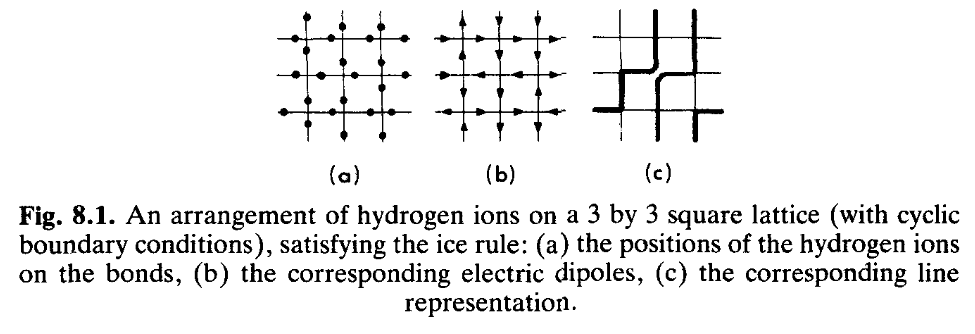
This figure appears in chapter 8 of R.J. Baxter’s book. It shows three visualizations of the same ice crystal.

More recently, vertex models have been adapted from two-dimensional classical crystals to one-dimensional quantum systems that evolve in time. Eric showed us how the ice vertices relate to QCA circuit rules. In doing so, Eric uncovered an even larger set of integrable Goldilocks QCA than that found by Lorenzo. Eventually, Lorenzo’s Jordan-Wigner transformation method and Eric’s six-vertex method agreed on the complete family of integrable Goldilocks QCA.

Representation of the six ice vertices from our recent paper (rotated 45 degrees from the lattice shown above). The a, b, and c variables represent the classical statistical weight or the quantum transition amplitude for each vertex type.

We finally had our Avengers-style collaboration: individual heroes brought together to wield their unique strengths. With Lincoln’s supervision, I developed the QCA models and performed the computations. Lorenzo found the Jordan-Wigner transformation. Tomaž found the first signals of integrability and delivered a set of conservation laws. Nicole brought her expertise in quantum thermodynamics, clarifying how the noncommuting charges constrain dynamics. Eric made the six-vertex connection. We drafted and redrafted the paper until it balanced the scientific story, the analytical derivations, and the numerical evidence.
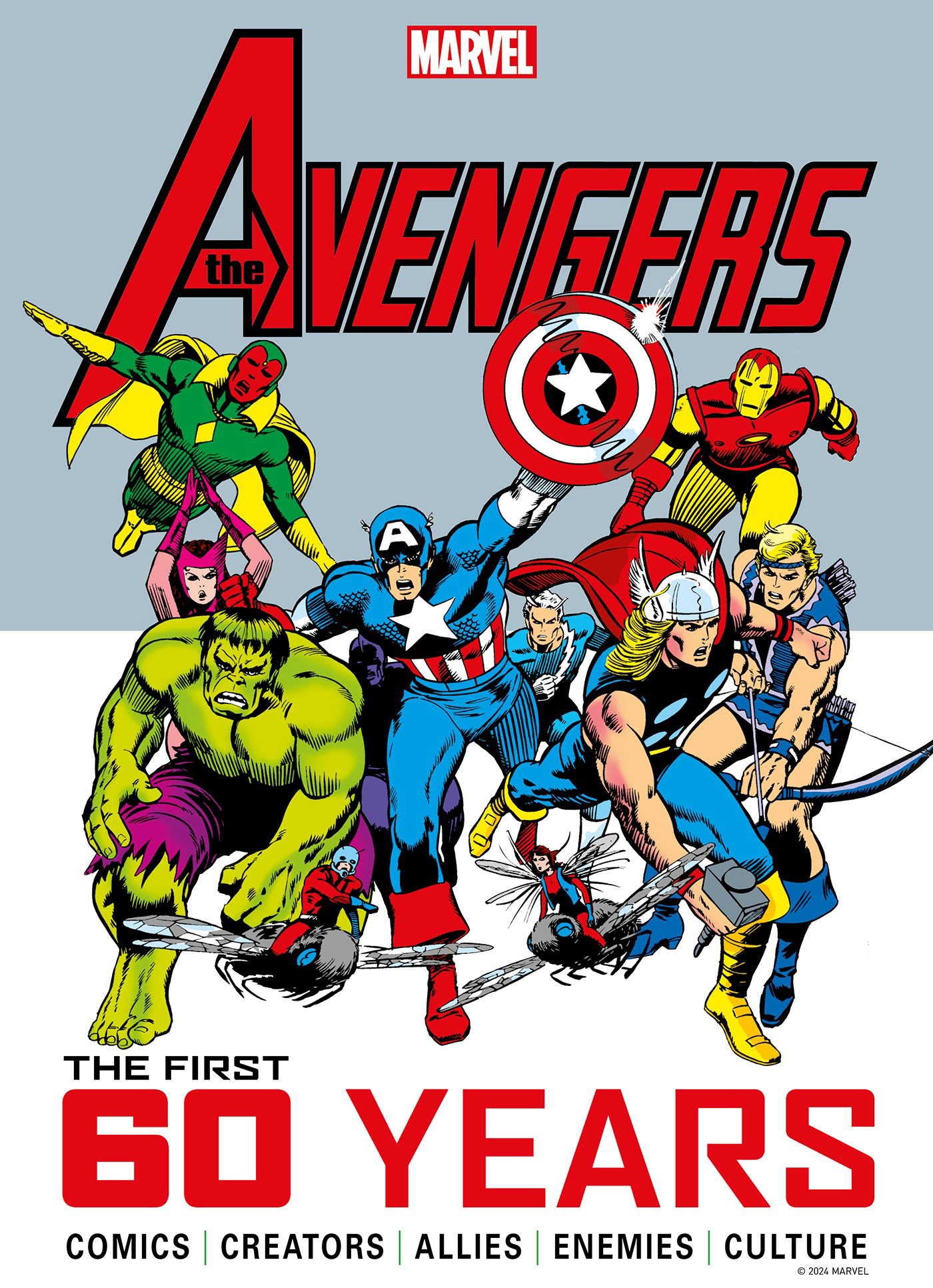
Our team collaborated over six years.
Art by Barry Windsor-Smith. Published by Titan Comics, 2024

Because the discovered family of Goldilocks QCA maps to free fermions, we can efficiently simulate them classically. I simulated 256 qubits on my laptop this way. These large simulations were satisfying: I had worked with this model for years with an order of magnitude fewer qubits and even saw the dynamics implemented on Google’s Sycamore-era hardware with 23 qubits. Most Goldilocks QCA are consistent with chaos rather than integrability, and therefore hard to simulate classically. Therefore, our work gives experimentalists a tunable model: dial in integrable dynamics for something checkable at large qubit number. Set up chaotic dynamics for a potential demonstration of quantum advantage.

While preparing this post, I opened my old email account to check the timeline set out above. I looked through nearly six years of email chains, some with hundreds of messages, full of logistics for coordinating each author’s ever-changing time zone, and dozens of calculations and results that never made it into the paper. This collaboration helped me grow as a researcher in a big way.

I found old emails where Nicole was coaching me on messaging potential collaborators. I can hardly believe she dedicated so much effort to mentoring me. We have never met in person, despite our shared work starting when I was an undergraduate and she was a graduate student more than a decade ago. If you know Nicole, you can probably believe it easily. I had similar moments with each collaborator. They all gave their time and expertise generously over the many years this paper took to come together.

As I continue my efforts in experimental physics, I will pay forward the effort and generosity shared with me by this collaboration. I may even keep my theoretical-physics license for a while longer.

  1. “By day” doesn’t mean “by daylight.” Laser labs are almost always in a windowless basement. ↩︎
  2. CAM-6 featured 32 kB of cell-state memory (CAM-8 had 8 MB ), far less than the memory currently used by this author’s numerous open browser tabs. ↩︎
  3. The coarse-grained momentum flux tensor was anisotropic. ↩︎
  4. Logarithmic derivatives of the parametric transfer matrix generate the conserved charges. ↩︎

Balancing the tradeoff

So much to do, so little time. Tending to one task is inevitably at the cost of another, so how does one decide how to spend their time? In the first few years of my PhD, I balanced problem sets, literature reviews, and group meetings, but at the detriment to my hobbies. I have played drums my entire life, but I largely fell out of practice in graduate school. Recently, I made time to play with a group of musicians, even landing a couple gigs in downtown Austin, Texas, “live music capital of the world.” I have found attending to my non-physics interests makes my research hours more productive and less taxing. Finding the right balance of on- versus off-time has been key to my success as my PhD enters its final year.

Of course, life within physics is also full of tradeoffs. My day job is as an experimentalist. I use tightly focused laser beams, known as optical tweezers, to levitate micrometer-sized glass spheres. I monitor a single microsphere’s motion as it undergoes collisions with air molecules, and I study the system as an environmental sensor of temperature, fluid flow, and acoustic waves; however, by night I am a computational physicist. I code simulations of interacting qubits subject to kinetic constraints, so-called quantum cellular automata (QCA). My QCA work started a few years ago for my Master’s degree, but my interest in the subject persists. I recently co-authored one paper summarizing the work so far and another detailing an experimental implementation.

The author doing his part to “keep Austin weird” by playing the drums dressed as grackle (note the beak), the central-Texas bird notorious for overrunning grocery store parking lots.
Balancing research interests: Trapping a glass microsphere with optical tweezers.
Balancing research interests: Visualizing the time evolution of four different QCA rules.

QCA, the subject of this post, are themselves tradeoff-aware systems. To see what I mean, first consider their classical counterparts cellular automata. In their simplest construction, the system is a one-dimensional string of bits. Each bit takes a value of 0 or 1 (white or black). The bitstring changes in discrete time steps based on a simultaneously-applied local update rule: Each bit, along with its two nearest-neighbors, determine the next state of the central bit. Put another way, a bit either flips, i.e., changes 0 to 1 or 1 to 0, or remains unchanged over a timestep depending on the state of that bit’s local neighborhood. Thus, by choosing a particular rule, one encodes a trade off between activity (bit flips) and inactivity (bit remains unchanged). Despite their simple construction, cellular automata dynamics are diverse; they can produce fractals and encryption-quality random numbers. One rule even has the ability to run arbitrary computer algorithms, a property known as universal computation.

Classical cellular automata. Left: rule 90 producing the fractal Sierpiński’s triangle. Middle: rule 30 can be used to generate random numbers. Right: rule 110 is capable of universal computation.

In QCA, bits are promoted to qubits. Instead of being just 0 or 1 like a bit, a qubit can be a continuous mixture of both 0 and 1, a property called superposition. In QCA, a qubit’s two neighbors being 0 or 1 determine whether or not it changes. For example, when in an active neighborhood configuration, a qubit can be coded to change from 0 to “0 plus 1” or from 1 to “0 minus 1”. This is already a head-scratcher, but things get even weirder. If a qubit’s neighbors are in a superposition, then the center qubit can become entangled with those neighbors. Entanglement correlates qubits in a way that is not possible with classical bits.

Do QCA support the emergent complexity observed in their classical cousins? What are the effects of a continuous state space, superposition, and entanglement? My colleagues and I attacked these questions by re-examining many-body physics tools through the lens of complexity science. Singing the lead, we have a workhorse of quantum and solid-state physics: two-point correlations. Singing harmony we have the bread-and-butter of network analysis: complex-network measures. The duet between the two tells the story of structured correlations in QCA dynamics.

In a bit more detail, at each QCA timestep we calculate the mutual information between all qubits i and all other qubits j. Doing so reveals how much there is to learn about one qubit by measuring another, including effects of quantum entanglement. Visualizing each qubit as a node, the mutual information can be depicted as weighted links between nodes: the more correlated two qubits are, the more strongly they are linked. The collection of nodes and links makes a network. Some QCA form unstructured, randomly-linked networks while others are highly structured. 

Complex-network measures are designed to highlight certain structural patterns within a network. Historically, these measures have been used to study diverse networked-systems like friend groups on Facebook, biomolecule pathways in metabolism, and functional-connectivity in the brain. Remarkably, the most structured QCA networks we observed quantitatively resemble those of the complex systems just mentioned despite their simple construction and quantum unitary dynamics. 

Visualizing mutual information networks. Left: A Goldilocks-QCA generated network. Right: a random network.

What’s more, the particular QCA that generate the most complex networks are those that balance the activity-inactivity trade-off. From this observation, we formulate what we call the Goldilocks principle: QCA that generate the most complexity are those that change a qubit if and only if the qubit’s neighbors contain an equal number of 1’s and 0’s. The Goldilocks rules are neither too inactive nor too active, balancing the tradeoff to be “just right.”  We demonstrated the Goldilocks principle for QCA with nearest-neighbor constraints as well as QCA with nearest-and-next-nearest-neighbor constraints.

To my delight, the scientific conclusions of my QCA research resonate with broader lessons-learned from my time as a PhD student: Life is full of trade-offs, and finding the right balance is key to achieving that “just right” feeling.

Life, cellular automata, and mentoring

One night last July, IQIM postdoc Ning Bao emailed me a photo. He’d found a soda can that read, “Share a Coke with Patrick.”

Ning and I were co-mentoring two Summer Undergraduate Research Fellows, or SURFers. One mentee received Ning’s photo: Caltech physics major Patrick Rall.

“Haha,” Patrick emailed back. “I’ll share a Coke.”

Patrick, Ning, and I shared the intellectual equivalent of a six-pack last summer. We shared papers, meals, frustrations, hopes, late-night emails (from Patrick and Ning), 7-AM emails (from me), and webcomic strips. Now a senior, Patrick is co-authoring a paper about his SURF project.

The project grew from the question “What would happen if we quantized Conway’s Game of Life?” (For readers unfamiliar with the game, I’ll explain below.) Lessons we learned about the Game of Life overlapped with lessons I learned about life, as a first-time mentor. The soda fountain of topics contained the following flavors.

Patrick + Coke

Update rules: Till last spring, I’d been burrowing into two models for out-of-equilibrium physics. PhD students burrow as no prairie dogs can. But, given five years in Caltech’s grassland, I wanted to explore. I wanted an update.

Ning and I had trespassed upon quantum game theory months earlier. Consider a nonquantum game, such as the Prisoner’s Dilemma or an election. Suppose that players have physical systems, such as photons (particles of light), that occupy superposed or entangled states. These quantum resources can change the landscape of the game’s possible outcomes. These changes clarify how we can harness quantum mechanics to process, transmit, and secure information.

How might quantum resources change Conway’s Game of Life, or GoL? British mathematician John Conway invented the game in 1970. Imagine a square board divided into smaller squares, or cells. On each cell sits a white or a black tile. Black represents a living organism; white represents a lack thereof.

Conway modeled population dynamics with an update rule. If prairie dogs overpopulate a field, some die from overcrowding. If a black cell borders more than three black neighbors, a white tile replaces the black. If separated from its pack, a prairie dog dies from isolation. If a black tile borders too few black neighbors, we exchange the black for a white. Mathematics columnist Martin Gardner detailed the rest of Conway’s update rule in this 1970 article.

Updating the board repeatedly evolves the population. Black and white shapes might flicker and undulate. Space-ship-like shapes can glide across the board. A simple update rule can generate complex outcomes—including, I found, frustrations, hopes, responsibility for another human’s contentment, and more meetings than I’d realized could fit in one summer.

Prairie dogs

Modeled by Conway’s Game of Life. And by PhD students.

Initial conditions: The evolution depends on the initial state, on how you distribute white and black tiles when preparing the board. Imagine choosing the initial state randomly from all the possibilities. White likely mingles with about as much black. The random initial condition might not generate eye-catchers such as gliders. The board might fade to, and remain, one color.*

Enthusiasm can fade as research drags onward. Project Quantum GoL has continued gliding due to its initial condition: The spring afternoon on which Ning, Patrick, and I observed the firmness of each other’s handshakes; Patrick walked Ning and me through a CV that could have intimidated a postdoc; and everyone tried to soothe everyone else’s nerves but occasionally avoided eye contact.

I don’t mean that awkwardness sustained the project. The awkwardness faded, as exclamation points and smiley faces crept into our emails. I mean that Ning and I had the fortune to entice Patrick. We signed up a bundle of enthusiasm, creativity, programming skills, and determination. That determination perpetuated the project through the summer and beyond. Initial conditions can determine a system’s evolution.

Long-distance correlations:  “Sure, I’d love to have dinner with you both! Thank you for the invitation!”

Lincoln Carr, a Colorado School of Mines professor, visited in June. Lincoln’s group, I’d heard, was exploring quantum GoLs.** He studies entanglement (quantum correlations) in many-particle systems. When I reached out, Lincoln welcomed our SURF group to collaborate.

I relished coordinating his visit with the mentees. How many SURFers could say that a professor had visited for his or her sake? When I invited Patrick to dinner with Lincoln, Patrick lit up like a sunrise over grasslands.

Our SURF group began skyping with Mines every Wednesday. We brainstorm, analyze, trade code, and kvetch with Mines student Logan Hillberry and colleagues. They offer insights about condensed matter; Patrick, about data processing and efficiency; I, about entanglement theory; and Ning, about entropy and time evolution.

We’ve learned together about long-range entanglement, about correlations between far-apart quantum systems. Thank goodness for skype and email that correlate far-apart research groups. Everyone would have learned less alone.

Correlations.001

Long-distance correlations between quantum states and between research groups

Time evolution: Logan and Patrick simulated quantum systems inspired by Conway’s GoL. Each researcher coded a simulation, or mathematical model, of a quantum system. They agreed on a nonquantum update rule; Logan quantized it in one way (constructed one quantum analog of the rule); and Patrick quantized the rule another way. They chose initial conditions, let their systems evolve, and waited.

In July, I noticed that Patrick brought a hand-sized green spiral notepad to meetings. He would synopsize his progress, and brainstorm questions, on the notepad before arriving. He jotted suggestions as we talked.

The notepad began guiding meetings in July. Patrick now steers discussions, ticking items off his agenda. The agenda I’ve typed remains minimized on my laptop till he finishes. My agenda contains few points absent from his, and his contains points not in mine.

Patrick and Logan are comparing their results. Behaviors of their simulations, they’ve found, depend on how they quantized their update rule. One might expect the update rule to determine a system’s evolution. One might expect the SURF program’s template to determine how research and mentoring skills evolve. But how we implement update rules matters.

SURF photo

Caltech’s 2015 quantum-information-theory Summer Undergraduate Research Fellows and mentors

Life: I’ve learned, during the past six months, about Conway’s Game of Life, simulations, and many-body entanglement. I’ve learned how to suggest references and experts when I can’t answer a question. I’ve learned that editing SURF reports by hand costs me less time than editing electronically. I’ve learned where Patrick and his family vacation, that he’s studying Chinese, and how undergrads regard on-campus dining. Conway’s Game of Life has expanded this prairie dog’s view of the grassland more than expected.

I’ll drink a Coke to that.

Glossary: Conway’s GoL is a cellular automatonA cellular automaton consists of a board whose tiles change according to some update rule. Different cellular automata correspond to different board shapes, to boards of different dimensions, to different types of tiles, and to different update rules.

*Reversible cellular automata have greater probabilities (than the GoL has) of updating random initial states through dull-looking evolutions.

**Others have pondered quantum variations on Conway’s GoL.