Quantum computing in the second quantum century

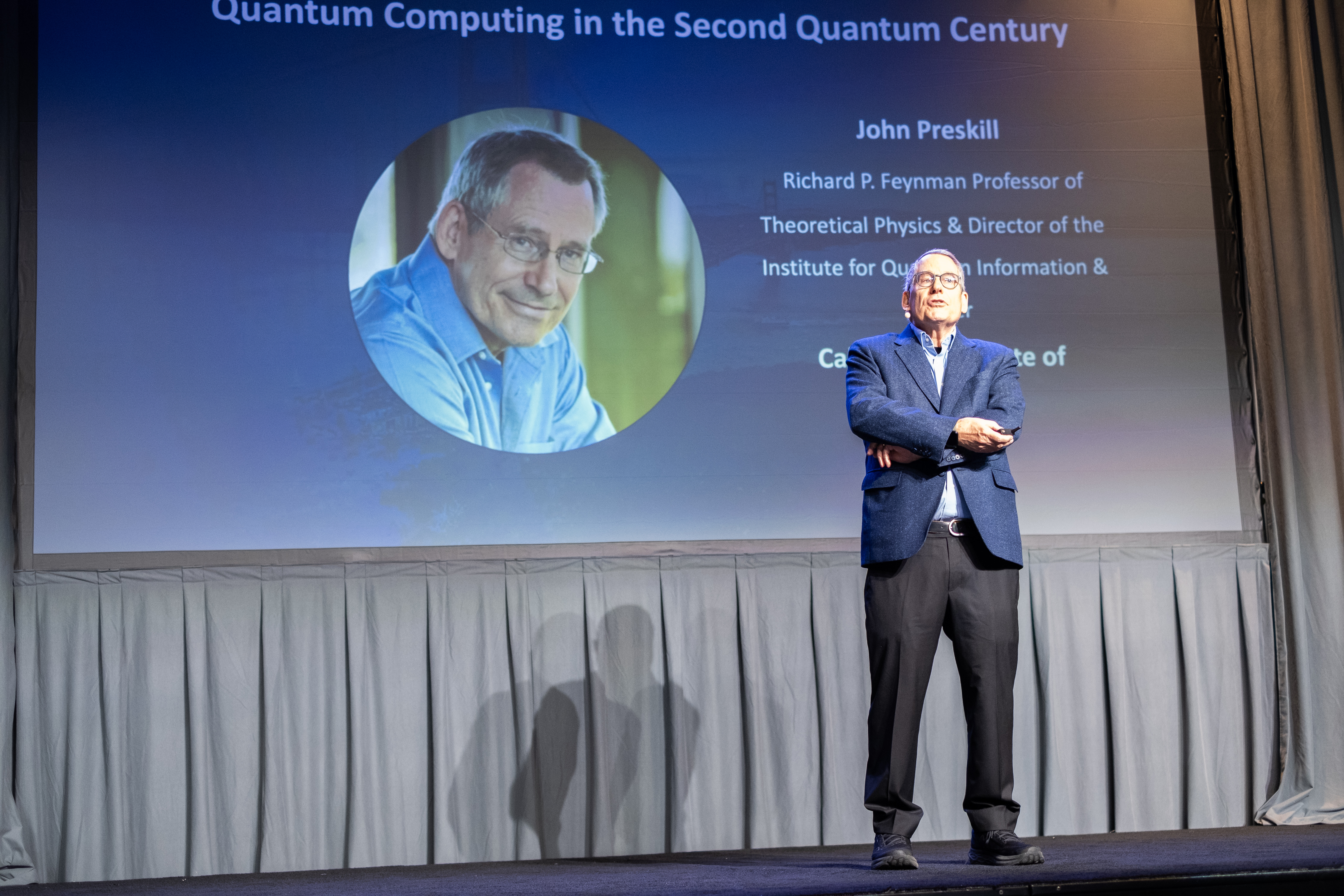
On December 10, I gave a keynote address at the Q2B 2025 Conference in Silicon Valley. This is a transcript of my remarks. The slides I presented are here.

The first century

We are nearing the end of the International Year of Quantum Science and Technology, so designated to commemorate the 100th anniversary of the discovery of quantum mechanics in 1925. The story goes that 23-year-old Werner Heisenberg, seeking relief from severe hay fever, sailed to the remote North Sea Island of Helgoland, where a crucial insight led to his first, and notoriously obscure, paper describing the framework of quantum mechanics.

In the years following, that framework was clarified and extended by Heisenberg and others. Notably among them was Paul Dirac, who emphasized that we have a theory of almost everything that matters in everyday life. It’s the Schrödinger equation, which captures the quantum behavior of many electrons interacting electromagnetically with one another and with atomic nuclei. That describes everything in chemistry and materials science and all that is built on those foundations. But, as Dirac lamented, in general the equation is too complicated to solve for more than a few electrons.

Somehow, over 50 years passed before Richard Feynman proposed that if we want a machine to help us solve quantum problems, it should be a quantum machine, not a classical machine. The quest for such a machine, he observed, is “a wonderful problem because it doesn’t look so easy,” a statement that still rings true.

I was drawn into that quest about 30 years ago. It was an exciting time. Efficient quantum algorithms for the factoring and discrete log problems were discovered, followed rapidly by the first quantum error-correcting codes and the foundations of fault-tolerant quantum computing. By late 1996, it was firmly established that a noisy quantum computer could simulate an ideal quantum computer efficiently if the noise is not too strong or strongly correlated. Many of us were then convinced that powerful fault-tolerant quantum computers could eventually be built and operated.

Three decades later, as we enter the second century of quantum mechanics, how far have we come? Today’s quantum devices can perform some tasks beyond the reach of the most powerful existing conventional supercomputers. Error correction had for decades been a playground for theorists; now informative demonstrations are achievable on quantum platforms. And the world is investing heavily in advancing the technology further.

Current NISQ machines can perform quantum computations with thousands of two-qubit gates, enabling early explorations of highly entangled quantum matter, but still with limited commercial value. To unlock a wide variety of scientific and commercial applications, we need machines capable of performing billions or trillions of two-qubit gates. Quantum error correction is the way to get there.

I’ll highlight some notable developments over the past year—among many others I won’t have time to discuss. (1) We’re seeing intriguing quantum simulations of quantum dynamics in regimes that are arguably beyond the reach of classical simulations. (2) Atomic processors, both ion traps and neutral atoms in optical tweezers, are advancing impressively. (3) We’re acquiring a deeper appreciation of the advantages of nonlocal connectivity in fault-tolerant protocols. (4) And resource estimates for cryptanalytically relevant quantum algorithms have dropped sharply.

Quantum machines for science

A few years ago, I was not particularly excited about running applications on the quantum platforms that were then available; now I’m more interested. We have superconducting devices from IBM and Google with over 100 qubits and two-qubit error rates approaching 10^{-3}. The Quantinuum ion trap device has even better fidelity as well as higher connectivity. Neutral-atom processors have many qubits; they lag behind now in fidelity, but are improving.

Users face tradeoffs: The high connectivity and fidelity of ion traps is an advantage, but their clock speeds are orders of magnitude slower than for superconducting processors. That limits the number of times you can run a given circuit, and therefore the attainable statistical accuracy when estimating expectations of observables.

Verifiable quantum advantage

Much attention has been paid to sampling from the output of random quantum circuits, because this task is provably hard classically under reasonable assumptions. The trouble is that, in the high-complexity regime where a quantum computer can reach far beyond what classical computers can do, the accuracy of the quantum computation cannot be checked efficiently. Therefore, attention is now shifting toward verifiable quantum advantage — tasks where the answer can be checked. If we solved a factoring or discrete log problem, we could easily check the quantum computer’s output with a classical computation, but we’re not yet able to run these quantum algorithms in the classically hard regime. We might settle instead for quantum verification, meaning that we check the result by comparing two quantum computations and verifying the consistency of the results.

A type of classical verification of a quantum circuit was demonstrated recently by BlueQubit on a Quantinuum processor. In this scheme, a designer builds a family of so-called “peaked” quantum circuits such that, for each such circuit and for a specific input, one output string occurs with unusually high probability. An agent with a quantum computer who knows the circuit and the right input can easily identify the preferred output string by running the circuit a few times. But the quantum circuits are cleverly designed to hide the peaked output from a classical agent — one may argue heuristically that the classical agent, who has a description of the circuit and the right input, will find it hard to predict the preferred output. Thus quantum agents, but not classical agents, can convince the circuit designer that they have reliable quantum computers. This observation provides a convenient way to benchmark quantum computers that operate in the classically hard regime.

The notion of quantum verification was explored by the Google team using Willow. One can execute a quantum circuit acting on a specified input, and then measure a specified observable in the output. By repeating the procedure sufficiently many times, one obtains an accurate estimate of the expectation value of that output observable. This value can be checked by any other sufficiently capable quantum computer that runs the same circuit. If the circuit is strategically chosen, then the output value may be very sensitive to many-qubit interference phenomena, in which case one may argue heuristically that accurate estimation of that output observable is a hard task for classical computers. These experiments, too, provide a tool for validating quantum processors in the classical hard regime. The Google team even suggests that such experiments may have practical utility for inferring molecular structure from nuclear magnetic resonance data.

Correlated fermions in two dimensions

Quantum simulations of fermionic systems are especially compelling, since electronic structure underlies chemistry and materials science. These systems can be hard to simulate in more than one dimension, particularly in parameter regimes where fermions are strongly correlated, or in other words profoundly entangled. The two-dimensional Fermi-Hubbard model is a simplified caricature of two-dimensional materials that exhibit high-temperature superconductivity and hence has been much studied in recent decades. Large-scale tensor-network simulations are reasonably successful at capturing static properties of this model, but the dynamical properties are more elusive.

Dynamics in the Fermi-Hubbard model has been simulated recently on both Quantinuum (here and here) and Google processors. Only a 6 x 6 lattice of electrons was simulated, but this is already well beyond the scope of exact classical simulation. Comparing (error-mitigated) quantum circuits with over 4000 two-qubit gates to heuristic classical tensor-network and Majorana path methods, discrepancies were noted, and the Phasecraft team argues that the quantum simulation results are more trustworthy. The Harvard group also simulated models of fermionic dynamics, but were limited to relatively low circuit depths due to atom loss. It’s encouraging that today’s quantum processors have reached this interesting two-dimensional strongly correlated regime, and with improved gate fidelity and noise mitigation we can go somewhat further, but expanding system size substantially in digital quantum simulation will require moving toward fault-tolerant implementations. We should also note that there are analog Fermi-Hubbard simulators with thousands of lattice sites, but digital simulators provide greater flexibility in the initial states we can prepare, the observables we can access, and the Hamiltonians we can reach.

When it comes to many-particle quantum simulation, a nagging question is: “Will AI eat quantum’s lunch?” There is surging interest in using classical artificial intelligence to solve quantum problems, and that seems promising. How will AI impact our quest for quantum advantage in this problem space? This question is part of a broader issue: classical methods for quantum chemistry and materials have been improving rapidly, largely because of better algorithms, not just greater processing power. But for now classical AI applied to strongly correlated matter is hampered by a paucity of training data.  Data from quantum experiments and simulations will likely enhance the power of classical AI to predict properties of new molecules and materials. The practical impact of that predictive power is hard to clearly foresee.

The need for fundamental research

Today is December 10th, the anniversary of Alfred Nobel’s death. The Nobel Prize award ceremony in Stockholm concluded about an hour ago, and the Laureates are about to sit down for a well-deserved sumptuous banquet. That’s a fitting coda to this International Year of Quantum. It’s useful to be reminded that the foundations for today’s superconducting quantum processors were established by fundamental research 40 years ago into macroscopic quantum phenomena. No doubt fundamental curiosity-driven quantum research will continue to uncover unforeseen technological opportunities in the future, just as it has in the past.

I have emphasized superconducting, ion-trap, and neutral atom processors because those are most advanced today, but it’s vital to continue to pursue alternatives that could suddenly leap forward, and to be open to new hardware modalities that are not top-of-mind at present. It is striking that programmable, gate-based quantum circuits in neutral-atom optical-tweezer arrays were first demonstrated only a few years ago, yet that platform now appears especially promising for advancing fault-tolerant quantum computing. Policy makers should take note!

The joy of nonlocal connectivity

As the fault-tolerant era dawns, we increasingly recognize the potential advantages of the nonlocal connectivity resulting from atomic movement in ion traps and tweezer arrays, compared to geometrically local two-dimensional processing in solid-state devices. Over the past few years, many contributions from both industry and academia have clarified how this connectivity can reduce the overhead of fault-tolerant protocols.

Even when using the standard surface code, the ability to implement two-qubit logical gates transversally—rather than through lattice surgery—significantly reduces the number of syndrome-measurement rounds needed for reliable decoding, thereby lowering the time overhead of fault tolerance. Moreover, the global control and flexible qubit layout in tweezer arrays increase the parallelism available to logical circuits.

Nonlocal connectivity also enables the use of quantum low-density parity-check (qLDPC) codes with higher encoding rates, reducing the number of physical qubits needed per logical qubit for a target logical error rate. These codes now have acceptably high accuracy thresholds, practical decoders, and—thanks to rapid theoretical progress this year—emerging constructions for implementing universal logical gate sets. (See for example here, here, here, here.)

A serious drawback of tweezer arrays is their comparatively slow clock speed, limited by the timescales for atom transport and qubit readout. A millisecond-scale syndrome-measurement cycle is a major disadvantage relative to microsecond-scale cycles in some solid-state platforms. Nevertheless, the reductions in logical-gate overhead afforded by atomic movement can partially compensate for this limitation, and neutral-atom arrays with thousands of physical qubits already exist.

To realize the full potential of neutral-atom processors, further improvements are needed in gate fidelity and continuous atom loading to maintain large arrays during deep circuits. Encouragingly, active efforts on both fronts are making steady progress.

Approaching cryptanalytic relevance

Another noteworthy development this year was a significant improvement in the physical qubit count required to run a cryptanalytically relevant quantum algorithm, reduced by Gidney to less than 1 million physical qubits from the 20 million Gidney and Ekerå had estimated earlier. This applies under standard assumptions: a two-qubit error rate of 10^{-3} and 2D geometrically local processing. The improvement was achieved using three main tricks. One was using approximate residue arithmetic to reduce the number of logical qubits. (This also suppresses the success probability and therefore lengthens the time to solution by a factor of a few.) Another was using a more efficient scheme to reduce the number of physical qubits for each logical qubit in cold storage. And the third was a recently formulated scheme for reducing the spacetime cost of non-Clifford gates. Further cost reductions seem possible using advanced fault-tolerant constructions, highlighting the urgency of accelerating migration from vulnerable cryptosystems to post-quantum cryptography.

Looking forward

Over the next 5 years, we anticipate dramatic progress toward scalable fault-tolerant quantum computing, and scientific insights enabled by programmable quantum devices arriving at an accelerated pace. Looking further ahead, what might the future hold? I was intrigued by a 1945 letter from John von Neumann concerning the potential applications of fast electronic computers. After delineating some possible applications, von Neumann added: “Uses which are not, or not easily, predictable now, are likely to be the most important ones … they will … constitute the most surprising extension of our present sphere of action.” Not even a genius like von Neumann could foresee the digital revolution that lay ahead. Predicting the future course of quantum technology is even more hopeless because quantum information processing entails an even larger step beyond past experience.

As we contemplate the long-term trajectory of quantum science and technology, we are hampered by our limited imaginations. But one way to loosely characterize the difference between the past and the future of quantum science is this: For the first hundred years of quantum mechanics, we achieved great success at understanding the behavior of weakly correlated many-particle systems, leading for example to transformative semiconductor and laser technologies. The grand challenge and opportunity we face in the second quantum century is acquiring comparable insight into the complex behavior of highly entangled states of many particles, behavior well beyond the scope of current theory or computation. The wonders we encounter in the second century of quantum mechanics, and their implications for human civilization, may far surpass those of the first century. So we should gratefully acknowledge the quantum pioneers of the past century, and wish good fortune to the quantum explorers of the future.
Credit: Iseult-Line Delfosse LLC, QC Ware

Make use of time, let not advantage slip

During the spring of 2022, I felt as though I kept dashing backward and forward in time. 

At the beginning of the season, hay fever plagued me in Maryland. Then, I left to present talks in southern California. There—closer to the equator—rose season had peaked, and wisteria petals covered the ground near Caltech’s physics building. From California, I flew to Canada to present a colloquium. Time rewound as I traveled northward; allergies struck again. After I returned to Maryland, the spring ripened almost into summer. But the calendar backtracked when I flew to Sweden: tulips and lilacs surrounded me again.

Caltech wisteria in April 2022: Thou art lovely and temperate.

The zigzagging through horticultural time disoriented my nose, but I couldn’t complain: it echoed the quantum information processing that collaborators and I would propose that summer. We showed how to improve quantum metrology—our ability to measure things, using quantum detectors—by simulating closed timelike curves.

Swedish wildflowers in June 2022

A closed timelike curve is a trajectory that loops back on itself in spacetime. If on such a trajectory, you’ll advance forward in time, reverse chronological direction to advance backward, and then reverse again. Author Jasper Fforde illustrates closed timelike curves in his novel The Eyre Affair. A character named Colonel Next buys an edition of Shakespeare’s works, travels to the Elizabethan era, bestows them on a Brit called Will, and then returns to his family. Will copies out the plays and stages them. His colleagues publish the plays after his death, and other editions ensue. Centuries later, Colonel Next purchases one of those editions to take to the Elizabethan era.1 

Closed timelike curves can exist according to Einstein’s general theory of relativity. But do they exist? Nobody knows. Many physicists expect not. But a quantum system can simulate a closed timelike curve, undergoing a process modeled by the same mathematics.

How can one formulate closed timelike curves in quantum theory? Oxford physicist David Deutsch proposed one formulation; a team led by MIT’s Seth Lloyd proposed another. Correlations distinguish the proposals. 

Two entities share correlations if a change in one entity tracks a change in the other. Two classical systems can correlate; for example, your brain is correlated with mine, now that you’ve read writing I’ve produced. Quantum systems can correlate more strongly than classical systems can, as by entangling

Suppose Colonel Next correlates two nuclei and gives one to his daughter before embarking on his closed timelike curve. Once he completes the loop, what relationship does Colonel Next’s nucleus share with his daughter’s? The nuclei retain the correlations they shared before Colonel Next entered the loop, according to Seth and collaborators. When referring to closed timelike curves from now on, I’ll mean ones of Seth’s sort.

Toronto hadn’t bloomed by May 2022.

We can simulate closed timelike curves by subjecting a quantum system to a circuit of the type illustrated below. We read the diagram from bottom to top. Along this direction, time—as measured by a clock at rest with respect to the laboratory—progresses. Each vertical wire represents a qubit—a basic unit of quantum information, encoded in an atom or a photon or the like. Each horizontal slice of the diagram represents one instant. 

At the bottom of the diagram, the two vertical wires sprout from one curved wire. This feature signifies that the experimentalist prepares the qubits in an entangled state, represented by the symbol | \Psi_- \rangle. Farther up, the left-hand wire runs through a box. The box signifies that the corresponding qubit undergoes a transformation (for experts: a unitary evolution). 

At the top of the diagram, the vertical wires fuse again: the experimentalist measures whether the qubits are in the state they began in. The measurement is probabilistic; we (typically) can’t predict the outcome in advance, due to the uncertainty inherent in quantum physics. If the measurement yields the yes outcome, the experimentalist has simulated a closed timelike curve. If the no outcome results, the experimentalist should scrap the trial and try again.

So much for interpreting the diagram above as a quantum circuit. We can reinterpret the illustration as a closed timelike curve. You’ve probably guessed as much, comparing the circuit diagram to the depiction, farther above, of Colonel Next’s journey. According to the second interpretation, the loop represents one particle’s trajectory through spacetime. The bottom and top show the particle reversing chronological direction—resembling me as I flew to or from southern California.

Me in southern California in spring 2022. Photo courtesy of Justin Dressel.

How can we apply closed timelike curves in quantum metrology? In Fforde’s books, Colonel Next has a brother, named Mycroft, who’s an inventor.2 Suppose that Mycroft is studying how two particles interact (e.g., by an electric force). He wants to measure the interaction’s strength. Mycroft should prepare one particle—a sensor—and expose it to the second particle. He should wait for some time, then measure how much the interaction has altered the sensor’s configuration. The degree of alteration implies the interaction’s strength. The particles can be quantum, if Mycroft lives not merely in Sherlock Holmes’s world, but in a quantum-steampunk one.

But how should Mycroft prepare the sensor—in which quantum state? Certain initial states will enable the sensor to acquire ample information about the interaction; and others, no information. Mycroft can’t know which preparation will work best: the optimal preparation depends on the interaction, which he hasn’t measured yet. 

Mycroft, as drawn by Sydney Paget in the 1890s

Mycroft can overcome this dilemma via a strategy published by my collaborator David Arvidsson-Shukur, his recent student Aidan McConnell, and me. According to our protocol, Mycroft entangles the sensor with a third particle. He subjects the sensor to the interaction (coupling the sensor to particle #2) and measures the sensor. 

Then, Mycroft learns about the interaction—learns which state he should have prepared the sensor in earlier. He effectively teleports this state backward in time to the beginning-of-protocol sensor, using particle #3 (which began entangled with the sensor).3 Quantum teleportation is a decades-old information-processing task that relies on entanglement manipulation. The protocol can transmit quantum states over arbitrary distances—or, effectively, across time.

We can view Mycroft’s experiment in two ways. Using several particles, he manipulates entanglement to measure the interaction strength optimally (with the best possible precision). This process is mathematically equivalent to another. In the latter process, Mycroft uses only one sensor. It comes forward in time, reverses chronological direction (after Mycroft learns the optimal initial state’s form), backtracks to an earlier time (to when the sensing protocol began), and returns to progressing forward in time (informing Mycroft about the interaction).

Where I stayed in Stockholm. I swear, I’m not making this up.

In Sweden, I regarded my work with David and Aidan as a lark. But it’s led to an experiment, another experiment, and two papers set to debut this winter. I even pass as a quantum metrologist nowadays. Perhaps I should have anticipated the metamorphosis, as I should have anticipated the extra springtimes that erupted as I traveled between north and south. As the bard says, there’s a time for all things.

More Swedish wildflowers from June 2022

1In the sequel, Fforde adds a twist to Next’s closed timelike curve. I can’t speak for the twist’s plausibility or logic, but it makes for delightful reading, so I commend the novel to you.

2You might recall that Sherlock Holmes has a brother, named Mycroft, who’s an inventor. Why? In Fforde’s novel, an evil corporation pursues Mycroft, who’s built a device that can transport him into the world of a book. Mycroft uses the device to hide from the corporation in Sherlock Holmes’s backstory.

3Experts, Mycroft implements the effective teleportation as follows: He prepares a fourth particle in the ideal initial sensor state. Then, he performs a two-outcome entangling measurement on particles 3 and 4: he asks “Are particles 3 and 4 in the state in which particles 1 and 3 began?” If the measurement yields the yes outcome, Mycroft has effectively teleported the ideal sensor state backward in time. He’s also simulated a closed timelike curve. If the measurement yields the no outcome, Mycroft fails to measure the interaction optimally. Figure 1 in our paper synopsizes the protocol.

The most steampunk qubit

I never imagined that an artist would update me about quantum-computing research.

Last year, steampunk artist Bruce Rosenbaum forwarded me a notification about a news article published in Science. The article reported on an experiment performed in physicist Yiwen Chu’s lab at ETH Zürich. The experimentalists had built a “mechanical qubit”: they’d stored a basic unit of quantum information in a mechanical device that vibrates like a drumhead. The article dubbed the device a “steampunk qubit.”

I was collaborating with Bruce on a quantum-steampunk sculpture, and he asked if we should incorporate the qubit into the design. Leave it for a later project, I advised. But why on God’s green Earth are you receiving email updates about quantum computing? 

My news feed sends me everything that says “steampunk,” he explained. So keeping a bead on steampunk can keep one up to date on quantum science and technology—as I’ve been preaching for years.

Other ideas displaced Chu’s qubit in my mind until I visited the University of California, Berkeley this January. Visiting Berkeley in January, one can’t help noticing—perhaps with a trace of smugness—the discrepancy between the temperature there and the temperature at home. And how better to celebrate a temperature difference than by studying a quantum-thermodynamics-style throwback to the 1800s?

One sun-drenched afternoon, I learned that one of my hosts had designed another steampunk qubit: Alp Sipahigil, an assistant professor of electrical engineering. He’d worked at Caltech as a postdoc around the time I’d finished my PhD there. We’d scarcely interacted, but I’d begun learning about his experiments in atomic, molecular, and optical physics then. Alp had learned about my work through Quantum Frontiers, as I discovered this January. I had no idea that he’d “met” me through the blog until he revealed as much to Berkeley’s physics department, when introducing the colloquium I was about to present.

Alp and collaborators proposed that a qubit could work as follows. It consists largely of a cantilever, which resembles a pendulum that bobs back and forth. The cantilever, being quantum, can have only certain amounts of energy. When the pendulum has a particular amount of energy, we say that the pendulum is in a particular energy level. 

One might hope to use two of the energy levels as a qubit: if the pendulum were in its lowest-energy level, the qubit would be in its 0 state; and the next-highest level would represent the 1 state. A bit—a basic unit of classical information—has 0 and 1 states. A qubit can be in a superposition of 0 and 1 states, and so the cantilever could be.

A flaw undermines this plan, though. Suppose we want to process the information stored in the cantilever—for example, to turn a 0 state into a 1 state. We’d inject quanta—little packets—of energy into the cantilever. Each quantum would contain an amount of energy equal to (the energy associated with the cantilever’s 1 state) – (the amount associated with the 0 state). This equality would ensure that the cantilever could accept the energy packets lobbed at it.

But the cantilever doesn’t have only two energy levels; it has loads. Worse, all the inter-level energy gaps equal each other. However much energy the cantilever consumes when hopping from level 0 to level 1, it consumes that much when hopping from level 1 to level 2. This pattern continues throughout the rest of the levels. So imagine starting the cantilever in its 0 level, then trying to boost the cantilever into its 1 level. We’d probably succeed; the cantilever would probably consume a quantum of energy. But nothing would stop the cantilever from gulping more quanta and rising to higher energy levels. The cantilever would cease to serve as a qubit.

We can avoid this problem, Alp’s team proposed, by placing an atomic-force microscope near the cantilever. An atomic force microscope maps out surfaces similarly to how a Braille user reads: by reaching out a hand and feeling. The microscope’s “hand” is a tip about ten nanometers across. So the microscope can feel surfaces far more fine-grained than a Braille user can. Bumps embossed on a page force a Braille user’s finger up and down. Similarly, the microscope’s tip bobs up and down due to forces exerted by the object being scanned. 

Imagine placing a microscope tip such that the cantilever swings toward it and then away. The cantilever and tip will exert forces on each other, especially when the cantilever swings close. This force changes the cantilever’s energy levels. Alp’s team chose the tip’s location, the cantilever’s length, and other parameters carefully. Under the chosen conditions, boosting the cantilever from energy level 1 to level 2 costs more energy than boosting from 0 to 1.

So imagine, again, preparing the cantilever in its 0 state and injecting energy quanta. The cantilever will gobble a quantum, rising to level 1. The cantilever will then remain there, as desired: to rise to level 2, the cantilever would have to gobble a larger energy quantum, which we haven’t provided.1

Will Alp build the mechanical qubit proposed by him and his collaborators? Yes, he confided, if he acquires a student nutty enough to try the experiment. For when he does—after the student has struggled through the project like a dirigible through a hurricane, but ultimately triumphed, and a journal is preparing to publish their magnum opus, and they’re brainstorming about artwork to represent their experiment on the journal’s cover—I know just the aesthetic to do the project justice.

1Chu’s team altered their cantilever’s energy levels using a superconducting qubit, rather than an atomic force microscope.

How writing a popular-science book led to a Nature Physics paper

Several people have asked me whether writing a popular-science book has fed back into my research. Nature Physics published my favorite illustration of the answer this January. Here’s the story behind the paper.

In late 2020, I was sitting by a window in my home office (AKA living room) in Cambridge, Massachusetts. I’d drafted 15 chapters of my book Quantum Steampunk. The epilogue, I’d decided, would outline opportunities for the future of quantum thermodynamics. So I had to come up with opportunities for the future of quantum thermodynamics. The rest of the book had related foundational insights provided by quantum thermodynamics about the universe’s nature. For instance, quantum thermodynamics had sharpened the second law of thermodynamics, which helps explain time’s arrow, into more-precise statements. Conventional thermodynamics had not only provided foundational insights, but also accompanied the Industrial Revolution, a paragon of practicality. Could quantum thermodynamics, too, offer practical upshots?

Quantum thermodynamicists had designed quantum engines, refrigerators, batteries, and ratchets. Some of these devices could outperform their classical counterparts, according to certain metrics. Experimentalists had even realized some of these devices. But the devices weren’t useful. For instance, a simple quantum engine consisted of one atom. I expected such an atom to produce one electronvolt of energy per engine cycle. (A light bulb emits about 1021 electronvolts of light per second.) Cooling the atom down and manipulating it would cost loads more energy. The engine wouldn’t earn its keep.

Autonomous quantum machines offered greater hope for practicality. By autonomous, I mean, not requiring time-dependent external control: nobody need twiddle knobs or push buttons to guide the machine through its operation. Such control requires work—organized, coordinated energy. Rather than receiving work, an autonomous machine accesses a cold environment and a hot environment. Heat—random, disorganized energy cheaper than work—flows from the hot to the cold. The machine transforms some of that heat into work to power itself. That is, the machine sources its own work from cheap heat in its surroundings. Some air conditioners operate according to this principle. So can some quantum machines—autonomous quantum machines.

Thermodynamicists had designed autonomous quantum engines and refrigerators. Trapped-ion experimentalists had realized one of the refrigerators, in a groundbreaking result. Still, the autonomous quantum refrigerator wasn’t practical. Keeping the ion cold and maintaining its quantum behavior required substantial work.

My community needed, I wrote in my epilogue, an analogue of solar panels in southern California. (I probably drafted the epilogue during a Boston winter, thinking wistfully of Pasadena.) If you built a solar panel in SoCal, you could sit back and reap the benefits all year. The panel would fulfill its mission without further effort from you. If you built a solar panel in Rochester, you’d have to scrape snow off of it. Also, the panel would provide energy only a few months per year. The cost might not outweigh the benefit. Quantum thermal machines resembled solar panels in Rochester, I wrote. We needed an analogue of SoCal: an appropriate environment. Most of it would be cold (unlike SoCal), so that maintaining a machine’s quantum nature would cost a user almost no extra energy. The setting should also contain a slightly warmer environment, so that net heat would flow. If you deposited an autonomous quantum machine in such a quantum SoCal, the machine would operate on its own.

Where could we find a quantum SoCal? I had no idea.

Sunny SoCal. (Specifically, the Huntington Gardens.)

A few months later, I received an email from quantum experimentalist Simone Gasparinetti. He was setting up a lab at Chalmers University in Sweden. What, he asked, did I see as opportunities for experimental quantum thermodynamics? We’d never met, but we agreed to Zoom. Quantum Steampunk on my mind, I described my desire for practicality. I described autonomous quantum machines. I described my yearning for a quantum SoCal.

I have it, Simone said.

Simone and his colleagues were building a quantum computer using superconducting qubits. The qubits fit on a chip about the size of my hand. To keep  the chip cold, the experimentalists put it in a dilution refrigerator. You’ve probably seen photos of dilution refrigerators from Google, IBM, and the like. The fridges tend to be cylindrical, gold-colored monstrosities from which wires stick out. (That is, they look steampunk.) You can easily develop the impression that the cylinder is a quantum computer, but it’s only the fridge.

Not a quantum computer

The fridge, Simone said, resembles an onion: it has multiple layers. Outer layers are warmer, and inner layers are colder. The quantum computer sits in the innermost layer, so that it behaves as quantum mechanically as possible. But sometimes, even the fridge doesn’t keep the computer cold enough.

Imagine that you’ve finished one quantum computation and you’re preparing for the next. The computer has written quantum information to certain qubits, as you’ve probably written on scrap paper while calculating something in a math class. To prepare for your next math assignment, given limited scrap paper, you’d erase your scrap paper. The quantum computer’s qubits need erasing similarly. Erasing, in this context, means cooling down even more than the dilution refrigerator can manage

Why not use an autonomous quantum refrigerator to cool the scrap-paper qubits?

I loved the idea, for three reasons. First, we could place the quantum refrigerator beside the quantum computer. The dilution refrigerator would already be cold, for the quantum computations’ sake. Therefore, we wouldn’t have to spend (almost any) extra work on keeping the quantum refrigerator cold. Second, Simone could connect the quantum refrigerator to an outer onion layer via a cable. Heat would flow from the warmer outer layer to the colder inner layer. From the heat, the quantum refrigerator could extract work. The quantum refrigerator would use that work to cool computational qubits—to erase quantum scrap paper. The quantum refrigerator would service the quantum computer. So, third, the quantum refrigerator would qualify as practical.

Over the next three years, we brought that vision to life. (By we, I mostly mean Simone’s group, as my group doesn’t have a lab.)

Artist’s conception of the autonomous-quantum-refrigerator chip. Credit: Chalmers University of Technology/Boid AB/NIST.

Postdoc Aamir Ali spearheaded the experiment. Then-master’s student Paul Jamet Suria and PhD student Claudia Castillo-Moreno assisted him. Maryland postdoc Jeffrey M. Epstein began simulating the superconducting qubits numerically, then passed the baton to PhD student José Antonio Marín Guzmán. 

The experiment provided a proof of principle: it demonstrated that the quantum refrigerator could operate. The experimentalists didn’t apply the quantum refrigerator in a quantum computation. Also, they didn’t connect the quantum refrigerator to an outer onion layer. Instead, they pumped warm photons to the quantum refrigerator via a cable. But even in such a stripped-down experiment, the quantum refrigerator outperformed my expectations. I thought it would barely lower the “scrap-paper” qubit’s temperature. But that qubit reached a temperature of 22 milliKelvin (mK). For comparison: if the qubit had merely sat in the dilution refrigerator, it would have reached a temperature of 45–70 mK. State-of-the-art protocols had lowered scrap-paper qubits’ temperatures to 40–49 mK. So our quantum refrigerator outperformed our competitors, through the lens of temperature. (Our quantum refrigerator cooled more slowly than they did, though.)

Simone, José Antonio, and I have followed up on our autonomous quantum refrigerator with a forward-looking review about useful autonomous quantum machines. Keep an eye out for a blog post about the review…and for what we hope grows into a subfield.

In summary, yes, publishing a popular-science book can benefit one’s research.

My favorite rocket scientist

Whenever someone protests, “I’m not a rocket scientist,” I think of my friend Jamie Rankin. Jamie is a researcher at Princeton University, and she showed me her lab this June. When I first met Jamie, she was testing instruments to be launched on NASA’s Parker Solar Probe. The spacecraft has approached closer to the sun than any of its predecessors. It took off in August 2018—fittingly, from my view, as I’d completed my PhD a few months earlier and met Jamie near the beginning of my PhD.

During my first term of Caltech courses, I noticed Jamie in one of my classes. She seemed sensible and approachable, so I invited her to check our answers against each other on homework assignments. Our homework checks evolved into studying together for qualifying exams—tests of basic physics knowledge, which serve as gateways to a PhD. The studying gave way to eating lunch together on weekends. After a quiet morning at my desk, I’d bring a sandwich to a shady patch of lawn in front of Caltech’s institute for chemical and biological research. (Pasadena lawns are suitable for eating on regardless of the season.) Jamie would regale me—as her token theorist friend—with tales of suiting up to use clean rooms; of puzzling out instrument breakages; and of working for the legendary Ed Stone, who’d headed NASA’s Jet Propulsion Laboratory (JPL).1

The Voyager probes were constructed at JPL during the 1970s. I’m guessing you’ve heard of Voyager, given how the project captured the public’s imagination. I heard about it on an educational audiotape when I was little. The probes sent us data about planets far out in our solar system. For instance, Voyager 2 was the first spacecraft to approach Neptune, as well as the first to approach four planets past Earth (Jupiter, Saturn, Uranus, and Neptune). But the probes’ mission still hasn’t ended. In 2012, Voyager 1 became the first human-made object to enter interstellar space. Both spacecrafts continue to transmit data. They also carry Golden Records, disks that encode sounds from Earth—a greeting to any intelligent aliens who find the probes.

Jamie published the first PhD thesis about data collected by Voyager. She now serves as Deputy Project Scientist for Voyager, despite her early-career status. The news didn’t surprise me much; I’d known for years how dependable and diligent she is.

A theorist intrudes on Jamie’s Princeton lab

As much as I appreciated those qualities in Jamie, though, what struck me more was her good-heartedness. In college, I found fellow undergrads to be interested and interesting, energetic and caring, open to deep conversations and self-evaluation—what one might expect of Dartmouth. At Caltech, I found grad students to be candid, generous, and open-hearted. Would you have expected as much from the tech school’s tech school—the distilled essence of the purification of concentrated Science? I didn’t. But I appreciated what I found, and Jamie epitomized it.

The back of the lab coat I borrowed

Jamie moved to Princeton after graduating. I’d moved to Harvard, and then I moved to NIST. We fell out of touch; the pandemic prevented her from attending my wedding, and we spoke maybe once a year. But, this June, I visited Princeton for the annual workshop of the Institute for Robust Quantum Simulation. We didn’t eat sandwiches on a lawn, but we ate dinner together, and she showed me around the lab she’d built. (I never did suit up for a clean-room tour at Caltech.)

In many ways, Jamie Rankin remains my favorite rocket scientist.


1Ed passed away between the drafting and publishing of this post. He oversaw my PhD class’s first-year seminar course. Each week, one faculty member would present to us about their research over pizza. Ed had landed the best teaching gig, I thought: continual learning about diverse, cutting-edge physics. So I associate Ed with intellectual breadth, curiosity, and the scent of baked cheese.

Memories of things past

My best friend—who’s held the title of best friend since kindergarten—calls me the keeper of her childhood memories. I recall which toys we played with, the first time I visited her house,1 and which beverages our classmates drank during snack time in kindergarten.2 She wouldn’t be surprised to learn that the first workshop I’ve co-organized centered on memory.

Memory—and the loss of memory—stars in thermodynamics. As an example, take what my husband will probably do this evening: bake tomorrow’s breakfast. I don’t know whether he’ll bake fruit-and-oat cookies, banana muffins, pear muffins, or pumpkin muffins. Whichever he chooses, his baking will create a scent. That scent will waft across the apartment, seep into air vents, and escape into the corridor—will disperse into the environment. By tomorrow evening, nobody will be able to tell by sniffing what my husband will have baked. 

That is, the kitchen’s environment lacks a memory. This lack contributes to our experience of time’s arrow: We sense that time passes partially by smelling less and less of breakfast. Physicists call memoryless systems and processes Markovian.

Our kitchen’s environment is Markovian because it’s large and particles churn through it randomly. But not all environments share these characteristics. Metaphorically speaking, a dispersed memory of breakfast may recollect, return to a kitchen, and influence the following week’s baking. For instance, imagine an atom in a quantum computer, rather than a kitchen in an apartment. A few other atoms may form our atom’s environment. Quantum information may leak from our atom into that environment, swish around in the environment for a time, and then return to haunt our atom. We’d call the atom’s evolution and environment non-Markovian.

I had the good fortune to co-organize a workshop about non-Markovianity—about memory—this February. The workshop took place at the Banff International Research Station, abbreviated BIRS, which you pronounce like the plural of what you say when shivering outdoors in Canada. BIRS operates in the Banff Centre for Arts and Creativity, high in the Rocky Mountains. The Banff Centre could accompany a dictionary entry for pristine, to my mind. The air feels crisp, the trees on nearby peaks stand out against the snow like evergreen fringes on white velvet, and the buildings balance a rustic-mountain-lodge style with the avant-garde. 

The workshop balanced styles, too, but skewed toward the theoretical and abstract. We learned about why the world behaves classically in our everyday experiences; about information-theoretic measures of the distances between quantum states; and how to simulate, on quantum computers, chemical systems that interact with environments. One talk, though, brought our theory back down to (the snow-dusted) Earth.

Gabriela Schlau-Cohen runs a chemistry lab at MIT. She wants to understand how plants transport energy. Energy arrives at a plant from the sun in the form of light. The light hits a pigment-and-protein complex. If the plant is lucky, the light transforms into a particle-like packet of energy called an exciton. The exciton traverses the receptor complex, then other complexes. Eventually, the exciton finds a spot where it can enable processes such as leaf growth. 

A high fraction of the impinging photons—85%—transform into excitons. How do plants convert and transport energy as efficiently as they do?

Gabriela’s group aims to find out—not by testing natural light-harvesting complexes, but by building complexes themselves. The experimentalists mimic the complex’s protein using DNA. You can fold DNA into almost any shape you want, by choosing the DNA’s base pairs (basic units) adroitly and by using “staples” formed from more DNA scraps. The sculpted molecules are called DNA origami.

Gabriela’s group engineers different DNA structures, analogous to complexes’ proteins, to have different properties. For instance, the experimentalists engineer rigid structures and flexible structures. Then, the group assesses how energy moves through each structure. Each structure forms an environment that influences excitons’ behaviors, similarly to how a memory-containing environment influences an atom.

Courtesy of Gabriela Schlau-Cohen

The Banff environment influenced me, stirring up memories like powder displaced by a skier on the slopes above us. I first participated in a BIRS workshop as a PhD student, and then I returned as a postdoc. Now, I was co-organizing a workshop to which I brought a PhD student of my own. Time flows, as we’re reminded while walking down the mountain from the Banff Centre into town: A cemetery borders part of the path. Time flows, but we belong to that thermodynamically remarkable class of systems that retain memories…memories and a few other treasures that resist change, such as friendships held since kindergarten.

1Plushy versions of Simba and Nala from The Lion King. I remain grateful to her for letting me play at being Nala.

2I’d request milk, another kid would request apple juice, and everyone else would request orange juice.

The spirit of relativity

One of the most immersive steampunk novels I’ve read winks at an experiment performed in a university I visited this month. The Watchmaker of Filigree Street, by Natasha Pulley, features a budding scientist named Grace Carrow. Grace attends Oxford as one of its few women students during the 1880s. To access the university’s Bodleian Library without an escort, she masquerades as male. The librarian grouses over her request.

“‘The American Journal of  Science – whatever do you want that for?’” As the novel points out, “The only books more difficult to get hold of than little American journals were first copies of [Isaac Newton’s masterpiece] Principia, which were chained to the desks.”

As a practitioner of quantum steampunk, I relish slipping back to this stage of intellectual history. The United States remained an infant, to centuries-old European countries. They looked down upon the US as an intellectual—as well as partially a literal—wilderness.1 Yet potential was budding, as Grace realized. She was studying an American experiment that paved the path for Einstein’s special theory of relativity.

How does light travel? Most influences propagate through media. For instance, ocean waves propagate in water. Sound propagates in air. The Victorians surmised that light similarly travels through a medium, which they called the luminiferous aether. Nobody, however, had detected the aether.

Albert A. Michelson and Edward W. Morley squared up to the task in 1887. Michelson, brought up in a Prussian immigrant family, worked as a professor at the Case School of Applied Science in Cleveland, Ohio. Morley taught chemistry at Western Reserve University, which shared its campus with the recent upstart Case. The two schools later merged to form Case Western Reserve University, which I visited this month.

We can intuit Michelson and Morley’s experiment by imagining two passengers on a (steam-driven, if you please) locomotive: Audrey and Baxter. Say that Audrey walks straight across the aisle, from one window to another. In the same time interval, and at the same speed relative to the train, Baxter walks down the aisle, from row to row of seats. The train carries both passengers in the direction in which Baxter walks.

The Audrey and Baxter drawings (not to scale) are by Todd Cahill.

Baxter travels farther than Audrey, as the figures below show. Covering a greater distance in the same time, he travels more quickly.

Relative lengths of Audrey’s and Baxter’s displacements (top and bottom, respectively)

Replace each passenger with a beam of light, and replace the train with the aether. (The aether, Michelson and Morley reasoned, was moving relative to their lab as a train moves relative to the countryside. The reason was, the aether filled space and the Earth was moving through space. The Earth was moving through the aether, so the lab was moving through the aether, so the aether was moving relative to the lab.)

The scientists measured how quickly the “Audrey” beam of light traveled relative to the “Baxter” beam. The measurement relied on an apparatus that now bears the name of one of the experimentalists: the Michelson interferometer. To the scientists’ surprise, the Audrey beam traveled just as quickly as the Baxter beam. The aether didn’t carry either beam along as a train carries a passenger. Light can travel in a vacuum, without any need for a medium.

Exhibit set up in Case Western Reserve’s physics department to illustrate the Michelson-Morley experiment rather more articulately than my sketch above does

The American Physical Society, among other sources, calls Michelson and Morley’s collaboration “what might be regarded as the most famous failed experiment to date.” The experiment provided the first rigorous evidence that the aether doesn’t exist and that, no matter how you measure light’s speed, you’ll only ever observe one value for it (if you measure it accurately). Einstein’s special theory of relativity provided a theoretical underpinning for these observations in 1905. The theory provides predictions about two observers—such as Audrey and Baxter—who are moving relative to each other. As long as they aren’t accelerating, they agree about all physical laws, including the speed of light.

Morley garnered accolades across the rest of his decades-long appointment at Western Reserve University. Michelson quarreled with his university’s administration and eventually resettled at the University of Chicago. In 1907, he received the first Nobel Prize awarded to any American for physics. The citation highlighted “his optical precision instruments and the spectroscopic and metrological investigations carried out with their aid.”

Today, both scientists enjoy renown across Case Western Reserve University. Their names grace the sit-down restaurant in the multipurpose center, as well as a dormitory and a chemistry building. A fountain on the quad salutes their experiment. And stories about a symposium held in 1987—the experiment’s centennial—echo through the physics building. 

But Michelson and Morley’s spirit most suffuses the population. During my visit, I had the privilege and pleasure of dining with members of WiPAC, the university’s Women in Physics and Astronomy Club. A more curious, energetic group, I’ve rarely seen. Grace Carrow would find kindred spirits there.

With thanks to Harsh Mathur (pictured above), Patricia Princehouse, and Glenn Starkman, for their hospitality, as well as to the Case Western Reserve Department of Physics, the Institute for the Science of Origins, and the Gundzik Endowment.

Aside: If you visit Cleveland, visit its art museum! As Quantum Frontiers regulars know, I have a soft spot for ancient near-Eastern and ancient Egyptian art. I was impressed by the Cleveland Museum of Art’s artifacts from the reign of pharaoh Amenhotep III and the museum’s reliefs of the Egyptian queen Nefertiti. Also, boasting a statue of Gudea (a ruler of the ancient city-state of Lagash) and a relief from the palace of Assyrian kind Ashurnasirpal II, the museum is worth its ancient-near-Eastern salt.

1Not that Oxford enjoyed scientific renown during the Victorian era. As Cecil Rhodes—creator of the Rhodes Scholarship—opined then, “Wherever you turn your eye—except in science—an Oxford man is at the top of the tree.”

Rocks that roll

In Terry Pratchett’s fantasy novel Soul Music, rock ’n roll arrives in Ankh-Morpork. Ankh-Morpork resembles the London of yesteryear—teeming with heroes and cutthroats, palaces and squalor—but also houses vampires, golems, wizards, and a sentient suitcase. Against this backdrop, a young harpist stumbles upon a mysterious guitar. He forms a band with a dwarf and with a troll who plays tuned rocks, after which the trio calls its style “Music with Rocks In.” The rest of the story consists of satire, drums, and rocks that roll. 

The topic of rolling rocks sounds like it should elicit more yawns than an Elvis concert elicited screams. But rocks’ rolling helped recent University of Maryland physics PhD student Zackery Benson win a National Research Council Fellowship. He and his advisor, Wolfgang Losert, converted me into a fan of granular flow.

What I’ve been studying recently. Kind of.

Grains make up materials throughout the galaxy, such as the substance of avalanches. Many granular materials undergo repeated forcing by their environments. For instance, the grains that form an asteroid suffer bombardment from particles flying through outer space. The gravel beneath train tracks is compressed whenever a train passes. 

Often, a pattern characterizes the forces in a granular system’s environment. For instance, trains in a particular weight class may traverse some patch of gravel, and the trains may arrive with a particular frequency. Some granular systems come to encode information about those patterns in their microscopic configurations and large-scale properties. So granular flow—little rocks that roll—can impact materials science, engineering, geophysics, and thermodynamics.

Granular flow sounds so elementary, you might expect us to have known everything about it since long before the Beatles’ time. But we didn’t even know until recently how to measure rolling in granular flows. 

Envision a grain as a tiny sphere, like a globe of the Earth. Scientists focused mostly on how far grains are translated through space in a flow, analogouslly to how far a globe travels across a desktop if flicked. Recently, scientists measured how far a grain rotates about one axis, like a globe fixed in a frame. Sans frame, though, a globe can spin about more than one axis—about three independent axes. Zack performed the first measurement of all the rotations and translations of all the particles in a granular flow.

Each grain was an acrylic bead about as wide as my pinky nail. Two holes were drilled into each bead, forming an X, for reasons I’ll explain. 

Image credit: Benson et al., Phys. Rev. Lett. 129, 048001 (2022).

Zack dumped over 10,000 beads into a rectangular container. Then, he poured in a fluid that filled the spaces between the grains. Placing a weight atop the grains, he exerted a constant pressure on them. Zack would push one of the container’s walls inward, compressing the grains similarly to how a train compresses gravel. Then, he’d decompress the beads. He repeated this compression cycle many times.

Image credit: Benson et al., Phys. Rev. E 103, 062906 (2021).

Each cycle consisted of many steps: Zack would compress the beads a tiny amount, pause, snap pictures, and then compress a tiny amount more. During each pause, the camera activated a fluorescent dye in the fluid, which looked clear in the photographs. Lacking the fluorescent dye, the beads showed up as dark patches. Clear X’s cut through the dark patches, as dye filled the cavities drilled into the beads. From the X’s, Zack inferred every grain’s orientation. He inferred how every grain rotated by comparing the orientation in one snapshot with the orientation in the next snapshot. 

Image credit: Benson et al., Phys. Rev. Lett. 129, 048001 (2022).

Wolfgang’s lab had been trying for fifteen years to measure all the motions in a granular flow. The feat required experimental and computational skill. I appreciated the chance to play a minor role, in analyzing the data. Physical Review Letters published our paper last month.

From Zack’s measurements, we learned about the unique roles played by rotations in granular flow. For instance, rotations dominate the motion in a granular system’s bulk, far from the container’s walls. Importantly, the bulk dissipates the most energy. Also, whereas translations are reversible—however far grains shift while compressed, they tend to shift oppositely while decompressed—rotations are not. Such irreversibility can contribute to materials’ aging.

In Soul Music, the spirit of rock ’n roll—conceived of as a force in its own right—offers the guitarist the opportunity to never age. He can live fast, die young, and enjoy immortality as a legend, for his guitar comes from a dusty little shop not entirely of Ankh-Morpork’s world. Such shops deal in fate and fortune, the author maintains. Doing so, he takes a dig at the River Ankh, which flows through the city of Ankh-Morpork. The Ankh’s waters hold so much garbage, excrement, midnight victims, and other muck that they scarcely count as waters:

And there was even an Ankh-Morpork legend, wasn’t there, about some old drum [ . . . ] that was supposed to bang itself if an enemy fleet was seen sailing up the Ankh? The legend had died out in recent centuries, partly because this was the Age of Reason and also because no enemy fleet could sail up the Ankh without a gang of men with shovels going in front.

Such a drum would qualify as magic easily, but don’t underestimate the sludge. As a granular-flow system, it’s more incredible than you might expect.

Quantum connections

We were seated in the open-air back of a boat, motoring around the Stockholm archipelago. The Swedish colors fluttered above our heads; the occasional speedboat zipped past, rocking us in its wake; and wildflowers dotted the bank on either side. Suddenly, a wood-trimmed boat glided by, and the captain waved from his perch.

The gesture surprised me. If I were in a vehicle of the sort most familiar to me—a car—I wouldn’t wave to other drivers. In a tram, I wouldn’t wave to passengers on a parallel track. Granted, trams and cars are closed, whereas boats can be open-air. But even as a pedestrian in a downtown crossing, I wouldn’t wave to everyone I passed. Yet, as boat after boat pulled alongside us, we received salutation after salutation.

The outing marked the midpoint of the Quantum Connections summer school. Physicists Frank Wilczek, Antti Niemi, and colleagues coordinate the school, which draws students and lecturers from across the globe. Although sponsored by Stockholm University, the school takes place at a century-old villa whose name I wish I could pronounce: Högberga Gård. The villa nestles atop a cliff on an island in the archipelago. We ventured off the island after a week of lectures.

Charlie Marcus lectured about materials formed from superconductors and semiconductors; John Martinis, about superconducting qubits; Jianwei Pan, about quantum advantages; and others, about symmetries, particle statistics, and more. Feeling like an ant among giants, I lectured about quantum thermodynamics. Two other lectures linked quantum physics with gravity—and in a way you might not expect. I appreciated the opportunity to reconnect with the lecturer: Igor Pikovski.

Cruising around Stockholm

Igor doesn’t know it, but he’s one of the reasons why I joined the Harvard-Smithsonian Institute for Theoretical Atomic, Molecular, and Optical Physics (ITAMP) as an ITAMP Postdoctoral Fellow in 2018. He’d held the fellowship beginning a few years before, and he’d earned a reputation for kindness and consideration. Also, his research struck me as some of the most fulfilling that one could undertake.

If you’ve heard about the intersection of quantum physics and gravity, you’ve probably heard of approaches other than Igor’s. For instance, physicists are trying to construct a theory of quantum gravity, which would describe black holes and the universe’s origin. Such a “theory of everything” would reduce to Einstein’s general theory of relativity when applied to planets and would reduce to quantum theory when applied to atoms. In another example, physicists leverage quantum technologies to observe properties of gravity. Such technologies enabled the observatory LIGO to register gravitational waves—ripples in space-time. 

Igor and his colleagues pursue a different goal: to observe phenomena whose explanations depend on quantum theory and on gravity.

In his lectures, Igor illustrated with an experiment first performed in 1975. The experiment relies on what happens if you jump: You gain energy associated with resisting the Earth’s gravitational pull—gravitational potential energy. A quantum object’s energy determines how the object’s quantum state changes in time. The experimentalists applied this fact to a beam of neutrons. 

They put the beam in a superposition of two locations: closer to the Earth’s surface and farther away. The closer component changed in time in one way, and the farther component changed another way. After a while, the scientists recombined the components. The two interfered with each other similarly to the waves created by two raindrops falling near each other on a puddle. The interference evidenced gravity’s effect on the neutrons’ quantum state.

Summer-school venue. I’d easily say it’s gorgeous but not easily pronounce its name.

The experimentalists approximated gravity as dominated by the Earth alone. But other masses can influence the gravitational field noticeably. What if you put a mass in a superposition of different locations? What would happen to space-time?

Or imagine two quantum particles too far apart to interact with each other significantly. Could a gravitational field entangle the particles by carrying quantum correlations from one to the other?

Physicists including Igor ponder these questions…and then ponder how experimentalists could test their predictions. The more an object influences gravity, the more massive the object tends to be, and the more easily the object tends to decohere—to spill the quantum information that it holds into its surroundings.

The “gravity-quantum interface,” as Igor entitled his lectures, epitomizes what I hoped to study in college, as a high-school student entranced by physics, math, and philosophy. What’s more curious and puzzling than superpositions, entanglement, and space-time? What’s more fundamental than quantum theory and gravity? Little wonder that connecting them inspires wonder.

But we humans are suckers for connections. I appreciated the opportunity to reconnect with a colleague during the summer school. Boaters on the Stockholm archipelago waved to our cohort as they passed. And who knows—gravitational influences may even have rippled between the boats, entangling us a little.

Requisite physicist-visiting-Stockholm photo

With thanks to the summer-school organizers, including Pouya Peighami and Elizabeth Yang, for their invitation and hospitality.

The power of being able to say “I can explain that”

Caltech condensed-matter theorist Gil Refael explained his scientific raison dê’tre early in my grad-school career: “What really gets me going is seeing a plot [of experimental data] and being able to say, ‘I can explain that.’” The quote has stuck with me almost word for word. When I heard it, I was working deep in abstract quantum information theory and thermodynamics, proving theorems about thought experiments. Embedding myself in pure ideas has always held an aura of romance for me, so I nodded along without seconding Gil’s view.

Roughly nine years later, I concede his point.

The revelation walloped me last month, as I was polishing a paper with experimental collaborators. Members of the Institute for Quantum Optics and Quantum Information (IQOQI) in Innsbruck, Austria—Florian Kranzl, Manoj Joshi, and Christian Roos—had performed an experiment in trapped-ion guru Rainer Blatt’s lab. Their work realized an experimental proposal that I’d designed with fellow theorists near the beginning of my postdoc stint. We aimed to observe signatures of particularly quantum thermalization

Throughout the universe, small systems exchange stuff with their environments. For instance, the Earth exchanges heat and light with the rest of the solar system. After exchanging stuff for long enough, the small system equilibrates with the environment: Large-scale properties of the small system (such as its volume and energy) remain fairly constant; and as much stuff enters the small system as leaves, on average. The Earth remains far from equilibrium, which is why we aren’t dead yet

Far from equilibrium and proud of it

In many cases, in equilibrium, the small system shares properties of the environment, such as the environment’s temperature. In these cases, we say that the small system has thermalized and, if it’s quantum, has reached a thermal state.

The stuff exchanged can consist of energy, particles, electric charge, and more. Unlike classical planets, quantum systems can exchange things that participate in quantum uncertainty relations (experts: that fail to commute). Quantum uncertainty mucks up derivations of the thermal state’s mathematical form. Some of us quantum thermodynamicists discovered the mucking up—and identified exchanges of quantum-uncertain things as particularly nonclassical thermodynamics—only a few years ago. We reworked conventional thermodynamic arguments to accommodate this quantum uncertainty. The small system, we concluded, likely equilibrates to near a thermal state whose mathematical form depends on the quantum-uncertain stuff—what we termed a non-Abelian thermal state. I wanted to see this equilibration in the lab. So I proposed an experiment with theory collaborators; and Manoj, Florian, and Christian took a risk on us.

The experimentalists arrayed between six and fifteen ions in a line. Two ions formed the small system, and the rest formed the quantum environment. The ions exchanged the x-, y-, and z-components of their spin angular momentum—stuff that participates in quantum uncertainty relations. The ions began with a fairly well-defined amount of each spin component, as described in another blog post. The ions exchanged stuff for a while, and then the experimentalists measured the small system’s quantum state.

The small system equilibrated to near the non-Abelian thermal state, we found. No conventional thermal state modeled the results as accurately. Score!

My postdoc and numerical-simulation wizard Aleks Lasek modeled the experiment on his computer. The small system, he found, remained farther from the non-Abelian thermal state in his simulation than in the experiment. Aleks plotted the small system’s distance to the non-Abelian thermal state against the ion chain’s length. The points produced experimentally sat lower down than the points produced numerically. Why?

I think I can explain that, I said. The two ions exchange stuff with the rest of the ions, which serve as a quantum environment. But the two ions exchange stuff also with the wider world, such as stray electromagnetic fields. The latter exchanges may push the small system farther toward equilibrium than the extra ions alone do.

Fortunately for the development of my explanatory skills, collaborators prodded me to hone my argument. The wider world, they pointed out, effectively has a very high temperature—an infinite temperature.1 Equilibrating with that environment, the two ions would acquire an infinite temperature themselves. The two ions would approach an infinite-temperature thermal state, which differs from the non-Abelian thermal state we aimed to observe.

Fair, I said. But the extra ions probably have a fairly high temperature themselves. So the non-Abelian thermal state is probably close to the infinite-temperature thermal state. Analogously, if someone cooks goulash similarly to his father, and the father cooks goulash similarly to his grandfather, then the youngest chef cooks goulash similarly to his grandfather. If the wider world pushes the two ions to equilibrate to infinite temperature, then, because the infinite-temperature state lies near the non-Abelian thermal state, the wider world pushes the two ions to equilibrate to near the non-Abelian thermal state.

Tasty, tasty thermodynamicis

I plugged numbers into a few equations to check that the extra ions do have a high temperature. (Perhaps I should have done so before proposing the argument above, but my collaborators were kind enough not to call me out.) 

Aleks hammered the nail into the problem’s coffin by incorporating into his simulations the two ions’ interaction with an infinite-temperature wider world. His numerical data points dropped to near the experimental data points. The new plot supported my story.

I can explain that! Aleks’s results buoyed me the whole next day; I found myself smiling at random times throughout the afternoon. Not that I’d explained a grand mystery, like the unexpected hiss heard by Arno Penzias and Robert Wilson when they turned on a powerful antenna in 1964. The hiss turned out to come from the cosmic microwave background (CMB), a collection of photons that fill the visible universe. The CMB provided evidence for the then-controversial Big Bang theory of the universe’s origin. Discovering the CMB earned Penzias and Wilson a Nobel Prize. If the noise caused by the CMB was music to cosmologists’ ears, the noise in our experiment is the quiet wailing of a shy banshee. But it’s our experiment’s noise, and we understand it now.

The experience hasn’t weaned me off the romance of proving theorems about thought experiments. Theorems about thermodynamic quantum uncertainty inspired the experiment that yielded the plot that confused us. But I now second Gil’s sentiment. In the throes of an experiment, “I can explain that” can feel like a battle cry.

1Experts: The wider world effectively has an infinite temperature because (i) the dominant decoherence is dephasing relative to the \sigma_z product eigenbasis and (ii) the experimentalists rotate their qubits often, to simulate a rotationally invariant Hamiltonian evolution. So the qubits effectively undergo dephasing relative to the \sigma_x, \sigma_y, and \sigma_z eigenbases.