My 10 biggest thrills

Wow!

BICEP2 results for the ratio r of gravitational wave perturbations to density perturbations, and the density perturbation spectral tilt n.

Evidence for gravitational waves produced during cosmic inflation. BICEP2 results for the ratio r of gravitational wave perturbations to density perturbations, and the density perturbation spectral tilt n.

Like many physicists, I have been reflecting a lot the past few days about the BICEP2 results, trying to put them in context. Other bloggers have been telling you all about it (here, here, and here, for example); what can I possibly add?

The hoopla this week reminds me of other times I have been really excited about scientific advances. And I recall some wise advice I received from Sean Carroll: blog readers like lists.  So here are (in chronological order)…

My 10 biggest thrills (in science)

This is a very personal list — your results may vary. I’m not saying these are necessarily the most important discoveries of my lifetime (there are conspicuous omissions), just that, as best I can recall, these are the developments that really started my heart pounding at the time.

1) The J/Psi from below (1974)

I was a senior at Princeton during the November Revolution. I was too young to appreciate fully what it was all about — having just learned about the Weinberg-Salam model, I thought at first that the Z boson had been discovered. But by stalking the third floor of Jadwin I picked up the buzz. No, it was charm! The discovery of a very narrow charmonium resonance meant we were on the right track in two ways — charm itself confirmed ideas about the electroweak gauge theory, and the narrowness of the resonance fit in with the then recent idea of asymptotic freedom. Theory triumphant!

2) A magnetic monopole in Palo Alto (1982)

By 1982 I had been thinking about the magnetic monopoles in grand unified theories for a few years. We thought we understood why no monopoles seem to be around. Sure, monopoles would be copiously produced in the very early universe, but then cosmic inflation would blow them away, diluting their density to a hopelessly undetectable value. Then somebody saw one …. a magnetic monopole obediently passed through Blas Cabrera’s loop of superconducting wire, producing a sudden jump in the persistent current. On Valentine’s Day!

According to then current theory, the monopole mass was expected to be about 10^16 GeV (10 million billion times heavier than a proton). Had Nature really been so kind as the bless us with this spectacular message from an staggeringly high energy scale? It seemed too good to be true.

It was. Blas never detected another monopole. As far as I know he never understood what glitch had caused the aberrant signal in his device.

3) “They’re green!” High-temperature superconductivity (1987)

High-temperature superconductors were discovered in 1986 by Bednorz and Mueller, but I did not pay much attention until Paul Chu found one in early 1987 with a critical temperature of 77 K. Then for a while the critical temperature seemed to be creeping higher and higher on an almost daily basis, eventually topping 130K …. one wondered whether it might go up, up, up forever.

It didn’t. Today 138K still seems to be the record.

My most vivid memory is that David Politzer stormed into my office one day with a big grin. “They’re green!” he squealed. David did not mean that high-temperature superconductors would be good for the environment. He was passing on information he had just learned from Phil Anderson, who happened to be visiting Caltech: Chu’s samples were copper oxides.

4) “Now I have mine” Supernova 1987A (1987)

What was most remarkable and satisfying about the 1987 supernova in the nearby Large Magellanic Cloud was that the neutrinos released in a ten second burst during the stellar core collapse were detected here on earth, by gigantic water Cerenkov detectors that had been built to test grand unified theories by looking for proton decay! Not a truly fundamental discovery, but very cool nonetheless.

Soon after it happened some of us were loafing in the Lauritsen seminar room, relishing the good luck that had made the detection possible. Then Feynman piped up: “Tycho Brahe had his supernova, Kepler had his, … and now I have mine!” We were all silent for a few seconds, and then everyone burst out laughing, with Feynman laughing the hardest. It was funny because Feynman was making fun of his own gargantuan ego. Feynman knew a good gag, and I heard him use this line at a few other opportune times thereafter.

5) Science by press conference: Cold fusion (1989)

The New York Times was my source for the news that two chemists claimed to have produced nuclear fusion in heavy water using an electrochemical cell on a tabletop. I was interested enough to consult that day with our local nuclear experts Charlie Barnes, Bob McKeown, and Steve Koonin, none of whom believed it. Still, could it be true?

I decided to spend a quiet day in my office, trying to imagine ways to induce nuclear fusion by stuffing deuterium into a palladium electrode. I came up empty.

My interest dimmed when I heard that they had done a “control” experiment using ordinary water, had observed the same excess heat as with heavy water, and remained just as convinced as before that they were observing fusion. Later, Caltech chemist Nate Lewis gave a clear and convincing talk to the campus community debunking the original experiment.

6) “The face of God” COBE (1992)

I’m often too skeptical. When I first heard in the early 1980s about proposals to detect the anisotropy in the cosmic microwave background, I doubted it would be possible. The signal is so small! It will be blurred by reionization of the universe! What about the galaxy! What about the dust! Blah, blah, blah, …

The COBE DMR instrument showed it could be done, at least at large angular scales, and set the stage for the spectacular advances in observational cosmology we’ve witnessed over the past 20 years. George Smoot infamously declared that he had glimpsed “the face of God.” Overly dramatic, perhaps, but he was excited! And so was I.

7) “83 SNU” Gallex solar neutrinos (1992)

Until 1992 the only neutrinos from the sun ever detected were the relatively high energy neutrinos produced by nuclear reactions involving boron and beryllium — these account for just a tiny fraction of all neutrinos emitted. Fewer than expected were seen, a puzzle that could be resolved if neutrinos have mass and oscillate to another flavor before reaching earth. But it made me uncomfortable that the evidence for solar neutrino oscillations was based on the boron-beryllium side show, and might conceivably be explained just by tweaking the astrophysics of the sun’s core.

The Gallex experiment was the first to detect the lower energy pp neutrinos, the predominant type coming from the sun. The results seemed to confirm that we really did understand the sun and that solar neutrinos really oscillate. (More compelling evidence, from SNO, came later.) I stayed up late the night I heard about the Gallex result, and gave a talk the next day to our particle theory group explaining its significance. The talk title was “83 SNU” — that was the initially reported neutrino flux in Solar Neutrino Units, later revised downward somewhat.

8) Awestruck: Shor’s algorithm (1994)

I’ve written before about how Peter Shor’s discovery of an efficient quantum algorithm for factoring numbers changed my life. This came at a pivotal time for me, as the SSC had been cancelled six months earlier, and I was growing pessimistic about the future of particle physics. I realized that observational cosmology would have a bright future, but I sensed that theoretical cosmology would be dominated by data analysis, where I would have little comparative advantage. So I became a quantum informationist, and have not regretted it.

9) The Higgs boson at last (2012)

The discovery of the Higgs boson was exciting because we had been waiting soooo long for it to happen. Unable to stream the live feed of the announcement, I followed developments via Twitter. That was the first time I appreciated the potential value of Twitter for scientific communication, and soon after I started to tweet.

10) A lucky universe: BICEP2 (2014)

Many past experiences prepared me to appreciate the BICEP2 announcement this past Monday.

I first came to admire Alan Guth‘s distinctive clarity of thought in the fall of 1973 when he was the instructor for my classical mechanics course at Princeton (one of the best classes I ever took). I got to know him better in the summer of 1979 when I was a graduate student, and Alan invited me to visit Cornell because we were both interested in magnetic monopole production  in the very early universe. Months later Alan realized that cosmic inflation could explain the isotropy and flatness of the universe, as well as the dearth of magnetic monopoles. I recall his first seminar at Harvard explaining his discovery. Steve Weinberg had to leave before the seminar was over, and Alan called as Steve walked out, “I was hoping to hear your reaction.” Steve replied, “My reaction is applause.” We all felt that way.

I was at a wonderful workshop in Cambridge during the summer of 1982, where Alan and others made great progress in understanding the origin of primordial density perturbations produced from quantum fluctuations during inflation (Bardeen, Steinhardt, Turner, Starobinsky, and Hawking were also working on that problem, and they all reached a consensus by the end of the three-week workshop … meanwhile I was thinking about the cosmological implications of axions).

I also met Andrei Linde at that same workshop, my first encounter with his mischievous grin and deadpan wit. (There was a delegation of Russians, who split their time between Xeroxing papers and watching the World Cup on TV.) When Andrei visited Caltech in 1987, I took him to Disneyland, and he had even more fun than my two-year-old daughter.

During my first year at Caltech in 1984, Mark Wise and Larry Abbott told me about their calculations of the gravitational waves produced during inflation, which they used to derive a bound on the characteristic energy scale driving inflation, a few times 10^16 GeV. We mused about whether the signal might turn out to be detectable someday. Would Nature really be so kind as to place that mass scale below the Abbott-Wise bound, yet high enough (above 10^16 GeV) to be detectable? It seemed unlikely.

Last week I caught up with the rumors about the BICEP2 results by scanning my Twitter feed on my iPad, while still lying in bed during the early morning. I immediately leapt up and stumbled around the house in the dark, mumbling to myself over and over again, “Holy Shit! … Holy Shit! …” The dog cast a curious glance my way, then went back to sleep.

Like millions of others, I was frustrated Monday morning, trying to follow the live feed of the discovery announcement broadcast from the hopelessly overtaxed Center for Astrophysics website. I was able to join in the moment, though, by following on Twitter, and I indulged in a few breathless tweets of my own.

Many of his friends have been thinking a lot these past few days about Andrew Lange, who had been the leader of the BICEP team (current senior team members John Kovac and Chao-Lin Kuo were Caltech postdocs under Andrew in the mid-2000s). One day in September 2007 he sent me an unexpected email, with the subject heading “the bard of cosmology.” Having discovered on the Internet a poem I had written to introduce a seminar by Craig Hogan, Andrew wrote:

“John,

just came across this – I must have been out of town for the event.

l love it.

it will be posted prominently in our lab today (with “LISA” replaced by “BICEP”, and remain our rallying cry till we detect the B-mode.

have you set it to music yet?

a”

I lifted a couplet from that poem for one of my tweets (while rumors were swirling prior to the official announcement):

We’ll finally know how the cosmos behaves
If we can detect gravitational waves.

Assuming the BICEP2 measurement r ~ 0.2 is really a detection of primordial gravitational waves, we have learned that the characteristic mass scale during inflation is an astonishingly high 2 X 10^16 GeV. Were it a factor of 2 smaller, the signal would have been far too small to detect in current experiments. This time, Nature really is on our side, eagerly revealing secrets about physics at a scale far, far beyond what we will every explore using particle accelerators. We feel lucky.

We physicists can never quite believe that the equations we scrawl on a notepad actually have something to do with the real universe. You would think we’d be used to that by now, but we’re not — when it happens we’re amazed. In my case, never more so than this time.

The BICEP2 paper, a historic document (if the result holds up), ends just the way it should:

“We dedicate this paper to the memory of Andrew Lange, whom we sorely miss.”

Fundamental Physics Prize Prediction: Green and Schwarz

Michael Green

Michael Green

John Schwarz

John Schwarz

The big news today is the announcement of the nominees for the 2014 Fundamental Physics Prize: (1) Michael Green and John Schwarz, for pioneering contributions to string theory, (2) Joseph Polchinski, for discovering the central role of D-branes in string theory, and (3) Andrew Strominger and Cumrun Vafa, for discovering (using D-branes) the microscopic origin of black hole entropy in string theory. As in past years, all the nominees are marvelously deserving. The winner of the $3 million prize will be announced in San Francisco on December 12; the others will receive the $300,000 Physics Frontiers Prize.

I wrote about my admiration for Joe Polchinski when he was nominated last year, and I have also greatly admired the work of Strominger and Vafa for many years. But the story of Green and Schwarz is especially compelling. String theory, which was originally proposed as a theory of the strong interaction, had been an active research area from 1968 through the early 70s. But when asymptotic freedom was discovered in 1973, and quantum chromodynamics became clearly established as the right theory of the strong interaction, interest in string theory collapsed. Even the 1974 proposal by Scherk and Schwarz that string theory is really a compelling candidate for a quantum theory of gravity failed to generate much excitement.

A faithful few continued to develop string theory through the late 70s and early 80’s, particularly Green and Schwarz, who began collaborating in 1979. Together they clarified the different variants of the theory, which they named Types I, IIA, and IIB, and which were later recognized as different solutions to a single underlying theory (sometimes called M-theory). In retrospect, Green and Schwarz were making remarkable progress, but were still largely ignored.

In 1983, Luis Alvarez-Gaume and Edward Witten analyzed the gravitational anomalies that afflict higher dimensional “chiral” theories (in which left-handed and right-handed particles behave differently), and discovered a beautiful cancellation of these anomalies in the Type IIB string theory. But anomalies, which render a theory inconsistent, seemed to be a nail in the coffin of Type I theory, at that time the best hope for uniting gravitation with the other fundamental (gauge) interactions.

Then, working together at the Aspen Center for Physics during the summer of 1984, Green and Schwarz discovered an even more miraculous cancellation of anomalies in Type I string theory, which worked for only one possible gauge group: SO(32). (Within days they and others found that anomalies cancel for E8 X E8 as well, which provided the impetus for the invention of the heterotic string theory.) The anomaly cancellation drove a surge of enthusiasm for string theory as a unified theory of fundamental physics. The transformation of string theory from a backwater to the hottest topic in physics occurred virtually overnight. It was an exciting time.

When John turned 60 in 2001, I contributed a poem to a book assembled in his honor, hoping to capture in the poem the transformation that Green and Schwarz fomented (and also to express irritation about the widespread misspelling of “Schwarz”). I have appended the poem below, along with the photo of myself I included at the time to express my appreciation for strings.

I’ll be delighted if Polchinski, or Strominger and Vafa win the prize — they deserve it. But it will be especially satisfying if Green and Schwarz win. They started it all, and refused to give up.

To John Schwarz

Thirty years ago or more
John saw what physics had in store.
He had a vision of a string
And focused on that one big thing.

But then in nineteen-seven-three
Most physicists had to agree
That hadrons blasted to debris
Were well described by QCD.

The string, it seemed, by then was dead.
But John said: “It’s space-time instead!
The string can be revived again.
Give masses twenty powers of ten!”

Then Dr. Green and Dr. Black,
Writing papers by the stack,
Made One, Two-A, and Two-B glisten.
Why is it none of us would listen?

We said, “Who cares if super tricks
Bring D to ten from twenty-six?
Your theory must have fatal flaws.
Anomalies will doom your cause.”

If you weren’t there you couldn’t know
The impact of that mightly blow:
“The Green-Schwarz theory could be true —
It works for S-O-thirty-two!”

Then strings of course became the rage
And young folks of a certain age
Could not resist their siren call:
One theory that explains it all.

Because he never would give in,
Pursued his dream with discipline,
John Schwarz has been a hero to me.
So please, don’t spell it with a “t”!

Expressing my admiration for strings in 2001

Expressing my admiration for strings in 2001.

Can a game teach kids quantum mechanics?

Five months ago, I received an email and then a phone call from Google’s Creative Lab Executive Producer, Lorraine Yurshansky. Lo, as she prefers to be called, is not your average thirty year-old. She has produced award-winning short films like Peter at the End (starring Napoleon Dynamite, aka Jon Heder), launched the wildly popular Maker Camp on Google+ and had time to run a couple of New York marathons as a warm-up to all of that. So why was she interested in talking to a quantum physicist?

You may remember reading about Google’s recent collaboration with NASA and D-Wave, on using NASA’s supercomputing facilities along with a D-Wave Two machine to solve optimization problems relevant to both Google (Glass, for example) and NASA (analysis of massive data sets). It was natural for Google, then, to want to promote this new collaboration through a short video about quantum computers. The video appeared last week on Google’s YouTube channel:

This is a very exciting collaboration in my view. Google has opened its doors to quantum computation and this has some powerful consequences. And it is all because of D-Wave. But, let me put my perspective in context, before Scott Aaronson unleashes the hounds of BQP on me.

Two years ago, together with Science magazine’s 2010 Breakthrough of the Year winner, Aaron O’ Connell, we decided to ask Google Ventures for $10,000,000 dollars to start a quantum computing company based on technology Aaron had developed as a graduate student at John Martini’s group at UCSB. The idea we pitched was that a hand-picked team of top experimentalists and theorists from around the world, would prototype new designs to achieve longer coherence times and greater connectivity between superconducting qubits, faster than in any academic environment. Google didn’t bite. At the time, I thought the reason behind the rejection was this: Google wants a real quantum computer now, not just a 10 year plan of how to make one based on superconducting X-mon qubits that may or may not work.

I was partially wrong. The reason for the rejection was not a lack of proof that our efforts would pay off eventually – it was a lack of any prototype on which Google could run algorithms relevant to their work. In other words, Aaron and I didn’t have something that Google could use right-away. But D-Wave did and Google was already dating D-Wave One for at least three years, before marrying D-Wave Two this May. Quantum computation has much to offer Google, so I am excited to see this relationship blossom (whether it be D-Wave or Pivit Inc that builds the first quantum computer). Which brings me back to that phone call five months ago…

Lorraine: Hi Spiro. Have you heard of Google’s collaboration with NASA on the new Quantum Artificial Intelligence Lab?

Me: Yes. It is all over the news!

Lo: Indeed. Can you help us design a mod for Minecraft to get kids excited about quantum mechanics and quantum computers?

Me: Minecraft? What is Minecraft? Is it like Warcraft or Starcraft?

Lo: (Omg, he doesn’t know Minecraft!?! How old is this guy?) Ahh, yeah, it is a game where you build cool structures by mining different kinds of blocks in this sandbox world. It is popular with kids.

Me: Oh, okay. Let me check out the game and see what I can come up with.

After looking at the game I realized three things:
1. The game has a fan base in the tens of millions.
2. There is an annual convention (Minecon) devoted to this game alone.
3. I had no idea how to incorporate quantum mechanics within Minecraft.

Lo and I decided that it would be better to bring some outside help, if we were to design a new mod for Minecraft. Enter E-Line Media and TeacherGaming, two companies dedicated to making games which focus on balancing the educational aspect with gameplay (which influences how addictive the game is). Over the next three months, producers, writers, game designers and coder-extraordinaire Dan200, came together to create a mod for Minecraft. But, we quickly came to a crossroads: Make a quantum simulator based on Dan200’s popular ComputerCraft mod, or focus on gameplay and a high-level representation of quantum mechanics within Minecraft?

The answer was not so easy at first, especially because I kept pushing for more authenticity (I asked Dan200 to create Hadamard and CNOT gates, but thankfully he and Scot Bayless – a legend in the gaming world – ignored me.) In the end, I would like to think that we went with the best of both worlds, given the time constraints we were operating under (a group of us are attending Minecon 2013 to showcase the new mod in two weeks) and the young audience we are trying to engage. For example, we decided that to prepare a pair of entangled qubits within Minecraft, you would use the Essence of Entanglement, an object crafted using the Essence of Superposition (Hadamard gate, yay!) and Quantum Dust placed in a CNOT configuration on a crafting table (don’t ask for more details). And when it came to Quantum Teleportation within the game, two entangled quantum computers would need to be placed at different parts of the world, each one with four surrounding pylons representing an encoding/decoding mechanism. Of course, on top of each pylon made of obsidian (and its far-away partner), you would need to place a crystal, as the required classical side-channel. As an authorized quantum mechanic, I allowed myself to bend quantum mechanics, but I could not bring myself to mess with Special Relativity.

As the mod launched two days ago, I am not sure how successful it will be. All I know is that the team behind its development is full of superstars, dedicated to making sure that John Preskill wins this bet (50 years from now):

The plan for the future is to upload a variety of posts and educational resources on qcraft.org discussing the science behind the high-level concepts presented within the game, at a level that middle-schoolers can appreciate. So, if you play Minecraft (or you have kids over the age of 10), download qCraft now and start building. It’s a free addition to Minecraft.

Frontiers of Quantum Information Science

Just a few years ago, if you wanted to look for recent research articles about quantum entanglement, you would check out the quantum physics [quant-ph] archive at arXiv.org. Since 1994, quant-ph has been the central repository for papers about quantum computing and the broader field of quantum information science. But over the past few years there has been a notable change. Increasingly, exciting papers about quantum entanglement are found at the condensed matter [cond-mat] and high energy physics – theory [hep-th] archives.

I don’t know for sure, but that trend may have had something to do with an invitation I received a few months ago from David Gross, to organize the next Jerusalem Winter School in Theoretical Physics. David has been the General Director of the School for, well, I’m not sure how long, but it must be a long time. In the past, the topic of the school has rotated between particle physics, condensed matter physics, and astrophysics. Every year, a group of world-class scientists gives lectures on cutting-edge research for an enthusiastic audience of postdoctoral scholars and advanced graduate students.

David suggested that a good topic for the next school would be “quantum information, broadly envisaged — from quantum computing to strongly correlated electrons.” After some hesitation for family reasons, I embraced this opportunity to amplify David’s message: quantum information has arrived as a major subfield of physics, and its relevance to other areas of physics is becoming broadly appreciated.

I’m not good at organizing things myself, so I recruited two friends who are very good at it to help me: Michael Ben-Or and Patrick Hayden. As the local organizer at The Hebrew University, Michael has to do a lot of the hard work that I’m glad to avoid. We decided to call the school “Frontiers of Quantum Information Science,” and put together a slate of 10 lecturers, which I’m very excited about. The lectures will cover the core areas of quantum information, as well as some of the important ways in which quantum information relates to quantum matter, quantum field theory, and quantum gravity. Each lecturer will give three or four ninety-minute lectures, on these topics:

Scott Aaronson (MIT), Quantum complexity and quantum optics
David DiVincenzo (Aachen), Quantum computing with superconducting circuits
Daniel Harlow (Princeton), Black holes and quantum information
Michal Horodecki (Gdansk), Quantum information and thermodynamics
Stephen Jordan (NIST), Quantum algorithms
Rob Myers (Perimeter), Entanglement in quantum field theory
Renato Renner (ETH), Quantum foundations
Ady Stern (Weizmann), Topological quantum computing
Barbara Terhal (Aachen), Quantum error correction
Frank Verstraete (Vienna), Quantum information and quantum matter

The school will run from 30 December 2013 to 9 January 2014 at the Israel Institute for Advanced Studies at The Hebrew University in Jerusalem. If you are interested in attending, please visit the website for more information and fill out the registration form by November 1. I hope you can come — it’s going to be a lot of fun.

Rereading the first paragraph of this post, I got slightly nervous about whether the trend I described can be documented, so I have done a little bit of research. Going back to 2005, I plotted the number of papers with the word “entanglement” in the title on quant-ph, cond-mat, hep-th, and also the general relativity and quantum cosmology [gr-qc] archive. For 2013, I rescaled the data for the year up to now, taking into account that Sep. 22 is the 265th day of the year. I didn’t make any adjustment for papers being cross-listed on multiple archives.

Here is the data for quant-ph:quantph-plot-pdfIt’s remarkably flat. Here is the aggregated data for the other three archives:arxiv-plot-pdfIt’s pretty clear that something started to happen around 2010. I realize one could do a much more serious study of this issue, but since I was only willing to spend an hour on it, I feel vindicated.

Free Feynman!

Last Friday the 13th was a lucky day for those who love physics — The online html version of Volume 1 of the Feynman Lectures on Physics (FLP) was released! Now anyone with Internet access and a web browser can enjoy these unique lectures for free. They look beautiful.

Mike Gottlieb at Caltech on 20 September 2013. He's the one on the right.

Mike Gottlieb at Caltech on 20 September 2013. He’s the one on the right.

On the day of release, over 86,000 visitors viewed the website, and the Amazon sales rank of the paperback version of FLP leapt over the weekend from 67,000 to 12,000. My tweet about the release was retweeted over 150 times (my most retweets ever).

Free html versions of Volumes 2 and 3 are in preparation. Soon pdf versions of all three volumes will be offered for sale, each available in both desktop and tablet versions at a price comparable to the cost of the paperback editions. All these happy developments resulted from a lot of effort by many people. You can learn about some of the history and the people involved from Kip Thorne’s 2010 preface to the print edition.

A hero of the story is Mike Gottlieb, who spends most of his time in Costa Rica, but passed through Caltech yesterday for a brief visit. Mike entered the University of Maryland to study mathematics at age 15 and at age 16 began a career as a self-employed computer software consultant. In 1999, when Mike was 39,  a chance meeting with Feynman’s friend and co-author Ralph Leighton changed Mike’s life.

At Ralph’s suggestion, Mike read Feynman’s Lectures on Computation. Impressed by Feynman’s insights and engaging presentation style, Mike became eager to learn more about physics; again following Ralph’s suggestion, he decided to master the Feynman Lectures on Physics. Holed up at a rented farm in Costa Rica without a computer, he pored over the lectures for six months, painstakingly compiling a handwritten list of about 200 errata.

Kip’s preface picks up the story at that stage. I won’t repeat all that, except to note two pivotal developments. Rudi Pfeiffer was a postdoc at the University of Vienna in 2006 when, frustrated by the publisher’s resistance to correcting errata that he and others had found, he (later joined by Gottlieb) began converting FLP to LaTeX, the modern computer system for typesetting mathematics. Eventually, all the figures were redrawn in electronic form as scalable vector graphics, paving the way for a “New Millenium Edition” of FLP (published in 2011), as well as other electronically enhanced editions planned for the future. Except that, before all that could happen, Caltech’s Intellectual Property Counsel Adam Cochran had to untangle a thicket of conflicting publishing rights, which I have never been able to understand in detail and therefore will not attempt to explain.

Rudi Pfeiffer and Mike Gottlieb at Caltech in 2008.

Rudi Pfeiffer and Mike Gottlieb at Caltech in 2008.

The proposal to offer an html version for free has been enthusiastically pursued by Caltech and has received essential financial support from Carver Mead. The task of converting Volume 1 from LaTeX to html was carried out for a fee by Caltech alum Michael Hartl; Gottlieb is doing the conversion himself for the other volumes, which are already far along.

Aside from the pending html editions of Volumes 2 and 3, and the pdf editions of all three volumes, there is another very exciting longer-term project in the works — the html will provide the basis for a Multimedia Edition of FLP. Audio for every one of Feynman’s lectures was recorded, and has been digitally enhanced by Ralph Leighton. In addition, the blackboards were photographed for almost all of the lectures. The audio and photos will be embedded in the Multimedia Edition, possibly accompanied by some additional animations and “Ken Burns style” movies. The audio in particular is great fun, bringing to life Feynman the consummate performer. For the impatient, a multimedia version of six of the lectures is already available as an iBook. To see a quick preview, watch Adam’s TEDxCaltech talk.

Mike Gottlieb has now devoted 13 years of his life to enhancing FLP and bringing the lectures to a broader audience, receiving little monetary compensation. I asked him yesterday about his motivation, and his answer surprised me somewhat. Mike wants to be able to look back at his life feeling that he has made a bigger contribution to the world than merely writing code and making money. He would love to have a role in solving the great open problems in physics, in particular the problem of reconciling general relativity with quantum mechanics, but feels it is beyond his ability to solve those problems himself. Instead, Mike feels he can best facilitate progress in physics by inspiring other very talented young people to become physicists and work on the most important problems. In Mike’s view, there is no better way of inspiring students to pursue physics than broadening access to the Feynman Lectures on Physics!

Quantum Matter Animated!

by Jorge Cham

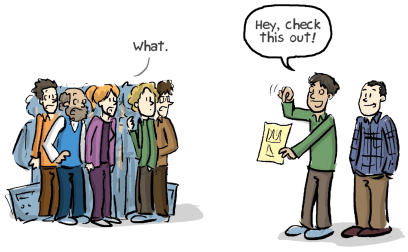
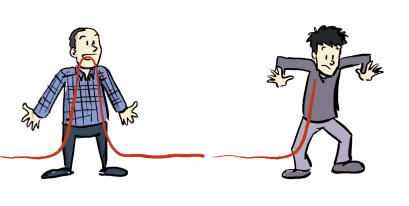
What does it mean for something to be Quantum? I have to confess, I don’t know. My Ph.D was in Robotics and Kinematics, so my neurons are deeply trained to think in terms of classical dynamics. I asked my siblings (two engineers and one architect) what comes to mind for them when they hear the word Quantum, what they remember from college physics, and here is what they said:

– “Quantum Leap!” (the late 80’s TV show)

– “Quantum of Solace!” (the James Bond movie which, incidentally, was filmed in my home country of Panama, even though the movie was set in Bolivia)

– “I don’t remember anything I learned in college”

– “Light acting as a particle instead of a wave?”

The third answer came from my sister, who went to MIT. The fourth came from my brother, who went to Stanford (+1 point for Stanford!).

Screen Shot 2013-06-11 at 12.15.21 AM

I also asked my spouse what comes to mind for her. She said, “Quantum Computing: it’s the next big advance in computers. Transistors the size of atoms.” Clearly, I married someone smarter than me (she also went to Stanford). When I asked if she knew how they worked, she said, “I don’t know how it works.” She also said, “Quantum is related to how time moves more slowly as you approach the speed of light, right?” Nice try, but that’s Relativity (-1 point for Stanford!).

I think the word Quantum has a special power in our collective consciousness. It’s used to convey science-iness, technology, the weirdness of the Physical world. If you Google “Quantum”, most of the top hits are for technology companies that have nothing to do with Quantum Physics (including Quantum Fishing Tackles. I suppose that half the time, you pull up a dead fish).

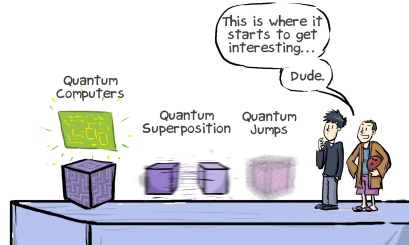
It’s one of those words that a lot of people have heard of, but very few really understand what it means. Which is why I was excited when Spiros Michalakis and IQIM approached me to produce a series of animations that explore and explain Quantum Information and Matter. Like my previous videos (The Higgs Boson, Dark Matter, Exoplanets), I’d have the chance to interview experts in this field and use their expertise and their voices to learn and to help others learn what amazing things lie just around the corner, beyond our classical understanding of the Universe.

Screen Shot 2013-06-11 at 12.16.55 AM

This will be a big Leap for me (I’m trying to avoid the obvious pun), and a journey of exploration. The first installment goes live today, and you can watch it below. Like Schrödinger’s box, I don’t know what we’ll discover with these videos, but I know there are exciting possibilities inside. This is also going to be a BIG challenge. Understanding and putting Quantum concepts in visual form will be hard. I mean, Hair-pulling hard. Fortunately, I’ve discovered there’s a remedy for that.

Screen Shot 2013-06-11 at 12.17.20 AM

Watch the first installment of this series:

Jorge Cham is the creator of Piled Higher and Deeper (www.phdcomics.com).

CREDITS:

Featuring: Amir Safavi-Naeini and Oskar Painter http://copilot.caltech.edu/

Produced in Partnership with the Institute for Quantum Information and Matter (http://iqim.caltech.edu) at Caltech with funding provided by the National Science Foundation.

Transcription: Noel Dilworth
Thanks to: Spiros Michalakis, John Preskill and Bert Painter

Entanglement = Wormholes

One of the most enjoyable and inspiring physics papers I have read in recent years is this one by Mark Van Raamsdonk. Building on earlier observations by Maldacena and by Ryu and Takayanagi. Van Raamsdonk proposed that quantum entanglement is the fundamental ingredient underlying spacetime geometry.* Since my first encounter with this provocative paper, I have often mused that it might be a Good Thing for someone to take Van Raamsdonk’s idea really seriously.

Now someone has.

I love wormholes. (Who doesn’t?) Picture two balls, one here on earth, the other in the Andromeda galaxy. It’s a long trip from one ball to the other on the background space, but there’s a shortcut:You can walk into the ball on earth and moments later walk out of the ball in Andromeda. That’s a wormhole.

I’ve mentioned before that John Wheeler was one of my heros during my formative years. Back in the 1950s, Wheeler held a passionate belief that “everything is geometry,” and one particularly intriguing idea he called “charge without charge.” There are no pointlike electric charges, Wheeler proclaimed; rather, electric field lines can thread the mouth of a wormhole. What looks to you like an electron is actually a tiny wormhole mouth. If you were small enough, you could dive inside the electron and emerge from a positron far away. In my undergraduate daydreams, I wished this idea could be true.

But later I found out more about wormholes, and learned about “topological censorship.” It turns out that if energy is nonnegative, Einstein’s gravitational field equations prevent you from traversing a wormhole — the throat always pinches off (or becomes infinitely long) before you get to the other side. It has sometimes been suggested that quantum effects might help to hold the throat open (which sounds like a good idea for a movie), but today we’ll assume that wormholes are never traversable no matter what you do.

Alice and Bob are in different galaxies, but each lives near a black hole, and their black holes are connected by a wormhole.

Love in a wormhole throat: Alice and Bob are in different galaxies, but each lives near a black hole, and their black holes are connected by a wormhole. If both jump into their black holes, they can enjoy each other’s company for a while before meeting a tragic end.

Are wormholes any fun if we can never traverse them? The answer might be yes if two black holes are connected by a wormhole. Then Alice on earth and Bob in Andromeda can get together quickly if each jumps into a nearby black hole. For solar mass black holes Alice and Bob will have only 10 microseconds to get acquainted before meeting their doom at the singularity. But if the black holes are big enough, Alice and Bob might have a fulfilling relationship before their tragic end.

This observation is exploited in a recent paper by Juan Maldacena and Lenny Susskind (MS) in which they reconsider the AMPS puzzle (named for Almheiri, Marolf, Polchinski, and Sully). I wrote about this puzzle before, so I won’t go through the whole story again. Here’s the short version: while classical correlations can easily be shared by many parties, quantum correlations are harder to share. If Bob is highly entangled with Alice, that limits his ability to entangle with Carrie, and if he entangles with Carrie instead he can’t entangle with Alice. Hence we say that entanglement is “monogamous.” Now, if, as most of us are inclined to believe, information is “scrambled” but not destroyed by an evaporating black hole, then the radiation emitted by an old black hole today should be highly entangled with radiation emitted a long time ago. And if, as most of us are inclined to believe, nothing unusual happens (at least not right away) to an observer who crosses the event horizon of a black hole, then the radiation emitted today should be highly entangled with stuff that is still inside the black hole. But we can’t have it both ways without violating the monogamy of entanglement!

The AMPS puzzle invites audacious reponses, and AMPS were suitably audacious. They proposed that an old black hole has no interior — a freely falling observer meets her doom right at the horizon rather than at a singularity deep inside.

MS are also audacious, but in a different way. They helpfully summarize their key point succinctly in a simple equation:

ER = EPR

Here, EPR means Einstein-Podolsky-Rosen, whose famous paper highlighted the weirdness of quantum correlations, while ER means Einstein-Rosen (sorry, Podolsky), who discovered wormhole solutions to the Einstein equations. (Both papers were published in 1935.) MS (taking Van Raamsdonk very seriously) propose that whenever any two quantum subsystems are entangled they are connected by a wormhole. In many cases, these wormholes are highly quantum mechanical, but in some cases (where the quantum system under consideration has a weakly coupled “gravitational dual”), the wormhole can have a smooth geometry like the one ER described. That wormholes are not traversable is important for the consistency of ER = EPR: just as Alice cannot use their shared entanglement to send a message to Bob instantaneously, so she is unable to send Bob a message through their shared wormhole.

AMPS imagined that Alice could distill qubit C from the black hole’s early radiation and carry it back to the black hole, successfully verifying its entanglement with another qubit B distilled from the recent radiation. Monogamy then ensures that qubit B cannot be entangled with qubit A behind the horizon. Hence when Alice falls through the horizon she will not observe the quiescent vacuum state in which A and B are entangled; instead she encounters a high-energy particle. MS agree with this conclusion.

AMPS go on to say that Alice’s actions before entering the black hole could not have created that energetic particle; it must have been there all along, one of many such particles constituting a seething firewall.

Here MS disagree. They argue that the excitation encountered by Alice as she crosses the horizon was actually created by Alice herself when she interacted with qubit C. How could Alice’s actions, executed far, far away from the black hole, dramatically affect the state of the black hole’s interior? Because C and A are connected by a wormhole!

The ER = EPR conjecture seems to allow us to view the early radiation with which the black hole is entangled as a complementary description of the black hole interior. It’s not clear yet whether this picture works in detail, and even if it does there could still be firewalls; maybe in some sense the early radiation is connected to the black hole via a wormhole, yet this wormhole is wildly fluctuating rather than a smooth geometry. Still, MS provide a promising new perspective on a deep problem.

As physicists we often rely on our sense of smell in judging scientific ideas, and earlier proposed resolutions of the AMPS puzzle (like firewalls) did not smell right. At first whiff, ER = EPR may smell fresh and sweet, but it will have to ripen on the shelf for a while. If this idea is on the right track, there should be much more to say about it. For now, wormhole lovers can relish the possibilities.

Eventually, Wheeler discarded “everything is geometry” in favor of an ostensibly deeper idea: “everything is information.” It would be a fitting vindication of Wheeler’s vision if everything in the universe, including wormholes, is made of quantum correlations.

*Update: Commenter JM reminded me to mention Brian Swingle’s beautiful 2009 paper, which preceded Van Raamsdonk’s and proposed a far-reaching connection between quantum entanglement and spacetime geometry.

“Nature, you instruct me.”

“Settle thy studies.”

Alone in his workroom, a student contemplates his future. Piles of books teeter next to him. Boxes line the walls; and glass vials, the boxes. Sunbeams that struggle through the stained-glass window illuminate dust.

The student’s name is Faust. I met him during my last winter in college, while complementing Physics 42: Introductory Quantum Mechanics with German 44: The Faust Tradition. A medieval German alchemist, Faust has inspired plays, novels, operas, the short story “The Devil and Daniel Webster” about an American Congressman, and the film “Bedazzled” starring Brendan Frasier.

Image

The Faust tradition in popular culture. Mephistopheles is the demon who buys Faust’s soul. (http://xkcd.com/501/)

As I wondered what to pursue a PhD in, so (roughly speaking) did Faust. In plays by Christopher Marlowe and Johann Wolfgang von Goethe, Faust wavers among law, theology, philosophy, and medicine. You’ve probably heard what happens next: Faust chooses sorcery, conjures a demon, and bargains away his soul. Hardly the role model for a college student. I preferred to keep my soul, though Maxwell’s demon had stolen my heart.

A few decades after Goethe penned Faust, English physicist James Maxwell proposed a thought experiment. Consider a box divided into two rooms, he wrote, and a demon controlling the door between the rooms. Since others have explained Maxwell’s paradox, I won’t parrot them. Suffice to say, the demon helps clarify why time flows, what knowledge is, and how information relates to matter. Quantum-information physicists, I learned in a seminar after German 44, study Maxwell’s demon. Via the demon, experiment, and math, QI physicists study the whole world. I wanted to contemplate the whole world, like Goethe’s Faust. By studying QI, I might approximate my goal. Faust, almost as much as my QI seminar, convinced me to pursue a PhD in physics.

Fast forward two years. Someone must have misread my application, because Caltech let me sign my soul to its PhD program. I am the newest Preskillite. Or Preskillnik. Whichever term, if either, irks my supervisor more.

For five years, I will haunt this blog. (Spiros will haunt me if I don’t haunt it.) I’ll try to post one article per month. Pure quantum information occupies me usually: abstract math that encodes physical effects, like entropy (a key to why time flows), decoherence (a system’s transformation from quantum to ordinary), and entanglement (one particle’s ability to affect another, instantaneously, from across a room).

In case I wax poetic about algebra, I apologize in advance. Apologies if I write too many stories about particles in boxes. In addition to training a scientist’s lens on atoms, I enjoy training it on science, culture, and communities. Tune in for scientists’ uses (and abuses) of language, why physics captivates us, and the bittersweetness of representing half our species in a roomful of male physicists (advantage: I rarely wait in line to use a physics department’s bathroom).

As I prepare to move to Caltech, a Faust line keeps replaying in my mind. It encapsulates my impression of a PhD, though written 200 years ago: “Nothing I had; and yet, enough for youth—/ delight in fiction, and the thirst for truth.”

Pleasure to meet you, Quantum Frontiers. Drink with me.

Topological insulator trio recognized by 2013 Physics Frontiers Prize

I was excited to hear that Charlie Kane, Laurens Molenkamp and Shoucheng Zhang were among the recipients of the 2013 Physics Frontiers Prize. Their seminal works both theoretically predicting and experimentally discovering the topological insulator have profoundly influenced the direction of condensed matter physics over the past few years and have shaped my own research agenda at Caltech.

I first learned about the topological insulator from a talk Charlie Kane delivered at the 2006 American Physical Society March Meeting. It was around this time that graphene was exploding onto the scene following Andre Geim and Konstantin Novoselov’s demonstration that single sheets of it could be peeled from graphite using Scotch tape. Inspired by the highly unconventional charge transport properties that were being measured from graphene, Charlie had begun to think about whether its spin transport properties might also yield surprises. The huge surprise, as Charlie would reveal in his talk, was that graphene could theoretically exhibit a quantum spin Hall effect in which spin-polarized charge carriers flow without dissipation along the edges of an electrically insulating material. Such quantum spin Hall insulators (later renamed the 2D topological insulator), as Charlie and his colleague Eugene Mele proved, are a phase of matter distinct from ordinary electrical insulators by virtue of a quantum entanglement of its electrons.
Continue reading

Ignacio Cirac and Peter Zoller get what they deserve

Ignacio Cirac, Dave Wineland, and Peter Zoller receiving the 2010 Franklin medal.

Ignacio Cirac, Dave Wineland, and Peter Zoller receiving the 2010 Franklin medal.

A good thing about a blog is that when my friends win prizes I have the opportunity to say nice things about them. This seems to be happening a lot lately (Kitaev, Wineland, Kimble, Hawking, Polchinski, …).

Today’s very exciting news is that Ignacio Cirac and Peter Zoller have won the 2013 Wolf Prize in Physics “for groundbreaking theoretical contributions to quantum information processing, quantum optics, and the physics of quantum gases.”
Continue reading