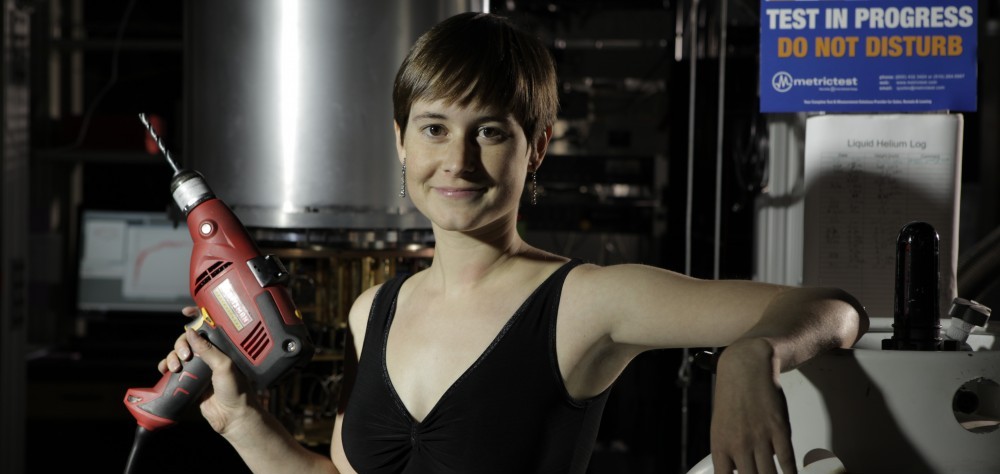
Introduction to Quantum Information

First slide, viewed on my laptop.

First slide, viewed on my laptop.

I’m lazy. The only reason I ever do anything is that sometimes in a weak moment I agree to do something, and after that I don’t have the nerve to back out. And that’s how I happened to give the introductory lectures leading off the 12th Canadian Summer School on Quantum Information last June.

The video of the lectures recently became available on YouTube in two one-hour segments, which is my reason for posting about them now:

Here are the slides I used. The school is pitched at beginning graduate students who have a solid background in quantum mechanics but may not be very familiar with quantum information concepts.

Andrew Childs, who knows my character flaws well, invited me to lecture at the school nearly a year in advance. Undaunted by my silence, he kept resending the invitation at regular intervals to improve his chances of catching me on a weak day. Sure enough, feeling a twinge of guilt over blowing off David Poulin when he made the same request the year before, and with a haunting sense that I had refused to do something Andrew had asked me to do on an earlier occasion (though I can’t recall what), one day in September I said yes, feeling the inevitable stab of regret just seconds after pushing the Send button. I consoled myself with the thought that this could be a Valuable Service to the Community.

Actually, it was fun to think about what to include in my lectures. The job was easier because I knew that the other lecturers who would follow me, all of them excellent, would be able to dig more deeply into some of the topics I would introduce. I decided that my first responsibility should be to convey what makes the topic important and exciting, without getting too bogged down in technicalities which were likely to be addressed later in the school. That meant emphasizing the essence of what makes quantum information different from ordinary “classical” information, and expounding on the theme that classical systems cannot in general simulate quantum systems efficiently.

The conditions under which I delivered the lectures were not quite ideal. Preparing PowerPoint slides is incredibly time consuming, and I believe in the principle that such a task can fill however much time is allotted for it. Therefore, as a matter of policy, I try to delay starting on the slides until the last moment, which has sometimes gotten me into hot water. In this case it meant working on the slides during the flight from LA to Toronto, in the car from Toronto to Waterloo, and then for a few more hours in my hotel room until I went to bed about midnight, with my alarm set for 6 am so I could finish my preparations in the morning.

It seemed like a good plan. But around 2 am I was awakened by an incredibly loud pounding, which sounded like a heavy mallet hammering on the ceiling below me. As I discovered when I complained to the front desk, this was literally true — they were repairing the air-conditioning ducts in the restaurant underneath my room. I was told that the hotel could not do anything about the noise, because the restaurant is under different ownership. I went back to bed, but lost patience around 3:30 am and demanded a different room, on the other side of the hotel. I was settled in my (perfectly quiet) new room by 4 am, but I was too keyed up to sleep, and read a book on my iPad until it was 6 am and time to get up.

I worked in my room as late as I could, then grabbed a taxi, showing the driver a map with the location of the summer school marked on it. Soon after he dropped me off, I discovered I was on the wrong side of the University of Waterloo campus, about a 20 minute walk from where I was supposed to be. It was about 8:15, and the school was to begin at 8:30, so I started jogging, though not, as it turned out, in the right direction. After twice asking passersby for help, I got to the lecture hall just in time, my heart pounding and my shirt soaked with sweat. Not in the best of moods, I barked at Andrew that I needed coffee, which he dutifully fetched for me.

Though my head was pounding and my legs felt rubbery, adrenalin kicked in as I started lecturing. I felt like I was performing in a lower gear than usual, but I wasn’t sure whether the audience could tell.

And as often happens when I reluctantly agree to do something, when it was all over I was glad I had done it.

Is Alice burning? The black hole firewall controversy

Quantum correlations are monogamous. Bob can be highly entangled with Alice or with Carrie, but not both.

Quantum correlations are monogamous. Bob can be highly entangled with Alice or with Carrie, but not both.

Back in the early 1990s, I was very interested in the quantum physics of black holes and devoted much of my research effort to thinking about how black holes process quantum information. That effort may have prepared me to appreciate Peter Shor’s spectacular breakthrough — the discovery of a quantum algorithm for factoring intergers efficiently. I told the story here of how I secretly struggled to understand Shor’s algorithm while attending a workshop on black holes in 1994.

Since the mid-1990s, quantum information has been the main focus of my research. I hope that some of the work I’ve done can help to hasten the onset of a new era in which quantum computers are used routinely to perform super-classical tasks. But I have always had another motivation for working on quantum information science — a conviction that insights gained by thinking about quantum computation can illuminate deep issues in other areas of physics, especially quantum condensed matter and quantum gravity. In recent years quantum information concepts have begun penetrating into other fields, and I expect that trend to continue.
Continue reading

Showtime for Sophomores

Exciting a square Chladni plate with a violin bow.

One of the many unique features of Caltech is our core curriculum. All of our undergraduates are required to take five terms of physics and five terms of math (all three terms freshman year and the fall and winter terms sophomore year) — though this will change for the class entering in the fall of 2013.

Each fall, about 170 sophomores take Physics 2a, a course on vibrations, waves, and quantum mechanics, while the remaining 60 or so sophomores take Physics 12a, a souped up course covering similar material at a level more appropriate for physics concentrators.

This term I am teaching Physics 2a. While 170 students is a lot more than in most courses I teach at Caltech, the workload is manageable, in part because I share the lecturing duties with another professor, and in part because we have a staff of capable and hard working Teaching Assistants who handle recitation sections and grade the homework and quizzes.

Continue reading

The TV Frontier

Hello, my name is Tim Blasius and I am a physics graduate student at Caltech.  I recently appeared in a comedy bit on the TV show Conan, where I corrected Conan O’Brien’s physics.  I have been asked to share a few words describing this experience.

As with any story involving unbridled success, it begins as a tale of unnoticed, under-appreciated  and nearly unending hard work – I usually watch the show Conan during dinner with my fiancé.  Accordingly, I have seen many segments called “fan corrections” where Conan viewers submit YouTube videos explaining mistakes that they believe Conan has made on the show.  Some are nerdy and funny like the one where viewers pointed out that Conan used a red-tailed hawk call instead of a bald eagle call.  I was like a crocodile lurking in the water waiting for Conan to make a mistake in my expertise.  Then, like a woefully ignorant antelope sipping from the river Nile, Conan made a physics mistake when mocking Felix Baumgartner’s free fall, and I, being the bloodthirsty physics predator that I am, snapped the jaws of immutable truth around his naïve self.

Continue reading

Quantum = Pink

Need we say more?

What color do you imagine when you close your eyes and think “Quantum”? If you are to buy a case for your quantum computer, have you already picked your favorite color? (Okay, maybe it’s too early for that.)
Below I argue that the collective unconscious has already made the choice for you: it is going to be pink.

Excited?

Fear not. We will easily differentiate ourselves from warm and fluffy pink slippers. Our color is pink on black. Closer to purple, actually. We have good heritage: purple with white was the color of kings. But kings are no more, so let’s admit it: People think that “spooky” quantum phenomena have a purple glow around them. The disaster movie “Quantum Apocalypse” has a mysterious purple vortex approach Earth. Sci-fi now has “quantum cannons” shooting pink aura at the enemies, unleashing the chaos of uncertainty. You can’t fly your battlecruiser if you’re no longer certain you still have a battlecruiser.
Continue reading

Fermat’s Lost Theorem

Pierre Fermat, known for his Last Theorem and for rarely proving any of his claims.


Last week, I posted a series of increasingly difficult challenges in the post One line proof. Today, I would like to spend some time with the second challenge:

Fermat’s Lost Theorem: Show that (x+y)^n = x^m+y^m has only one solution for integers x > y > 0 and m,n > 1.

The truth is, I don’t know how to solve this problem myself. But, I think that we can figure it out together. Below, I will give the solution to the simpler case of y=1 and x > 1. I expect that many of you know the following variant of the problem:

Fermat’s Last Theorem: Show that z^m = x^m + y^m has no solutions for integers z > x > y > 0 and m > 2.

The above theorem was one of the most important unsolved problems in mathematics, until Andrew Wiles presented his proof to the public at a conference in Cambridge in 1993. Then someone pointed out a serious flaw in his proof and the extreme high Wiles was feeling turned into a dark abyss of despair. But being awesome implies that you pick yourself up and run full force towards the wall as if you didn’t get floored the last time you tried breaking through. And so Andy went back to his office and, with a little help from his friend (and former student) Richard Taylor, he fixed the flaw and published the massive proof in the most prestigious journal of mathematics, the Annals of Mathematics, in 1995.
Continue reading

One line proof

It is not often that we come across a problem whose solution can fit in the margins of a notebook. In fact, many of the problems I have worked on in the field of quantum many-body physics require proofs that often exceed 30 pages. And that is without taking into account the several references included as sources for results used as “elementary” tools in the proof (referees love these papers…) So it is natural to think that a proof is a proof, so long as it is correct, and once confirmed by the academic community it is time to move on to something new.

But… sometimes things get interesting. A 30-page proof collapses to a 3-page proof when a different point of view is adopted (see the famous Prime Number Theorem). Below, you will find two problems that may, or may not have a “one-line” proof. The challenge is for you to find the shortest, most elegant proof for each problem:

A unit triangle: A triangle with sides a\le b \le c has area 1. Show that b^2 \ge 2.

Fermat’s Lost Theorem: Show that (x+y)^n = x^m+y^m has only one solution with positive integers x > y > 0 and m,n > 1.

Continue reading

Individual quantum systems

When I went to school in the 20th century, “quantum measurements” in the laboratory were typically performed on ensembles of similarly prepared systems. In the 21st century, it is becoming increasingly routine to perform quantum measurements on single atoms, photons, electrons, or phonons. The 2012 Nobel Prize in Physics recognizes two of the heros who led these revolutionary advances, Serge Haroche and Dave Wineland. Good summaries of their outstanding achievements can be found at the Nobel Prize site, and at Physics Today.

Serge Haroche developed cavity quantum electrodynamics in the microwave regime. Among other impressive accomplishments, his group has performed “nondemolition” measurements of the number of photons stored in a cavity (that is, the photons can be counted without any of the photons being absorbed). The measurement is done by preparing a Rubidium atom in a superposition of two quantum states. As the Rb atom traverses the cavity, the energy splitting of these two states is slightly perturbed by the cavity’s quantized electromagnetic field, resulting in a detectable phase shift that depends on the number of photons present. (Caltech’s Jeff Kimble, the Director of IQIM, has pioneered the development of analogous capabilities for optical photons.)
Continue reading

No calculators allowed

During Friday evenings at Caltech, the Institute for Quantum Information and Matter runs a seminar series focusing on research talks geared towards a diverse audience whose common background is quantum mechanics (just that, nothing else…) But, the fun doesn’t end after the 45 minute talks are over. The seminar is followed by a mingling session on the brand new patio of East Bridge, the building where Richard Feynman delivered his famous lectures.

Grigori Perelman. Not a Russian middle-schooler anymore, but still pretty smart.

Last Friday, Aleksander Kubica (pronounced Koobitsa), a Polish graduate student in the Theory group of IQIM and a first prize winner of the 2009 European Union Contest for Young Scientists, decided to test our ingenuity by giving us a problem that Russian middle-schoolers are expected to solve. If you haven’t met any Russian middle-schoolers, well, let’s just say that you should think carefully before accepting a challenge that is geared towards their level of mathematical maturity. What was the challenge?

Problem 1: Show that: \frac{1}{2}\cdot \frac{3}{4}\cdot \frac{5}{6}\cdot \frac{7}{8}\cdot \frac{9}{10}\cdots \frac{99}{100} < \frac{1}{10}.
Continue reading

Redemption: Part II

Last week, a journey began to find the solution to a problem I could not solve as a seventeen year-old boy. That problem became an obsession of mine during the last days of the International Math Olympiad of 1997, the days when I also met the first girl I ever kissed. At the time, I did not have the heart to tell the girl that I had traveled across the Atlantic to compete with the best and brightest and had come up short. I told her that I had solved the problem, but that the page with my answer had been lost. I told my parents the same thing and to everyone at school who would ask me why I did not return with a medal from the Math Olympics. The lie became so powerful that I did not look at that problem again until now. So, you may be wondering why a blog about Quantum Information Science at Caltech includes posts on problems from Math Olympiads. And why I would open the book on the page with that one problem after fifteen years… Continue reading


