Remember to take it slow

“Spiros, can you explain to me this whole business about time being an illusion?”

These were William Shatner’s words to me, minutes after I walked into the green room at Silicon Valley’s Comic Con. The iconic Star Trek actor, best known for his portrayal of James Tiberius Kirk, captain of the starship Enterprise, was chatting with Andy Weir, author of The Martian, when I showed up at the door. I was obviously in the wrong room. I had been looking for the room reserved for science panelists, but had been sent up an elevator to the celebrity green room instead (a special room reserved for VIPs during their appearance at the convention). Realizing quickly that something was off, I did what anyone else would do in my position. I sat down. To my right was Mr. Weir and to my left was Mr. Shatner and his agent, Mr. Gary Hasson. For the first few minutes I was invisible, listening in casually as Mr. Weir revealed juicy details about his upcoming novel. And then, it happened. Mr. Shatner turned to me and asked: “And who are you?” Keep calm young man. You can outrun him if you have to. You are as entitled to the free croissants as any of them. “I am Spiros,” I replied. “And what do you do, Spiros?” he continued. “I am a quantum physicist at Caltech.” Drop the mic. Boom. Now I will see myself out before security…

comic_con_bg

“Spiros, can you explain to me this whole business about time being an illusion?”

Huh, I wonder if he means the… “You know, how there is no past, present or future in quantum mechanics,” Mr. Shatner continued. “Well, yes,” I responded, “that is called the arrow of time, an emergent direction in the time parameter found in the equation describing evolution in quantum physics. By the way, that time parameter itself is also emergent.” And then things got out of hand. “Wait a minute, are you telling me that not just the arrow of time, but time itself as a concept is an illusion?” asked Mr. Shatner with genuine excitement. “Yes. For starters, the arrow of time itself is a consequence of an emergent asymmetry between events that are all equally likely at the microscopic level. Think about flipping a fair coin one hundred times, for example. The probability of getting all heads is astronomically small. Zero point zero zero zero… with thirty zeroes before the one. Same is true if I ask you how likely it is that you flip fifty heads and then fifty tails,” I said and waited. “OK… still following,” Mr. Shatner assured me, so I continued, “but, say that you have trouble keeping track of all the different positions of the heads and tails; all you care about is counting how many times you flipped heads and how many times you flipped tails. What is the probability that you would count one hundred heads?” I asked. Mr. Shatner thought for a second, and so did Mr. Weir, before they answered almost in unison, “Well, it is still astronomically small. Just like before.” Yes! Holy cow, Batman, this is actually happening. I am having a conversation about physics with captain Kirk and the mastermind behind this year’s Golden Globe winner for Best Motion Picture: Musical or Comedy! This makes no sense! And I am not talking about the movie award – The Martian was hilarious.

andy-weir

“Exactly,” I replied. “But what about flipping the coin and counting fifty heads and fifty tails?” I asked. I could see that their wheels were spinning. What was I getting at? How was this different from before? “Does it have to be the first fifty heads, or can it be any which way, as long as it is fifty?” asked Mr. Weir. Bingo. “Any which way. We can only keep track of the number of them, not their position,” I reminded him. “Well, there are many more ways then to get fifty heads,” noted Mr. Shatner. “Yes there are,” I agreed and continued, “In fact, there are about one thousand billion billion billion combinations that all give fifty heads and fifty tails. In other words, one in ten times you flip a coin a hundred times, you will count exactly fifty heads and fifty tails. Think about this for a second. The probability of counting exactly fifty heads the first time you flip a coin a hundred times is thirty orders of magnitude larger than counting one hundred heads. Remember that any particular configuration of heads and tails is equally – astronomically – unlikely. But if you zoom out, then magic happens and an emergent asymmetry appears. A really huge asymmetry, at that.” They were hooked. It was time for the grand finale. “So, which events then are more likely for us to experience in the next second, if all of them are equally likely at some fundamental level?” I asked. Mr. Shatner responded first: “The ones that have billions of microscopic configurations that all look the same when you zoom out. Like the fifty heads thing.” Then, Mr. Weir, turning to Mr. Shatner added, “That’s the arrow of time following the direction of entropy as it increases.” I nodded (maybe a little too eagerly) and looked at my phone to see that it was close to noon. It would take me about five minutes to walk to Room 2 of the San Jose convention center, where Mr. Weir was to headline a panel titled “Let’s Go to Mars!” There was no way I was missing that panel. I knew that by now there would be a very long line of eager attendees waiting to hear Mr. Weir and Mr. Adam Savage (of Mythbusters fame) talk about Mars exploration. With some luck, I could walk there with Mr. Weir and sneak in without being noticed by the door police. I told Mr. Weir that it was time for us to go downstairs. He got up, I got up and…

“Spiros, where do you think you are going? Come here, sit right next to me. You promised to explain how time works. You can’t leave me hanging now!” Mr. Shatner was adamant.

I looked to Mr. Hasson and Mr. Weir, who were caught in the middle of this. “I… I can come back and we can talk more after Andy’s panel… My panel isn’t until 2 o’ clock,” I pleaded. Mr. Shatner did not think so. Science could not wait another second. He was actually interested in what I had to say, so I turned to Mr. Weir apologetically and he nodded with understanding and a “good luck, kid” kind-of-smile. Mr. Hasson seemed pleased with my choice and made some room for me to sit next to the captain.

william-shatner

“Now, where were we? Ah yes, you were going to explain to me how time itself is an illusion. Something about time in quantum evolution being emergent. What do you mean?” asked Mr. Shatner, cutting right to the chase. It was time for me to go all in: “Well, you see, there is this equation in quantum mechanics – Erwin Schrodinger came up with it – that tells us how the state of the universe at the quantum level changes with time. But where does time come from? Is it a fundamental concept, or is there something out there without which time itself cannot exist?” I waited for a second, as Mr. Shatner contemplated my question. He was stumped. What could possibly be more fundamental than time? Hmm… “Change,” I said. “Without change, there is no time and, thus, no quantum evolution. And without quantum evolution there is no classical evolution, no arrow of time. So everything hinges on the ability of the quantum state of the visible universe to change.” I paused to make sure he was following, then continued, “But if there is change, then where does it come from? Wherever it comes from, unless we end up with a timeless, unchanging and featureless entity, we will always be on the hook for explaining why it is changing, how it is changing and why it looks the way it does and not some other way,” I said and waited a second to let this sink in. “Spiros, if you are right, then how the heck can you get something out of nothing? If the whole thing is static, how come we are not frozen in time?” asked pointedly Mr. Shatner. “We are not the whole thing,” I said, maybe a bit too abruptly. “What do you mean we are not the whole thing? What else is there?” questioned Mr. Shatner. At this point I could see a large smile forming on Mr. Hasson’s face. His old friend, Bill Shatner, was having fun. A different kind of fun. A different kind of Comic Con. Sure, Bill still had to sit at a table in the main Exhibit Hall to greet thousands of fans, sign their favorite pictures of him and, for a premium, stand next to them for a picture that they would frame and display in their homes for decades to come. “Spiros, do you have a card?” interjected Mr. Hasson. Hmm, how do I say that this is not a thing among scientists… “I ran out. Sorry, everyone wants one these days, so… Here, I can type my email and number in your phone. Would that work?” I said, stretching the truth 1/slightly. “That would be great, thanks,” replied Mr. Hasson.

IMG_1168

With Mr. Stan Lee at the Silicon Valley Comic Con. At 93, Mr. Lee spent the whole weekend with fans, not once showing up at the green room to take a break. So I hunted him down with help from Mr. Hasson.

“Hey, stop distracting him! We are so close to the good stuff!” blasted Mr. Shatner. “Go on, now, Spiros. How does anything ever change?” asked Mr. Shatner with some urgency in his voice. “Dynamic equilibrium,” I replied. “Like a chemical reaction that is in equilibrium. You look from afar and see nothing happening. No bubbles, nothing. But zoom in a little and you see products and reactants dissolving and recombining like crazy, but always in perfect balance. The whole remains static, while the parts experience dramatic change.” I let this simmer for a moment. “We are not the whole. We are just a part of the whole. We are too big to see the quantum evolution as it happens in all its glory. But we are also too small to remain unchanged. Our visible universe is in dynamic equilibrium with a clock universe with which we are maximally entangled. We change only because the state of the clock universe changes randomly and we have no control over it, but to change along with it so that the whole remains unchanged,” I concluded, hoping that he would be convinced by a theory that had not seen the light of day until that fateful afternoon. He was not convinced yet. “Wait a minute, why would that clock universe change in the first place?” he asked suspiciously. “It doesn’t have to,” I replied, anticipating this excellent question, and went on, “It could remain in the same state for a million years. But we wouldn’t know it, because the state of our visible universe would have to remain in the same state also for a million years. We wouldn’t be able to tell that a million years passed between every microsecond of change, just like a person under anesthesia can’t tell that they are undergoing surgery for hours, only to wake up thinking it was just a moment earlier that they were counting down to zero.” He fell silent for a moment and then a big smile appeared on his face. “Spiros, you have an accent,” he said, as if stating the obvious. “Can I offer you a piece of advise?” he asked, in a calm voice. I nodded. “One day you will be in front of a large crowd talking about this stuff. When you are up there, make sure you talk slow so people can keep up. When you get excited, you start speaking faster and faster. Take breaks in-between,” he offered. I smiled and thanked him for the advise. By then, it was almost one o’ clock and Mr. Weir’s panel was about to end. I needed to go down there for real this time and meet up with my co-panelists, Shaun Maguire and Laetitia Garriott de Cayeux, since our panel was coming up next. I got up and as I was leaving the room, I heard from behind,

“Remember to take it slow, Spiros. When you are back, you will tell me all about how space is also an illusion.”

Aye aye captain!

March madness and quantum memory

Madness seized me this March. It pounced before newspaper and Facebook feeds began buzzing about basketball.1 I haven’t bought tickets or bet on teams. I don’t obsess over jump-shot statistics. But madness infected me two weeks ago. I began talking with condensed-matter physicists.

Condensed-matter physicists study collections of many particles. Example collections include magnets and crystals. And the semiconductors in the iPhones that report NCAA updates.

Caltech professor Gil Refael studies condensed matter. He specializes in many-body localization. By “many-body,” I mean “involving lots of quantum particles.” By “localization,” I mean “each particle anchors itself to one spot.” We’d expect these particles to spread out, like the eau de hotdog that wafts across a basketball court. But Gil’s particles stay put.

Hot-dog smell

How many-body-localized particles don’t behave.

Experts call many-body localization “MBL.” I’ve accidentally been calling many-body localization “MLB.” Hence the madness. You try injecting baseball into quantum discussions without sounding one out short of an inning.2

I wouldn’t have minded if the madness had erupted in October. The World Series began in October. The World Series involves Major League Baseball, what normal people call “the MLB.” The MLB dominates October; the NCAA dominates March. Preoccupation with the MLB during basketball season embarrasses me. I feel like I’ve bet on the last team that I could remember winning the championship, then realized that that team had last won in 2002.

March madness has been infecting my thoughts about many-body localization. I keep envisioning a localized particle as dribbling a basketball in place, opponents circling, fans screaming, “Go for it!” Then I recall that I’m pondering MBL…I mean, MLB…or the other way around. The dribbler gives way to a baseball player who refuses to abandon first base for second. Then I recall that I should be pondering particles, not playbooks.

Baseball diamond

Localized particles.

Recollection holds the key to MBL’s importance. Colleagues of Gil’s want to build quantum computers. Computers store information in memories. Memories must retain their contents; information mustn’t dribble away.

Consider recording halftime scores. You could encode the scores in the locations of the particles that form eau de hotdog. (Imagine you have advanced technology that manipulates scent particles.) If Duke had scored one point, you’d put this particle here; if Florida had scored two, you’d put that particle there. The particles—as smells too often do—would drift. You’d lose the information you’d encoded. Better to paint the scores onto scorecards. Dry paint stays put, preserving information.

The quantum particles studied by Gil stay put. They inspire scientists who develop memories for quantum computers. Quantum computation is gunning for a Most Valuable Player plaque in the technology hall of fame. Many-body localized systems could contain Most Valuable Particles.

MVP medal

Remembering the past, some say, one can help one read the future. I don’t memorize teams’ records. I can’t advise you about whom root for. But prospects for quantum memories are brightening. Bet on quantum information science.

1Non-American readers: University basketball teams compete in a tournament each March. The National Collegiate Athletic Association (NCAA) hosts the tournament. Fans glue themselves to TVs, tweet exaltations and frustrations, and excommunicate friends who support opposing teams.

2Without being John Preskill.

Carbon copy

The anticipatory excitement of summer vacation endures in the teaching profession like no place outside childhood schooldays. Undoubtedly, ranking high on the list that keep teachers teaching. The excitement was high as the summer of 2015 started out the same as it had the three previous years at Caltech. I would show up, find a place to set up, and wait for orders from scientist David Boyd. Upon arrival in Dr. Yeh’s lab, surprisingly, I found all the equipment and my work space very much untouched from last year. I was happy to find it this way, because it likely meant I could continue exactly where I left off last summer. Later, I realized David’s time since I left was devoted to the development of a revolutionary new process for making graphene in large sheets at low temperatures. He did not have time to mess with my stuff, including the stepper-motor I had been working on last summer.

landscape-1426869044-dboyd-ncyeh-0910So, I place my glorified man purse in a bottom drawer, log into my computer, and wait.   After maybe a half hour I hear the footsteps set to a rhythm defined only by someone with purpose, and I’m sure it’s David.  He peeks in the little office where I’m seated and with a brief welcoming phrase informs me that the goal for the summer is to wrap graphene around a thin copper wire using, what he refers to as, “your motor.” The motor is a stepper motor from an experiment David ran several years back. I wired and set up the track and motor last year for a proposed experiment that was never realized involving the growth of graphene strips. Due to the limited time I spend each summer at Caltech (8 weeks), that experiment came to a halt when I left, and was to be continued this year. Instead, the focus veered from growing graphene strips to growing a two to three layer coating of graphene around a copper wire. The procedure remains the same, however, the substrate onto which the graphene grows changes. When growing graphene-strips the substrate is a 25 micron thick copper foil, and after growth the graphene needs to be removed from the copper substrate. In our experiment we used a copper wire with an average thickness of 154 microns, and since the goal is to acquire a copper wire with graphene wrapped around, there’s no need to remove the graphene. 

Noteworthy of mention is the great effort toward research concerning the removal and transfer of graphene from copper to more useful substrates. After graphene growth, the challenge shifts to separating the graphene sheet from the copper substrate without damaging the graphene. Next, the graphene is transferred to various substrates for fabrication and other purposes. Current techniques to remove graphene from copper often damage the graphene, ill-effecting the amazing electrical properties warranting great attention from R&D groups globally. A surprisingly simple new technique employs water to harmlessly remove graphene from copper. This technique has been shown to be effective on plasma-enhanced chemical vapor deposition (PECVD).  PECVD is the technique employed by scientist David Boyd, and is the focus of his paper published in Nature Communications in March of 2015.

So, David wants me to do something that has never been done before; grow graphene around a copper wire using a translation stage. The technique is to attach an Evenson cavity to the stage of a stepper motor/threaded rod apparatus, and very slowly move the plasma along a strip of copper wire. If successful, this could have far reaching implications for use with copper wire including, but certainly not limited to, corrosion prevention and thermal dissipation due to the high thermal conductivity exhibited by graphene. With David granting me free reign in his lab, and Ph.D. candidate Chen-Chih Hsu agreeing to help, I felt I had all the tools to give it a go.

Setting up this experiment is similar to growing graphene on copper foil using PECVD with a couple modifications. First, prior to pumping the quartz tube down to a near vacuum, we place a single copper wire into the tube instead of thin copper foil. Also, special care is taken when setting up the translation stage ensuring the Evenson cavity, attached to the stage, travels perfectly parallel to the quartz tube so as not to create a bind between the cavity and tube during travel. For the first trial we decide to grow along a 5cm long section of copper wire at a translation speed of 25 microns per second, which is a very slow speed made possible by the use of the stepper motor apparatus. Per usual, after growth we check the sample using Raman Spectroscopy. The graph shown here is the actual Raman taken in the lab immediately after growth. As the sample is scanned, the graph develops from right to left.  We’re not expecting to see anything of much interest, however, hope and excitement steadily rise as the computer monitor shows a well defined 2D-peak (right peak), a G-peak (middle peak)Raman of Graphene on Copper Wire 4, and a D-peak (left peak) with a height indicative of high defects.  Not the greatest of Raman spectra if we were shooting for defect-free monolayer graphene, but this is a very strong indication that we have 2-3 layer graphene on the copper wire.  How could this be? Chen-Chih and I looked at each other incredulously.  We quickly checked several locations along the wire and found the same result.  We did it!  Not only did we do it, but we did it on our first try!  OK, now we can party.  Streamers popped up into the air, a DJ with a turn table slid out from one of the walls, a perfectly synchronized kick line of cabaret dancers pranced about…… okay, back to reality, we had a high-five and a back-and-forth “wow, that’s so cool!”

We knew before we even reported our success to David, and eventually Professor Yeh, that they would both, immediately, ask for the exact parameters of the experiment and if the results were reproducible. So, we set off to try and grow again. Unfortunately, the second run did not yield a copper wire coated with graphene. The third trial did not yield graphene, and neither did the fourth or fifth. We were, however, finding that multi-layer graphene was growing at the tips of the copper wire, but not in the middle sections.  Our hypothesis at that point was that the existence of three edges at the tips of the wire aided the growth of graphene, compared to only two edges in the wire’s midsection (we are still not sure if this is the whole story).

In an effort to repeat the experiment and attain the parameters for growth, an issue with the experimental setup needed to be addressed. We lacked control concerning the exact mixture of each gas employed for CVD (Chemical Vapor Deposition). In the initial setup of the experiment, a lack of control was acceptable, because the goal was only to discover if growing graphene around a copper wire was possible. Now that we knew it was possible, attaining reproducible results required a deeper understanding of the process, therefore, more precise control in our setup. Dr. Boyd agreed, and ordered two leak valves, providing greater control over the exact recipe for the mixture of gases used for CVD. With this improved control, the hope is to be able to control and, therefore, detect the exact gas mixture yielding the much needed parameters for reliable graphene growth on a copper wire.

Unfortunately, my last day at Caltech before returning to my regular teaching gig, and the delivery of the leak valves occurred on the same day. Fortunately, I will be returning this summer (2016) to continue the search for the elusive parameters. If we succeed, David Boyd’s and Chen-Chih’s names will, once again, show up in a prestigious journal (Nature, Science, one of those…) and, just maybe, mine will make it there too. For the first time ever.  


SQuInTing in the Southwest

The 18th Annual Southwest Quantum Information and Technology (SQuInT) Workshop is an outreach and service activity of the Center for Quantum Information and Control (CQuIC), and is about to take place this February 18-20, 2016 in Albuquerque New Mexico, SQuInT2016.  With over 160 participants, 45 talks, and 60 posters, SQuInT has become one of the largest and most diverse meetings in Quantum Information Science in the United States.  Under Chief SQuInT Organizer, Prof. Akimasa Miyake, this year’s program includes reports on the ground breaking experiments in loophole-free violations Bell’s Inequalities, the latest developments in quantum dots, superconductors, and ion and neutral atom traps, and a wide range of quantum information theory.  The SQuInT 2016 Keynote will be delivered by IQIM’s very own, Prof. John Preskill.

How did SQuInT get here? Its origin stems from the history of Quantum Information Science (QIS) itself. I joined the faculty at UNM in 1995.  Those were heady times, on the heels of Shor’s  algorithm and new developments in quantum information theory, which  occurred at inflationary speeds.  Simultaneously, Bose Einstein Condensation had just been observed.  These two developments caused a revolution in quantum optics and AMO-physics from with SQuInT was founded.

I, together with my colleague and now 20-year academic partner, Prof. Poul Jessen at the College of Optical Science, University of Arizona, focused on “optical lattices,” a brand new idea at that time, and the subject of Poul’s PhD thesis.  In Poul’s dissertation, he demonstrated that the motion of laser-cooled atoms,  trapped at the antinodes of standing waves, was quantized.  This quantum motion was reminiscent of that seen in atomic ions in Paul traps, and we set out to exploit this in optical lattices.  Indeed, a hot development of the 1990s was the ability to engineer nonclassical states of motion of ions, leveraging off of the analogy with the Jaynes-Cummings model of cavity QED.  As a side note, this capability was at the heart of the 1995 proposal by  Ignacio Cirac & Peter Zoller  for ion trap quantum computing and the immediate demonstration by Chris Monroe & Dave Wineland of the first CNOT gate.  Given these connections, in 1997 I organized a small workshop at UNM entitled Quantum Control of Atomic Motion, which brought together neutral atom trappers, ion trappers, and quantum opticians. Among the participants were Rainer Blatt, Hideo Mabuchi, Hersch Rabitz, and Dave Wineland.  Hersch’s presence was a new dimension, as we began to understand that the tools of quantum optimal control, previously developed mostly in the context of NMR and in physical chemistry, would be important for quantum control of atoms.  The meeting was repeated in 1998, as Quantum Control of Atomic Motion II.  By that time quantum computing was fully taking hold in the community.  Chris Monroe presented his logic gate results and we presented the first ideas for quantum computing in optical lattices.  The attendees decided we should be broadening the scope of the meeting to Quantum Information Science and Technology.  Hideo Mabuchi corresponded with Ike Chuang, who was at IBM-Almaden in San Jose California at the time.  Ike, of course, was at the center of the QI revolution and in December 1998 assembled a meeting of some of the key players including: Carl Caves, Richard Cleve, Chris Fuchs, Paul Kwiat, Poul Jessen, Hideo Mabuchi, David Meyer, Chris Monroe, John Preskill, Lu Sham, and  Birgitta Whaley.


SQ

SQuInT Founders Meeting, IBM Almaden, San Jose CA, December 1998


And thus SQuInT was born.  The first meeting was held in 1999 (SQuInT99) in Albuquerque New Mexico at a budget hotel known as the Holiday Inn “Mountain View.”  Mostly we had a view of the nearby truck stop. But the meeting was of the highest quality.  Our first session was Chaired by Dave Wineland.  The speakers were Serge Haroche, Jeff Kimble, and Hideo Mabuchi.  I’d say we were on the right track!

First Annual SQuInT Workshop

First Annual SQuInT Workshop, February 1999, Albuquerque NM

At this first meeting we voted on the SQuInT Logo, created by Jon Dowling

squintlogo

Here’s the backstory. Alice and Bob Kokepelli, the Hopi fertility deities, play their flutes to the dreamcatcher.   What has the dreamcathcer caught?  Part of the circuit diagram for quantum teleportation of course!

At the time, SQuInT was envisioned to be a regional network.  As QIS was a new field, the plan was to facilitate collaborations and exchange of information given the local strength in the southwestern United States.  Some of the key nodes of the SQuInT Network at the time included Caltech, IBM-Almaden, Los Alamos, NIST Boulder, UA, UCB, UCSB, UCSD, and UNM.  SQuInT took as its mission two key objectives: (1) building a network where the interdisciplinary subject matter of QIS would grow through direct interactions of theoretical and experimental physicists and computer scientists, as well as chemists, engineers, and mathematicians; (2) provide training of students, postdocs, and others who were entering a newly emerging discipline.  In line with goal (2), the Annual SQuInT Workshop has been a forum friendly to young scientists, where students and postdocs give talks alongside senior leaders in the field, and where new networks and collaborations can build.  In addition, students organized “summer retreats,” which essentially served as summer schools, since there were few courses in QIS at that time.

After its initial founding, SQuInT grew and the Annual Workshop traveled amongst the node institutions.  By the fourth meeting, we had grown to over 75 participants.

SQuInT2000s


After its establishment in 2007, CQuIC became the official administrative home of SQuInT.  The Annual Meeting alternates between New Mexico and one of the Node Institutions, of which there are now 30 across the United States and some international. These Nodes include universities, national laboratories, and industry, the latter of which has an increasing presence given the rapid developments in QI technologies (SQuInTNodes).   SQuInT Node institutions serve on the SQuInT Steering Committee and are the core participants in SQuInT, and can act as local hosts of the Annual Workshop.  Last year’s meeting took place in Berkeley CA with over 200 participants.

SQuInT2016

Seventeenth Annual SQuInT Meeting, February 2015, Berkeley CA


After 17 years serving as the Chief SQuInT Coordinator (plus 2 years of proto-SQuInT organization), I am proud to hand over the reigns to Prof. Akimasa Miyake.  SQuInT remains true to its goals of training, education, and growth of an interdisciplinary subject. Under Akimasa’s organization, we have a top-notch program, and I look forward to attending SQuInT, as a participant!


Quantum Chess

Two years ago, as a graduate student in Physics at USC,  I began work on a game whose mechanics were based on quantum mechanics. When I had a playable version ready, my graduate adviser, Todd Brun, put me in contact with IQIM’s Spiros Michalakis, who had already worked with Google to design qCraft, a mod introducing quantum mechanics into Minecraft. Spiros must have seen potential in my clunky prototype and our initial meeting turned into weekly brainstorming lunches at Caltech’s Chandler cafeteria. More than a year later, the game had evolved into Quantum Chess and we began talking about including a video showing some gameplay at an upcoming Caltech event celebrating Feynman’s quantum legacy. The next few months were a whirlwind. Somehow this video turned into a Quantum Chess battle for the future of humanity, between Stephen Hawking and Paul Rudd. And it was being narrated by Keanu Reeves! The video, called Anyone Can Quantum, and directed by Alex Winter, premiered at Caltech’s One Entangled Evening on January 26, 2016 and has since gone viral. If you haven’t watched it, now would be a good time to do so (if you are at work, be prepared to laugh quietly).

So, what exactly is Quantum Chess and how does it make use of quantum physics? It is a modern take on the centuries-old game of strategy that endows each chess piece with quantum powers. You don’t need to know quantum mechanics to play the game. On the other hand, understanding the rules of chess might help [1].  But if you already know the basics of regular chess, you can just start playing. Over time, your brain will get used to some of the strange quantum behavior of the chess pieces and the battles you wage in Quantum Chess will make regular chess look like tic-tac-toe [2].

Quantum ChessIn this post, I will discuss the concept of quantum superposition and how it plays a part in the game. There will be more posts to follow that will discuss entanglement, interference, and quantum measurement [3].

In quantum chess, players have the ability to perform quantum moves in addition to the standard chess moves. Each time a player chooses to move a piece, they can indicate whether they want to perform a standard move, or a quantum move. A quantum move creates a superposition of boards. If any of you ever saw Star Trek 3D Chess, you can think of this in a similar way.

Star Trek 3D Chess

There are multiple boards on which pieces exist. However, in Quantum Chess, the number of possible boards is not fixed, it can increase or decrease. All possible boards exist in a superposition. The player is presented with a single board that represents the entire superposition. In Quantum Chess, any individual move will act on all boards at the same time.  Each time a player makes a quantum move, the number of possible boards present in the superposition doubles. Let’s look at some pictures that might clarify things.

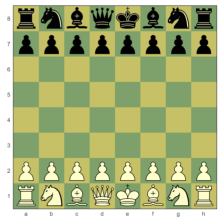
The Quantum Chess board begins in the same configuration as standard chess.

InitialConfigAll pawns move the same as they would in standard chess, but all other pieces get a choice of two movement types, standard or quantum. Standard moves act exactly as they would in standard chess. However, quantum moves, create superpositions. Let’s look at an example of a quantum move for the white queen.

QueenQuantumMoveIn this diagram, we see what happens when we perform a quantum move of the white queen from D1 to D3. We get two possible boards. On one board the queen did not move at all. On the other, the queen did move. Each board has a 50% chance of “existence”. Showing every possible board, though, would get quite complicated after just a few moves. So, the player view of the game is a single board. After the same quantum queen move, the player sees this:

PlayerViewQQD1D3The teal colored “fill” of each queen shows the probability of finding the queen in that space; the same queen, existing in different locations on the board. The queen is in a superposition of being in two places at once. On their next turn, the player can choose to move any one of their pieces.   

So, let’s talk about moving the queen, again. You may be wondering, “What happens if I want to move a piece that is in a superposition?” The queen exists in two spaces. You choose which of those two positions you would like to move from, and you can perform the same standard or quantum moves from that space. Let’s look at trying to perform a standard move, instead of a quantum move, on the queen that now exists in a superposition. The result would be as follows:

StandardSuperpositionQueenMoveThe move acts on all boards in the superposition. On any board where the queen is in space D3, it will be moved to B5. On any board where the queen is still in space D1, it will not be moved. There is a 50% chance that the queen is still in space D1 and a 50% chance that it is now located in B5. The player view, as illustrated below, would again be a 50/50 superposition of the queen’s position. This was just an example of a standard move on a piece in a superposition, but a quantum move would work similarly.

PlayerViewQueenMove

Some of you might have noticed the quantum move basically gives you a 50% chance to pass your turn. Not a very exciting thing to do for most players. That’s why I’ve given the quantum move an added bonus. With a quantum move, you can choose a target space that is up to two standard moves away! For example, the queen could choose a target that is forward two spaces and then left two spaces. Normally, this would take two turns: The first turn to move from D1 to D3 and the second turn to move from D3 to B3. A quantum move gives you a 50% chance to move from D1 to B3 in a single turn!

Let’s look at a quantum queen move from D1 to B3.

QQD1B3Just like the previous quantum move we looked at, we get a 50% probability that the move was successful and a 50% probability that nothing happened. As a player, we would see the board below.

QuantumQueenD1toB3There is a 50% chance the queen completed two standard moves in one turn! Don’t worry though, things are not just random. The fact that the board is a superposition of boards and that movement is unitary (just a fancy word for how quantum things evolve) can lead to some interesting effects. I’ll end this post here. Now, I hope I’ve given you some idea of how superposition is present in Quantum Chess. In the next post I’ll go into entanglement and a bit more on the quantum move!

Notes:

[1] For those who would like to know more about chess, here is a good link.

[2] If you would like to see a public release of Quantum Chess (and get a copy of the game), consider supporting the Kickstarter campaign.

[3] I am going to be describing aspects of the game in terms of probability and multiple board states. For those with a scientific or technical understanding of how quantum mechanics works, this may not appear to be very quantum. I plan to go into a more technical description of the quantum aspects of the game in a later post. Also, a reminder to the non-scientific audience. You don’t need to know quantum mechanics to play this game. In fact, you don’t even need to know what I’m going to be describing here to play! These posts are just for those with an interest in how concepts like superposition, entanglement, and interference can be related to how the game works.

LIGO: Playing the long game, and winning big!

Wow. What a day! And what a story!

Kip Thorne in 1972, around the time MTW was completed.

Kip Thorne in 1972, around the time MTW was completed.

It is hard for me to believe, but I have been on the Caltech faculty for nearly a third of a century. And when I arrived in 1983, interferometric detection of gravitational waves was already a hot topic of discussion here. At Kip Thorne’s urging, Ron Drever had been recruited to Caltech and was building the 40-meter prototype interferometer (which is still operating as a testbed for future detection technologies). Kip and his colleagues, spurred by Vladimir Braginsky’s insights, had for several years been actively studying the fundamental limits of quantum measurement precision, and how these might impact the search for gravitational waves.

I decided to bone up a bit on the subject, so naturally I pulled down from my shelf the “telephone book” — Misner, Thorne, and Wheeler’s mammoth Gravitationand browsed Chapter 37 (Detection of Gravitational Wave), for which Kip had been the lead author. The chapter brimmed over with enthusiasm for the subject, but to my surprise interferometers were hardly mentioned. Instead the emphasis was on mechanical bar detectors. These had been pioneered by Joseph Weber, whose efforts in the 1960s had first aroused Kip’s interest in detecting gravitational waves, and by Braginsky.

I sought Kip out for an explanation, and with characteristic clarity and patience he told how his views had evolved. He had realized in the 1970s that a strain sensitivity of order 10^{-21} would be needed for a good chance at detection, and after many discussions with colleagues like Drever, Braginsky, and Rai Weiss, he had decided that kind of sensitivity would not be achievable with foreseeable technology using bars.

Ron Drever, who built Caltech's 40-meter prototype interferometer in the 1980s.

Ron Drever, who built Caltech’s 40-meter prototype interferometer in the 1980s.

We talked about what would be needed — a kilometer scale detector capable of sensing displacements of 10^{-18} meters. I laughed. As he had many times by then, Kip told why this goal was not completely crazy, if there is enough light in an interferometer, which bounces back and forth many times as a waveform passes. Immediately after the discussion ended I went to my desk and did some crude calculations. The numbers kind of worked, but I shook my head, unconvinced. This was going to be a huge undertaking. Success seemed unlikely. Poor Kip!

I’ve never been involved in LIGO, but Kip and I remained friends, and every now and then he would give me the inside scoop on the latest developments (most memorably while walking the streets of London for hours on a beautiful spring evening in 1991). From afar I followed the forced partnership between Caltech and MIT that was forged in the 1980s, and the painful transition from a small project under the leadership of Drever-Thorne-Weiss (great scientists but lacking much needed management expertise) to a large collaboration under a succession of strong leaders, all based at Caltech.

Vladimir Braginsky, who realized that quantum effects constrain gravitational wave detectors.

Vladimir Braginsky, who realized that quantum effects limit the sensitivity of  gravitational wave detectors.

During 1994-95, I co-chaired a committee formulating a long-range plan for Caltech physics, and we spent more time talking about LIGO than any other issue. Part of our concern was whether a small institution like Caltech could absorb such a large project, which was growing explosively and straining Institute resources. And we also worried about whether LIGO would ultimately succeed. But our biggest worry of all was different — could Caltech remain at the forefront of gravitational wave research so that if and when LIGO hit paydirt we would reap the scientific benefits?

A lot has changed since then. After searching for years we made two crucial new faculty appointments: theorist Yanbei Chen (2007), who provided seminal ideas for improving sensitivity, and experimentalist Rana Adhikari (2006), a magician at the black art of making an interferometer really work. Alan Weinstein transitioned from high energy physics to become a leader of LIGO data analysis. We established a world-class numerical relativity group, now led by Mark Scheel. Staff scientists like Stan Whitcomb also had an essential role, as did longtime Project Manager Gary Sanders. LIGO Directors Robbie Vogt, Barry Barish, Jay Marx, and now Dave Reitze have provided effective and much needed leadership.

Rai Weiss, around the time he conceived LIGO in an amazing 1972 paper.

Rai Weiss, around the time he conceived LIGO in an amazing 1972 paper.

My closest connection to LIGO arose during the 1998-99 academic year, when Kip asked me to participate in a “QND reading group” he organized. (QND stands for Quantum Non-Demolition, Braginsky’s term for measurements that surpass the naïve quantum limits on measurement precision.) At that time we envisioned that Advanced LIGO would turn on in 2008, yet there were still many questions about how it would achieve the sensitivity required to ensure detection. I took part enthusiastically, and learned a lot, but never contributed any ideas of enduring value. The discussions that year did have positive outcomes, however; leading for example to a seminal paper by Kimble, Levin, Matsko, Thorne, and Vyatchanin on improving precision through squeezing of light. By the end of the year I had gained a much better appreciation of the strength of the LIGO team, and had accepted that Advanced LIGO might actually work!

I once asked Vladimir Braginsky why he spent years working on bar detectors for gravitational waves, while at the same time realizing that fundamental limits on quantum measurement would make successful detection very unlikely. Why wasn’t he trying to build an interferometer already in the 1970s? Braginsky loved to be asked questions like this, and his answer was a long story, told with many dramatic flourishes. The short answer is that he viewed interferometric detection of gravitational waves as too ambitious. A bar detector was something he could build in his lab, while an interferometer of the appropriate scale would be a long-term project involving a much larger, technically diverse team.

Joe Weber, who audaciously believed gravitational waves can be detected on earth.

Joe Weber, whose audacious belief that gravitational waves are detectable on earth inspired Kip Thorne and many others.

Kip’s chapter in MTW ends with section 37.10 (“Looking toward the future”) which concludes with this juicy quote (written almost 45 years ago):

“The technical difficulties to be surmounted in constructing such detectors are enormous. But physicists are ingenious; and with the impetus provided by Joseph Weber’s pioneering work, and with the support of a broad lay public sincerely interested in pioneering in science, all obstacles will surely be overcome.”

That’s what we call vision, folks. You might also call it cockeyed optimism, but without optimism great things would never happen.

Optimism alone is not enough. For something like the detection of gravitational waves, we needed technical ingenuity, wise leadership, lots and lots of persistence, the will to overcome adversity, and ultimately the efforts of hundreds of hard working, talented scientists and engineers. Not to mention the courage displayed by the National Science Foundation in supporting such a risky project for decades.

I have never been prouder than I am today to be part of the Caltech family.

Some like it cold.

When I reached IBM’s Watson research center, I’d barely seen Aaron in three weeks. Aaron is an experimentalist pursuing a physics PhD at Caltech. I eat dinner with him and other friends, most Fridays. The group would gather on a sidewalk in the November dusk, those three weeks. Light would spill from a lamppost, and we’d tuck our hands into our pockets against the chill. Aaron’s wife would shake her head.

“The fridge is running,” she’d explain.

Aaron cools down mechanical devices to near absolute zero. Absolute zero is the lowest temperature possible,1 lower than outer space’s temperature. Cold magnifies certain quantum behaviors. Researchers observe those behaviors in small systems, such as nanoscale devices (devices about 10-9 meters long). Aaron studies few-centimeter-long devices. Offsetting the devices’ size with cold might coax them into exhibiting quantum behaviors.

The cooling sounds as effortless as teaching a cat to play fetch. Aaron lowers his fridge’s temperature in steps. Each step involves checking for leaks: A mix of two fluids—two types of helium—cools the fridge. One type of helium costs about $800 per liter. Lose too much helium, and you’ve lost your shot at graduating. Each leak requires Aaron to warm the fridge, then re-cool it. He hauled helium and pampered the fridge for ten days, before the temperature reached 10 milliKelvins (0.01 units above absolute zero). He then worked like…well, like a grad student to check for quantum behaviors.

Aaron came to mind at IBM.

“How long does cooling your fridge take?” I asked Nick Bronn.

Nick works at Watson, IBM’s research center in Yorktown Heights, New York. Watson has sweeping architecture frosted with glass and stone. The building reminded me of Fred Astaire: decades-old, yet classy. I found Nick outside the cafeteria, nursing a coffee. He had sandy hair, more piercings than I, and a mandate to build a quantum computer.

thumb_IMG_0158_1024

IBM Watson

“Might I look around your lab?” I asked.

“Definitely!” Nick fished out an ID badge; grabbed his coffee cup; and whisked me down a wide, window-paneled hall.

Different researchers, across the world, are building quantum computers from different materials. IBMers use superconductors. Superconductors are tiny circuits. They function at low temperatures, so IBM has seven closet-sized fridges. Different teams use different fridges to tackle different challenges to computing.

Nick found a fridge that wasn’t running. He climbed half-inside, pointed at metallic wires and canisters, and explained how they work. I wondered how his cooling process compared to Aaron’s.

“You push a button.” Nick shrugged. “The fridge cools in two days.”

IBM, I learned, has dry fridges. Aaron uses a wet fridge. Dry and wet fridges operate differently, though both require helium. Aaron’s wet fridge vibrates less, jiggling his experiment less. Jiggling relates to transferring heat. Heat suppresses the quantum behaviors Aaron hopes to observe.

Heat and warmth manifest in many ways, in physics. Count Rumford, an 18th-century American-Brit, conjectured the relationship between heat and jiggling. He noticed that drilling holes into canons immersed in water boils the water. The drill bits rotated–moved in circles–transferring energy of movement to the canons, which heated up. Heat enraptures me because it relates to entropy, a measure of disorderliness and ignorance. The flow of heat helps explain why time flows in just one direction.

A physicist friend of mine writes papers, he says, when catalyzed by “blinding rage.” He reads a paper by someone else, whose misunderstandings anger him. His wrath boils over into a research project.

Warmth manifests as the welcoming of a visitor into one’s lab. Nick didn’t know me from Fred Astaire, but he gave me the benefit of the doubt. He let me pepper him with questions and invited more questions.

Warmth manifests as a 500-word disquisition on fridges. I asked Aaron, via email, about how his cooling compares to IBM’s. I expected two sentences and a link to Wikipedia, since Aaron works 12-hour shifts. But he took pity on his theorist friend. He also warmed to his subject. Can’t you sense the zeal in “Helium is the only substance in the world that will naturally isotopically separate (neat!)”? No knowledge of isotopic separation required.

Many quantum scientists like it cold. But understanding, curiosity, and teamwork fire us up. Anyone under the sway of those elements of science likes it hot.

With thanks to Aaron and Nick. Thanks also to John Smolin and IBM Watson’s quantum-computing-theory team for their hospitality.

1In many situations. Some systems, like small magnets, can access negative temperatures.

More than Its Parts

“The whole not only becomes more than but very different from the sum of its parts.”
– P. W. Anderson

It was a brainstorming meeting. We went from referencing a melodramatic viral Thai video to P. W. Anderson’s famous paper, “More is Different” to a vote-splitting internally produced Caltech video to the idea of extracting an edit out of existing video we already had from prior IQIM-Parveen Shah Productions’ shoots. And just like that, stepping from one idea to the next, hopping along, I pitched a theorist vs experimentalist “interrogation”. They must have liked it because the opinion in the room hushed for a few seconds. It seemed plausibly exciting and dangerously perhaps…fresh. But what I witnessed in the room was exactly the idea of collaboration and the “storm” of the brain. This wasn’t a conclusion we could likely have arrived to if all of us were sitting alone. There was a sense of the dust settling around the chaotic storm of the collective brain(s). John Preskill, Crystal Dilworth, Spiros Michalakis and I finally agreed on a plan of action going forward. And mind you, this of course was very far from the first meeting or email we had had about the video.

Capitalizing on the instant excitement, the emails started going around. Who will be the partners in crime? A combination of personality, representation, willingness and profile were balanced to decide the participants. We reached out to Gil Refael, David Hsieh, Nai-Chang Yeh, Xie Chen and Oskar Painter. They all said “yes”! It seemed deceivingly easy. And alas it came. Once the idea of the interrogation was unleashed; pitting them against one another or should I say “with” one another, brought about a bit of anxiety and confusion at first. “Wait, we’re supposed to fight on camera?” “But, our fields don’t match necessarily.” “No, no, it just doesn’t make sense.” I was prepared for the paranoia. It was natural and a bit less than what we got back when we pitched the high-fashion shoot for geeks video. I was taking them out of their comfort zone. It was natural. I abated the fears. I told them it was not going to be that controversial.

But I had to prep it to a certain level of “conflict” or “drama” so that what we got on camera, was at least some remnant of the initial emotional intention. The questions, the “tone” had to be set. Then we realized that it wasn’t just the meeting of the professorial brains but also the other researchers of the Institute that needed to be represented. And so, we also added some post docs and graduate students. Johannes Pollanen (now already an Assistant Professor at Michigan State University), Chandni Usha and Shaun Maguire. The idea of a nebulous conversation about theory vs practical or theory and practical seemed like a literal experiment of the very idea of the formation of the IQIM: putting the best brains in the field, in a sandbox, shaking them around to see the entangled interactions produced. It seemed too perfect.

The resulting video might not have produced the exact linear narrative I desired…but it was indeed “more than the sum of its parts”. It showed the excitement, the constant interaction, the curious conversations and the anxiety of being at the forefront, the cutting edge, where one is sometimes limited by another and sometimes enabled by the other, but most importantly, constantly growing and evolving. IQIM to me signifies that community.

Being accepted and integrated as a filmmaker itself is a virtue of that forced and encouraged collaboration and interaction.

And so we began. Before we filmed, I spent time with each duo, discussing and requesting a narrative and answers to some proposed questions.

Cinematographer, Anthony C. Kuhnz, and I were excited to shoot in Keith Schwab’s spacious lab, that had produced the memorable shot of Emma Wollman for our initial promo video. It’s space and background was exactly what we needed for the blurred backgrounds of this “brain space” we were hoping to create.

The lighting was certainly inspired by an interrogation scene but dampened for the dream state. We wanted to bring people into a behind the scenes discussion of some of the most brilliant minds in quantum physics, seeing the issues and challenges that face them; the exciting possibilities that they predict. The handheld camera and the dynamic pans from one to another were also inspired to communicate that transitional and collaborative “ball toss” energy. Once you feel that tangible creativity, then we go into the depths of what IQIM really is, how it creates its community within and without, the latter by focusing on the outreach and the educational efforts to spread the magic and sparkle of Physics.

I’m proud of this video. When I watch it, whether or not I understand everything being said, I do certainly want to be engaged with IQIM and that is the hope for others who watch it.

Nature is subtle and so is the effect of this video…as in, we hope that…we gotcha!

Life, cellular automata, and mentoring

One night last July, IQIM postdoc Ning Bao emailed me a photo. He’d found a soda can that read, “Share a Coke with Patrick.”

Ning and I were co-mentoring two Summer Undergraduate Research Fellows, or SURFers. One mentee received Ning’s photo: Caltech physics major Patrick Rall.

“Haha,” Patrick emailed back. “I’ll share a Coke.”

Patrick, Ning, and I shared the intellectual equivalent of a six-pack last summer. We shared papers, meals, frustrations, hopes, late-night emails (from Patrick and Ning), 7-AM emails (from me), and webcomic strips. Now a senior, Patrick is co-authoring a paper about his SURF project.

The project grew from the question “What would happen if we quantized Conway’s Game of Life?” (For readers unfamiliar with the game, I’ll explain below.) Lessons we learned about the Game of Life overlapped with lessons I learned about life, as a first-time mentor. The soda fountain of topics contained the following flavors.

Patrick + Coke

Update rules: Till last spring, I’d been burrowing into two models for out-of-equilibrium physics. PhD students burrow as no prairie dogs can. But, given five years in Caltech’s grassland, I wanted to explore. I wanted an update.

Ning and I had trespassed upon quantum game theory months earlier. Consider a nonquantum game, such as the Prisoner’s Dilemma or an election. Suppose that players have physical systems, such as photons (particles of light), that occupy superposed or entangled states. These quantum resources can change the landscape of the game’s possible outcomes. These changes clarify how we can harness quantum mechanics to process, transmit, and secure information.

How might quantum resources change Conway’s Game of Life, or GoL? British mathematician John Conway invented the game in 1970. Imagine a square board divided into smaller squares, or cells. On each cell sits a white or a black tile. Black represents a living organism; white represents a lack thereof.

Conway modeled population dynamics with an update rule. If prairie dogs overpopulate a field, some die from overcrowding. If a black cell borders more than three black neighbors, a white tile replaces the black. If separated from its pack, a prairie dog dies from isolation. If a black tile borders too few black neighbors, we exchange the black for a white. Mathematics columnist Martin Gardner detailed the rest of Conway’s update rule in this 1970 article.

Updating the board repeatedly evolves the population. Black and white shapes might flicker and undulate. Space-ship-like shapes can glide across the board. A simple update rule can generate complex outcomes—including, I found, frustrations, hopes, responsibility for another human’s contentment, and more meetings than I’d realized could fit in one summer.

Prairie dogs

Modeled by Conway’s Game of Life. And by PhD students.

Initial conditions: The evolution depends on the initial state, on how you distribute white and black tiles when preparing the board. Imagine choosing the initial state randomly from all the possibilities. White likely mingles with about as much black. The random initial condition might not generate eye-catchers such as gliders. The board might fade to, and remain, one color.*

Enthusiasm can fade as research drags onward. Project Quantum GoL has continued gliding due to its initial condition: The spring afternoon on which Ning, Patrick, and I observed the firmness of each other’s handshakes; Patrick walked Ning and me through a CV that could have intimidated a postdoc; and everyone tried to soothe everyone else’s nerves but occasionally avoided eye contact.

I don’t mean that awkwardness sustained the project. The awkwardness faded, as exclamation points and smiley faces crept into our emails. I mean that Ning and I had the fortune to entice Patrick. We signed up a bundle of enthusiasm, creativity, programming skills, and determination. That determination perpetuated the project through the summer and beyond. Initial conditions can determine a system’s evolution.

Long-distance correlations:  “Sure, I’d love to have dinner with you both! Thank you for the invitation!”

Lincoln Carr, a Colorado School of Mines professor, visited in June. Lincoln’s group, I’d heard, was exploring quantum GoLs.** He studies entanglement (quantum correlations) in many-particle systems. When I reached out, Lincoln welcomed our SURF group to collaborate.

I relished coordinating his visit with the mentees. How many SURFers could say that a professor had visited for his or her sake? When I invited Patrick to dinner with Lincoln, Patrick lit up like a sunrise over grasslands.

Our SURF group began skyping with Mines every Wednesday. We brainstorm, analyze, trade code, and kvetch with Mines student Logan Hillberry and colleagues. They offer insights about condensed matter; Patrick, about data processing and efficiency; I, about entanglement theory; and Ning, about entropy and time evolution.

We’ve learned together about long-range entanglement, about correlations between far-apart quantum systems. Thank goodness for skype and email that correlate far-apart research groups. Everyone would have learned less alone.

Correlations.001

Long-distance correlations between quantum states and between research groups

Time evolution: Logan and Patrick simulated quantum systems inspired by Conway’s GoL. Each researcher coded a simulation, or mathematical model, of a quantum system. They agreed on a nonquantum update rule; Logan quantized it in one way (constructed one quantum analog of the rule); and Patrick quantized the rule another way. They chose initial conditions, let their systems evolve, and waited.

In July, I noticed that Patrick brought a hand-sized green spiral notepad to meetings. He would synopsize his progress, and brainstorm questions, on the notepad before arriving. He jotted suggestions as we talked.

The notepad began guiding meetings in July. Patrick now steers discussions, ticking items off his agenda. The agenda I’ve typed remains minimized on my laptop till he finishes. My agenda contains few points absent from his, and his contains points not in mine.

Patrick and Logan are comparing their results. Behaviors of their simulations, they’ve found, depend on how they quantized their update rule. One might expect the update rule to determine a system’s evolution. One might expect the SURF program’s template to determine how research and mentoring skills evolve. But how we implement update rules matters.

SURF photo

Caltech’s 2015 quantum-information-theory Summer Undergraduate Research Fellows and mentors

Life: I’ve learned, during the past six months, about Conway’s Game of Life, simulations, and many-body entanglement. I’ve learned how to suggest references and experts when I can’t answer a question. I’ve learned that editing SURF reports by hand costs me less time than editing electronically. I’ve learned where Patrick and his family vacation, that he’s studying Chinese, and how undergrads regard on-campus dining. Conway’s Game of Life has expanded this prairie dog’s view of the grassland more than expected.

I’ll drink a Coke to that.

Glossary: Conway’s GoL is a cellular automatonA cellular automaton consists of a board whose tiles change according to some update rule. Different cellular automata correspond to different board shapes, to boards of different dimensions, to different types of tiles, and to different update rules.

*Reversible cellular automata have greater probabilities (than the GoL has) of updating random initial states through dull-looking evolutions.

**Others have pondered quantum variations on Conway’s GoL.

Quantum Information: Episode II: The Tools’ Applications

Monday dawns. Headlines report that “Star Wars: Episode VII” has earned more money, during its opening weekend, than I hope to earn in my lifetime. Trading the newspaper for my laptop, I learn that a friend has discovered ThinkGeek’s BB-8 plushie. “I want one!” she exclaims in a Facebook post. “Because BB-8 definitely needs to be hugged.”

BB-8 plays sidekick to Star Wars hero Poe Dameron. The droid has a spherical body covered with metallic panels and lights.Mr. Gadget and Frosty the Snowman could have spawned such offspring. BB-8 has captured viewers’ hearts, and its chirps have captured cell-phone ringtones.

BB-8

ThinkGeek’s BB-8 plushie

Still, I scratch my head over my friend’s Facebook post. Hugged? Why would she hug…

Oh. Oops.

I’ve mentally verbalized “BB-8” as “BB84.” BB84 denotes an application of quantum theory to cryptography. Cryptographers safeguard information from eavesdroppers and tampering. I’ve been thinking that my friend wants to hug a safety protocol.

Charles Bennett and Gilles Brassard invented BB84 in 1984. Imagine wanting to tell someone a secret. Suppose I wish to coordinate, with a classmate, the purchase of a BB-8 plushie for our friend the droid-hugger. Suppose that the classmate and I can communicate only via a public channel on which the droid-hugger eavesdrops.

Cryptographers advise me to send my classmate a key. A key is a random string of letters, such as CCCAAACCABACA. I’ll encode my message with the string, with which my classmate will decode the message.

Key 2

I have to transmit the key via the public channel. But the droid-hugger eavesdrops on the public channel. Haven’t we taken one step forward and one step back? Why would the key secure our information?

Because quantum-information science enables me to to transmit the key without the droid-hugger’s obtaining it. I won’t transmit random letters; I’ll transmit quantum states. That is, I’ll transmit physical systems, such as photons (particles of light), whose properties encode quantum information.

A nonquantum letter has a value, such as A or B or C.  Each letter has one and only one value, regardless of whether anyone knows what value the letter has. You can learn the value by measuring (looking at) the letter. We can’t necessarily associate such a value with a quantum state. Imagine my classmate measuring a state I send. Which value the measurement device outputs depends on chance and on how my classmate looks at the state.

If the droid-hugger intercepts and measures the state, she’ll change it. My classmate and I will notice such changes. We’ll scrap our key and repeat the BB84 protocol until the droid-hugger quits eavesdropping.

BB84 launched quantum cryptography, the safeguarding of information with quantum physics. Today’s quantum cryptographers rely on BB84 as you rely, when planning a holiday feast, on a carrot-cake recipe that passed your brother’s taste test on his birthday. Quantum cryptographers construct protocols dependent on lines like “The message sender and receiver are assumed to share a key distributed, e.g., via the BB84 protocol.”

BB84 has become a primitive task, a solved problem whose results we invoke in more-complicated problems. Other quantum-information primitives include (warning: jargon ahead) entanglement distillation, entanglement dilution, quantum data compression, and quantum-state merging. Quantum-information scientists solved many primitive problems during the 1990s and early 2000s. You can apply those primitives, even if you’ve forgotten how to prove them.

Caveman

A primitive task, like quantum-entanglement distillation

Those primitives appear to darken quantum information’s horizons. The spring before I started my PhD, an older physicist asked me why I was specializing in quantum information theory. Haven’t all the problems been solved? he asked. Isn’t quantum information theory “dead”?

Imagine discovering how to power plasma blades with kyber crystals. Would you declare, “Problem solved” and relegate your blades to the attic? Or would you apply your tool to defending freedom?

Saber + what to - small

Primitive quantum-information tools are unknotting problems throughout physics—in computer science; chemistry; optics (the study of light); thermodynamics (the study of work, heat, and efficiency); and string theory. My advisor has tracked how uses of “entanglement,” a quantum-information term, have swelled in high-energy-physics papers.

A colleague of that older physicist views quantum information theory as a toolkit, a perspective, a lens through which to view science. During the 1700s, the calculus invented by Isaac Newton and Gottfried Leibniz revolutionized physics. Emmy Noether (1882—1935) recast physics in terms of symmetries and conservation laws. (If the forces acting on a system don’t change in time, for example, the system doesn’t gain or lose energy. A constant force is invariant under, or symmetric with respect to, the progression of time. This symmetry implies that the system’s energy is conserved.) We can cast physics instead (jargon ahead) in terms of the minimization of a free energy or an action.

Quantum information theory, this physicist predicted, will revolutionize physics as calculus, symmetries, conservation, and free energy have. Quantum-information tools such as entropies, entanglement, and qubits will bleed into subfields of physics as Lucasfilm has bled into the fanfiction, LEGO, and Halloween-costume markets.

BB84, and the solution of other primitives, have not killed quantum information. They’ve empowered it to spread—thankfully, to this early-career quantum information scientist. Never mind BB-8; I’d rather hug BB84. Perhaps I shall. Engineers have realized technologies that debuted on Star Trek; quantum mechanics has secured key sharing; bakers have crafted cakes shaped like the Internet; and a droid’s popularity rivals R2D2’s. Maybe next Monday will bring a BB84 plushie.

Plushie

The author hugging the BB84 paper and a plushie. On my wish list: a combination of the two.