Superconductors in the Summer

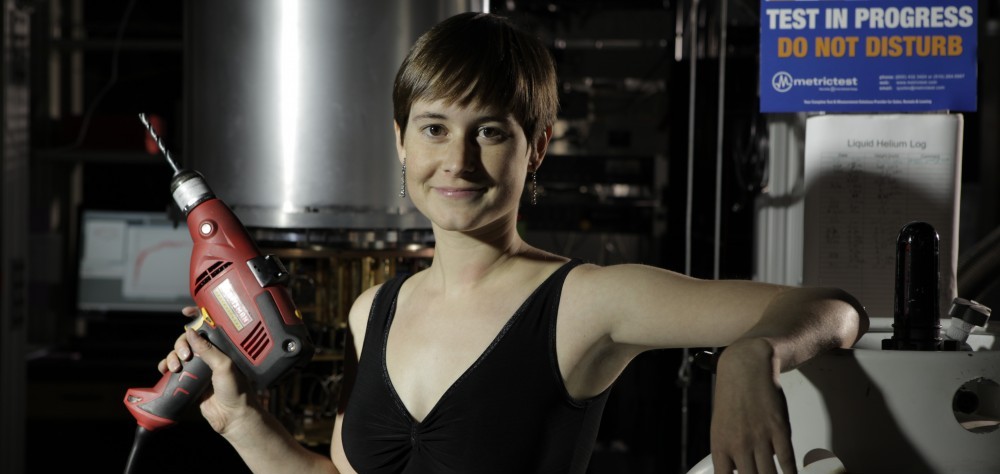
As a little girl I would play school with the neighborhood children. Ever since fourth grade I knew I wanted to be a teacher in a classroom full of eager-to-learn nine-year olds, but it wasn’t until my freshman year of college that my plans changed. In Geology for Elementary Teachers, I remember thinking, “This material is great! I need to learn more!” My hunger for a deeper understanding of how the physical world works led me to reflect on what my favorite science in high school was: Physics. Not long after, I changed my major to Physics and I was on the path to becoming a high school Physics teacher. Fast forward a decade, and I have my dream job. I get to explore the exciting world of Physics all day with 150+ adolescents and I wouldn’t change that for the world.

At Caltech after an exciting day at the lab!


Continue reading

Sad about Sally

Sally Ride

I’m really sad about the death of Sally Ride. Aside from all her other achievements, she devoted herself to getting kids, especially girls, excited about math, science and technology. She was 61.

On April 28, 1994 (yes, I really know the date … I keep records), Sally spoke at the Caltech physics colloquium about the future of the US Space Program, and in particular about the case for building the International Space Station. The talk was remarkably frank about how ill suited the Space Station would be for scientific research.

My daughter Carina was 8, and I took her to Caltech after school to meet Sally. Carina brought her copy of Sally’s book To Space and Back, which Sally signed, “To Carina, Reach for the Stars! – Sally Ride”
Continue reading

Supremacy Now?

Martin Zwierlein

In May 1994, Artur Ekert visited Caltech to give a seminar about quantum cryptography. Near the end of the talk, Ekert revealed an exciting new development — just weeks earlier, Peter Shor had announced the discovery of an efficient quantum algorithm for finding the prime factors of large composite integers, a problem for which no efficient classical algorithm is known.

Perhaps I’ve embellished the memory over time, but I recall being awestruck by this news. I spent the next month at the Isaac Newton Institute attending a workshop about quantum black holes, and though it was a very good workshop and I had some great discussions, I spent most of my time there secretly trying to understand Shor’s paper, which Ekert had emailed to me. This took some effort, because I knew little about algorithms or computational complexity at that time (even less than I know now), but by the end of the workshop I felt I understood the ideas behind Shor’s algorithm pretty well. I did not yet realize that I was in the midst of a career transition from particle physics to quantum information science.
Continue reading

How I learned to stop worrying and love graphene

Five years ago, I was staring out one of the few windowed cubicles in a cluttered office full of overambitious salespeople willing to throw their own father under a bus, if it meant a couple more dollars in commission and maybe a few more brownie points from the sweaty, beer-bellied sales manager. What was going through my mind as I stared out that window? Often nothing, sometimes an In-N-Out double-double with whole grilled onions, and every so often I would imagine I had a career with guts… substance. A career that I wouldn’t inaudibly mutter under my breath as an answer when asked the inevitable initial small talk question, “Well, what do you do?” A career that I would proudly proclaim to the world.

In front of the CAPSI House at Caltech, where we play with lasers in the name of enhancing high school education.

Early in life, there was always an attraction towards teaching, and during college I took education courses in route to becoming a high school teacher. However, money, that enticing savage, redirected my path away from education and into the world of sales, where feelings of shame (due to the high cheese-factor associated with the job) and satisfaction (due to the substantial pay check) took turns dominating my feelings regarding my career choice. Eventually, the cheese-factor won out and I needed a way out. So, I left the sales job and fell back on what I initially set out to do – teach.
Continue reading

Closure

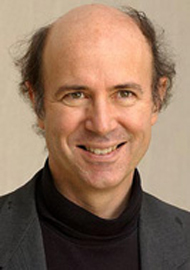
Frank Wilczek

There are two kinds of particle physicists: those who wanted the Higgs boson to be discovered, and those who wanted the Higgs boson not to be discovered.

At a conference last fall, I sat at the same dinner table with Frank Wilczek. Inevitably, the conversation came around to the prospects for discovering the Higgs boson in 2012. “It would be much more exciting if the Higgs isn’t found,” I insisted. Frank did not claim to disagree, but was adamant: “I want closure.”*

In the late fall of 1974, I had applied to graduate school, but did not yet know where I would be accepted. Roberta (then my fiance, now my wife) and I were in Boston for the day, so we decided to stop by Harvard to look around. We noticed Steve Weinberg was in his office, and though I had never met Weinberg and had no appointment, we barged in. I introduced Roberta and announced I was interested in coming to Harvard the following year.
Continue reading

More to come

John Wheeler. Photo by the New York Times/Redux.

As a sophomore at Princeton I took a class called Honors Physics from a man named Johnny Wheeler. He wore a suit and tie to class, loved explosions, and created vivid art in real time with colored chalk. Implausibly old, he had worked on nuclear fission with Niels Bohr. He was 61.

The lectures were long on inspiration and short on information about how to do the homework. I was in awe of Wheeler. Some students thought he sucked.

One day I arrived late to find Wheeler conducting a poll. We were voting on the future of science: is there “more to come” or “less to come”? I don’t remember the count, but “more to come” won handily. Wheeler was pleased.

Later, at a student-faculty lunch, Wheeler seemed troubled. He had been asked to explain the essence of quantum mechanics in five words or less, and was stumped. Frank Calaprice, a nuclear physicist within earshot, interjected helpfully, “What we expect to measure?” I was silent.

The question was absurd. It was fascinating. I still think about it. I can’t answer it.

This year I taught a course on quantum statistical physics to Caltech sophomores. I wore khakis and always used the white chalk. Though I’m 59, few students seemed awed. Some thought I sucked. Maybe I did sometimes.

Johnny Wheeler never blogged. If he had, some readers would have been awed. Some would have thought he sucked.

But Johnny would not have reminisced about a class he took 40 years ago. He knew there was more to come.

Welcome to Quantum Frontiers! We hope that the posts to come will be long on inspiration, even if short on information about how to do your homework. Enjoy!

Hello quantum world!

Welcome to a new blog by the licensed quantum mechanics here at IQIM, the Institute for Quantum Information and Matter at Caltech!

Caltech in bloom. Photo by Lance Hayashida.

IQIM is the newest Physics Frontiers Center supported by the National Science Foundation and the Gordon and Betty Moore Foundation. We study physical systems in which the weirdness of the quantum world becomes manifest on macroscopic scales. Our work spans a wide range of cutting edge research, from superconductivity and nanotechnology, to exotic phases of matter and quantum computation!

We are excited to bring you firsthand accounts of the groundbreaking research taking place inside the labs of IQIM, and to answer your questions about our past, present and future work on some of the most fascinating questions at the frontiers of quantum science.

We hope you will join us on this incredible journey of discovery!