More than Its Parts

“The whole not only becomes more than but very different from the sum of its parts.”
– P. W. Anderson

It was a brainstorming meeting. We went from referencing a melodramatic viral Thai video to P. W. Anderson’s famous paper, “More is Different” to a vote-splitting internally produced Caltech video to the idea of extracting an edit out of existing video we already had from prior IQIM-Parveen Shah Productions’ shoots. And just like that, stepping from one idea to the next, hopping along, I pitched a theorist vs experimentalist “interrogation”. They must have liked it because the opinion in the room hushed for a few seconds. It seemed plausibly exciting and dangerously perhaps…fresh. But what I witnessed in the room was exactly the idea of collaboration and the “storm” of the brain. This wasn’t a conclusion we could likely have arrived to if all of us were sitting alone. There was a sense of the dust settling around the chaotic storm of the collective brain(s). John Preskill, Crystal Dilworth, Spiros Michalakis and I finally agreed on a plan of action going forward. And mind you, this of course was very far from the first meeting or email we had had about the video.

Capitalizing on the instant excitement, the emails started going around. Who will be the partners in crime? A combination of personality, representation, willingness and profile were balanced to decide the participants. We reached out to Gil Refael, David Hsieh, Nai-Chang Yeh, Xie Chen and Oskar Painter. They all said “yes”! It seemed deceivingly easy. And alas it came. Once the idea of the interrogation was unleashed; pitting them against one another or should I say “with” one another, brought about a bit of anxiety and confusion at first. “Wait, we’re supposed to fight on camera?” “But, our fields don’t match necessarily.” “No, no, it just doesn’t make sense.” I was prepared for the paranoia. It was natural and a bit less than what we got back when we pitched the high-fashion shoot for geeks video. I was taking them out of their comfort zone. It was natural. I abated the fears. I told them it was not going to be that controversial.

But I had to prep it to a certain level of “conflict” or “drama” so that what we got on camera, was at least some remnant of the initial emotional intention. The questions, the “tone” had to be set. Then we realized that it wasn’t just the meeting of the professorial brains but also the other researchers of the Institute that needed to be represented. And so, we also added some post docs and graduate students. Johannes Pollanen (now already an Assistant Professor at Michigan State University), Chandni Usha and Shaun Maguire. The idea of a nebulous conversation about theory vs practical or theory and practical seemed like a literal experiment of the very idea of the formation of the IQIM: putting the best brains in the field, in a sandbox, shaking them around to see the entangled interactions produced. It seemed too perfect.

The resulting video might not have produced the exact linear narrative I desired…but it was indeed “more than the sum of its parts”. It showed the excitement, the constant interaction, the curious conversations and the anxiety of being at the forefront, the cutting edge, where one is sometimes limited by another and sometimes enabled by the other, but most importantly, constantly growing and evolving. IQIM to me signifies that community.

Being accepted and integrated as a filmmaker itself is a virtue of that forced and encouraged collaboration and interaction.

And so we began. Before we filmed, I spent time with each duo, discussing and requesting a narrative and answers to some proposed questions.

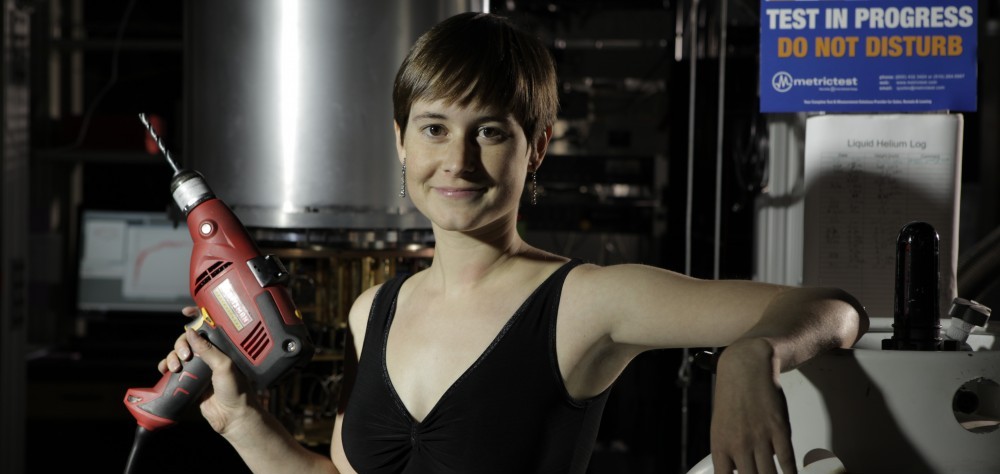
Cinematographer, Anthony C. Kuhnz, and I were excited to shoot in Keith Schwab’s spacious lab, that had produced the memorable shot of Emma Wollman for our initial promo video. It’s space and background was exactly what we needed for the blurred backgrounds of this “brain space” we were hoping to create.

The lighting was certainly inspired by an interrogation scene but dampened for the dream state. We wanted to bring people into a behind the scenes discussion of some of the most brilliant minds in quantum physics, seeing the issues and challenges that face them; the exciting possibilities that they predict. The handheld camera and the dynamic pans from one to another were also inspired to communicate that transitional and collaborative “ball toss” energy. Once you feel that tangible creativity, then we go into the depths of what IQIM really is, how it creates its community within and without, the latter by focusing on the outreach and the educational efforts to spread the magic and sparkle of Physics.

I’m proud of this video. When I watch it, whether or not I understand everything being said, I do certainly want to be engaged with IQIM and that is the hope for others who watch it.

Nature is subtle and so is the effect of this video…as in, we hope that…we gotcha!

Life, cellular automata, and mentoring

One night last July, IQIM postdoc Ning Bao emailed me a photo. He’d found a soda can that read, “Share a Coke with Patrick.”

Ning and I were co-mentoring two Summer Undergraduate Research Fellows, or SURFers. One mentee received Ning’s photo: Caltech physics major Patrick Rall.

“Haha,” Patrick emailed back. “I’ll share a Coke.”

Patrick, Ning, and I shared the intellectual equivalent of a six-pack last summer. We shared papers, meals, frustrations, hopes, late-night emails (from Patrick and Ning), 7-AM emails (from me), and webcomic strips. Now a senior, Patrick is co-authoring a paper about his SURF project.

The project grew from the question “What would happen if we quantized Conway’s Game of Life?” (For readers unfamiliar with the game, I’ll explain below.) Lessons we learned about the Game of Life overlapped with lessons I learned about life, as a first-time mentor. The soda fountain of topics contained the following flavors.

Patrick + Coke

Update rules: Till last spring, I’d been burrowing into two models for out-of-equilibrium physics. PhD students burrow as no prairie dogs can. But, given five years in Caltech’s grassland, I wanted to explore. I wanted an update.

Ning and I had trespassed upon quantum game theory months earlier. Consider a nonquantum game, such as the Prisoner’s Dilemma or an election. Suppose that players have physical systems, such as photons (particles of light), that occupy superposed or entangled states. These quantum resources can change the landscape of the game’s possible outcomes. These changes clarify how we can harness quantum mechanics to process, transmit, and secure information.

How might quantum resources change Conway’s Game of Life, or GoL? British mathematician John Conway invented the game in 1970. Imagine a square board divided into smaller squares, or cells. On each cell sits a white or a black tile. Black represents a living organism; white represents a lack thereof.

Conway modeled population dynamics with an update rule. If prairie dogs overpopulate a field, some die from overcrowding. If a black cell borders more than three black neighbors, a white tile replaces the black. If separated from its pack, a prairie dog dies from isolation. If a black tile borders too few black neighbors, we exchange the black for a white. Mathematics columnist Martin Gardner detailed the rest of Conway’s update rule in this 1970 article.

Updating the board repeatedly evolves the population. Black and white shapes might flicker and undulate. Space-ship-like shapes can glide across the board. A simple update rule can generate complex outcomes—including, I found, frustrations, hopes, responsibility for another human’s contentment, and more meetings than I’d realized could fit in one summer.

Prairie dogs

Modeled by Conway’s Game of Life. And by PhD students.

Initial conditions: The evolution depends on the initial state, on how you distribute white and black tiles when preparing the board. Imagine choosing the initial state randomly from all the possibilities. White likely mingles with about as much black. The random initial condition might not generate eye-catchers such as gliders. The board might fade to, and remain, one color.*

Enthusiasm can fade as research drags onward. Project Quantum GoL has continued gliding due to its initial condition: The spring afternoon on which Ning, Patrick, and I observed the firmness of each other’s handshakes; Patrick walked Ning and me through a CV that could have intimidated a postdoc; and everyone tried to soothe everyone else’s nerves but occasionally avoided eye contact.

I don’t mean that awkwardness sustained the project. The awkwardness faded, as exclamation points and smiley faces crept into our emails. I mean that Ning and I had the fortune to entice Patrick. We signed up a bundle of enthusiasm, creativity, programming skills, and determination. That determination perpetuated the project through the summer and beyond. Initial conditions can determine a system’s evolution.

Long-distance correlations:  “Sure, I’d love to have dinner with you both! Thank you for the invitation!”

Lincoln Carr, a Colorado School of Mines professor, visited in June. Lincoln’s group, I’d heard, was exploring quantum GoLs.** He studies entanglement (quantum correlations) in many-particle systems. When I reached out, Lincoln welcomed our SURF group to collaborate.

I relished coordinating his visit with the mentees. How many SURFers could say that a professor had visited for his or her sake? When I invited Patrick to dinner with Lincoln, Patrick lit up like a sunrise over grasslands.

Our SURF group began skyping with Mines every Wednesday. We brainstorm, analyze, trade code, and kvetch with Mines student Logan Hillberry and colleagues. They offer insights about condensed matter; Patrick, about data processing and efficiency; I, about entanglement theory; and Ning, about entropy and time evolution.

We’ve learned together about long-range entanglement, about correlations between far-apart quantum systems. Thank goodness for skype and email that correlate far-apart research groups. Everyone would have learned less alone.

Correlations.001

Long-distance correlations between quantum states and between research groups

Time evolution: Logan and Patrick simulated quantum systems inspired by Conway’s GoL. Each researcher coded a simulation, or mathematical model, of a quantum system. They agreed on a nonquantum update rule; Logan quantized it in one way (constructed one quantum analog of the rule); and Patrick quantized the rule another way. They chose initial conditions, let their systems evolve, and waited.

In July, I noticed that Patrick brought a hand-sized green spiral notepad to meetings. He would synopsize his progress, and brainstorm questions, on the notepad before arriving. He jotted suggestions as we talked.

The notepad began guiding meetings in July. Patrick now steers discussions, ticking items off his agenda. The agenda I’ve typed remains minimized on my laptop till he finishes. My agenda contains few points absent from his, and his contains points not in mine.

Patrick and Logan are comparing their results. Behaviors of their simulations, they’ve found, depend on how they quantized their update rule. One might expect the update rule to determine a system’s evolution. One might expect the SURF program’s template to determine how research and mentoring skills evolve. But how we implement update rules matters.

SURF photo

Caltech’s 2015 quantum-information-theory Summer Undergraduate Research Fellows and mentors

Life: I’ve learned, during the past six months, about Conway’s Game of Life, simulations, and many-body entanglement. I’ve learned how to suggest references and experts when I can’t answer a question. I’ve learned that editing SURF reports by hand costs me less time than editing electronically. I’ve learned where Patrick and his family vacation, that he’s studying Chinese, and how undergrads regard on-campus dining. Conway’s Game of Life has expanded this prairie dog’s view of the grassland more than expected.

I’ll drink a Coke to that.

Glossary: Conway’s GoL is a cellular automatonA cellular automaton consists of a board whose tiles change according to some update rule. Different cellular automata correspond to different board shapes, to boards of different dimensions, to different types of tiles, and to different update rules.

*Reversible cellular automata have greater probabilities (than the GoL has) of updating random initial states through dull-looking evolutions.

**Others have pondered quantum variations on Conway’s GoL.

Quantum Information: Episode II: The Tools’ Applications

Monday dawns. Headlines report that “Star Wars: Episode VII” has earned more money, during its opening weekend, than I hope to earn in my lifetime. Trading the newspaper for my laptop, I learn that a friend has discovered ThinkGeek’s BB-8 plushie. “I want one!” she exclaims in a Facebook post. “Because BB-8 definitely needs to be hugged.”

BB-8 plays sidekick to Star Wars hero Poe Dameron. The droid has a spherical body covered with metallic panels and lights.Mr. Gadget and Frosty the Snowman could have spawned such offspring. BB-8 has captured viewers’ hearts, and its chirps have captured cell-phone ringtones.

BB-8

ThinkGeek’s BB-8 plushie

Still, I scratch my head over my friend’s Facebook post. Hugged? Why would she hug…

Oh. Oops.

I’ve mentally verbalized “BB-8” as “BB84.” BB84 denotes an application of quantum theory to cryptography. Cryptographers safeguard information from eavesdroppers and tampering. I’ve been thinking that my friend wants to hug a safety protocol.

Charles Bennett and Gilles Brassard invented BB84 in 1984. Imagine wanting to tell someone a secret. Suppose I wish to coordinate, with a classmate, the purchase of a BB-8 plushie for our friend the droid-hugger. Suppose that the classmate and I can communicate only via a public channel on which the droid-hugger eavesdrops.

Cryptographers advise me to send my classmate a key. A key is a random string of letters, such as CCCAAACCABACA. I’ll encode my message with the string, with which my classmate will decode the message.

Key 2

I have to transmit the key via the public channel. But the droid-hugger eavesdrops on the public channel. Haven’t we taken one step forward and one step back? Why would the key secure our information?

Because quantum-information science enables me to to transmit the key without the droid-hugger’s obtaining it. I won’t transmit random letters; I’ll transmit quantum states. That is, I’ll transmit physical systems, such as photons (particles of light), whose properties encode quantum information.

A nonquantum letter has a value, such as A or B or C.  Each letter has one and only one value, regardless of whether anyone knows what value the letter has. You can learn the value by measuring (looking at) the letter. We can’t necessarily associate such a value with a quantum state. Imagine my classmate measuring a state I send. Which value the measurement device outputs depends on chance and on how my classmate looks at the state.

If the droid-hugger intercepts and measures the state, she’ll change it. My classmate and I will notice such changes. We’ll scrap our key and repeat the BB84 protocol until the droid-hugger quits eavesdropping.

BB84 launched quantum cryptography, the safeguarding of information with quantum physics. Today’s quantum cryptographers rely on BB84 as you rely, when planning a holiday feast, on a carrot-cake recipe that passed your brother’s taste test on his birthday. Quantum cryptographers construct protocols dependent on lines like “The message sender and receiver are assumed to share a key distributed, e.g., via the BB84 protocol.”

BB84 has become a primitive task, a solved problem whose results we invoke in more-complicated problems. Other quantum-information primitives include (warning: jargon ahead) entanglement distillation, entanglement dilution, quantum data compression, and quantum-state merging. Quantum-information scientists solved many primitive problems during the 1990s and early 2000s. You can apply those primitives, even if you’ve forgotten how to prove them.

Caveman

A primitive task, like quantum-entanglement distillation

Those primitives appear to darken quantum information’s horizons. The spring before I started my PhD, an older physicist asked me why I was specializing in quantum information theory. Haven’t all the problems been solved? he asked. Isn’t quantum information theory “dead”?

Imagine discovering how to power plasma blades with kyber crystals. Would you declare, “Problem solved” and relegate your blades to the attic? Or would you apply your tool to defending freedom?

Saber + what to - small

Primitive quantum-information tools are unknotting problems throughout physics—in computer science; chemistry; optics (the study of light); thermodynamics (the study of work, heat, and efficiency); and string theory. My advisor has tracked how uses of “entanglement,” a quantum-information term, have swelled in high-energy-physics papers.

A colleague of that older physicist views quantum information theory as a toolkit, a perspective, a lens through which to view science. During the 1700s, the calculus invented by Isaac Newton and Gottfried Leibniz revolutionized physics. Emmy Noether (1882—1935) recast physics in terms of symmetries and conservation laws. (If the forces acting on a system don’t change in time, for example, the system doesn’t gain or lose energy. A constant force is invariant under, or symmetric with respect to, the progression of time. This symmetry implies that the system’s energy is conserved.) We can cast physics instead (jargon ahead) in terms of the minimization of a free energy or an action.

Quantum information theory, this physicist predicted, will revolutionize physics as calculus, symmetries, conservation, and free energy have. Quantum-information tools such as entropies, entanglement, and qubits will bleed into subfields of physics as Lucasfilm has bled into the fanfiction, LEGO, and Halloween-costume markets.

BB84, and the solution of other primitives, have not killed quantum information. They’ve empowered it to spread—thankfully, to this early-career quantum information scientist. Never mind BB-8; I’d rather hug BB84. Perhaps I shall. Engineers have realized technologies that debuted on Star Trek; quantum mechanics has secured key sharing; bakers have crafted cakes shaped like the Internet; and a droid’s popularity rivals R2D2’s. Maybe next Monday will bring a BB84 plushie.

Plushie

The author hugging the BB84 paper and a plushie. On my wish list: a combination of the two.

Discourse in Delft

A camel strolled past, yards from our window in the Applied-Sciences Building.

I hadn’t expected to see camels at TU Delft, aka the Delft University of Technology, in Holland. I breathed, “Oh!” and turned to watch until the camel followed its turbaned leader out of sight. Nelly Ng, the PhD student with whom I was talking, followed my gaze and laughed.

Nelly works in Stephanie Wehner’s research group. Stephanie—a quantum cryptographer, information theorist, thermodynamicist, and former Caltech postdoc—was kind enough to host me for half August. I arrived at the same time as TU Delft’s first-year undergrads. My visit coincided with their orientation. The orientation involved coffee hours, team-building exercises, and clogging the cafeteria whenever the Wehner group wanted lunch.

And, as far as I could tell, a camel.

Not even a camel could unseat Nelly’s and my conversation. Nelly, postdoc Mischa Woods, and Stephanie are the Wehner-group members who study quantum and small-scale thermodynamics. I study quantum and small-scale thermodynamics, as Quantum Frontiers stalwarts might have tired of hearing. The four of us exchanged perspectives on our field.

Mischa knew more than Nelly and I about clocks; Nelly knew more about catalysis; and I knew more about fluctuation relations. We’d read different papers. We’d proved different theorems. We explained the same phenomena differently. Nelly and I—with Mischa and Stephanie, when they could join us—questioned and answered each other almost perpetually, those two weeks.

We talked in our offices, over lunch, in the group discussion room, and over tea at TU Delft’s Quantum Café. We emailed. We talked while walking. We talked while waiting for Stephanie to arrive so that she could talk with us.

IMG_0125

The site of many a tête-à-tête.

The copiousness of the conversation drained me. I’m an introvert, formerly “the quiet kid” in elementary school. Early some mornings in Delft, I barricaded myself in the visitors’ office. Late some nights, I retreated to my hotel room or to a canal bank. I’d exhausted my supply of communication; I had no more words for anyone. Which troubled me, because I had to finish a paper. But I regret not one discussion, for three reasons.

First, we relished our chats. We laughed together, poked fun at ourselves, commiserated about calculations, and confided about what we didn’t understand.

We helped each other understand, second. As I listened to Mischa or as I revised notes about a meeting, a camel would stroll past a window in my understanding. I’d see what I hadn’t seen before. Mischa might be explaining which quantum states represent high-quality clocks. Nelly might be explaining how a quantum state ξ can enable a state ρ to transform into a state σ. I’d breathe, “Oh!” and watch the mental camel follow my interlocutor through my comprehension.

Nelly’s, Mischa’s, and Stephanie’s names appear in the acknowledgements of the paper I’d worried about finishing. The paper benefited from their explanations and feedback.

Third, I left Delft with more friends than I’d had upon arriving. Nelly, Mischa, and I grew to know each other, to trust each other, to enjoy each other’s company. At the end of my first week, Nelly invited Mischa and me to her apartment for dinner. She provided pasta; I brought apples; and Mischa brought a sweet granola-and-seed mixture. We tasted and enjoyed more than we would have separately.

IMG_0050

Dinner with Nelly and Mischa.

I’ve written about how Facebook has enhanced my understanding of, and participation in, science. Research involves communication. Communication can challenge us, especially many of us drawn to science. Let’s shoulder past the barrier. Interlocutors point out camels—and hot-air balloons, and lemmas and theorems, and other sources of information and delight—that I wouldn’t spot alone.

With gratitude to Stephanie, Nelly, Mischa, the rest of the Wehner group (with whom I enjoyed talking), QuTech and TU Delft.

During my visit, Stephanie and Delft colleagues unveiled the “first loophole-free Bell test.” Their paper sent shockwaves (AKA camels) throughout the quantum community. Scott Aaronson explains the experiment here.

BTZ black holes for #BlackHoleFriday

Yesterday was a special day. And no I’m not referring to #BlackFriday — but rather to #BlackHoleFriday. I just learned that NASA spawned this social media campaign three years ago. The timing of this year’s Black Hole Friday is particularly special because we are exactly 100 years + 2 days after Einstein published his field equations of general relativity (GR). When Einstein introduced his equations he only had an exact solution describing “flat space.” These equations are notoriously difficult to solve so their introduction sent out a call-to-arms to mathematically-minded-physicists and physically-minded-mathematicians who scrambled to find new solutions.

If I had to guess, Karl Schwarzschild probably wasn’t sleeping much exactly a century ago. Not only was he deployed to the Russian Front as a solider in the German Army, but a little more than one month after Einstein introduced his equations, Schwarzschild was the first to find another solution. His solution describes the curvature of spacetime outside of a spherically symmetric mass. It has the incredible property that if the spherical mass is compact enough then spacetime will be so strongly curved that nothing will be able to escape (at least from the perspective of GR; we believe that there are corrections to this when you add quantum mechanics to the mix.) Schwarzchild’s solution took black holes from the realm of clever thought experiments to the status of being a testable prediction about how Nature behaves.

It’s worth mentioning that between 1916-1918 Reissner and Nordstrom generalized Schwarzschild’s solution to one which also has electric charge. Kerr found a solution in 1963 which describes a spinning black hole and this was generalized by Newman et al in 1965 to a solution which includes both spin (angular momentum) and electric charge. These solutions are symmetric about their spin axis. It’s worth mentioning that we can also write sensible equations which describe small perturbations around these solutions.

And that’s pretty much all that we’ve got in terms of exact solutions which are physically relevant to the 3+1 dimensional spacetime that we live in (it takes three spatial coordinates to specify a meeting location and another +1 to specify the time.) This is the setting that’s closest to our everyday experiences and these solutions are the jumping off points for trying to understand the role that black holes play in astrophysics. As I already mentioned, studying GR using pen and paper is quite challenging. But one exciting direction in the study of astrophysical black holes comes from recent progresses in the field of numerical relativity; which discretizes the calculations and then uses supercomputers to study approximate time dynamics.

Screen Shot 2015-11-27 at 10.39.41 AM

Artist’s rendition of dust+gas in an “accretion disk” orbiting a spinning black hole. Friction in the accretion disk generates temperatures oftentimes exceeding 10M degrees C (2000 times the temperature of the Sun.) This high temperature region emits x-rays and other detectable EM radiation. The image also shows a jet of plasma. The mechanism for this plasma jet is not yet well understood. Studying processes like this requires all of tools that we have available to us: from numerical relativity; to cutting edge space observatories like NuSTAR; to LIGO in the immediate future *hopefully.* Image credit: NASA/Caltech-JPL

I don’t expect many of you to be experts in the history outlined above. And I expect even fewer of you to know that Einstein’s equations still make sense in any number of dimensions. In this context, I want to briefly introduce a 2+1 dimensional solution called the BTZ black hole and outline why it has been astonishingly important since it was introduced 23 years ago by Bañados, Teteilboim and Zanelli (their paper has been cited over 2k times which is a tremendous number for theoretical physics.)

There are many different viewpoints which yield the BTZ black hole and this is one of them. This is a  time=0 slice of the BTZ black hole obtained by gluing together special curves (geodesics) related to each other by a translation symmetry. The BTZ black hole is a solution of Einstein’s equations in 2+1d which has two asymptotic regions which are causally separated from each other by an event horizon. The arrows leading to “quantum states” come into play when you use the BTZ black hole as a toy model for thinking about quantum gravity.

One of the most striking implications of Einstein’s theory of general relativity is that our universe is described by a curved geometry which we call spacetime. Einstein’s equations describe the dynamical interplay between the curvature of spacetime and the distribution of energy+matter. This may be counterintuitive, but there are many solutions even when there is no matter or energy in the spacetime. We call these vacuum solutions. Vacuum solutions can have positive, negative or zero “curvature.

As 2d surfaces: the sphere is positively curved; a saddle has negative curvature; and a plane has zero curvature.

It came as a great surprise when BTZ showed in 1992 that there is a vacuum solution in 2+1d which has many of the same properties as the more physical 3+1d black holes mentioned above. But most excitingly — and something that I can’t imagine BTZ could have anticipated — is that their solution has become the toy model of all toy models for trying to understand “quantum gravity.

GR in 2+1d has many convenient properties. Two beautiful things that happen in 2+1d are that:

  • There are no gravitational waves. Technically, this is because the Riemann tensor is fully determined by the Ricci tensor — the number of degrees of freedom in this system is exactly equal to the number of constraints given by Einstein’s equations. This makes GR in 2+1d something called a “topological field theory” which is much easier to quantize than its full blown gauge theory cousin in 3+1d.
  • The maximally symmetric vacuum solution with negative curvature, which we call Anti de-Sitter space, has a beautiful symmetry. This manifold is exactly equal to the “group manifold” SL(2,R). This enables us to translate many challenging analytical questions into simple algebraic computations. In particular, it enables us to find a huge category of solutions which we call multiboundary wormholes, with BTZ being the most famous example.
Some "multiboundary wormhole" pictures that I made.

Some “multiboundary wormhole” pictures that I made. The left shows the constant time=0 slice for a few different solutions and what you are left with after gluing according to the equations on the right. These are solutions to GR in 2+1d.

These properties make 2+1d GR particularly useful as a sandbox for making progress towards a theory of quantum gravity. As examples of what this might entail:

  • Classically, a particle is in one definite location. In quantum mechanics, a particle can be in a superposition of places. In quantum gravity, can spacetime be in a superposition of geometries? How does this work?
  • When you go from classical physics to quantum physics, tunneling becomes a thing. Can the same thing happen with quantum gravity? Where we tunnel from one spacetime geometry to another? What controls the transition amplitudes?
  • The holographic principle is an incredibly important idea in modern theoretical physics. It stems from the fact that the entropy of a black hole is proportional to the area of its event horizon — whereas the entropy of a glass of water is proportional to the volume of water inside the glass. We believe that this reduction in dimensionality is wildly significant.

A few years after the holographic principle was introduced in the early 1990’s, by Gerard ‘t Hooft and Lenny Susskind, Juan Maldacena came up with a concrete manifestation which is now called the AdS/CFT correspondence. Maldacena’s paper has been cited over 14k times making it one of the most cited theoretical physics papers of all time. However, despite having a “correspondence” it’s still very hard to translate questions back and forth between the “gravity and quantum sides” in practice. The BTZ black hole is the gravity solution where this correspondence is best understood. Its quantum dual is a state called the thermofield double, which is given by: |\Psi_{CFT}\rangle = \frac{1}{\sqrt{Z}} \sum_{n=1}^{\infty} e^{-\beta E_n/2} |n\rangle_1 \otimes |n \rangle_2 . This describes a quantum state which lives on two circles (see my BTZ picture above.) There is entanglement between the two circles. If an experimentalist only had access to one of the circles and if they were asked to try to figure out what state they have, their best guess would be a “thermal state.” A state that has been exposed to a heat-bath for too long and has lost all of its initial quantum coherence.

It is in this sense that the BTZ black hole has been hugely important. It’s also evidence of how mysterious Einstein’s equations still remain, even to this day. We still don’t have exact solutions for many settings of interest, like for two black holes merging in 3+1d. It was only in 1992 that BTZ came up with their solution–77 years after Einstein formulated his theory! Judging by historical precedence, exactly solvable toy models are profoundly useful and BTZ has already proven to be an important signpost as we continue on our quest to understand quantum gravity. There’s already broad awareness that astrophysical black holes are fascinating objects. In this post I hope I conveyed a bit of the excitement surrounding how black holes are useful in a different setting — in aiding our understanding of quantum gravity. And all of this is in the spirit of #BlackHoleFriday, of course.

How to get more girls into STEM

Hey all, I’m back! I’ve been stuck in a black hole for the past couple years. Nobody ever said that doing a PhD in quantum gravity would be easy. Actually, my advisor John Preskill explicitly warned me that it would be exceptionally difficult (but in an encouraging manner; he was managing my expectations.) I wish I could say that I’ve returned w/ emergent spacetime figured out, but alas, I was simply inspired to write about a heady topic that is quite personal to me: how to increase gender diversity in STEM. (Maybe the key to understanding quantum gravity is to have more women thinking about these questions?)

I’ve been thinking about this topic for well over a decade but my interest bubbled over last week and I decided to write this post. Some entrepreneur friends were on a panel at Caltech (John Hering, Diego Berdakin and Joe Lonsdale) and during a wonderful sub-convo about increasing gender diversity in STEM a male undergrad asked: “as someone who’s only a student, what can I do to help with this issue?” The panel pretty much nailed it with their responses but this is an incredibly important issue and I want to capture some of their comments in writing, to frame this with broader context and to add some personal anecdotes.

FullSizeRender (3)

Before providing a few recommendations here are some bullets which I think are important in terms of framing this issue.

1. Full stack problem: this isn’t an issue that can be tackled by targeting any specific age range. It especially can’t be tackled by only focusing on recruitment for colleges or STEM jobs. Our current lack of diversity literally starts the day children are born. We have a broad culture of pushing kids away from STEM but these pressures disproportionately target girls.

2. Implicit biases: one of the most damaging and least spoken about mechanisms through which this happens are implicit biases. Very few people understand the depth of this issue and as an extension how guilty WE ALL ARE. Implicit biases are pervasive and they are pushing girls out of STEM. Here are examples from my own childhood which highlight how subtle the issue is.

I have a younger sister who has basically the same brain as myself (truly, we can read each others minds.) I became a theoretical physicist and entrepreneur and she’s a lawyer. This is obviously a worthy profession but how did we choose these paths? For years I’ve been looking back and trying to answer this question. Upon reflection, I was astonished by the strength of my implicit biases.

a. An Uncle helped me build a computer when I was seven. No one did the same for my sister. I spent most of the ages of 7-16 hacking around on computers which provided the foundation for many of the things that I’ve done in my adult life. This gesture by my Uncle was easily one of the most impactful things that anyone has ever done for me.

b. When my sister had computer problems I would treat her like she’s stupid and simply fix the problem for her (these words are overly dramatic but I’m trying to make a point.) Whereas when my male cousin had issues I would sit next to him and patiently explain the underlying issue and teach him how to fix his problem. That teaching a man to fish metaphor is a thing.

c. When people gave us presents they would give me Legos and my sister art supplies or clothes. Gifts didn’t always fall into these categories (obviously) but they almost always had a similar gender-specific split.

d. When I was the first to finish my multiplication tables in 3rd grade, my teacher encouraged me to read science books. When my sister finished she was encouraged to draw. This teacher was female.

e. These are only a few examples of implicit biases. I wasn’t aware of the potential cause-and-effect of my actions while making them. Only after years of reflection and seeing how amplified the problem becomes by making it to the tip of the funnel was I able to connect these personal dots. These biases are so deeply engrained that addressing them requires societal-scale reprogramming — but it starts with enhanced self-awareness. I obviously feel some level of guilt for being oblivious to these actions as a kid. And I’d be delusional to think I’m beyond having similar biases today.

3. Explicit/systematic biases: there’s much broader awareness of these category of biases so I’m mainly going to explain by linking to some recent headlines. The short of it is that on their path to STEM, women have to put up with many more hurdles than men. From hiring biases to sexual harassment. These biases disproportionately adversely affect women. Here’s a tiny sample of some of the most glaring recent headlines:

a. Geoff Marcy was a serial harasser for at least twenty years” — Gizmodo.

b. Why women are poor at science, by Harvard president (Larry Summers)” — Guardian headline. Granted, his comments were more nuanced than the media portrayed. But in any case, extremely damaging and evidence of an outmoded way of thinking.

c. Could it be that researchers find a hiring bias that favors women?” — NPR. I wanted to include this example to highlight that sometimes systematic biases (this isn’t exactly an explicit bias) go the other direction. But of course if we search hard enough we will be able to find specific instances in the stack where the bias favors women. My personal interpretation of this headline is: “the fearless women that have braved decades of doubt may have a minuscule advantage when competing for STEM jobs, but only after they have been disproportionately filtered out of the applicant pool on a massive scale.” Here are some statistics which show why this headline is only scratching the surface: NGCP and Techbridge.

If we acknowledge that this is a problem that literally starts the day children are born, then what can we, as individuals, do about it?

1. Constantly run a mental loop to check your implicit biases. I’m hoping we can compile a list of examples in the comments that can serve as a check-list of things NOT TO DO! E.g. When you ask: “what do you want to be when you grow-up?” Don’t answer before kids can get back to you with something like: “be a princess?” or “be a baseball player?” Those kids might want to be mathematicians! Maryam Mirzakhani or Terry Tao!

2. Provide encouragement to young girls without being over the top or condescending. Here’s a simple example from the past week. A.K. is ~8 years old and she visited Caltech recently (yes, I got permission from her mother to use this example.) This girl is a rockstar.

Screen Shot 2015-11-19 at 11.30.50 AMThe tragic reality is that A.K. is going to spend her next decade being pushed away from STEM. Don’t get me wrong, she’s lucky to have encouraging parents who are preempting this push, but they will be competing with the sway of the media and her peers.

Small gestures, such as @Caltechedu reposting the above photo on Instagram provides a powerful dosage of motivation. The way I think about it is this: kids, but especially girls, are going to face a persistent push away from STEM. They are going to get teased for being “too smart” + “not girly enough” + “weird” + “nerdy” + etc. Small votes of confidence from people that have made it through and can therefore speak with authority are like little bits of body armor. Comments sting a little bit less when the freedom+success of the other side is visible and you’re being told that you can make it too. Don’t underestimate the power of small gestures. One comment can literally make a world of difference. Do this. But it absolutely must be genuine.

3. Make a conscious effort to share your passion + enthusiasm for STEM. Our culture does an abysmal job of motivating and promoting the beauty + wonder of science. This advice applies to both girls and boys and it’s incredibly important. One of my favorite essays is “A Mathematician’s Lament” by Paul Lockhart. In it he contrasts the way that we teach mathematics compared to how we teach painting and music. Imagine if before letting kids see a finished masterwork or picking up a brush and playing around, we forced them to learn: color theory, the history of art, how to hold a brush, etc! If you’re at Caltech then invite kids to the SURF seminar day or to interesting public lectures. Go give a talk at a local school and explain via examples that science is a work in progress — there’s an infinite amount that we still don’t know! For example, a brilliant non-physicist hacker friend asked me yesterday if the Casimir effect is temperature dependent? The answer is yes, but this is still barely understood theoretically. At what temperature will a gecko’s stick stop working? Questions like this are engaging. It will only take a few hours of your time to emphasize to dozens of kids how exciting science is. Outreach is usually asymmetric.

As an aside, writing this reminded me of an outreach story from 2010. Somehow I finagled travel funds to attend the International Congress of Mathematicians (ICM) in Hyderabad, India. During our day off (one day during a two week conference), I set out early to do some sightseeing and a dude pulled up next to me on a scooter. He asked if I was there for the congress. It’s kind of a long story but after chatting for a bit I agreed to spend the day riding around on his scooter while spreading my passion for mathematics at a variety of schools in the Hyderabad area. I lectured to hundreds of kids that day. I wrote a blog post that ended up getting picked up by a few national newspapers and even made the official ICM newsletter (page six of this; FYI they condensed my post and convoluted some facts.) I’m sure that I ended up benefitting wayyyyyy more from my outreach than any of the students I spoke to. The crazy reality is that outreach is oftentimes like this.

hyderabad

4. There is literally nothing more rewarding than mentoring hyper talented kids and then watching them succeed. This is also incredibly asymmetric. Two hours of your time will provide direction and motivation for months. Do not discount the power of giving kids confidence and a small amount of direction.

In this post, I ignored some very important parts of the problem and also opportunities for addressing it in an attempt to focus on aspects that I think are under appreciated. Specifically how pervasive implicit biases are and how asymmetric outreach is. Increasing diversity in STEM is a societal scale problem that isn’t going to be fixed overnight. However, I believe it’s possible to make huge progress over the next two decades. We’re in the process of taking our first step, which is global-awareness of the problem. And now we need to take the next step which is broad self-awareness about the impacts of our individual actions and implicit biases. It seems to me like wildly increasing our talent pool is a useful endeavor. In the spirit of this blog, unlocking this hidden potential might even be the key to making progress with quantum gravity! And definitely towards making progress on an innumerable number of other science and engineering goals.

And, hey S, sorry for not teaching you more about computers 😦

********************************************************

Now some shameless on-topic plugs to promote my friends:

One of my roommates, Jason Porath, makes Rejected Princesses. This is a great site that all young girls should be aware of. Think badass women meet Disney glorification from a feminist perspective.

Try Goldie Blox to augment your kids’ Lego collection or as an alternative. If nothing else, watch their video featuring a Rube Goldberg inspired “Princess Machine!”

IQIM is heavily involved w/ Project Scientist which is a great program for young girls with an aptitude and interest in STEM.

Wouldn’t you like to know what’s going on in my mind?

I suppose most theoretical physicists who (like me) are comfortably past the age of 60 worry about their susceptibility to “crazy-old-guy syndrome.” (Sorry for the sexism, but all the victims of this malady I know are guys.) It can be sad when a formerly great scientist falls far out of the mainstream and seems to be spouting nonsense.

Matthew Fisher is only 55, but reluctance to be seen as a crazy old guy might partially explain why he has kept pretty quiet about his passionate pursuit of neuroscience over the past three years. That changed two months ago when he posted a paper on the arXiv about Quantum Cognition.

Neuroscience has a very seductive pull, because it is at once very accessible and very inaccessible. While a theoretical physicist might think and write about a brane even without having or seeing a brane, everybody’s got a brain (some scarecrows excepted). On the other hand, while it’s not too hard to write down and study the equations that describe a brane, it is not at all easy to write down the equations for a brain, let alone solve them. The brain is fascinating because we know so little about it. And … how can anyone with a healthy appreciation for Gödel’s Theorem not be intrigued by the very idea of a brain that thinks about itself?

(Almost) everybody's got a brain.

(Almost) everybody’s got a brain.

The idea that quantum effects could have an important role in brain function is not new, but is routinely dismissed as wildly implausible. Matthew Fisher begs to differ. And those who read his paper (as I hope many will) are bound to conclude: This old guy’s not so crazy. He may be onto something. At least he’s raising some very interesting questions.

My appreciation for Matthew and his paper was heightened further this Wednesday, when Matthew stopped by Caltech for a lunch-time seminar and one of my interminable dinner-time group meetings. I don’t know whether my brain is performing quantum information processing (and neither does Matthew), but just the thought that it might be is lighting me up like a zebrafish.

Following Matthew, let’s take a deep breath and ask ourselves: What would need to be true for quantum information processing to be important in the brain? Presumably we would need ways to (1) store quantum information for a long time, (2) transport quantum information, (3) create entanglement, and (4) have entanglement influence the firing of neurons. After a three-year quest, Matthew has interesting things to say about all of these issues. For details, you should read the paper.

Matthew argues that the only plausible repositories for quantum information in the brain are the Phosphorus-31 nuclear spins in phosphate ions. Because these nuclei are spin-1/2, they have no electric quadrupole moments and hence corresponding long coherence times — of order a second. That may not be long enough, but phosphate ions can be bound with calcium ions into objects called Posner clusters, each containing six P-31 nuclei. The phosphorus nuclei in Posner clusters might have coherence times greatly enhanced by motional narrowing, perhaps as long as weeks or even longer.

Where energy is being consumed in a cell, ATP sometimes releases diphosphate ions (what biochemists call pyrophosphate), which are later broken into two separate phosphate ions, each with a single P-31 qubit. Matthew argues that the breakup of the diphosphate, catalyzed by a suitable enzyme, will occur at an enhanced rate when these two P-31 qubits are in a spin singlet rather than a spin triplet. The reason is that the enzyme has to grab ahold of the diphosphate molecule and stop its rotation in order to break it apart, which is much easier when the molecule has even rather than odd orbital angular momentum; therefore due to Fermi statistics the spin state of the P-31 nuclei must be antisymmetric. Thus wherever ATP is consumed there is a plentiful source of entangled qubit pairs.

If the phosphate molecules remain unbound, this entanglement will decay in about a second, but it is a different story if the phosphate ions group together quickly enough into Posner clusters, allowing the entanglement to survive for a much longer time. If the two members of an entangled qubit pair are snatched up by different Posner clusters, the clusters may then be transported into different cells, distributing the entanglement over relatively long distances.

(a) Two entangled Posner clusters. Each dot is a P-31 nuclear spin, and each dashed line represents a singlet pair. (b) Many entangled Posner clusters. [From the paper]

(a) Two entangled Posner clusters. Each dot is a P-31 nuclear spin, and each dashed line represents a singlet pair. (b) Many entangled Posner clusters. [From Fisher 2015]

What causes a neuron to fire is a complicated story that I won’t attempt to wade into. Suffice it to say that part of the story may involve the chemical binding of a pair of Posner clusters which then melt if the environment is sufficiently acidic, releasing calcium ions and phosphate ions which enhance the firing. The melting rate depends on the spin state of the six P-31 nuclei within the cluster, so that entanglement between clusters in different cells may induce nonlocal correlations among different neurons, which could be quite complex if entanglement is widely distributed.

This scenario raises more questions than it answers, but these are definitely scientific questions inviting further investigation and experimental exploration. One thing that is far from clear at this stage is whether such quantum correlations among neurons (if they exist at all) would be easy to simulate with a classical computer. Even if that turns out to be so, these potential quantum effects involving many neurons could be fabulously interesting. IQIM’s mission is to reach for transformative quantum science, particularly approaches that take advantage of synergies between different fields of study. This topic certainly qualifies.* It’s going to be great fun to see where it leads.

If you are a young and ambitious scientist, you may be contemplating the dilemma: Should I pursue quantum physics or neuroscience? Maybe, just maybe, the right answer is: Both.

*Matthew is the only member of the IQIM faculty who is not a Caltech professor, though he once was.

Surprise Happens in Experiments

The discovery of high temperature superconductivity in copper-oxide-based ceramics (cuprates) in 1986 created tremendous excitement in the scientific community. For the first time superconductivity, the ability of a material to conduct electricity with zero energy loss to heat, was possible at temperatures an order of magnitude higher than what were previously thought possible. Thus began the dream of room temperature superconductivity, a dream that has been heavily sought but still unfulfilled to this day.

The difficulty in creating a room temperature superconductor is that we still do not even understand how cuprate high temperature superconductors exactly work. We have known that the superconductivity is born from removing or adding a proper amount of electrons to an insulating antiferromagnet. What is more is that the material experiences a mysterious region, usually called pseudogap, when transiting from the insulating antiferromagnet into the superconductor. For decades, scientists have debated whether the pseudogap in cuprates is a continuous evolution into superconductivity or a competing phase of matter with distinct symmetry properties, and some believe that a better understanding of its nature and relationship to superconductivity can help to pave a path towards room temperature superconductivity.

The compound that we are studying, strontium-iridium-oxide (Sr2IrO4), is a promising candidate for a new family of high temperature superconductors. Recent experimental findings in Sr2IrO4 reveal great similarities between Sr2IrO4 and cuprates. Sr2IrO4 is a novel insulator at room temperature and turns into an antiferromagnet below a critical temperature called Néel temperature (TN). With a certain amount of electrons added or removed by introducing foreign atoms in it, Sr2IrO4 enters into the pseudogap regime. At an even higher charge carrier concentration and a lower temperature, Sr2IrO4 exhibits strong signatures of unconventional superconductivity. A summary of the evolution of Sr2IrO4 as functions of charge carrier density and temperature, usually referred as a phase diagram, is depicted into a cartoon below, which mimics that of cuprates.

A cartoon showing similarities between Sr2IrO4 and Cuprates

A cartoon showing similarities between Sr2IrO4 and cuprates.

Our experimental results on the multipolar order in Sr2IrO4 further bridges the connection between Sr2IrO4 and cuprates. On one hand, there have been growing experimental evidences in recent years to support the presence of symmetry breaking phases of matter in the pseudogap regime of cuprates. On the other hand, the discovery of multipolar order in Sr2IrO4 where the psuedogap phenomenon has also been observed suggests a possible connection between these two. To establish the relationship between the multipolar order and the pseudogap in Sr2IrO4, one needs to compare the temperature scales at which each of them happens. So far, we have bounded a line in the Sr2IrO4 phase diagram for the multipolar ordered phase that breaks the 90o rotational symmetry from its high temperature state. However, the onset temperature for the pseudogap in Sr2IrO4 remains unknown in the community.

An artistic rendition of rotational anisotropy patterns both above and below the transition temperature T_Ω where the multipolar order happens, showing the 90^o rotational symmetry breaking across T_Ω

An artistic rendition of rotational anisotropy patterns both above and below the transition temperature T_Ω where the multipolar order happens, showing the 90^o rotational symmetry breaking across T_Ω.

Retrospectively, the scientific story was told as above in which it seems our experiment perfectly fits in a void in the connections between Sr2IrO4 and cuprates. In reality, this experiment is my first encounter of serendipity in scientific researches. When we started our experiment, there were no experimental indications about pseudogap or superconductivity in Sr2IrO4, and we were just planning to refine its antiferromagnetic structure based upon its recently refined crystallographic structure. This joyful surprise makes me aware of the importance of sensitivity to unexpected results, especially in a developing field. Another surprise to me is the technique that we used in this study, namely rotational anisotropy optical second harmonic generation. This technique is as simple as shining light of frequency ω at the sample from a series of angles and collecting light of frequency 2ω reflected from the sample. The novelty of our setup is to move the light around the sample as opposed to the other way in the traditional version of this technique. Exactly thank to this seemingly trivial novelty, we are able to probe the multipolar order that is still challenging for other more sophisticated symmetry sensitive techniques. To me, it is this experience that is more valuable, and that is what I feel happiest to share.

Although the dream of room temperature superconductivity is still unfulfilled, the cross comparisons between Sr2IrO4 and cuprates could be insightful in determining the important factors for superconductivity, and eventually make the journey towards the dream.

Please find more details in our paper and Caltech media.

Artist's rendition of spatially segregated domains of multipolar order in the Sr2IrO4 crystal.

Artist’s rendition of spatially segregated domains of multipolar order in the Sr2IrO4 crystal.

Explaining Quantum Physics to Newton… in 140 characters

Sir Isaac Newton is considered by many as the greatest physicist of all time. But despite Newton’s contributions to classical physics, the man never even fathomed that the world was actually governed by the equations of quantum mechanics. We think it is time to right that wrong. With your help, we plan to send a Tweet back in time (something about time machines restricts quantum telegraphs to 140 characters) that explains what quantum is all about to Sir Isaac. This mini competition is taking place on our Twitter account over @IQIM_Caltech and ends on November 5th, 2015. The prize is a one-year digital subscription to Scientific American.

For more details, please see below. This mini competition is part of Quantum Shorts, a flash fiction competition conceived and executed by our friends at the Center for Quantum Technologies.

QSmini_oct28_twitter

Let the games begin!

Nothing has been done yet. The world is your oyster…still.

The three things that come to mind when I watch Simon’s video are: travel, perspective and discomfort. They remind me of some of the things I also said in my TEDx talk titled “Get Uncomfortable Now”.

Simon’s video exemplifies a lot of what I feel is true in filmmaking as well. He goes running to clear his mind and get more creative, I take long walks when I’m stuck at a point in my screenplays or edits. He travels to learn more about what’s out there, I travel to absorb culture as well, he tries diversity of experiences to enrich his mind, so do I in a selfish desire to enrich every character I write or direct; all with the ultimate goal of growth & transience: emotional, physical, mental.

Simon also says something very exciting in the film, “there’s so much left to do out there”, a thought that isn’t expressed that often, the idea that “I can do something novel right here in the lab” makes the chance of innovation, success and achievement very tangible; achievable. That honesty, excitement and drive is important to be repeated in an otherwise very jaded and intimidated world. The belief in the power of the individual driving forward and having the potential to change the status quo, in the lab and outside, is critical.

It was hard to get Simon to narrow it down to the one hobby that drove him. After Debaleena’s video being internal and about family, we knew we wanted something more external. Filming in Griffith park is usually a nightmare but that early morning, we got everything we wanted minus possibly a clearer view of downtown LA, thanks to Marcia Brown’s usual detailed planning.

The shoot was complete with a steadicam operator, running videos and even the spotting of a snake!

The most memorable thing for me are Simon’s slow motion shots that highlight the sound of foot steps, of pushing forward, step by step, one ahead of the other; that basic contact that lunges us into the future. There was something very “grounding” about watching that, no pun intended.

Without further ado, here’s the video: