Finding Ed Jaynes’s ghost

You might have heard of the conundrum “What do you give the man who has everything?” I discovered a variation on it last October: how do you celebrate the man who studied (nearly) everything? Physicist Edwin Thompson Jaynes impacted disciplines from quantum information theory to biomedical imaging. I almost wrote “theoretical physicist,” instead of “physicist,” but a colleague insisted that Jaynes had a knack for electronics and helped design experiments, too. Jaynes worked at Washington University in St. Louis (WashU) from 1960 to 1992. I’d last visited the university in 2018, as a newly minted postdoc collaborating with WashU experimentalist Kater Murch. I’d scoured the campus for traces of Jaynes like a pilgrim seeking a saint’s forelock or humerus. The blog post “Chasing Ed Jaynes’s ghost” documents that hunt.

I found his ghost this October.

Kater and colleagues hosted the Jaynes Centennial Symposium on a brilliant autumn day when the campus’s trees were still contemplating shedding their leaves. The agenda featured researchers from across the sciences and engineering. We described how Jaynes’s legacy has informed 21st-century developments in quantum information theory, thermodynamics, biophysics, sensing, and computation. I spoke about quantum thermodynamics and information theory—specifically, incompatible conserved quantities, about which my research-group members and I have blogged many times.

Irfan Siddiqi spoke about quantum technologies. An experimentalist at the University of California, Berkeley, Irfan featured on Quantum Frontiers seven years ago. His lab specializes in superconducting qubits, tiny circuits in which current can flow forever, without dissipating. How can we measure a superconducting qubit? We stick the qubit in a box. Light bounces back and forth across the box. The light interacts with the qubit while traversing it, in accordance with the Jaynes–Cummings model. We can’t seal any box perfectly, so some light will leak out. That light carries off information about the qubit. We can capture the light using a photodetector to infer about the qubit’s state.

The first half of Jaynes–Cummings

Bill Bialek, too, spoke about inference. But Bill is a Princeton biophysicist, so fruit flies preoccupy him more than qubits do. A fruit fly metamorphoses from a maggot that hatches from an egg. As the maggot develops, its cells differentiate: some form a head, some form a tail, and so on. Yet all the cells contain the same genetic information. How can a head ever emerge, to differ from a tail? 

A fruit-fly mother, Bill revealed, injects molecules into an egg at certain locations. These molecules diffuse across the egg, triggering the synthesis of more molecules. The knock-on molecules’ concentrations can vary strongly across the egg: a maggot’s head cells contain molecules at certain concentrations, and the tail cells contain the same molecules at other concentrations.

At this point in Bill’s story, I was ready to take my hat off to biophysicists for answering the question above, which I’ll rephrase here: if we find that a certain cell belongs to a maggot’s tail, why does the cell belong to the tail? But I enjoyed even more how Bill turned the question on its head (pun perhaps intended): imagine that you’re a maggot cell. How can you tell where in the maggot you are, to ascertain how to differentiate? Nature asks this question (loosely speaking), whereas human observers ask Bill’s first question.

To answer the second question, Bill recalled which information a cell accesses. Suppose you know four molecules’ concentrations: c_1, c_2, c_3, and c_4. How accurately can you predict the cell’s location? That is, what probability does the cell have of sitting at some particular site, conditioned on the cs? That probability is large only at one site, biophysicists have found empirically. So a cell can accurately infer its position from its molecules’ concentrations.

I’m no biophysicist (despite minor evidence to the contrary), but I enjoyed Bill’s story as I enjoyed Irfan’s. Probabilities, information, and inference are abstract notions; yet they impact physical reality, from insects to quantum science. This tension between abstraction and concreteness arrested me when I first encountered entropy, in a ninth-grade biology lecture. The tension drew me into information theory and thermodynamics. These toolkits permeate biophysics as they permeate my disciplines. So, throughout the symposium, I spoke with engineers, medical-school researchers, biophysicists, thermodynamicists, and quantum scientists. They all struck me as my kind of people, despite our distribution across the intellectual landscape. Jaynes reasoned about distributions—probability distributions—and I expect he’d have approved of this one. The man who studied nearly everything deserves a celebration that illuminates nearly everything.

Beyond NISQ: The Megaquop Machine

On December 11, I gave a keynote address at the Q2B 2024 Conference in Silicon Valley. This is a transcript of my remarks. The slides I presented are here. The video of the talk is here.

NISQ and beyond

I’m honored to be back at Q2B for the 8th year in a row.

The Q2B conference theme is “The Roadmap to Quantum Value,” so I’ll begin by showing a slide from last year’s talk. As best we currently understand, the path to economic impact is the road through fault-tolerant quantum computing. And that poses a daunting challenge for our field and for the quantum industry.

We are in the NISQ era. And NISQ technology already has noteworthy scientific value. But as of now there is no proposed application of NISQ computing with commercial value for which quantum advantage has been demonstrated when compared to the best classical hardware running the best algorithms for solving the same problems. Furthermore, currently there are no persuasive theoretical arguments indicating that commercially viable applications will be found that do not use quantum error-correcting codes and fault-tolerant quantum computing.

NISQ, meaning Noisy Intermediate-Scale Quantum, is a deliberately vague term. By design, it has no precise quantitative meaning, but it is intended to convey an idea: We now have quantum machines such that brute force simulation of what the quantum machine does is well beyond the reach of our most powerful existing conventional computers. But these machines are not error-corrected, and noise severely limits their computational power.

In the future we can envision FASQ* machines, Fault-Tolerant Application-Scale Quantum computers that can run a wide variety of useful applications, but that is still a rather distant goal. What term captures the path along the road from NISQ to FASQ? Various terms retaining the ISQ format of NISQ have been proposed [here, here, here], but I would prefer to leave ISQ behind as we move forward, so I’ll speak instead of a megaquop or gigaquop machine and so on meaning one capable of executing a million or a billion quantum operations, but with the understanding that mega means not precisely a million but somewhere in the vicinity of a million.

Naively, a megaquop machine would have an error rate per logical gate of order 10^{-6}, which we don’t expect to achieve anytime soon without using error correction and fault-tolerant operation. Or maybe the logical error rate could be somewhat larger, as we expect to be able to boost the simulable circuit volume using various error mitigation techniques in the megaquop era just as we do in the NISQ era. Importantly, the megaquop machine would be capable of achieving some tasks beyond the reach of classical, NISQ, or analog quantum devices, for example by executing circuits with of order 100 logical qubits and circuit depth of order 10,000.

What resources are needed to operate it? That depends on many things, but a rough guess is that tens of thousands of high-quality physical qubits could suffice. When will we have it? I don’t know, but if it happens in just a few years a likely modality is Rydberg atoms in optical tweezers, assuming they continue to advance in both scale and performance.

What will we do with it? I don’t know, but as a scientist I expect we can learn valuable lessons by simulating the dynamics of many-qubit systems on megaquop machines. Will there be applications that are commercially viable as well as scientifically instructive? That I can’t promise you.

The road to fault tolerance

To proceed along the road to fault tolerance, what must we achieve? We would like to see many successive rounds of accurate error syndrome measurement such that when the syndromes are decoded the error rate per measurement cycle drops sharply as the code increases in size. Furthermore, we want to decode rapidly, as will be needed to execute universal gates on protected quantum information. Indeed, we will want the logical gates to have much higher fidelity than physical gates, and for the logical gate fidelities to improve sharply as codes increase in size. We want to do all this at an acceptable overhead cost in both the number of physical qubits and the number of physical gates. And speed matters — the time on the wall clock for executing a logical gate should be as short as possible.

A snapshot of the state of the art comes from the Google Quantum AI team. Their recently introduced Willow superconducting processor has improved transmon lifetimes, measurement errors, and leakage correction compared to its predecessor Sycamore. With it they can perform millions of rounds of surface-code error syndrome measurement with good stability, each round lasting about a microsecond. Most notably, they find that the logical error rate per measurement round improves by a factor of 2 (a factor they call Lambda) when the code distance increases from 3 to 5 and again from 5 to 7, indicating that further improvements should be achievable by scaling the device further. They performed accurate real-time decoding for the distance 3 and 5 codes. To further explore the performance of the device they also studied the repetition code, which corrects only bit flips, out to a much larger code distance. As the hardware continues to advance we hope to see larger values of Lambda for the surface code, larger codes achieving much lower error rates, and eventually not just quantum memory but also logical two-qubit gates with much improved fidelity compared to the fidelity of physical gates.

Last year I expressed concern about the potential vulnerability of superconducting quantum processors to ionizing radiation such as cosmic ray muons. In these events, errors occur in many qubits at once, too many errors for the error-correcting code to fend off. I speculated that we might want to operate a superconducting processor deep underground to suppress the muon flux, or to use less efficient codes that protect against such error bursts.

The good news is that the Google team has demonstrated that so-called gap engineering of the qubits can reduce the frequency of such error bursts by orders of magnitude. In their studies of the repetition code they found that, in the gap-engineered Willow processor, error bursts occurred about once per hour, as opposed to once every ten seconds in their earlier hardware.  Whether suppression of error bursts via gap engineering will suffice for running deep quantum circuits in the future is not certain, but this progress is encouraging. And by the way, the origin of the error bursts seen every hour or so is not yet clearly understood, which reminds us that not only in superconducting processors but in other modalities as well we are likely to encounter mysterious and highly deleterious rare events that will need to be understood and mitigated.

Real-time decoding

Fast real-time decoding of error syndromes is important because when performing universal error-corrected computation we must frequently measure encoded blocks and then perform subsequent operations conditioned on the measurement outcomes. If it takes too long to decode the measurement outcomes, that will slow down the logical clock speed. That may be a more serious problem for superconducting circuits than for other hardware modalities where gates can be orders of magnitude slower.

For distance 5, Google achieves a latency, meaning the time from when data from the final round of syndrome measurement is received by the decoder until the decoder returns its result, of about 63 microseconds on average. In addition, it takes about another 10 microseconds for the data to be transmitted via Ethernet from the measurement device to the decoding workstation. That’s not bad, but considering that each round of syndrome measurement takes only a microsecond, faster would be preferable, and the decoding task becomes harder as the code grows in size.

Riverlane and Rigetti have demonstrated in small experiments that the decoding latency can be reduced by running the decoding algorithm on FPGAs rather than CPUs, and by integrating the decoder into the control stack to reduce communication time. Adopting such methods may become increasingly important as we scale further. Google DeepMind has shown that a decoder trained by reinforcement learning can achieve a lower logical error rate than a decoder constructed by humans, but it’s unclear whether that will work at scale because the cost of training rises steeply with code distance. Also, the Harvard / QuEra team has emphasized that performing correlated decoding across multiple code blocks can reduce the depth of fault-tolerant constructions, but this also increases the complexity of decoding, raising concern about whether such a scheme will be scalable.

Trading simplicity for performance

The Google processors use transmon qubits, as do superconducting processors from IBM and various other companies and research groups. Transmons are the simplest superconducting qubits and their quality has improved steadily; we can expect further improvement with advances in materials and fabrication. But a logical qubit with very low error rate surely will be a complicated object due to the hefty overhead cost of quantum error correction. Perhaps it is worthwhile to fashion a more complicated physical qubit if the resulting gain in performance might actually simplify the operation of a fault-tolerant quantum computer in the megaquop regime or well beyond. Several versions of this strategy are being pursued.

One approach uses cat qubits, in which the encoded 0 and 1 are coherent states of a microwave resonator, well separated in phase space, such that the noise afflicting the qubit is highly biased. Bit flips are exponentially suppressed as the mean photon number of the resonator increases, while the error rate for phase flips induced by loss from the resonator increases only linearly with the photon number. This year the AWS team built a repetition code to correct phase errors for cat qubits that are passively protected against bit flips, and showed that increasing the distance of the repetition code from 3 to 5 slightly improves the logical error rate. (See also here.)

Another helpful insight is that error correction can be more effective if we know when and where the errors occur in a quantum circuit. We can apply this idea using a dual rail encoding of the qubits. With two microwave resonators, for example, we can encode a qubit by placing a single photon in either the first resonator (the 10) state, or the second resonator (the 01 state). The dominant error is loss of a photon, causing either the 01 or 10 state to decay to 00. One can check whether the state is 00, detecting whether the error occurred without disturbing a coherent superposition of 01 and 10. In a device built by the Yale / QCI team, loss errors are detected over 99% of the time and all undetected errors are relatively rare. Similar results were reported by the AWS team, encoding a dual-rail qubit in a pair of transmons instead of resonators.

Another idea is encoding a finite-dimensional quantum system in a state of a resonator that is highly squeezed in two complementary quadratures, a so-called GKP encoding. This year the Yale group used this scheme to encode 3-dimensional and 4-dimensional systems with decay rate better by a factor of 1.8 than the rate of photon loss from the resonator. (See also here.)

A fluxonium qubit is more complicated than a transmon in that it requires a large inductance which is achieved with an array of Josephson junctions, but it has the advantage of larger anharmonicity, which has enabled two-qubit gates with better than three 9s of fidelity, as the MIT team has shown.

Whether this trading of simplicity for performance in superconducting qubits will ultimately be advantageous for scaling to large systems is still unclear. But it’s appropriate to explore such alternatives which might pay off in the long run.

Error correction with atomic qubits

We have also seen progress on error correction this year with atomic qubits, both in ion traps and optical tweezer arrays. In these platforms qubits are movable, making it possible to apply two-qubit gates to any pair of qubits in the device. This opens the opportunity to use more efficient coding schemes, and in fact logical circuits are now being executed on these platforms. The Harvard / MIT / QuEra team sampled circuits with 48 logical qubits on a 280-qubit device –- that big news broke during last year’s Q2B conference. Atom computing and Microsoft ran an algorithm with 28 logical qubits on a 256-qubit device. Quantinuum and Microsoft prepared entangled states of 12 logical qubits on a 56-qubit device.

However, so far in these devices it has not been possible to perform more than a few rounds of error syndrome measurement, and the results rely on error detection and postselection. That is, circuit runs are discarded when errors are detected, a scheme that won’t scale to large circuits. Efforts to address these drawbacks are in progress. Another concern is that the atomic movement slows the logical cycle time. If all-to-all coupling enabled by atomic movement is to be used in much deeper circuits, it will be important to speed up the movement quite a lot.

Toward the megaquop machine

How can we reach the megaquop regime? More efficient quantum codes like those recently discovered by the IBM team might help. These require geometrically nonlocal connectivity and are therefore better suited for Rydberg optical tweezer arrays than superconducting processors, at least for now. Error mitigation strategies tailored for logical circuits, like those pursued by Qedma, might help by boosting the circuit volume that can be simulated beyond what one would naively expect based on the logical error rate. Recent advances from the Google team, which reduce the overhead cost of logical gates, might also be helpful.

What about applications? Impactful applications to chemistry typically require rather deep circuits so are likely to be out of reach for a while yet, but applications to materials science provide a more tempting target in the near term. Taking advantage of symmetries and various circuit optimizations like the ones Phasecraft has achieved, we might start seeing informative results in the megaquop regime or only slightly beyond.

As a scientist, I’m intrigued by what we might conceivably learn about quantum dynamics far from equilibrium by doing simulations on megaquop machines, particularly in two dimensions. But when seeking quantum advantage in that arena we should bear in mind that classical methods for such simulations are also advancing impressively, including in the past year (for example, here and here).

To summarize, advances in hardware, control, algorithms, error correction, error mitigation, etc. are bringing us closer to megaquop machines, raising a compelling question for our community: What are the potential uses for these machines? Progress will require innovation at all levels of the stack.  The capabilities of early fault-tolerant quantum processors will guide application development, and our vision of potential applications will guide technological progress. Advances in both basic science and systems engineering are needed. These are still the early days of quantum computing technology, but our experience with megaquop machines will guide the way to gigaquops, teraquops, and beyond and hence to widely impactful quantum value that benefits the world.

I thank Dorit Aharonov, Sergio Boixo, Earl Campbell, Roland Farrell, Ashley Montanaro, Mike Newman, Will Oliver, Chris Pattison, Rob Schoelkopf, and Qian Xu for helpful comments.

*The acronym FASQ was suggested to me by Andrew Landahl.

The megaquop machine (image generated by ChatGPT.
The megaquop machine (image generated by ChatGPT).

Happy 200th birthday, Carnot’s theorem!

In Kenneth Grahame’s 1908 novel The Wind in the Willows, a Mole meets a Water Rat who lives on a River. The Rat explains how the River permeates his life: “It’s brother and sister to me, and aunts, and company, and food and drink, and (naturally) washing.” As the River plays many roles in the Rat’s life, so does Carnot’s theorem play many roles in a thermodynamicist’s.

Nicolas Léonard Sadi Carnot lived in France during the turn of the 19th century. His father named him Sadi after the 13th-century Persian poet Saadi Shirazi. Said father led a colorful life himself,1 working as a mathematician, engineer, and military commander for and before the Napoleonic Empire. Sadi Carnot studied in Paris at the École Polytechnique, whose members populate a “Who’s Who” list of science and engineering. 

As Carnot grew up, the Industrial Revolution was humming. Steam engines were producing reliable energy on vast scales; factories were booming; and economies were transforming. France’s old enemy Britain enjoyed two advantages. One consisted of inventors: Englishmen Thomas Savery and Thomas Newcomen invented the steam engine. Scotsman James Watt then improved upon Newcomen’s design until rendering it practical. Second, northern Britain contained loads of coal that industrialists could mine to power her engines. France had less coal. So if you were a French engineer during Carnot’s lifetime, you should have cared about engines’ efficiencies—how effectively engines used fuel.2

Carnot proved a fundamental limitation on engines’ efficiencies. His theorem governs engines that draw energy from heat—rather than from, say, the motional energy of water cascading down a waterfall. In Carnot’s argument, a heat engine interacts with a cold environment and a hot environment. (Many car engines fall into this category: the hot environment is burning gasoline. The cold environment is the surrounding air into which the car dumps exhaust.) Heat flows from the hot environment to the cold. The engine siphons off some heat and converts it into work. Work is coordinated, well-organized energy that one can directly harness to perform a useful task, such as turning a turbine. In contrast, heat is the disordered energy of particles shuffling about randomly. Heat engines transform random heat into coordinated work.

In The Wind and the Willows, Toad drives motorcars likely powered by internal combustion, rather than by a steam engine of the sort that powered the Industrial Revolution.

An engine’s efficiency is the bang we get for our buck—the upshot we gain, compared to the cost we spend. Running an engine costs the heat that flows between the environments: the more heat flows, the more the hot environment cools, so the less effectively it can serve as a hot environment in the future. An analogous statement concerns the cold environment. So a heat engine’s efficiency is the work produced, divided by the heat spent.

Carnot upper-bounded the efficiency achievable by every heat engine of the sort described above. Let T_{\rm C} denote the cold environment’s temperature; and T_{\rm H}, the hot environment’s. The efficiency can’t exceed 1 - \frac{ T_{\rm C} }{ T_{\rm H} }. What a simple formula for such an extensive class of objects! Carnot’s theorem governs not only many car engines (Otto engines), but also the Stirling engine that competed with the steam engine, its cousin the Ericsson engine, and more.

In addition to generality and simplicity, Carnot’s bound boasts practical and fundamental significances. Capping engine efficiencies caps the output one can expect of a machine, factory, or economy. The cap also prevents engineers from wasting their time on daydreaming about more-efficient engines. 

More fundamentally than these applications, Carnot’s theorem encapsulates the second law of thermodynamics. The second law helps us understand why time flows in only one direction. And what’s deeper or more foundational than time’s arrow? People often cast the second law in terms of entropy, but many equivalent formulations express the law’s contents. The formulations share a flavor often synopsized with “You can’t win.” Just as we can’t grow younger, we can’t beat Carnot’s bound on engines. 

Video courtesy of FQxI

One might expect no engine to achieve the greatest efficiency imaginable: 1 - \frac{ T_{\rm C} }{ T_{\rm H} }, called the Carnot efficiency. This expectation is incorrect in one way and correct in another. Carnot did design an engine that could operate at his eponymous efficiency: an eponymous engine. A Carnot engine can manifest as the thermodynamicist’s favorite physical system: a gas in a box topped by a movable piston. The gas undergoes four strokes, or steps, to perform work. The strokes form a closed cycle, returning the gas to its initial conditions.3 

Steampunk artist Todd Cahill beautifully illustrated the Carnot cycle for my book. The gas performs useful work because a weight sits atop the piston. Pushing the piston upward, the gas lifts the weight.

The gas expands during stroke 1, pushing the piston and so outputting work. Maintaining contact with the hot environment, the gas remains at the temperature T_{\rm H}. The gas then disconnects from the hot environment. Yet the gas continues to expand throughout stroke 2, lifting the weight further. Forfeiting energy, the gas cools. It ends stroke 2 at the temperature T_{\rm C}.

The gas contacts the cold environment throughout stroke 3. The piston pushes on the gas, compressing it. At the end of the stroke, the gas disconnects from the cold environment. The piston continues compressing the gas throughout stroke 4, performing more work on the gas. This work warms the gas back up to T_{\rm H}.

In summary, Carnot’s engine begins hot, performs work, cools down, has work performed on it, and warms back up. The gas performs more work on the piston than the piston performs on it.

At what cost, if the engine operates at the Carnot efficiency? The engine mustn’t waste heat. One wastes heat by roiling up the gas unnecessarily—by expanding or compressing it too quickly. The gas must stay in equilibrium, a calm, quiescent state. One can keep the gas quiescent only by running the cycle infinitely slowly. The cycle will take an infinitely long time, outputting zero power (work per unit time). So one can achieve the perfect efficiency only in principle, not in practice, and only by sacrificing power. Again, you can’t win.

Efficiency trades off with power.

Carnot’s theorem may sound like the Eeyore of physics, all negativity and depression. But I view it as a companion and backdrop as rich, for thermodynamicists, as the River is for the Water Rat. Carnot’s theorem curbs diverse technologies in practical settings. It captures the second law, a foundational principle. The Carnot cycle provides intuition, serving as a simple example on which thermodynamicists try out new ideas, such as quantum engines. Carnot’s theorem also provides what physicists call a sanity check: whenever a researcher devises a new (for example, quantum) heat engine, they can confirm that the engine obeys Carnot’s theorem, to help confirm their proposal’s accuracy. Carnot’s theorem also serves as a school exercise and a historical tipping point: the theorem initiated the development of thermodynamics, which continues to this day. 

So Carnot’s theorem is practical and fundamental, pedagogical and cutting-edge—brother and sister, and aunts, and company, and food and drink. I just wouldn’t recommend trying to wash your socks in Carnot’s theorem.

1To a theoretical physicist, working as a mathematician and an engineer amounts to leading a colorful life.

2People other than Industrial Revolution–era French engineers should care, too.

3A cycle doesn’t return the hot and cold environments to their initial conditions, as explained above.

Sculpting quantum steampunk

In 2020, many of us logged experiences that we’d never anticipated. I wrote a nonfiction book and got married outside the Harvard Faculty Club (because nobody was around to shoo us away). Equally unexpectedly, I received an invitation to collaborate with a professional artist. One Bruce Rosenbaum emailed me out of the blue:

I watched your video on Quantum Steampunk: Quantum Information Meets Thermodynamics. [ . . . ] I’d like to explore collaborating with you on bringing together the fusion of Quantum physics and Thermodynamics into the real world with functional Steampunk art and design.

This Bruce Rosenbaum, I reasoned, had probably seen some colloquium of mine that a university had recorded and posted online. I’d presented a few departmental talks about how quantum thermodynamics is the real-world incarnation of steampunk.

I looked Bruce up online. Wired Magazine had called the Massachusetts native “the steampunk evangelist,” and The Wall Street Journal had called him “the steampunk guru.” He created sculptures for museums and hotels, in addition to running workshops that riffed on the acronym STEAM (science, technology, engineering, art, and mathematics). MTV’s Extreme Cribs had spotlighted his renovation of a Victorian-era church into a home and workshop.

The Rosenbaums’ kitchen (photo from here)

All right, I replied, I’m game. But research fills my work week, so can you talk at an unusual time?

We Zoomed on a Saturday afternoon. Bruce Zooms from precisely the room that you’d hope to find a steampunk artist in: a workshop filled with brass bits and bobs spread across antique-looking furniture. Something intricate is usually spinning atop a table behind him. And no, none of it belongs to a virtual background. Far from an overwrought inventor, though, Bruce exudes a vibe as casual as the T-shirt he often wears—when not interviewing in costume. A Boston-area accent completed the feeling of chatting with a neighbor.

Bruce proposed building a quantum-steampunk sculpture. I’d never dreamed of the prospect, but it sounded like an adventure, so I agreed. We settled on a sculpture centered on a quantum engine. Classical engines inspired the development of thermodynamics around the time of the Industrial Revolution. One of the simplest engines—the heat engine—interacts with two environments, or reservoirs: one cold and one hot. Heat—the energy of random atomic motion—flows from the hot to the cold. The engine siphons off part of the heat, converting it into work—coordinated energy that can, say, turn a turbine. 

Can a quantum system convert random heat into useful work? Yes, quantum thermodynamicists have shown. Bell Labs scientists designed a quantum engine formed from one atom, during the 1950s and 1960s. Since then, physicists have co-opted superconducting qubits, trapped ions, and more into quantum engines. Entanglement can enhance quantum engines, which can both suffer and benefit from quantum coherences (wave-like properties, in the spirit of wave–particle duality). Experimentalists have realized quantum engines in labs. So Bruce and I placed (an artistic depiction of) a quantum engine at our sculpture’s center. The engine consists of a trapped ion—a specialty of Maryland, where I accepted a permanent position that spring.

Bruce engaged an illustrator, Jim Su, to draw the sculpture. We iterated through draft after draft, altering shapes and fixing scientific content. Versions from the cutting-room floor now adorn the Maryland Quantum-Thermodynamics Hub’s website.

Designing the sculpture was a lark. Finding funding to build it has required more grit. During the process, our team grew to include scientific-computing expert Alfredo Nava-Tudelo, physicist Bill Phillips, senior faculty specialist Daniel Serrano, and Quantum Frontiers gatekeeper Spiros Michalakis. We secured a grant from the University of Maryland’s Arts for All program this spring. The program is promoting quantum-inspired art this year, in honor of the UN’s designation of 2025 as the International Year of Quantum Science and Technology

Through the end of 2024, we’re building a tabletop version of the sculpture. We were expecting a 3D-printout version to consume our modest grant. But quantum steampunk captured the imagination of Empire Group, the design-engineering company hired by Bruce to create and deploy technical drawings. Empire now plans to include metal and moving parts in the sculpture. 

The Quantum-Steampunk Engine sculpture (drawing by Jim Su)

Empire will create CAD (computer-aided–design) drawings this November, in dialogue with the scientific team and Bruce. The company will fabricate the sculpture in December. The scientists will create educational materials that explain the thermodynamics and quantum physics represented in the sculpture. Starting in 2025, we’ll exhibit the sculpture everywhere possible. Plans include the American Physical Society’s Global Physics Summit (March Meeting), the quantum-steampunk creative-writing course I’m co-teaching next spring, and the Quantum World Congress. Bruce will incorporate the sculpture into his STEAMpunk workshops. Drop us a line if you want the Quantum-Steampunk Engine sculpture at an event as a centerpiece or teaching tool. And stay tuned for updates on the sculpture’s creation process and outreach journey.

Our team’s schemes extend beyond the tabletop sculpture: we aim to build an 8’-by-8’-by-8’ version. The full shebang will contain period antiques, lasers, touchscreens, and moving and interactive parts. We hope that a company, university, or individual will request the full-size version upon seeing its potential in the tabletop.

A sculpture, built by ModVic for a corporate office, of the scale we have in mind. The description on Bruce’s site reads, “A 300 lb. Clipper of the Clouds sculpture inspired by a Jules Verne story. The piece suspends over the corporate lobby.”

After all, what are steampunk and science for, if not dreaming?

Now published: Building Quantum Computers

Building Quantum Computers: A Practical Introduction by Shayan Majidy, Christopher Wilson, and Raymond Laflamme has been published by Cambridge University Press and will be released in the US on September 30. The authors invited me to write a Foreword for the book, which I was happy to do. The publisher kindly granted permission for me to post the Foreword here on Quantum Frontiers.

Foreword

The principles of quantum mechanics, which as far as we know govern all natural phenomena, were discovered in 1925. For 99 years we have built on that achievement to reach a comprehensive understanding of much of the physical world, from molecules to materials to elementary particles and much more. No comparably revolutionary advance in fundamental science has occurred since 1925. But a new revolution is in the offing.

Up until now, most of what we have learned about the quantum world has resulted from considering the behavior of individual particles — for example a single electron propagating as a wave through a crystal, unfazed by barriers that seem to stand in its way. Understanding that single-particle physics has enabled us to explore nature in unprecedented ways, and to build information technologies that have profoundly transformed our lives.

What’s happening now is we’re learning how to instruct particles to evolve in coordinated ways that can’t be accurately described in terms of the behavior of one particle at a time. The particles, as we like to say, can become entangled. Many particles, like electrons or photons or atoms, when highly entangled, exhibit an extraordinary complexity that we can’t capture with the most powerful of today’s supercomputers, or with our current theories of how nature works. That opens extraordinary opportunities for new discoveries and new applications.

Most temptingly, we anticipate that by building and operating large-scale quantum computers, which control the evolution of very complex entangled quantum systems, we will be able to solve some computational problems that are far beyond the reach of today’s digital computers. The concept of a quantum computer was proposed over 40 years ago, and the task of building quantum computing hardware has been pursued in earnest since the 1990s. After decades of steady progress, quantum information processors with hundreds of qubits have become feasible and are scientifically valuable. But we may need quantum processors with millions of qubits to realize practical applications of broad interest. There is still a long way to go.

Why is it taking so long? A conventional computer processes bits, where each bit could be, say, a switch which is either on or off. To build highly complex entangled quantum states, the fundamental information-carrying component of a quantum computer must be what we call a “qubit” rather than a bit. The trouble is that qubits are much more fragile than bits — when a qubit interacts with its environment, the information it carries is irreversibly damaged, a process called decoherence. To perform reliable logical operations on qubits, we need to prevent decoherence by keeping the qubits nearly perfectly isolated from their environment. That’s very hard to do. And because a qubit, unlike a bit, can change continuously, precisely controlling a qubit is a further challenge, even when decoherence is in check.

While theorists may find it convenient to regard a qubit (or a bit) as an abstract object, in an actual processor a qubit needs to be encoded in a particular physical system. There are many options. It might, for example, be encoded in a single atom which can be in either one of two long-lived internal states. Or the spin of a single atomic nucleus or electron which points either up or down along some axis. Or a single photon that occupies either one of two possible optical modes. These are all remarkable encodings, because the qubit resides in a very simple single quantum system, yet, thanks to technical advances over several decades, we have learned to control such qubits reasonably well. Alternatively, the qubit could be encoded in a more complex system, like a circuit conducting electricity without resistance at very low temperature. This is also remarkable, because although the qubit involves the collective motion of billions of pairs of electrons, we have learned to make it behave as though it were a single atom.

To run a quantum computer, we need to manipulate individual qubits and perform entangling operations on pairs of qubits. Once we can perform such single-qubit and two-qubit “quantum gates” with sufficient accuracy, and measure and initialize the qubits as well, then in principle we can perform any conceivable quantum computation by assembling sufficiently many qubits and executing sufficiently many gates.

It’s a daunting engineering challenge to build and operate a quantum system of sufficient complexity to solve very hard computation problems. That systems engineering task, and the potential practical applications of such a machine, are both beyond the scope of Building Quantum Computers. Instead the focus is on the computer’s elementary constituents for four different qubit modalities: nuclear spins, photons, trapped atomic ions, and superconducting circuits. Each type of qubit has its own fascinating story, told here expertly and with admirable clarity.

For each modality a crucial question must be addressed: how to produce well-controlled entangling interactions between two qubits. Answers vary. Spins have interactions that are always on, and can be “refocused” by applying suitable pulses. Photons hardly interact with one another at all, but such interactions can be mocked up using appropriate measurements. Because of their Coulomb repulsion, trapped ions have shared normal modes of vibration that can be manipulated to generate entanglement. Couplings and frequencies of superconducting qubits can be tuned to turn interactions on and off. The physics underlying each scheme is instructive, with valuable lessons for the quantum informationists to heed.

Various proposed quantum information processing platforms have characteristic strengths and weaknesses, which are clearly delineated in this book. For now it is important to pursue a variety of hardware approaches in parallel, because we don’t know for sure which ones have the best long term prospects. Furthermore, different qubit technologies might be best suited for different applications, or a hybrid of different technologies might be the best choice in some settings. The truth is that we are still in the early stages of developing quantum computing systems, and there is plenty of potential for surprises that could dramatically alter the outlook.

Building large-scale quantum computers is a grand challenge facing 21st-century science and technology. And we’re just getting started. The qubits and quantum gates of the distant future may look very different from what is described in this book, but the authors have made wise choices in selecting material that is likely to have enduring value. Beyond that, the book is highly accessible and fun to read. As quantum technology grows ever more sophisticated, I expect the study and control of highly complex many-particle systems to become an increasingly central theme of physical science. If so, Building Quantum Computers will be treasured reading for years to come.

John Preskill
Pasadena, California

Version 1.0.0

Announcing the quantum-steampunk creative-writing course!

Why not run a quantum-steampunk creative-writing course?

Quantum steampunk, as Quantum Frontiers regulars know, is the aesthetic and spirit of a growing scientific field. Steampunk is a subgenre of science fiction. In it, futuristic technologies invade Victorian-era settings: submarines, time machines, and clockwork octopodes populate La Belle Èpoque, a recently liberated Haiti, and Sherlock Holmes’s London. A similar invasion characterizes my research field, quantum thermodynamics: thermodynamics is the study of heat, work, temperature, and efficiency. The Industrial Revolution spurred the theory’s development during the 1800s. The theory’s original subject—nineteenth-century engines—were large, were massive, and contained enormous numbers of particles. Such engines obey the classical mechanics developed during the 1600s. Hence thermodynamics needs re-envisioning for quantum systems. To extend the theory’s laws and applications, quantum thermodynamicists use mathematical and experimental tools from quantum information science. Quantum information science is, in part, the understanding of quantum systems through how they store and process information. The toolkit is partially cutting-edge and partially futuristic, as full-scale quantum computers remain under construction. So applying quantum information to thermodynamics—quantum thermodynamics—strikes me as the real-world incarnation of steampunk.

But the thought of a quantum-steampunk creative-writing course had never occurred to me, and I hesitated over it. Quantum-steampunk blog posts, I could handle. A book, I could handle. Even a short-story contest, I’d handled. But a course? The idea yawned like the pitch-dark mouth of an unknown cavern in my imagination.

But the more I mulled over Edward Daschle’s suggestion, the more I warmed to it. Edward was completing a master’s degree in creative writing at the University of Maryland (UMD), specializing in science fiction. His mentor Emily Brandchaft Mitchell had sung his praises via email. In 2023, Emily had served as a judge for the Quantum-Steampunk Short-Story Contest. She works as a professor of English at UMD, writes fiction, and specializes in the study of genre. I reached out to her last spring about collaborating on a grant for quantum-inspired art, and she pointed to her protégé.

Who won me over. Edward and I are co-teaching “Writing Quantum Steampunk: Science-Fiction Workshop” during spring 2025.

The course will alternate between science and science fiction. Under Edward’s direction, we’ll read and discuss published fiction. We’ll also learn about what genres are and how they come to be. Students will try out writing styles by composing short stories themselves. Everyone will provide feedback about each other’s writing: what works, what’s confusing, and opportunities for improvement. 

The published fiction chosen will mirror the scientific subjects we’ll cover: quantum physics; quantum technologies; and thermodynamics, including quantum thermodynamics. I’ll lead this part of the course. The scientific studies will interleave with the story reading, writing, and workshopping. Students will learn about the science behind the science fiction while contributing to the growing subgenre of quantum steampunk.

We aim to attract students from across campus: physics, English, the Jiménez-Porter Writers’ House, computer science, mathematics, and engineering—plus any other departments whose students have curiosity and creativity to spare. The course already has four cross-listings—Arts and Humanities 270, Physics 299Q, Computer Science 298Q, and Mechanical Engineering 299Q—and will probably acquire a fifth (Chemistry 298Q). You can earn a Distributive Studies: Scholarship in Practice (DSSP) General Education requirement, and undergraduate and graduate students are welcome. QuICS—the Joint Center for Quantum Information and Computer Science, my home base—is paying Edward’s salary through a seed grant. Ross Angelella, the director of the Writers’ House, arranged logistics and doused us with enthusiasm. I’m proud of how organizations across the university are uniting to support the course.

The diversity we seek, though, poses a challenge. The course lacks prerequisites, so I’ll need to teach at a level comprehensible to the non-science students. I’d enjoy doing so, but I’m concerned about boring the science students. Ideally, the science students will help me teach, while the non-science students will challenge us with foundational questions that force us to rethink basic concepts. Also, I hope that non-science students will galvanize discussions about ethical and sociological implications of quantum technologies. But how can one ensure that conversation will flow?

This summer, Edward and I traded candidate stories for the syllabus. Based on his suggestions, I recommend touring science fiction under an expert’s guidance. I enjoyed, for a few hours each weekend, sinking into the worlds of Ted Chiang, Ursula K. LeGuinn, N. K. Jemison, Ken Liu, and others. My scientific background informed my reading more than I’d expected. Some authors, I could tell, had researched their subjects thoroughly. When they transitioned from science into fiction, I trusted and followed them. Other authors tossed jargon into their writing but evidenced a lack of deep understanding. One author nailed technical details about quantum computation, initially impressing me, but missed the big picture: his conflict hinged on a misunderstanding about entanglement. I see all these stories as affording opportunities for learning and teaching, in different ways.

Students can begin registering for “Writing Quantum Steampunk: Science-Fiction Workshop” on October 24. We can offer only 15 seats, due to Writers’ House standards, so secure yours as soon as you can. Part of me still wonders how the Hilbert space I came to be co-teaching a quantum-steampunk creative-writing course.1 But I look forward to reading with you next spring!


1A Hilbert space is a mathematical object that represents a quantum system. But you needn’t know that to succeed in the course.

Always appropriate

I met boatloads of physicists as a master’s student at the Perimeter Institute for Theoretical Physics in Waterloo, Canada. Researchers pass through Perimeter like diplomats through my current neighborhood—the Washington, DC area—except that Perimeter’s visitors speak math instead of legalese and hardly any of them wear ties. But Nilanjana Datta, a mathematician at the University of Cambridge, stood out. She was one of the sharpest, most on-the-ball thinkers I’d ever encountered. Also, she presented two academic talks in a little black dress.

The academic year had nearly ended, and I was undertaking research at the intersection of thermodynamics and quantum information theory for the first time. My mentors and I were applying a mathematical toolkit then in vogue, thanks to Nilanjana and colleagues of hers: one-shot quantum information theory. To explain one-shot information theory, I should review ordinary information theory. Information theory is the study of how efficiently we can perform information-processing tasks, such as sending messages over a channel. 

Say I want to send you n copies of a message. Into how few bits (units of information) can I compress the n copies? First, suppose that the message is classical, such that a telephone could convey it. The average number of bits needed per copy equals the message’s Shannon entropy, a measure of your uncertainty about which message I’m sending. Now, suppose that the message is quantum. The average number of quantum bits needed per copy is the von Neumann entropy, now a measure of your uncertainty. At least, the answer is the Shannon or von Neumann entropy in the limit as n approaches infinity. This limit appears disconnected from reality, as the universe seems not to contain an infinite amount of anything, let alone telephone messages. Yet the limit simplifies the mathematics involved and approximates some real-world problems.

But the limit doesn’t approximate every real-world problem. What if I want to send only one copy of my message—one shot? One-shot information theory concerns how efficiently we can process finite amounts of information. Nilanjana and colleagues had defined entropies beyond Shannon’s and von Neumann’s, as well as proving properties of those entropies. The field’s cofounders also showed that these entropies quantify the optimal rates at which we can process finite amounts of information.

My mentors and I were applying one-shot information theory to quantum thermodynamics. I’d read papers of Nilanjana’s and spoken with her virtually (we probably used Skype back then). When I learned that she’d visit Waterloo in June, I was a kitten looking forward to a saucer of cream.

Nilanjana didn’t disappoint. First, she presented a seminar at Perimeter. I recall her discussing a resource theory (a simple information-theoretic model) for entanglement manipulation. One often models entanglement manipulators as experimentalists who can perform local operations and classical communications: each experimentalist can poke and prod the quantum system in their lab, as well as link their labs via telephone. We abbreviate the set of local operations and classical communications as LOCC. Nilanjana broadened my view to the superset SEP, the operations that map every separable (unentangled) state to a separable state.

Kudos to John Preskill for hunting down this screenshot of the video of Nilanjana’s seminar. The author appears on the left.

Then, because she eats seminars for breakfast, Nilanjana presented an even more distinguished talk the same day: a colloquium. It took place at the University of Waterloo’s Institute for Quantum Computing (IQC), a nearly half-hour walk from Perimeter. Would I be willing to escort Nilanjana between the two institutes? I most certainly would.

Nilanjana and I arrived at the IQC auditorium before anyone else except the colloquium’s host, Debbie Leung. Debbie is a University of Waterloo professor and another of the most rigorous quantum information theorists I know. I sat a little behind the two of them and marveled. Here were two of the scions of the science I was joining. Pinch me.

My relationship with Nilanjana deepened over the years. The first year of my PhD, she hosted a seminar by me at the University of Cambridge (although I didn’t present a colloquium later that day). Afterward, I wrote a Quantum Frontiers post about her research with PhD student Felix Leditzky. The two of them introduced me to second-order asymptotics. Second-order asymptotics dictate the rate at which one-shot entropies approach standard entropies as n (the number of copies of a message I’m compressing, say) grows large. 

The following year, Nilanjana and colleagues hosted me at “Beyond i.i.d. in Information Theory,” an annual conference dedicated to one-shot information theory. We convened in the mountains of Banff, Canada, about which I wrote another blog post. Come to think of it, Nilanjana lies behind many of my blog posts, as she lies behind many of my papers.

But I haven’t explained about the little black dress. Nilanjana wore one when presenting at Perimeter and the IQC. That year, I concluded that pants and shorts caused me so much discomfort, I’d wear only skirts and dresses. So I stuck out in physics gatherings like a theorem in a newspaper. My mother had schooled me in the historical and socioeconomic significance of the little black dress. Coco Chanel invented the slim, simple, elegant dress style during the 1920s. It helped free women from stifling, time-consuming petticoats and corsets: a few decades beforehand, dressing could last much of the morning—and then one would change clothes for the afternoon and then for the evening. The little black dress offered women freedom of movement, improved health, and control over their schedules. Better, the little black dress could suit most activities, from office work to dinner with friends.

Yet I didn’t recall ever having seen anyone present physics in a little black dress.

I almost never use this verb, but Nilanjana rocked that little black dress. She imbued it with all the professionalism and competence ever associated with it. Also, Nilanjana had long, dark hair, like mine (although I’ve never achieved her hair’s length); and she wore it loose, as I liked to. I recall admiring the hair hanging down her back after she received a question during the IQC colloquium. She’d whirled around to write the answer on the board, in the rapid-fire manner characteristic of her intellect. If one of the most incisive scientists I knew could wear dresses and long hair, then so could I.

Felix is now an assistant professor at the University of Illinois in Urbana-Champaign. I recently spoke with him and Mark Wilde, another one-shot information theorist and a guest blogger on Quantum Frontiers. The conversation led me to reminisce about the day I met Nilanjana. I haven’t visited Cambridge in years, and my research has expanded from one-shot thermodynamics into many-body physics. But one never forgets the classics.

Building a Visceral Understanding of Quantum Phenomena

A great childhood memory that I have comes from first playing “The Incredible Machine” on PC in the early 90’s. For those not in the know, this is a physics-based puzzle game about building Rube Goldberg style contraptions to achieve given tasks. What made this game a standout for me was the freedom that it granted players. In many levels you were given a disparate set of components (e.g. strings, pulleys, rubber bands, scissors, conveyor belts, Pokie the Cat…) and it was entirely up to you to “MacGuyver” your way to some kind of solution (incidentally, my favorite TV show from that time period). In other words, it was often a creative exercise in designing your own solution, rather than “connecting the dots” to find a single intended solution. Growing up with games like this undoubtedly had significant influence in directing me to my profession as a research scientist: a job which is often about finding novel or creative solutions to a task given a limited set of tools.

From the late 90’s onwards puzzle games like “The Incredible Machine” largely went out of fashion as developers focused more on 3D games that exploited that latest hardware advances. However, this genre saw a resurgence in 2010’s spearheaded by developer “Zachtronics” who released a plethora of popular, and exceptionally challenging, logic and programming based puzzle games (some of my favorites include Opus Magnum and TIS-100). Zachtronics games similarly encouraged players to solve problems through creative designs, but also had the side-effect of helping players to develop and practice tangible programming skills (e.g. design patterns, control flow, optimization). This is a really great way to learn, I thought to myself.

So, fast-forward several years, while teaching undergraduate/graduate quantum courses at Georgia Tech I began thinking about whether it would be possible to incorporate quantum mechanics (and specifically quantum circuits) into a Zachtronics-style puzzle game. My thinking was that such a game might provide an opportunity for students to experiment with quantum through a hands-on approach, one that encouraged creativity and self-directed exploration. I was also hoping that representing quantum processes through a visual language that emphasized geometry, rather than mathematical language, could help students develop intuition in this setting. These thoughts ultimately led to the development of The Qubit Factory. At its core, this is a quantum circuit simulator with a graphic interface (not too dissimilar to the Quirk quantum circuit simulator) but providing a structured sequence of challenges, many based on tasks of real-life importance to quantum computing, that players must construct circuits to solve.

An example level of The Qubit Factory in action, showcasing a potential solution to a task involving quantum error correction. The column of “?” tiles represents a noisy channel that has a small chance of flipping any qubit that passes through. Players are challenged to send qubits from the input on the left to the output on the right while mitigating errors that occur due to this noisy channel. The solution shown here is based on a bit-flip code, although a more advanced strategy is required to earn a bonus star for the level!

Quantum Gamification and The Qubit Factory

My goal in designing The Qubit Factory was to provide an accurate simulation of quantum mechanics (although not necessarily a complete one), such that players could learn some authentic, working knowledge about quantum computers and how they differ from regular computers. However, I also wanted to make a game that was accessible to the layperson (i.e. without a prior knowledge of quantum mechanics or the underlying mathematical foundations like linear algebra). These goals, which are largely opposing one-another, are not easy to balance!

A key step in achieving this balance was to find a suitable visual depiction of quantum states and processes; here the Bloch sphere, which provides a simple geometric representation of qubit states, was ideal. However, it is also here that I made my first major compromise to the scope of the physics within the game by restricting the game state to real-valued wave-functions (which in turn implies that only gates which transform qubits within the X-Z plane can be allowed). I feel that this compromise was ultimately the correct choice: it greatly enhanced the visual clarity by allowing qubits to be represented as arrows on a flat disk rather than on a sphere, and similarly allowed the action of single-qubit gates to depicted clearly (i.e. as rotations and flips on the disk). Some purists may object to this limitation on grounds that it prevents universal quantum computation, but my counterpoint would be that there are still many interesting quantum tasks and algorithms that can be performed within this restricted scope. In a similar spirit, I decided to forgo the standard quantum circuit notation: instead I used stylized circuits to emphasize the geometric interpretation as demonstrated in the example below. This choice was made with the intention of allowing players to infer the action of gates from the visual design alone.

A quantum circuit in conventional notation versus the same circuit depicted in The Qubit Factory.

Okay, so while the Bloch sphere provides a nice way to represent (unentangled) single qubit states, we also need a way to represent entangled states of multiple qubits. Here I made use of some creative license to show entangled states as blinking through the basis states. I found this visualization to work well for conveying simple states such as the singlet state presented below, but players are also able to view the complete list of wave-function amplitudes if necessary.

\textrm{Singlet: }\left| \psi \right\rangle = \tfrac{1}{\sqrt{2}} \left( \left| \uparrow \downarrow \right\rangle - \left| \downarrow \uparrow \right\rangle \right)

A singlet state is created by entangling a pair of qubits via a CNOT gate.

Although the blinking effect is not a perfect solution for displaying superpositions, I think that it is useful in conveying key aspects like uncertainty and correlation. The animation below shows an example of the entangled wave-function collapsing when one of the qubits is measured.

A single qubit from a singlet is measured. While each qubit has a 50/50 chance of giving ▲ or ▼ when measured individually, once one qubit is measured the other qubit collapses to the anti-aligned state.

So, thus far, I have described a quantum circuit simulator with some added visual cues and animations, but how can this be turned into a game? Here, I leaned heavily on the existing example of Zachtronic (and Zachtronic-like) games: each level in The Qubit Factory provides the player with some input bits/qubits and requires the player to perform some logical task in order to produce a set of desired outputs. Some of the levels within the game are highly structured, similar to textbook exercises. They aim to teach a specific concept and may only have a narrow set of potential solutions. An example of such a structured level is the first quantum level (lvl QI.A) which tasks the player with inverting a sequence of single qubit gates. Of course, this problem would be trivial to those of you already familiar with quantum mechanics: you could use the linear algebra result (AB)^\dag = B^\dag A^\dag together with the knowledge that quantum gates are unitary, so the Hermitian conjugate of each gate doubles as its inverse. But what if you didn’t know quantum mechanics, or even linear algebra? Could this problem be solved through logical reasoning alone? This is where I think that the visuals really help; players should be able to infer several key points from geometry alone:

  • the inverse of a flip (or mirroring about some axis) is another equal flip.
  • the inverse of a rotation is an equal rotation in the opposite direction.
  • the last transformation done on each qubit should be the first transformation to be inverted.

So I think it is plausible that, even without prior knowledge in quantum mechanics or linear algebra, a player could not only solve the level but also grasp some important concepts (i.e. that quantum gates are invertible and that the order in which they are applied matters).

An early level challenges the player to invert the action of the 3 gates on the left. A solution is given on the right, formed by composing the inverse of each gate in reverse order.

Many of the levels in The Qubit Factory are also designed to be open-ended. Such levels, which often begin with a blank factory, have no single intended solution. The player is instead expected to use experimentation and creativity to design their own solution; this is the setting where I feel that the “game” format really shines. An example of an open-ended level is QIII.E, which gives the player 4 copies of a single qubit state \left| \psi \right\rangle, guaranteed to be either the +Z or +X eigenstate, and tasks the player to determine which state they have been given. Those familiar with quantum computing will recognize this as a relatively simple problem in state tomography. There are many viable strategies that could be employed to solve this task (and I am not even sure of the optimal one myself). However, by circumventing the need for a mathematical calculation, the Qubit Factory allows players to easily and quickly explore different approaches. Hopefully this could allow players to find effective strategies through trial-and-error, gaining some understanding of state tomography (and why it is challenging) in the process.

An example of a level in action! This level challenges the player to construct a circuit that can identify an unknown qubit state given several identical copies; a task in state tomography. The solution shown here uses a cascaded sequence of measurements, where the result of one measurement is used to control the axis of a subsequent measurement.

The Qubit Factory begins with levels covering the basics of qubits, gates and measurements. It later progresses to more advanced concepts like superpositions, basis changes and entangled states. Finally it culminates with levels based on introductory quantum protocols and algorithms (including quantum error correction, state tomography, super-dense coding, quantum repeaters, entanglement distillation and more). Even if you are familiar with the aforementioned material you should still be in for a substantial challenge, so please check it out if that sounds like your thing!

The Potential of Quantum Games

I believe that interactive games have great potential to provide new opportunities for people to better understand the quantum realm (a position shared by the IQIM, members of which have developed several projects in this area). As young children, playing is how we discover the world around us and build intuition for the rules that govern it. This is perhaps a significant reason why quantum mechanics is often a challenge for new students to learn; we don’t have direct experience or intuition with the quantum world in the same way that we do with the classical world. A quote from John Preskill puts it very succinctly:

“Perhaps kids who grow up playing quantum games will acquire a visceral understanding of quantum phenomena that our generation lacks.”


The Qubit Factory can be played at www.qubitfactory.io

My favorite rocket scientist

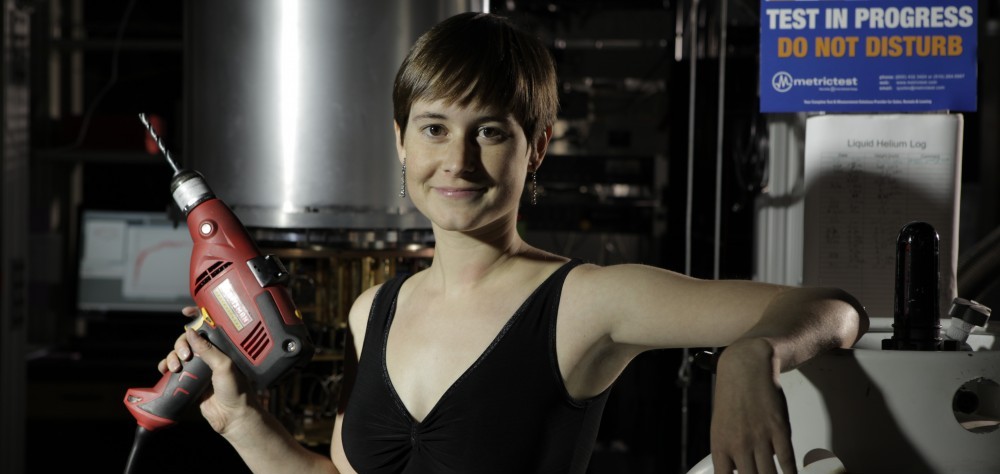
Whenever someone protests, “I’m not a rocket scientist,” I think of my friend Jamie Rankin. Jamie is a researcher at Princeton University, and she showed me her lab this June. When I first met Jamie, she was testing instruments to be launched on NASA’s Parker Solar Probe. The spacecraft has approached closer to the sun than any of its predecessors. It took off in August 2018—fittingly, from my view, as I’d completed my PhD a few months earlier and met Jamie near the beginning of my PhD.

During my first term of Caltech courses, I noticed Jamie in one of my classes. She seemed sensible and approachable, so I invited her to check our answers against each other on homework assignments. Our homework checks evolved into studying together for qualifying exams—tests of basic physics knowledge, which serve as gateways to a PhD. The studying gave way to eating lunch together on weekends. After a quiet morning at my desk, I’d bring a sandwich to a shady patch of lawn in front of Caltech’s institute for chemical and biological research. (Pasadena lawns are suitable for eating on regardless of the season.) Jamie would regale me—as her token theorist friend—with tales of suiting up to use clean rooms; of puzzling out instrument breakages; and of working for the legendary Ed Stone, who’d headed NASA’s Jet Propulsion Laboratory (JPL).1

The Voyager probes were constructed at JPL during the 1970s. I’m guessing you’ve heard of Voyager, given how the project captured the public’s imagination. I heard about it on an educational audiotape when I was little. The probes sent us data about planets far out in our solar system. For instance, Voyager 2 was the first spacecraft to approach Neptune, as well as the first to approach four planets past Earth (Jupiter, Saturn, Uranus, and Neptune). But the probes’ mission still hasn’t ended. In 2012, Voyager 1 became the first human-made object to enter interstellar space. Both spacecrafts continue to transmit data. They also carry Golden Records, disks that encode sounds from Earth—a greeting to any intelligent aliens who find the probes.

Jamie published the first PhD thesis about data collected by Voyager. She now serves as Deputy Project Scientist for Voyager, despite her early-career status. The news didn’t surprise me much; I’d known for years how dependable and diligent she is.

A theorist intrudes on Jamie’s Princeton lab

As much as I appreciated those qualities in Jamie, though, what struck me more was her good-heartedness. In college, I found fellow undergrads to be interested and interesting, energetic and caring, open to deep conversations and self-evaluation—what one might expect of Dartmouth. At Caltech, I found grad students to be candid, generous, and open-hearted. Would you have expected as much from the tech school’s tech school—the distilled essence of the purification of concentrated Science? I didn’t. But I appreciated what I found, and Jamie epitomized it.

The back of the lab coat I borrowed

Jamie moved to Princeton after graduating. I’d moved to Harvard, and then I moved to NIST. We fell out of touch; the pandemic prevented her from attending my wedding, and we spoke maybe once a year. But, this June, I visited Princeton for the annual workshop of the Institute for Robust Quantum Simulation. We didn’t eat sandwiches on a lawn, but we ate dinner together, and she showed me around the lab she’d built. (I never did suit up for a clean-room tour at Caltech.)

In many ways, Jamie Rankin remains my favorite rocket scientist.


1Ed passed away between the drafting and publishing of this post. He oversaw my PhD class’s first-year seminar course. Each week, one faculty member would present to us about their research over pizza. Ed had landed the best teaching gig, I thought: continual learning about diverse, cutting-edge physics. So I associate Ed with intellectual breadth, curiosity, and the scent of baked cheese.

Quantum Frontiers salutes an English teacher

If I ever mention a crazy high-school English teacher to you, I might be referring to Mr. Lukacs. One morning, before the first bell rang, I found him wandering among the lockers, wearing a white beard and a mischievous grin. (The school had pronounced the day “Dress Up as Your Favorite Writer” Day, or some such designation, but still.1) Mr. Lukacs was carrying a copy of Leaves of Grass, a book by the nineteenth-century American poet Walt Whitman, and yawping. To yawp is to cry out, and Whitman garnered acclaim for weaving such colloquialisms into his poetry. “I sound my barbaric yawp over the roofs of the world,” he wrote in Leaves of Grass—as Mr. Lukacs illustrated until the bells rang for class. And, for all I know, until the final bell.

I call Mr. Lukacs one of my crazy high-school English teachers despite never having taken any course of his.2 He served as the faculty advisor for the school’s literary magazine, on whose editorial board I served. As a freshman and sophomore, I kept my head down and scarcely came to know Mr. Lukacs. He wore small, round glasses and a bowtie. As though to ham up the idiosyncrasy, he kept a basket of bowties in his classroom. His hair had grayed, he spoke slowly, and he laughed in startling little bursts that resembled gasps. 

Junior year, I served as co-editor-in-chief of the literary magazine; and, senior year, as editor-in-chief. I grew to conjecture that Mr. Lukacs spoke slowly because he was hunting for the optimal word to use next. Finding that word cost him a pause, but learning his choice enriched the listener. And Mr. Lukacs adored literature. You could hear, when he read aloud, how he invested himself in it. 

I once submitted to the literary magazine a poem about string theory, inspired by a Brian Greene book.3 As you might expect, if you’ve ever read about string theory, the poem invoked music. Mr. Lukacs pretended to no expertise in science; he even had a feud with the calculus teacher.4 But he wrote that the poem made him feel like dancing.

You might fear that Mr. Lukacs too strongly echoed the protagonist of Dead Poets Society to harbor any originality. The 1989 film Dead Poets Society stars Robin Williams as an English teacher who inspires students to discover their own voices, including by yawping à la Whitman. But Mr. Lukacs leaned into the film, with a gleeful sort of exultation. He even interviewed one of the costars, who’d left acting to teach, for a job. The interview took place beside a cardboard-cutout advertisement for Dead Poets Society—a possession, I’m guessing, of Mr. Lukacs’s.

This winter, friends of Mr. Lukacs’s helped him create a Youtube video for his former students. He sounded as he had twenty years before. But he said goodbye, expecting his cancer journey to end soon. Since watching the video, I’ve been waffling between reading Goodbye, Mr. Chips—a classic novella I learned of around the time the video debuted—and avoiding it. I’m not sure what Mr. Lukacs would advise—probably to read, rather than not to read. But I like the thought of saluting a literary-magazine advisor on Quantum Frontiers. We became Facebook friends years ago; and, although I’ve rarely seen activity by him, he’s occasionally effused over some physics post of mine.

Physics brought me to the Washington, DC area, where a Whitman quote greets entrants to the Dupont Circle metro station. The DC area also houses Abraham Lincoln’s Cottage, where the president moved with his wife. They sought quietude to mourn their son Willie, who’d succumbed to an illness. Lincoln rode from the cottage to the White House every day. Whitman lived along his commute, according to a panel in the visitors’ center. I was tickled to learn that the two men used to exchange bows during that commute—one giant of politics and one giant of literature.

I wrote the text above this paragraph, as well as the text below, within a few weeks of watching the Youtube video. The transition between the two bothered me; it felt too abrupt. But I asked Mr. Lukacs via email whether he’d mind my posting the story. I never heard back. I learned why this weekend: he’d passed away on Friday. The announcement said, “please consider doing something that reminds you of George in the coming days. Read a few lines of a cherished text. Marvel at a hummingbird…” So I determined to publish the story without approval. I can think of no tribute more fitting than a personal essay published on a quantum blog that’s charted my intellectual journey of the past decade.

Here’s to another giant of literature. Goodbye, Mr. Lukacs.

Image from wmata.com

1I was too boring to dress up as anyone.

2I call him one of my crazy high-school English teachers because his wife merits the epithet, too. She called herself senile, enacted the climax of Jude the Obscure with a student’s person-shaped pencil case, and occasionally imitated a chipmunk; but damn, do I know my chiasmus from my caesura because of her.

3That fact sounds hackneyed to me now. But I’m proud never to have entertained grand dreams of discovering a theory of everything.

4AKA my crazy high-school calculus teacher. My high school had loads of crazy teachers, but it also had loads of excellent teachers, and the crazy ones formed a subset of the excellent ones.