A (quantum) complex legacy

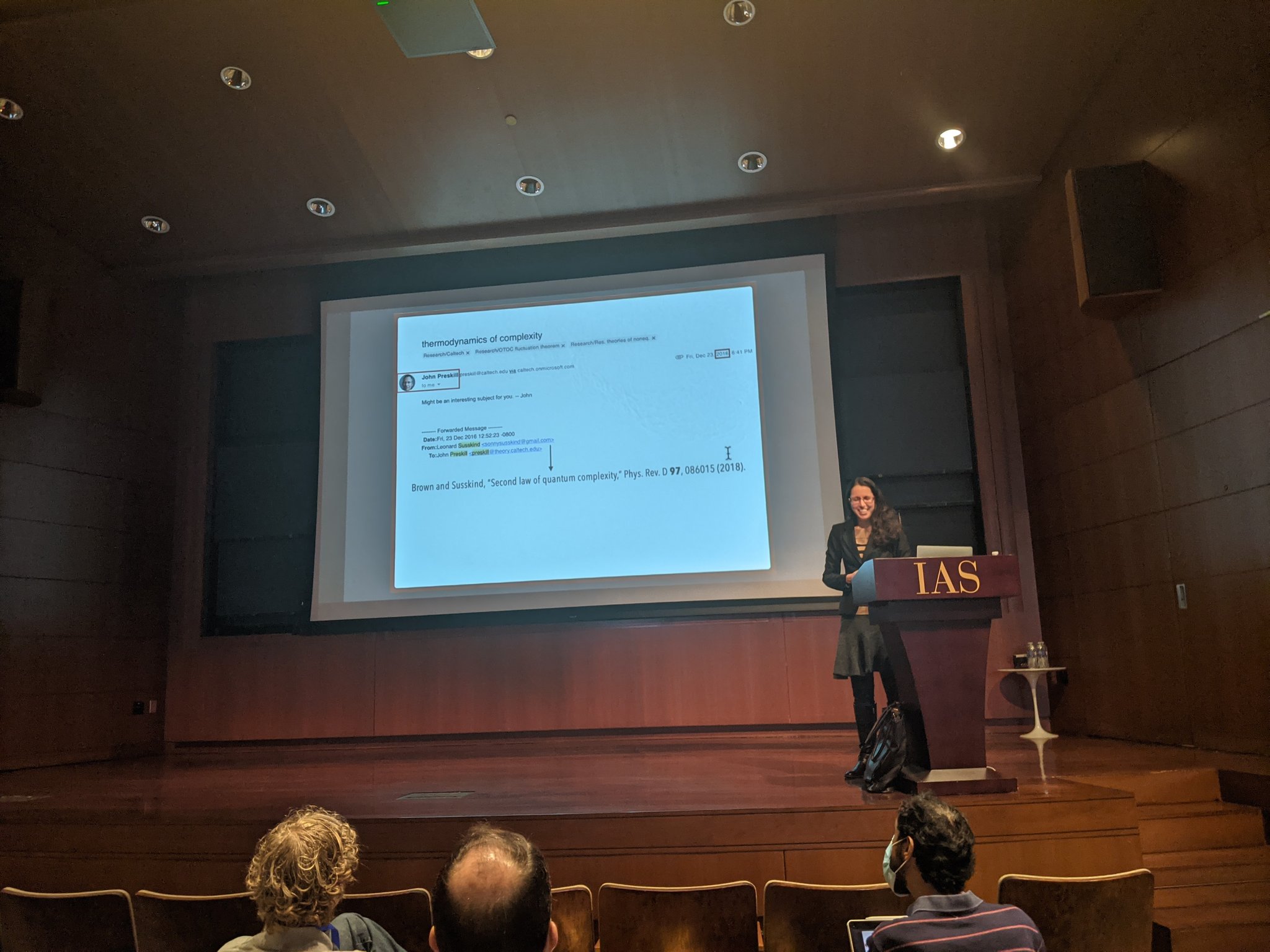
Early in the fourth year of my PhD, I received a most John-ish email from John Preskill, my PhD advisor. The title read, “thermodynamics of complexity,” and the message was concise the way that the Amazon River is damp: “Might be an interesting subject for you.” 

Below the signature, I found a paper draft by Stanford physicists Adam Brown and Lenny Susskind. Adam is a Brit with an accent and a wit to match his Oxford degree. Lenny, known to the public for his books and lectures, is a New Yorker with an accent that reminds me of my grandfather. Before the physicists posted their paper online, Lenny sought feedback from John, who forwarded me the email.

The paper concerned a confluence of ideas that you’ve probably encountered in the media: string theory, black holes, and quantum information. String theory offers hope for unifying two physical theories: relativity, which describes large systems such as our universe, and quantum theory, which describes small systems such as atoms. A certain type of gravitational system and a certain type of quantum system participate in a duality, or equivalence, known since the 1990s. Our universe isn’t such a gravitational system, but never mind; the duality may still offer a toehold on a theory of quantum gravity. Properties of the gravitational system parallel properties of the quantum system and vice versa. Or so it seemed.

The gravitational system can have two black holes linked by a wormhole. The wormhole’s volume can grow linearly in time for a time exponentially long in the black holes’ entropy. Afterward, the volume hits a ceiling and approximately ceases changing. Which property of the quantum system does the wormhole’s volume parallel?

Envision the quantum system as many particles wedged close together, so that they interact with each other strongly. Initially uncorrelated particles will entangle with each other quickly. A quantum system has properties, such as average particle density, that experimentalists can measure relatively easily. Does such a measurable property—an observable of a small patch of the system—parallel the wormhole volume? No; such observables cease changing much sooner than the wormhole volume does. The same conclusion applies to the entanglement amongst the particles.

What about a more sophisticated property of the particles’ quantum state? Researchers proposed that the state’s complexity parallels the wormhole’s volume. To grasp complexity, imagine a quantum computer performing a computation. When performing computations in math class, you needed blank scratch paper on which to write your calculations. A quantum computer needs the quantum equivalent of blank scratch paper: qubits (basic units of quantum information, realized, for example, as atoms) in a simple, unentangled, “clean” state. The computer performs a sequence of basic operations—quantum logic gates—on the qubits. These operations resemble addition and subtraction but can entangle the qubits. What’s the minimal number of basic operations needed to prepare a desired quantum state (or to “uncompute” a given state to the blank state)? The state’s quantum complexity.1 

Quantum complexity has loomed large over multiple fields of physics recently: quantum computing, condensed matter, and quantum gravity. The latter, we established, entails a duality between a gravitational system and a quantum system. The quantum system begins in a simple quantum state that grows complicated as the particles interact. The state’s complexity parallels the volume of a wormhole in the gravitational system, according to a conjecture.2 

The conjecture would hold more water if the quantum state’s complexity grew similarly to the wormhole’s volume: linearly in time, for a time exponentially large in the quantum system’s size. Does the complexity grow so? The expectation that it does became the linear-growth conjecture.

Evidence supported the conjecture. For instance, quantum information theorists modeled the quantum particles as interacting randomly, as though undergoing a quantum circuit filled with random quantum gates. Leveraging probability theory,3 the researchers proved that the state’s complexity grows linearly at short times. Also, the complexity grows linearly for long times if each particle can store a great deal of quantum information. But what if the particles are qubits, the smallest and most ubiquitous unit of quantum information? The question lingered for years.

Jonas Haferkamp, a PhD student in Berlin, dreamed up an answer to an important version of the question.4 I had the good fortune to help formalize that answer with him and members of his research group: master’s student Teja Kothakonda, postdoc Philippe Faist, and supervisor Jens Eisert. Our paper, published in Nature Physics last year, marked step one in a research adventure catalyzed by John Preskill’s email 4.5 years earlier.

Imagine, again, qubits undergoing a circuit filled with random quantum gates. That circuit has some architecture, or arrangement of gates. Slotting different gates into the architecture effects different transformations5 on the qubits. Consider the set of all transformations implementable with one architecture. This set has some size, which we defined and analyzed.

What happens to the set’s size if you add more gates to the circuit—let the particles interact for longer? We can bound the size’s growth using the mathematical toolkits of algebraic geometry and differential topology. Upon bounding the size’s growth, we can bound the state’s complexity. The complexity, we concluded, grows linearly in time for a time exponentially long in the number of qubits.

Our result lends weight to the complexity-equals-volume hypothesis. The result also introduces algebraic geometry and differential topology into complexity as helpful mathematical toolkits. Finally, the set size that we bounded emerged as a useful concept that may elucidate circuit analyses and machine learning.

John didn’t have machine learning in mind when forwarding me an email in 2017. He didn’t even have in mind proving the linear-growth conjecture. The proof enables step two of the research adventure catalyzed by that email: thermodynamics of quantum complexity, as the email’s title stated. I’ll cover that thermodynamics in its own blog post. The simplest of messages can spin a complex legacy.

The links provided above scarcely scratch the surface of the quantum-complexity literature; for a more complete list, see our paper’s bibliography. For a seminar about the linear-growth paper, see this video hosted by Nima Lashkari’s research group.

1The term complexity has multiple meanings; forget the rest for the purposes of this article.

2According to another conjecture, the quantum state’s complexity parallels a certain space-time region’s action. (An action, in physics, isn’t a motion or a deed or something that Hamlet keeps avoiding. An action is a mathematical object that determines how a system can and can’t change in time.) The first two conjectures snowballed into a paper entitled “Does complexity equal anything?” Whatever it parallels, complexity plays an important role in the gravitational–quantum duality. 

3Experts: Such as unitary t-designs.

4Experts: Our work concerns quantum circuits, rather than evolutions under fixed Hamiltonians. Also, our work concerns exact circuit complexity, the minimal number of gates needed to prepare a state exactly. A natural but tricky extension eluded us: approximate circuit complexity, the minimal number of gates needed to approximate the state.

5Experts: Unitary operators.

Eight highlights from publishing a science book for the general public

What’s it like to publish a book?

I’ve faced the question again and again this year, as my book Quantum Steampunk hit bookshelves in April. Two responses suggest themselves.

On the one hand, I channel the Beatles: It’s a hard day’s night. Throughout the publication process, I undertook physics research full-time. Media opportunities squeezed themselves into the corners of the week: podcast and radio-show recordings, public-lecture preparations, and interviews with journalists. After submitting physics papers to coauthors and journals, I drafted articles for Quanta Magazine, Literary Hub, the New Scientist newsletter, and other venues—then edited the articles, then edited them again, and then edited them again. Often, I apologized to editors about not having the freedom to respond to their comments till the weekend. Before public-lecture season hit, I catalogued all the questions that I imagined anyone might ask, and I drafted answers. The resulting document spans 16 pages, and I study it before every public lecture and interview.

Public lecture at the Institute for the Science of Origins at Case Western Reserve University

Answer number two: Publishing a book is like a cocktail of watching the sun rise over the Pacific from Mt. Fuji, taking off in an airplane for the first time, and conducting a symphony in Carnegie Hall.1 I can scarcely believe that I spoke in the Talks at Google lecture series—a series that’s hosted Tina Fey, Noam Chomsky, and Andy Weir! And I found my book mentioned in the Boston Globe! And in a Dutch science publication! If I were an automaton from a steampunk novel, the publication process would have wound me up for months.

Publishing a book has furnished my curiosity cabinet of memories with many a seashell, mineral, fossil, and stuffed crocodile. Since you’ve asked, I’ll share eight additions that stand out.

Breakfast on publication day. Because how else would one celebrate the publication of a steampunk book?

1) I guest-starred on a standup-comedy podcast. Upon moving into college, I received a poster entitled 101 Things to Do Before You Graduate from Dartmouth. My list of 101 Things I Never Expected to Do in a Physics Career include standup comedy.2 I stand corrected.

Comedian Anthony Jeannot bills his podcast Highbrow Drivel as consisting of “hilarious conversations with serious experts.” I joined him and guest comedienne Isabelle Farah in a discussion about film studies, lunch containers, and hippies, as well as quantum physics. Anthony expected me to act as the straight man, to my relief. That said, after my explanation of how quantum computers might help us improve fertilizer production and reduce global energy consumption, Anthony commented that, if I’d been holding a mic, I should have dropped it. I cherish the memory despite having had to look up the term mic drop when the recording ended.

At Words Worth Books in Waterloo, Canada

2) I met Queen Victoria. In mid-May, I arrived in Canada to present about my science and my book at the University of Toronto. En route to the physics department, I stumbled across the Legislative Assembly of Ontario. Her Majesty was enthroned in front of the intricate sandstone building constructed during her reign. She didn’t acknowledge me, of course. But I hope she would have approved of the public lecture I presented about physics that blossomed during her era. 

Her Majesty, Queen Victoria

3) You sent me your photos of Quantum Steampunk. They arrived through email, Facebook, Twitter, text, and LinkedIn. They showed you reading the book, your pets nosing it, steampunk artwork that you’d collected, and your desktops and kitchen counters. The photographs have tickled and surprised me, although I should have expected them, upon reflection: Quantum systems submit easily to observation by their surroundings.3 Furthermore, people say that art—under which I classify writing—fosters human connection. Little wonder, then, that quantum physics and writing intersect in shared book selfies.

Photos from readers

4) A great-grandson of Ludwig Boltzmann’s emailed. Boltzmann, a 19th-century Austrian physicist, helped mold thermodynamics and its partner discipline statistical mechanics. So I sat up straighter upon opening an email from a physicist descended from the giant. Said descendant turned out to have watched a webinar I’d presented for the magazine Physics Today. Although time machines remain in the domain of steampunk fiction, they felt closer to reality that day.

5) An experiment bore out a research goal inspired by the book. My editors and I entitled the book’s epilogue Where to next? The future of quantum steampunk. The epilogue spurred me to brainstorm about opportunities and desiderata—literally, things desired. Where did I want for quantum thermodynamics to head? I shared my brainstorming with an experimentalist later that year. We hatched a project, whose experiment concluded this month. I’ll leave the story for after the paper debuts, but I can say for now that the project gives me chills—in a good way.

6) I recited part of Edgar Allan Poe’s “The Raven” with a fellow physicist at a public lecture. The Harvard Science Book Talks form a lecture series produced by the eponymous university and bookstore. I presented a talk hosted by Jacob Barandes—a Harvard physics lecturer, the secret sauce behind the department’s graduate program, and an all-around exemplar of erudition. He asked how entropy relates to “The Raven.”

Image from the Harvard Gazette

For the full answer, see chapter 11 of my book. Briefly: Many entropies exist. They quantify the best efficiencies with which we can perform thermodynamic tasks such as running an engine. Different entropies can quantify different tasks’ efficiencies if the systems are quantum, otherwise small, or far from equilibrium—outside the purview of conventional 19th-century thermodynamics. Conventional thermodynamics describes many-particle systems, such as factory-scale steam engines. We can quantify conventional systems’ efficiencies using just one entropy: the thermodynamic entropy that you’ve probably encountered in connection with time’s arrow. How does this conventional entropy relate to the many quantum entropies? Imagine starting with a quantum system, then duplicating it again and again, until accruing infinitely many copies. The copies’ quantum entropies converge (loosely speaking), collapsing onto one conventional-looking entropy. The book likens this collapse to a collapse described in “The Raven”:

The speaker is a young man who’s startled, late one night, by a tapping sound. The tapping exacerbates his nerves, which are on edge due to the death of his love: “Deep into that darkness peering, long I stood there wondering, fearing, / Doubting, dreaming dreams no mortal ever dared to dream before.” The speaker realizes that the tapping comes from the window, whose shutter he throws open. His wonders, fears, doubts, and dreams collapse onto a bird’s form as a raven steps inside. So do the many entropies collapse onto one entropy as the system under consideration grows infinitely large. We could say, instead, that the entropies come to equal each other, but I’d rather picture “The Raven.” 

I’d memorized the poem in high school but never had an opportunity to recite it for anyone—and it’s a gem to declaim. So I couldn’t help reciting a few stanzas in response to Jacob. But he turned out to have memorized the poem, too, and responded with the next several lines! Even as a physicist, I rarely have the chance to reach such a pinnacle of nerdiness.

With Pittsburgh Quantum Institute head honchos Rob Cunningham and Adam Leibovich

7) I stumbled across a steam-driven train in Pittsburgh. Even before self-driving cars heightened the city’s futuristic vibe, Pittsburgh has been as steampunk as the Nautilus. Captains of industry (or robber barons, if you prefer) raised the city on steel that fed the Industrial Revolution.4 And no steampunk city would deserve the title without a Victorian botanical garden.

A Victorian botanical garden features in chapter 5 of my book. To see a real-life counterpart, visit the Phipps Conservatory. A poem in glass and aluminum, the Phipps opened in 1893 and even boasts a Victoria Room.

Yes, really.

I sneaked into the Phipps during the Pittsburgh Quantum Institute’s annual conference, where I was to present a public lecture about quantum steampunk. Upon reaching the sunken garden, I stopped in my tracks. Yards away stood a coal-black, 19th-century steam train. 

At least, an imitation train stood yards away. The conservatory had incorporated Monet paintings into its scenery during a temporary exhibition. Amongst the palms and ponds were arranged props inspired by the paintings. Monet painted The Gare Saint-Lazare: Arrival of a Train near a station, so a miniature train stood behind a copy of the artwork. The scene found its way into my public lecture—justifying my playing hooky from the conference for a couple of hours (I was doing research for my talk!).

My book’s botanical garden houses hummingbirds, wildebeests, and an artificial creature called a Yorkicockasheepapoo. I can’t promise that you’ll spy Yorkicockasheepapoos while wandering the Phipps, but send me a photo if you do.

8) My students and postdocs presented me with a copy of Quantum Steampunk that they’d signed. They surprised me one afternoon, shortly after publication day, as I was leaving my office. The gesture ranks as one of the most adorable things that’ve ever happened to me, and their book is now the copy that I keep on campus. 

Students…book-selfie photographers…readers halfway across the globe who drop a line…People have populated my curiosity cabinet of with some of the most extraordinary book-publication memories. Thanks for reading, and thanks for sharing.

Book signing after public lecture at Chapman University. Photo from Justin Dressel.

1Or so I imagine, never having watched the sun rise from Mt. Fuji or conducted any symphony, let alone one at Carnegie Hall, and having taken off in a plane for the first time while two months old.

2Other items include serve as an extra in a film, become stranded in Taiwan, and publish a PhD thesis whose title contains the word “steampunk.”

3This ease underlies the difficulty of quantum computing: Any stray particle near a quantum computer can “observe” the computer—interact with the computer and carry off a little of the information that the computer is supposed to store.

4The Pittsburgh Quantum Institute includes Carnegie Mellon University, which owes its name partially to captain of industry Andrew Carnegie.

Announcing the quantum-steampunk short-story contest!

The year I started studying calculus, I took the helm of my high school’s literary magazine. Throughout the next two years, the editorial board flooded campus with poetry—and poetry contests. We papered the halls with flyers, built displays in the library, celebrated National Poetry Month, and jerked students awake at morning assembly (hitherto known as the quiet kid you’d consult if you didn’t understand the homework, I turned out to have a sense of humor and a stage presence suited to quoting from that venerated poet Dr. Seuss.1 Who’d’ve thought?). A record number of contest entries resulted.

That limb of my life atrophied in college. My college—a stereotypical liberal-arts affair complete with red bricks—boasted a literary magazine. But it also boasted English and comparative-literature majors. They didn’t need me, I reasoned. The sun ought to set on my days of engineering creative-writing contests.

I’m delighted to be eating my words, in announcing the Quantum-Steampunk Short-Story Contest.

From Pinterest

The Maryland Quantum-Thermodynamics Hub is running the contest this academic year. I’ve argued that quantum thermodynamics—my field of research—resembles the literary and artistic genre of steampunk. Steampunk stories combine Victorian settings and sensibilities with futuristic technologies, such as dirigibles and automata. Quantum technologies are cutting-edge and futuristic, whereas thermodynamics—the study of energy—developed during the 1800s. Inspired by the first steam engines, thermodynamics needs retooling for quantum settings. That retooling is quantum thermodynamics—or, if you’re feeling whimsical (as every physicist should), quantum steampunk.

The contest opens this October and closes on January 15, 2023. Everyone aged 13 or over may enter a story, written in English, of up to 3,000 words. Minimal knowledge of quantum theory is required; if you’ve heard of Schrödinger’s cat, superpositions, or quantum uncertainty, you can pull out your typewriter and start punching away. 

Entries must satisfy two requirements: First, stories must be written in a steampunk style, including by taking place at least partially during the 1800s. Transport us to Meiji Japan; La Belle Époque in Paris; gritty, smoky Manchester; or a camp of immigrants unfurling a railroad across the American west. Feel free to set your story partially in the future; time machines are welcome.

Second, each entry must feature at least one quantum technology, real or imagined. Real and under-construction quantum technologies include quantum computers, communication networks, cryptographic systems, sensors, thermometers, and clocks. Experimentalists have realized quantum engines, batteries, refrigerators, and teleportation, too. Surprise us with your imagined quantum technologies (and inspire our next research-grant proposals).

In an upgrade from my high-school days, we’ll be awarding $4,500 worth of Visa gift certificates. The grand prize entails $1,500. Entries can also win in categories to be finalized during the judging process; I anticipate labels such as Quantum Technology We’d Most Like to Have, Most Badass Steampunk Hero/ine, Best Student Submission, and People’s Choice Award.

Our judges run the gamut from writers to quantum physicists. Judge Ken Liu‘s latest novel peered out from a window of my local bookstore last month. He’s won Hugo, Nebula, and World Fantasy Awards—the topmost three prizes that pop up if you google “science-fiction awards.” Appropriately for a quantum-steampunk contest, Ken has pioneered the genre of silkpunk, “a technology aesthetic based on a science fictional elaboration of traditions of engineering in East Asia’s classical antiquity.” 

Emily Brandchaft Mitchell is an Associate Professor of English at the University of Maryland. She’s authored a novel and published short stories in numerous venues. Louisa Gilder wrote one of the New York Times 100 Notable Books of 2009, The Age of Entanglement. In it, she imagines conversations through which scientists came to understand the core of this year’s Nobel Prize in physics. Jeffrey Bub is a philosopher of physics and a Distinguished University Professor Emeritus at the University of Maryland. He’s also published graphic novels about special relativity and quantum physics with his artist daughter. 

Patrick Warfield, a musicologist, serves as the Associate Dean for Arts and Programming at the University of Maryland. (“Programming” as in “activities,” rather than as in “writing code,” the meaning I encounter more often.) Spiros Michalakis is a quantum mathematician and the director of Caltech’s quantum outreach program. You may know him as a scientific consultant for Marvel Comics films.

Walter E. Lawrence III is a theoretical quantum physicist and a Professor Emeritus at Dartmouth College. As department chair, he helped me carve out a niche for myself in physics as an undergrad. Jack Harris, an experimental quantum physicist, holds a professorship at Yale. His office there contains artwork that features dragons.

University of Maryland undergraduate Hannah Kim designed the ad above. She and Jade LeSchack, founder of the university’s Undergraduate Quantum Association, round out the contest’s leadership team. We’re standing by for your submissions through—until the quantum internet exists—the hub’s website. Send us something to dream on.

This contest was made possible through the support of Grant 62422 from the John Templeton Foundation.

1Come to think of it, Seuss helped me prepare for a career in physics. He coined the terms wumbus and nerd; my PhD advisor invented NISQ, the name for a category of quantum devices. NISQ now has its own Wikipedia page, as does nerd

We’re founding a quantum-thermodynamics hub!

We’re building a factory in Maryland. 

It’ll tower over the University of Maryland campus, a behemoth of 19th-century brick and 21st-century glass across from the football field. Turbines will turn, and gears will grind, where students now sip lattes near the Stadium Drive parking lot. The factory’s fuel: steam, quantum physics, and ambition. Its goal: to create an epicenter for North American quantum thermodynamics.

The factory is metaphorical, of course. Collaborators and I are establishing a quantum-thermodynamics hub centered at the University of Maryland. The hub is an abstraction—a community that’ll collaborate on research, coordinate gatherings, host visitors, and raise the public’s awareness of quantum thermodynamics. But I’d rather envision the hub as a steampunk factory that pumps out discoveries and early-career scientists.

Quantum thermodynamics has burgeoned over the past decade, especially in Europe. At the beginning of my PhD, I read paper after paper that acknowledged COST, a funding agency established by the European Union. COST dedicated a grant to thermodynamics guided by the mathematics and concepts of quantum information theory. The grant funded students, travel, and the first iterations of an annual conference that continues today. Visit Germany, Finland, France, Britain (which belonged to the European Union when I began my PhD), or elsewhere across the pond, and you’ll stumble across quantum-thermodynamics strongholds. Hotspots burn also in Brazil, Israel, Singapore, and elsewhere.

Inspired by our international colleagues, collaborators and I are banding together. Since I founded a research group last year, Maryland has achieved a critical mass of quantum thermodynamicists: Chris Jarzynski reigns as a king of the field of fluctuation relations, equalities that help us understand why time flows in only one direction. Sebastian Deffner, I regard as an academic older brother to look up to. And I run the Quantum-Steampunk Laboratory.

We’ve built railroads to research groups across the continent and steamers to cross the ocean. Other members of the hub include Kanu Sinha, a former Marylander who studies open systems in Arizona; Steve Campbell, a Dublin-based prover of fundamental bounds; and two experts on quantum many-body systems: former Marylander Amir Kalev and current Marylander Luis Pedro García-Pintos. We’re also planning collaborations with institutions from Canada to Vienna.

The hub will pursue a threefold mission of research, community building, and outreach. As detailed on our research webpage, “We aim to quantify how, thermodynamically, decoherence and the spread of information lead to emergent phenomena: classical objectivity and the flow of time.” To grow North America’s quantum-thermodynamics community, we’ll run annual symposia and an international conference. Our visitors’ program will create the atmosphere of a local watering hole. Outreach will include more posts on this blog—including by guest authors—a quantum-steampunk short-story contest (expect details this fall), and more.

Come visit us by dirigible, train, or gyropter. Air your most thought-provoking quantum-thermodynamics discoveries in a seminar with us, and solicit feedback. Find collaborators, and learn about the latest. The factory wheels are beginning to turn.

With thanks to the John Templeton Foundation for the grant to establish the hub.

Rocks that roll

In Terry Pratchett’s fantasy novel Soul Music, rock ’n roll arrives in Ankh-Morpork. Ankh-Morpork resembles the London of yesteryear—teeming with heroes and cutthroats, palaces and squalor—but also houses vampires, golems, wizards, and a sentient suitcase. Against this backdrop, a young harpist stumbles upon a mysterious guitar. He forms a band with a dwarf and with a troll who plays tuned rocks, after which the trio calls its style “Music with Rocks In.” The rest of the story consists of satire, drums, and rocks that roll. 

The topic of rolling rocks sounds like it should elicit more yawns than an Elvis concert elicited screams. But rocks’ rolling helped recent University of Maryland physics PhD student Zackery Benson win a National Research Council Fellowship. He and his advisor, Wolfgang Losert, converted me into a fan of granular flow.

What I’ve been studying recently. Kind of.

Grains make up materials throughout the galaxy, such as the substance of avalanches. Many granular materials undergo repeated forcing by their environments. For instance, the grains that form an asteroid suffer bombardment from particles flying through outer space. The gravel beneath train tracks is compressed whenever a train passes. 

Often, a pattern characterizes the forces in a granular system’s environment. For instance, trains in a particular weight class may traverse some patch of gravel, and the trains may arrive with a particular frequency. Some granular systems come to encode information about those patterns in their microscopic configurations and large-scale properties. So granular flow—little rocks that roll—can impact materials science, engineering, geophysics, and thermodynamics.

Granular flow sounds so elementary, you might expect us to have known everything about it since long before the Beatles’ time. But we didn’t even know until recently how to measure rolling in granular flows. 

Envision a grain as a tiny sphere, like a globe of the Earth. Scientists focused mostly on how far grains are translated through space in a flow, analogouslly to how far a globe travels across a desktop if flicked. Recently, scientists measured how far a grain rotates about one axis, like a globe fixed in a frame. Sans frame, though, a globe can spin about more than one axis—about three independent axes. Zack performed the first measurement of all the rotations and translations of all the particles in a granular flow.

Each grain was an acrylic bead about as wide as my pinky nail. Two holes were drilled into each bead, forming an X, for reasons I’ll explain. 

Image credit: Benson et al., Phys. Rev. Lett. 129, 048001 (2022).

Zack dumped over 10,000 beads into a rectangular container. Then, he poured in a fluid that filled the spaces between the grains. Placing a weight atop the grains, he exerted a constant pressure on them. Zack would push one of the container’s walls inward, compressing the grains similarly to how a train compresses gravel. Then, he’d decompress the beads. He repeated this compression cycle many times.

Image credit: Benson et al., Phys. Rev. E 103, 062906 (2021).

Each cycle consisted of many steps: Zack would compress the beads a tiny amount, pause, snap pictures, and then compress a tiny amount more. During each pause, the camera activated a fluorescent dye in the fluid, which looked clear in the photographs. Lacking the fluorescent dye, the beads showed up as dark patches. Clear X’s cut through the dark patches, as dye filled the cavities drilled into the beads. From the X’s, Zack inferred every grain’s orientation. He inferred how every grain rotated by comparing the orientation in one snapshot with the orientation in the next snapshot. 

Image credit: Benson et al., Phys. Rev. Lett. 129, 048001 (2022).

Wolfgang’s lab had been trying for fifteen years to measure all the motions in a granular flow. The feat required experimental and computational skill. I appreciated the chance to play a minor role, in analyzing the data. Physical Review Letters published our paper last month.

From Zack’s measurements, we learned about the unique roles played by rotations in granular flow. For instance, rotations dominate the motion in a granular system’s bulk, far from the container’s walls. Importantly, the bulk dissipates the most energy. Also, whereas translations are reversible—however far grains shift while compressed, they tend to shift oppositely while decompressed—rotations are not. Such irreversibility can contribute to materials’ aging.

In Soul Music, the spirit of rock ’n roll—conceived of as a force in its own right—offers the guitarist the opportunity to never age. He can live fast, die young, and enjoy immortality as a legend, for his guitar comes from a dusty little shop not entirely of Ankh-Morpork’s world. Such shops deal in fate and fortune, the author maintains. Doing so, he takes a dig at the River Ankh, which flows through the city of Ankh-Morpork. The Ankh’s waters hold so much garbage, excrement, midnight victims, and other muck that they scarcely count as waters:

And there was even an Ankh-Morpork legend, wasn’t there, about some old drum [ . . . ] that was supposed to bang itself if an enemy fleet was seen sailing up the Ankh? The legend had died out in recent centuries, partly because this was the Age of Reason and also because no enemy fleet could sail up the Ankh without a gang of men with shovels going in front.

Such a drum would qualify as magic easily, but don’t underestimate the sludge. As a granular-flow system, it’s more incredible than you might expect.

These are a few of my favorite steampunk books

As a physicist, one grows used to answering audience questions at the end of a talk one presents. As a quantum physicist, one grows used to answering questions about futuristic technologies. As a quantum-steampunk physicist, one grows used to the question “Which are your favorite steampunk books?”

Literary Hub has now published my answer.

According to its website, “Literary Hub is an organizing principle in the service of literary culture, a single, trusted, daily source for all the news, ideas and richness of contemporary literary life. There is more great literary content online than ever before, but it is scattered, easily lost—with the help of its editorial partners, Lit Hub is a site readers can rely on for smart, engaged, entertaining writing about all things books.”

My article, “Five best books about the romance of Victorian science,” appeared there last week. You’ll find fiction, nonfiction as imaginative as fiction, and crossings of the border between the two. 

My contribution to literature about the romance of Victorian science—my (mostly) nonfiction book, Quantum Steampunk: The Physics Of Yesterday’s Tomorrow—was  published two weeks ago. Where’s a hot-air-balloon emoji when you need one?

One equation to rule them all?

In lieu of composing a blog post this month, I’m publishing an article in Quanta Magazine. The article provides an introduction to fluctuation relations, souped-up variations on the second law of thermodynamics, which helps us understand why time flows in only one direction. The earliest fluctuation relations described classical systems, such as single strands of DNA. Many quantum versions have been proved since. Their proliferation contrasts with the stereotype of physicists as obsessed with unification—with slimming down a cadre of equations into one über-equation. Will one quantum fluctuation relation emerge to rule them all? Maybe, and maybe not. Maybe the multiplicity of quantum fluctuation relations reflects the richness of quantum thermodynamics.

You can read more in Quanta Magazine here and yet more in chapter 9 of my book. For recent advances in fluctuation relations, as opposed to the broad introduction there, check out earlier Quantum Frontiers posts here, here, here, here, and here.

The power of being able to say “I can explain that”

Caltech condensed-matter theorist Gil Refael explained his scientific raison dê’tre early in my grad-school career: “What really gets me going is seeing a plot [of experimental data] and being able to say, ‘I can explain that.’” The quote has stuck with me almost word for word. When I heard it, I was working deep in abstract quantum information theory and thermodynamics, proving theorems about thought experiments. Embedding myself in pure ideas has always held an aura of romance for me, so I nodded along without seconding Gil’s view.

Roughly nine years later, I concede his point.

The revelation walloped me last month, as I was polishing a paper with experimental collaborators. Members of the Institute for Quantum Optics and Quantum Information (IQOQI) in Innsbruck, Austria—Florian Kranzl, Manoj Joshi, and Christian Roos—had performed an experiment in trapped-ion guru Rainer Blatt’s lab. Their work realized an experimental proposal that I’d designed with fellow theorists near the beginning of my postdoc stint. We aimed to observe signatures of particularly quantum thermalization

Throughout the universe, small systems exchange stuff with their environments. For instance, the Earth exchanges heat and light with the rest of the solar system. After exchanging stuff for long enough, the small system equilibrates with the environment: Large-scale properties of the small system (such as its volume and energy) remain fairly constant; and as much stuff enters the small system as leaves, on average. The Earth remains far from equilibrium, which is why we aren’t dead yet

Far from equilibrium and proud of it

In many cases, in equilibrium, the small system shares properties of the environment, such as the environment’s temperature. In these cases, we say that the small system has thermalized and, if it’s quantum, has reached a thermal state.

The stuff exchanged can consist of energy, particles, electric charge, and more. Unlike classical planets, quantum systems can exchange things that participate in quantum uncertainty relations (experts: that fail to commute). Quantum uncertainty mucks up derivations of the thermal state’s mathematical form. Some of us quantum thermodynamicists discovered the mucking up—and identified exchanges of quantum-uncertain things as particularly nonclassical thermodynamics—only a few years ago. We reworked conventional thermodynamic arguments to accommodate this quantum uncertainty. The small system, we concluded, likely equilibrates to near a thermal state whose mathematical form depends on the quantum-uncertain stuff—what we termed a non-Abelian thermal state. I wanted to see this equilibration in the lab. So I proposed an experiment with theory collaborators; and Manoj, Florian, and Christian took a risk on us.

The experimentalists arrayed between six and fifteen ions in a line. Two ions formed the small system, and the rest formed the quantum environment. The ions exchanged the x-, y-, and z-components of their spin angular momentum—stuff that participates in quantum uncertainty relations. The ions began with a fairly well-defined amount of each spin component, as described in another blog post. The ions exchanged stuff for a while, and then the experimentalists measured the small system’s quantum state.

The small system equilibrated to near the non-Abelian thermal state, we found. No conventional thermal state modeled the results as accurately. Score!

My postdoc and numerical-simulation wizard Aleks Lasek modeled the experiment on his computer. The small system, he found, remained farther from the non-Abelian thermal state in his simulation than in the experiment. Aleks plotted the small system’s distance to the non-Abelian thermal state against the ion chain’s length. The points produced experimentally sat lower down than the points produced numerically. Why?

I think I can explain that, I said. The two ions exchange stuff with the rest of the ions, which serve as a quantum environment. But the two ions exchange stuff also with the wider world, such as stray electromagnetic fields. The latter exchanges may push the small system farther toward equilibrium than the extra ions alone do.

Fortunately for the development of my explanatory skills, collaborators prodded me to hone my argument. The wider world, they pointed out, effectively has a very high temperature—an infinite temperature.1 Equilibrating with that environment, the two ions would acquire an infinite temperature themselves. The two ions would approach an infinite-temperature thermal state, which differs from the non-Abelian thermal state we aimed to observe.

Fair, I said. But the extra ions probably have a fairly high temperature themselves. So the non-Abelian thermal state is probably close to the infinite-temperature thermal state. Analogously, if someone cooks goulash similarly to his father, and the father cooks goulash similarly to his grandfather, then the youngest chef cooks goulash similarly to his grandfather. If the wider world pushes the two ions to equilibrate to infinite temperature, then, because the infinite-temperature state lies near the non-Abelian thermal state, the wider world pushes the two ions to equilibrate to near the non-Abelian thermal state.

Tasty, tasty thermodynamicis

I plugged numbers into a few equations to check that the extra ions do have a high temperature. (Perhaps I should have done so before proposing the argument above, but my collaborators were kind enough not to call me out.) 

Aleks hammered the nail into the problem’s coffin by incorporating into his simulations the two ions’ interaction with an infinite-temperature wider world. His numerical data points dropped to near the experimental data points. The new plot supported my story.

I can explain that! Aleks’s results buoyed me the whole next day; I found myself smiling at random times throughout the afternoon. Not that I’d explained a grand mystery, like the unexpected hiss heard by Arno Penzias and Robert Wilson when they turned on a powerful antenna in 1964. The hiss turned out to come from the cosmic microwave background (CMB), a collection of photons that fill the visible universe. The CMB provided evidence for the then-controversial Big Bang theory of the universe’s origin. Discovering the CMB earned Penzias and Wilson a Nobel Prize. If the noise caused by the CMB was music to cosmologists’ ears, the noise in our experiment is the quiet wailing of a shy banshee. But it’s our experiment’s noise, and we understand it now.

The experience hasn’t weaned me off the romance of proving theorems about thought experiments. Theorems about thermodynamic quantum uncertainty inspired the experiment that yielded the plot that confused us. But I now second Gil’s sentiment. In the throes of an experiment, “I can explain that” can feel like a battle cry.

1Experts: The wider world effectively has an infinite temperature because (i) the dominant decoherence is dephasing relative to the \sigma_z product eigenbasis and (ii) the experimentalists rotate their qubits often, to simulate a rotationally invariant Hamiltonian evolution. So the qubits effectively undergo dephasing relative to the \sigma_x, \sigma_y, and \sigma_z eigenbases.

Space-time and the city

I felt like a gum ball trying to squeeze my way out of a gum-ball machine. 

I was one of 50-ish physicists crammed into the lobby—and in the doorway, down the stairs, and onto the sidewalk—of a Manhattan hotel last December. Everyone had received a COVID vaccine, and the omicron variant hadn’t yet begun chewing up North America. Everyone had arrived on the same bus that evening, feeding on the neon-bright views of Fifth Avenue through dinnertime. Everyone wanted to check in and offload suitcases before experiencing firsthand the reason for the nickname “the city that never sleeps.” So everyone was jumbled together in what passed for a line.

We’d just passed the halfway point of the week during which I was pretending to be a string theorist. I do that whenever my research butts up against black holes, chaos, quantum gravity (the attempt to unify quantum physics with Einstein’s general theory of relativity), and alternative space-times. These topics fall under the heading “It from Qubit,” which calls for understanding puzzling physics (“It”) by analyzing how quantum systems process information (“Qubit”). The “It from Qubit” crowd convenes for one week each December, to share progress and collaborate.1 The group spends Monday through Wednesday at Princeton’s Institute for Advanced Study (IAS), dogged by photographs of Einstein, busts of Einstein, and roads named after Einstein. A bus ride later, the group spends Thursday and Friday at the Simons Foundation in New York City.

I don’t usually attend “It from Qubit” gatherings, as I’m actually a quantum information theorist and quantum thermodynamicist. Having admitted as much during the talk I presented at the IAS, I failed at pretending to be a string theorist. Happily, I adore being the most ignorant person in a roomful of experts, as the experience teaches me oodles. At lunch and dinner, I’d plunk down next to people I hadn’t spoken to and ask what they see as trending in the “It from Qubit” community. 

One buzzword, I’d first picked up on shortly before the pandemic had begun (replicas). Having lived a frenetic life, that trend seemed to be declining. Rising buzzwords (factorization and islands), I hadn’t heard in black-hole contexts before. People were still tossing around terms from when I’d first forayed into “It from Qubit” (scrambling and out-of-time-ordered correlator), but differently from then. Five years ago, the terms identified the latest craze. Now, they sounded entrenched, as though everyone expected everyone else to know and accept their significance.

One buzzword labeled my excuse for joining the workshops: complexity. Complexity wears as many meanings as the stereotypical New Yorker wears items of black clothing. Last month, guest blogger Logan Hillberry wrote about complexity that emerges in networks such as brains and social media. To “It from Qubit,” complexity quantifies the difficulty of preparing a quantum system in a desired state. Physicists have conjectured that a certain quantum state’s complexity parallels properties of gravitational systems, such as the length of a wormhole that connects two black holes. The wormhole’s length grows steadily for a time exponentially large in the gravitational system’s size. So, to support the conjecture, researchers have been trying to prove that complexity typically grows similarly. Collaborators and I proved that it does, as I explained in my talk and as I’ll explain in a future blog post. Other speakers discussed experimental complexities, as well as the relationship between complexity and a simplified version of Einstein’s equations for general relativity.

Inside the Simons Foundation on Fifth Avenue in Manhattan

I learned a bushel of physics, moonlighting as a string theorist that week. The gum-ball-machine lobby, though, retaught me something I’d learned long before the pandemic. Around the time I squeezed inside the hotel, a postdoc struck up a conversation with the others of us who were clogging the doorway. We had a decent fraction of an hour to fill; so we chatted about quantum thermodynamics, grant applications, and black holes. I asked what the postdoc was working on, he explained a property of black holes, and it reminded me of a property of thermodynamics. I’d nearly reached the front desk when I realized that, out of the sheer pleasure of jawing about physics with physicists in person, I no longer wanted to reach the front desk. The moment dangles in my memory like a crystal ornament from the lobby’s tree—pendant from the pandemic, a few inches from the vaccines suspended on one side and from omicron on the other. For that moment, in a lobby buoyed by holiday lights, wrapped in enough warmth that I’d forgotten the December chill outside, I belonged to the “It from Qubit” community as I hadn’t belonged to any community in 22 months.

Happy new year.

Presenting at the IAS was a blast. Photo credit: Jonathan Oppenheim.

1In person or virtually, pandemic-dependently.

Thanks to the organizers of the IAS workshop—Ahmed Almheiri, Adam Bouland, Brian Swingle—for the invitation to present and to the organizers of the Simons Foundation workshop—Patrick Hayden and Matt Headrick—for the invitation to attend.

A quantum-steampunk photo shoot

Shortly after becoming a Fellow of QuICS, the Joint Center for Quantum Information and Computer Science, I received an email from a university communications office. The office wanted to take professional photos of my students and postdocs and me. You’ve probably seen similar photos, in which theoretical physicists are writing equations, pointing at whiteboards, and thinking deep thoughts. No surprise there. 

A big surprise followed: Tom Ventsias, the director of communications at the University of Maryland Institute for Advanced Computer Studies (UMIACS), added, “I wanted to hear your thoughts about possibly doing a dual photo shoot for you—one more ‘traditional,’ one ‘quantum steampunk’ style.”

Steampunk, as Quantum Frontiers regulars know, is a genre of science fiction. It combines futuristic technologies, such as time machines and automata, with Victorian settings. I call my research “quantum steampunk,” as it combines the cutting-edge technology of quantum information science with the thermodynamics—the science of energy—developed during the 1800s. I’ve written a thesis called “Quantum steampunk”; authored a trade nonfiction book with the same title; and presented enough talks about quantum steampunk that, strung together, they’d give one laryngitis. But I don’t own goggles, hoop skirts, or petticoats. The most steampunk garb I’d ever donned before this autumn, I wore for a few minutes at age six or so, for dress-up photos at a theme park. I don’t even like costumes.

But I earned my PhD under the auspices of fellow Quantum Frontiers blogger John Preskill,1 whose career suggests a principle to live by: While unravelling the universe’s nature and helping to shape humanity’s intellectual future, you mustn’t take yourself too seriously. This blog has exhibited a photo of John sitting in Caltech’s information-sciences building, exuding all the gravitas of a Princeton degree, a Harvard degree, and world-impacting career—sporting a baseball glove you’d find in a high-school gym class, as though it were a Tag Heuer watch. John adores baseball, and the photographer who documented Caltech’s Institute for Quantum Information and Matter brought out the touch of whimsy like the ghost of a smile.

Let’s try it, I told Tom.

One rust-colored November afternoon, I climbed to the top of UMIACS headquarters—the Iribe Center—whose panoramic view of campus begs for photographs. Two students were talking in front of a whiteboard, and others were lunching on the sandwiches, fruit salad, and cheesecake ordered by Tom’s team. We took turns brandishing markers, gesturing meaningfully, and looking contemplative.

Then, the rest of my team dispersed, and the clock rewound 150 years.

The professionalism and creativity of Tom’s team impressed me. First, they’d purchased a steampunk hat, complete with goggles and silver wires. Recalling the baseball-glove photo, I suggested that I wear the hat while sitting at a table, writing calculations as I ordinarily would.

What hat? Quit bothering me while I’m working.

Then, the team upped the stakes. Earlier that week, Maria Herd, a member of the communications office, had driven me to the University of Maryland performing-arts center. We’d sifted through the costume repository until finding skirts, vests, and a poofy white shirt reminiscent of the 1800s. I swapped clothes near the photo-shoot area, while the communications team beamed a London street in from the past. Not really, but they nearly did: They’d found a backdrop suitable for the 2020 Victorian-era Netflix hit Enola Holmes and projected the backdrop onto a screen. I stood in front of the screen, and a sheet of glass stood in front of me. I wrote equations on the glass while the photographer, John Consoli, snapped away.

The final setup, I would never have dreamed of. Days earlier, the communications team had located an elevator lined, inside, with metal links. They’d brought colorful, neon-lit rods into the elevator and experimented with creating futuristic backdrops. On photo-shoot day, they positioned me in the back of the elevator and held the light-saber-like rods up. 

But we couldn’t stop anyone from calling the elevator. We’d ride up to the third or fourth floor, and the door would open. A student would begin to step in; halt; and stare my floor-length skirt, the neon lights, and the photographer’s back.

“Feel free to get in.” John’s assistant, Gail Marie Rupert, would wave them inside. The student would shuffle inside—in most cases—and the door would close.

“What floor?” John would ask.

“Um…one.”

John would twist around, press the appropriate button, and then turn back to his camera.

Once, when the door opened, the woman who entered complimented me on my outfit. Another time, the student asked if he was really in the Iribe Center. I regard that question as evidence of success.

John Consoli took 654 photos. I found the process fascinating, as a physicist. I have a domain of expertise; and I know the feeling of searching for—working toward—pushing for—a theorem or a conceptual understanding that satisfies me, in that domain. John’s area of expertise differs from mine, so I couldn’t say what he was searching for. But I recognized his intent and concentration, as Gail warned him that time had run out and he then made an irritated noise, inched sideways, and stole a few more snapshots. I felt like I was seeing myself in a reflection—not in the glass I was writing on, but in another sphere of the creative life.

The communications team’s eagerness to engage in quantum steampunk—to experiment with it, to introduce it into photography, to make it their own—bowled me over. Quantum steampunk isn’t just a stack of papers by one research group; it’s a movement. Seeing a team invest its time, energy, and imagination in that movement felt like receiving a deep bow or curtsy. Thanks to the UMIACS communications office for bringing quantum steampunk to life.

The Quantum-Steampunk Lab. Not pictured: Shayan Majidy.

1Who hasn’t blogged in a while. How about it, John?