Life, cellular automata, and mentoring

One night last July, IQIM postdoc Ning Bao emailed me a photo. He’d found a soda can that read, “Share a Coke with Patrick.”

Ning and I were co-mentoring two Summer Undergraduate Research Fellows, or SURFers. One mentee received Ning’s photo: Caltech physics major Patrick Rall.

“Haha,” Patrick emailed back. “I’ll share a Coke.”

Patrick, Ning, and I shared the intellectual equivalent of a six-pack last summer. We shared papers, meals, frustrations, hopes, late-night emails (from Patrick and Ning), 7-AM emails (from me), and webcomic strips. Now a senior, Patrick is co-authoring a paper about his SURF project.

The project grew from the question “What would happen if we quantized Conway’s Game of Life?” (For readers unfamiliar with the game, I’ll explain below.) Lessons we learned about the Game of Life overlapped with lessons I learned about life, as a first-time mentor. The soda fountain of topics contained the following flavors.

Patrick + Coke

Update rules: Till last spring, I’d been burrowing into two models for out-of-equilibrium physics. PhD students burrow as no prairie dogs can. But, given five years in Caltech’s grassland, I wanted to explore. I wanted an update.

Ning and I had trespassed upon quantum game theory months earlier. Consider a nonquantum game, such as the Prisoner’s Dilemma or an election. Suppose that players have physical systems, such as photons (particles of light), that occupy superposed or entangled states. These quantum resources can change the landscape of the game’s possible outcomes. These changes clarify how we can harness quantum mechanics to process, transmit, and secure information.

How might quantum resources change Conway’s Game of Life, or GoL? British mathematician John Conway invented the game in 1970. Imagine a square board divided into smaller squares, or cells. On each cell sits a white or a black tile. Black represents a living organism; white represents a lack thereof.

Conway modeled population dynamics with an update rule. If prairie dogs overpopulate a field, some die from overcrowding. If a black cell borders more than three black neighbors, a white tile replaces the black. If separated from its pack, a prairie dog dies from isolation. If a black tile borders too few black neighbors, we exchange the black for a white. Mathematics columnist Martin Gardner detailed the rest of Conway’s update rule in this 1970 article.

Updating the board repeatedly evolves the population. Black and white shapes might flicker and undulate. Space-ship-like shapes can glide across the board. A simple update rule can generate complex outcomes—including, I found, frustrations, hopes, responsibility for another human’s contentment, and more meetings than I’d realized could fit in one summer.

Prairie dogs

Modeled by Conway’s Game of Life. And by PhD students.

Initial conditions: The evolution depends on the initial state, on how you distribute white and black tiles when preparing the board. Imagine choosing the initial state randomly from all the possibilities. White likely mingles with about as much black. The random initial condition might not generate eye-catchers such as gliders. The board might fade to, and remain, one color.*

Enthusiasm can fade as research drags onward. Project Quantum GoL has continued gliding due to its initial condition: The spring afternoon on which Ning, Patrick, and I observed the firmness of each other’s handshakes; Patrick walked Ning and me through a CV that could have intimidated a postdoc; and everyone tried to soothe everyone else’s nerves but occasionally avoided eye contact.

I don’t mean that awkwardness sustained the project. The awkwardness faded, as exclamation points and smiley faces crept into our emails. I mean that Ning and I had the fortune to entice Patrick. We signed up a bundle of enthusiasm, creativity, programming skills, and determination. That determination perpetuated the project through the summer and beyond. Initial conditions can determine a system’s evolution.

Long-distance correlations:  “Sure, I’d love to have dinner with you both! Thank you for the invitation!”

Lincoln Carr, a Colorado School of Mines professor, visited in June. Lincoln’s group, I’d heard, was exploring quantum GoLs.** He studies entanglement (quantum correlations) in many-particle systems. When I reached out, Lincoln welcomed our SURF group to collaborate.

I relished coordinating his visit with the mentees. How many SURFers could say that a professor had visited for his or her sake? When I invited Patrick to dinner with Lincoln, Patrick lit up like a sunrise over grasslands.

Our SURF group began skyping with Mines every Wednesday. We brainstorm, analyze, trade code, and kvetch with Mines student Logan Hillberry and colleagues. They offer insights about condensed matter; Patrick, about data processing and efficiency; I, about entanglement theory; and Ning, about entropy and time evolution.

We’ve learned together about long-range entanglement, about correlations between far-apart quantum systems. Thank goodness for skype and email that correlate far-apart research groups. Everyone would have learned less alone.

Correlations.001

Long-distance correlations between quantum states and between research groups

Time evolution: Logan and Patrick simulated quantum systems inspired by Conway’s GoL. Each researcher coded a simulation, or mathematical model, of a quantum system. They agreed on a nonquantum update rule; Logan quantized it in one way (constructed one quantum analog of the rule); and Patrick quantized the rule another way. They chose initial conditions, let their systems evolve, and waited.

In July, I noticed that Patrick brought a hand-sized green spiral notepad to meetings. He would synopsize his progress, and brainstorm questions, on the notepad before arriving. He jotted suggestions as we talked.

The notepad began guiding meetings in July. Patrick now steers discussions, ticking items off his agenda. The agenda I’ve typed remains minimized on my laptop till he finishes. My agenda contains few points absent from his, and his contains points not in mine.

Patrick and Logan are comparing their results. Behaviors of their simulations, they’ve found, depend on how they quantized their update rule. One might expect the update rule to determine a system’s evolution. One might expect the SURF program’s template to determine how research and mentoring skills evolve. But how we implement update rules matters.

SURF photo

Caltech’s 2015 quantum-information-theory Summer Undergraduate Research Fellows and mentors

Life: I’ve learned, during the past six months, about Conway’s Game of Life, simulations, and many-body entanglement. I’ve learned how to suggest references and experts when I can’t answer a question. I’ve learned that editing SURF reports by hand costs me less time than editing electronically. I’ve learned where Patrick and his family vacation, that he’s studying Chinese, and how undergrads regard on-campus dining. Conway’s Game of Life has expanded this prairie dog’s view of the grassland more than expected.

I’ll drink a Coke to that.

Glossary: Conway’s GoL is a cellular automatonA cellular automaton consists of a board whose tiles change according to some update rule. Different cellular automata correspond to different board shapes, to boards of different dimensions, to different types of tiles, and to different update rules.

*Reversible cellular automata have greater probabilities (than the GoL has) of updating random initial states through dull-looking evolutions.

**Others have pondered quantum variations on Conway’s GoL.

Quantum Information: Episode II: The Tools’ Applications

Monday dawns. Headlines report that “Star Wars: Episode VII” has earned more money, during its opening weekend, than I hope to earn in my lifetime. Trading the newspaper for my laptop, I learn that a friend has discovered ThinkGeek’s BB-8 plushie. “I want one!” she exclaims in a Facebook post. “Because BB-8 definitely needs to be hugged.”

BB-8 plays sidekick to Star Wars hero Poe Dameron. The droid has a spherical body covered with metallic panels and lights.Mr. Gadget and Frosty the Snowman could have spawned such offspring. BB-8 has captured viewers’ hearts, and its chirps have captured cell-phone ringtones.

BB-8

ThinkGeek’s BB-8 plushie

Still, I scratch my head over my friend’s Facebook post. Hugged? Why would she hug…

Oh. Oops.

I’ve mentally verbalized “BB-8” as “BB84.” BB84 denotes an application of quantum theory to cryptography. Cryptographers safeguard information from eavesdroppers and tampering. I’ve been thinking that my friend wants to hug a safety protocol.

Charles Bennett and Gilles Brassard invented BB84 in 1984. Imagine wanting to tell someone a secret. Suppose I wish to coordinate, with a classmate, the purchase of a BB-8 plushie for our friend the droid-hugger. Suppose that the classmate and I can communicate only via a public channel on which the droid-hugger eavesdrops.

Cryptographers advise me to send my classmate a key. A key is a random string of letters, such as CCCAAACCABACA. I’ll encode my message with the string, with which my classmate will decode the message.

Key 2

I have to transmit the key via the public channel. But the droid-hugger eavesdrops on the public channel. Haven’t we taken one step forward and one step back? Why would the key secure our information?

Because quantum-information science enables me to to transmit the key without the droid-hugger’s obtaining it. I won’t transmit random letters; I’ll transmit quantum states. That is, I’ll transmit physical systems, such as photons (particles of light), whose properties encode quantum information.

A nonquantum letter has a value, such as A or B or C.  Each letter has one and only one value, regardless of whether anyone knows what value the letter has. You can learn the value by measuring (looking at) the letter. We can’t necessarily associate such a value with a quantum state. Imagine my classmate measuring a state I send. Which value the measurement device outputs depends on chance and on how my classmate looks at the state.

If the droid-hugger intercepts and measures the state, she’ll change it. My classmate and I will notice such changes. We’ll scrap our key and repeat the BB84 protocol until the droid-hugger quits eavesdropping.

BB84 launched quantum cryptography, the safeguarding of information with quantum physics. Today’s quantum cryptographers rely on BB84 as you rely, when planning a holiday feast, on a carrot-cake recipe that passed your brother’s taste test on his birthday. Quantum cryptographers construct protocols dependent on lines like “The message sender and receiver are assumed to share a key distributed, e.g., via the BB84 protocol.”

BB84 has become a primitive task, a solved problem whose results we invoke in more-complicated problems. Other quantum-information primitives include (warning: jargon ahead) entanglement distillation, entanglement dilution, quantum data compression, and quantum-state merging. Quantum-information scientists solved many primitive problems during the 1990s and early 2000s. You can apply those primitives, even if you’ve forgotten how to prove them.

Caveman

A primitive task, like quantum-entanglement distillation

Those primitives appear to darken quantum information’s horizons. The spring before I started my PhD, an older physicist asked me why I was specializing in quantum information theory. Haven’t all the problems been solved? he asked. Isn’t quantum information theory “dead”?

Imagine discovering how to power plasma blades with kyber crystals. Would you declare, “Problem solved” and relegate your blades to the attic? Or would you apply your tool to defending freedom?

Saber + what to - small

Primitive quantum-information tools are unknotting problems throughout physics—in computer science; chemistry; optics (the study of light); thermodynamics (the study of work, heat, and efficiency); and string theory. My advisor has tracked how uses of “entanglement,” a quantum-information term, have swelled in high-energy-physics papers.

A colleague of that older physicist views quantum information theory as a toolkit, a perspective, a lens through which to view science. During the 1700s, the calculus invented by Isaac Newton and Gottfried Leibniz revolutionized physics. Emmy Noether (1882—1935) recast physics in terms of symmetries and conservation laws. (If the forces acting on a system don’t change in time, for example, the system doesn’t gain or lose energy. A constant force is invariant under, or symmetric with respect to, the progression of time. This symmetry implies that the system’s energy is conserved.) We can cast physics instead (jargon ahead) in terms of the minimization of a free energy or an action.

Quantum information theory, this physicist predicted, will revolutionize physics as calculus, symmetries, conservation, and free energy have. Quantum-information tools such as entropies, entanglement, and qubits will bleed into subfields of physics as Lucasfilm has bled into the fanfiction, LEGO, and Halloween-costume markets.

BB84, and the solution of other primitives, have not killed quantum information. They’ve empowered it to spread—thankfully, to this early-career quantum information scientist. Never mind BB-8; I’d rather hug BB84. Perhaps I shall. Engineers have realized technologies that debuted on Star Trek; quantum mechanics has secured key sharing; bakers have crafted cakes shaped like the Internet; and a droid’s popularity rivals R2D2’s. Maybe next Monday will bring a BB84 plushie.

Plushie

The author hugging the BB84 paper and a plushie. On my wish list: a combination of the two.

Discourse in Delft

A camel strolled past, yards from our window in the Applied-Sciences Building.

I hadn’t expected to see camels at TU Delft, aka the Delft University of Technology, in Holland. I breathed, “Oh!” and turned to watch until the camel followed its turbaned leader out of sight. Nelly Ng, the PhD student with whom I was talking, followed my gaze and laughed.

Nelly works in Stephanie Wehner’s research group. Stephanie—a quantum cryptographer, information theorist, thermodynamicist, and former Caltech postdoc—was kind enough to host me for half August. I arrived at the same time as TU Delft’s first-year undergrads. My visit coincided with their orientation. The orientation involved coffee hours, team-building exercises, and clogging the cafeteria whenever the Wehner group wanted lunch.

And, as far as I could tell, a camel.

Not even a camel could unseat Nelly’s and my conversation. Nelly, postdoc Mischa Woods, and Stephanie are the Wehner-group members who study quantum and small-scale thermodynamics. I study quantum and small-scale thermodynamics, as Quantum Frontiers stalwarts might have tired of hearing. The four of us exchanged perspectives on our field.

Mischa knew more than Nelly and I about clocks; Nelly knew more about catalysis; and I knew more about fluctuation relations. We’d read different papers. We’d proved different theorems. We explained the same phenomena differently. Nelly and I—with Mischa and Stephanie, when they could join us—questioned and answered each other almost perpetually, those two weeks.

We talked in our offices, over lunch, in the group discussion room, and over tea at TU Delft’s Quantum Café. We emailed. We talked while walking. We talked while waiting for Stephanie to arrive so that she could talk with us.

IMG_0125

The site of many a tête-à-tête.

The copiousness of the conversation drained me. I’m an introvert, formerly “the quiet kid” in elementary school. Early some mornings in Delft, I barricaded myself in the visitors’ office. Late some nights, I retreated to my hotel room or to a canal bank. I’d exhausted my supply of communication; I had no more words for anyone. Which troubled me, because I had to finish a paper. But I regret not one discussion, for three reasons.

First, we relished our chats. We laughed together, poked fun at ourselves, commiserated about calculations, and confided about what we didn’t understand.

We helped each other understand, second. As I listened to Mischa or as I revised notes about a meeting, a camel would stroll past a window in my understanding. I’d see what I hadn’t seen before. Mischa might be explaining which quantum states represent high-quality clocks. Nelly might be explaining how a quantum state ξ can enable a state ρ to transform into a state σ. I’d breathe, “Oh!” and watch the mental camel follow my interlocutor through my comprehension.

Nelly’s, Mischa’s, and Stephanie’s names appear in the acknowledgements of the paper I’d worried about finishing. The paper benefited from their explanations and feedback.

Third, I left Delft with more friends than I’d had upon arriving. Nelly, Mischa, and I grew to know each other, to trust each other, to enjoy each other’s company. At the end of my first week, Nelly invited Mischa and me to her apartment for dinner. She provided pasta; I brought apples; and Mischa brought a sweet granola-and-seed mixture. We tasted and enjoyed more than we would have separately.

IMG_0050

Dinner with Nelly and Mischa.

I’ve written about how Facebook has enhanced my understanding of, and participation in, science. Research involves communication. Communication can challenge us, especially many of us drawn to science. Let’s shoulder past the barrier. Interlocutors point out camels—and hot-air balloons, and lemmas and theorems, and other sources of information and delight—that I wouldn’t spot alone.

With gratitude to Stephanie, Nelly, Mischa, the rest of the Wehner group (with whom I enjoyed talking), QuTech and TU Delft.

During my visit, Stephanie and Delft colleagues unveiled the “first loophole-free Bell test.” Their paper sent shockwaves (AKA camels) throughout the quantum community. Scott Aaronson explains the experiment here.

Explaining Quantum Physics to Newton… in 140 characters

Sir Isaac Newton is considered by many as the greatest physicist of all time. But despite Newton’s contributions to classical physics, the man never even fathomed that the world was actually governed by the equations of quantum mechanics. We think it is time to right that wrong. With your help, we plan to send a Tweet back in time (something about time machines restricts quantum telegraphs to 140 characters) that explains what quantum is all about to Sir Isaac. This mini competition is taking place on our Twitter account over @IQIM_Caltech and ends on November 5th, 2015. The prize is a one-year digital subscription to Scientific American.

For more details, please see below. This mini competition is part of Quantum Shorts, a flash fiction competition conceived and executed by our friends at the Center for Quantum Technologies.

QSmini_oct28_twitter

Let the games begin!

Nothing has been done yet. The world is your oyster…still.

The three things that come to mind when I watch Simon’s video are: travel, perspective and discomfort. They remind me of some of the things I also said in my TEDx talk titled “Get Uncomfortable Now”.

Simon’s video exemplifies a lot of what I feel is true in filmmaking as well. He goes running to clear his mind and get more creative, I take long walks when I’m stuck at a point in my screenplays or edits. He travels to learn more about what’s out there, I travel to absorb culture as well, he tries diversity of experiences to enrich his mind, so do I in a selfish desire to enrich every character I write or direct; all with the ultimate goal of growth & transience: emotional, physical, mental.

Simon also says something very exciting in the film, “there’s so much left to do out there”, a thought that isn’t expressed that often, the idea that “I can do something novel right here in the lab” makes the chance of innovation, success and achievement very tangible; achievable. That honesty, excitement and drive is important to be repeated in an otherwise very jaded and intimidated world. The belief in the power of the individual driving forward and having the potential to change the status quo, in the lab and outside, is critical.

It was hard to get Simon to narrow it down to the one hobby that drove him. After Debaleena’s video being internal and about family, we knew we wanted something more external. Filming in Griffith park is usually a nightmare but that early morning, we got everything we wanted minus possibly a clearer view of downtown LA, thanks to Marcia Brown’s usual detailed planning.

The shoot was complete with a steadicam operator, running videos and even the spotting of a snake!

The most memorable thing for me are Simon’s slow motion shots that highlight the sound of foot steps, of pushing forward, step by step, one ahead of the other; that basic contact that lunges us into the future. There was something very “grounding” about watching that, no pun intended.

Without further ado, here’s the video:

“Experimenting” with women-in-STEM stereotypes

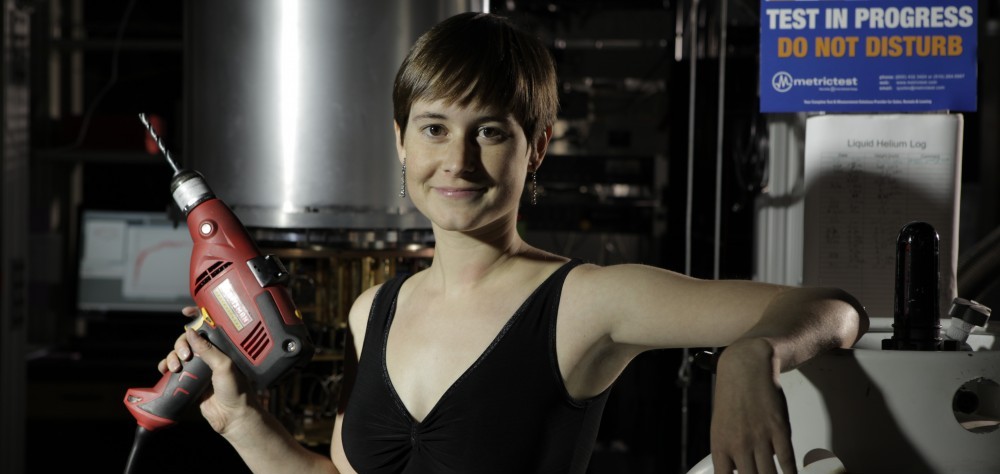
When signing up for physics grad school, I didn’t expect to be interviewed by a comedienne on a spoof science show about women in STEM.

Last May, I received an email entitled “Amy Poehler’s Smart Girls.” The actress, I read, had co-founded the Smart Girls organization to promote confidence and creativity in preteens and teens. Smart Girls was creating a webseries hosted by Megan Amram, author of Science…for Her! The book parodies women’s magazines and ridicules stereotypes of women as unsuited for science.

Megan would host the webseries, “Experimenting with Megan,” in character as an airhead. She planned to interview “kick-ass lady scientists/professors/doctors” in a parody of a talk show. Would I, the email asked, participate?

I’m such a straitlaced fogey, I never say “kick-ass.” I’m such a workaholic, I don’t watch webshows. I’ve not seen Parks and Recreation, the TV series that starred Amy Poehler and for which Megan wrote. The Hollywood bug hasn’t bitten me, though I live 30 minutes from Studio City.

But I found myself in a studio the next month. Young men and women typed on laptops and chattered in the airy, bright waiting lounge. Beyond a doorway lay the set, enclosed by fabric-covered walls that prevented sounds from echoing. Script-filled binders passed from hand to hand, while makeup artists, cameramen, and gophers scurried about.

APSG-Nicole-Yunger-Halpern1

Being interviewed on “Experimenting with Megan.”

Disney’s Mouseketeers couldn’t have exuded more enthusiasm or friendliness than the “Experimenting” team. “Can I bring you a bottle of water?” team members kept asking me and each other. “Would you like a chair?” The other women who interviewed that day—two biologist postdocs—welcomed me into their powwow. Each of us, we learned, is outnumbered by men at work. None of us wears a lab coat, despite stereotypes of scientists as white-coated. Each pours herself into her work: One postdoc was editing a grant proposal while off-set.

I watched one interview, in which Megan asked why biologists study fruit flies instead of “cuter” test subjects. Then I stepped on-set beside her. I perched on an armchair that threatened to swallow my 5’ 3.5” self.* Textbooks, chemistry flasks, and high-heeled pumps stood on the bookshelves behind Megan.

The room quieted. A clapperboard clapped: “Take one.” Megan thanked me for coming, then launched into questions.

Megan hadn’t warned me what she’d ask. We began with “Do you like me?” and “What is the ‘information’ [in ‘quantum information theory’], and do you ever say, ‘Too much information’?” Each question rode hot on the heels of the last. The barrage reminded me of interviews for not-necessarily-scientific scholarships. Advice offered by one scholarship-committee member, the year before I came to Caltech, came to mind: Let loose. Act like an athlete tearing down the field, the opposing team’s colors at the edges of your vision. Savor the challenge.

I savored it. I’d received instructions to play the straight man, answering Megan’s absurdity with science. To “Too much information?” I parried that we can never know enough. When I mentioned that quantum mechanics describes electrons, Megan asked about the electricity she feels upon seeing Chris Hemsworth. (I hadn’t heard of Chris Hemsworth. After watching the interview online, a friend reported that she’d enjoyed the reference to Thor. “What reference to Thor?” I asked. Hemsworth, she informed me, plays the title character.) I dodged Chris Hemsworth; caught “electricity”; and stretched to superconductors, quantum devices whose charges can flow forever.

Academic seminars conclude with question-and-answer sessions. If only those Q&As zinged with as much freshness and flexibility as Megan’s.

The “Experimenting” approach to stereotype-blasting diverges from mine. High-heeled pumps, I mentioned, decorated the set. The “Experimenting” team was parodying the stereotype of women as shoe-crazed. “Look at this stereotype!” the set shouts. “Isn’t it ridiculous?”

As a woman who detests high heels and shoe shopping, I prefer to starve the stereotype of justification. I’ve preferred reading to shopping since before middle school, when classmates began frequenting malls. I feel more comfortable demonstrating, through silence, how little shoes interest me. I’d rather offer no reason for anyone to associate me with shoes.**

I scarcely believe that I appear just after a “sexy science” tagline and a hot-or-not quiz. Before my interview on her quantum episode, Megan discussed the relationship between atoms and Adams. Three guests helped her, three Hollywood personalities named “Adam.”*** Megan held up cartoons of atoms, and photos of Adams, and asked her guests to rate their hotness. I couldn’t have played Megan’s role, couldn’t imagine myself in her (high-heeled) shoes.

But I respect the “Experimenting” style. Megan’s character serves as a foil for the interviewee I watched. Megan’s ridiculousness underscored the postdoc’s professionalism and expertise.

According to online enthusiasm, “Experimenting” humor resonates with many viewers. So diverse is the community that needs introducing to STEM, diverse senses of humor have roles to play. So deep run STEM’s social challenges, multiple angles need attacking.

Just as diverse perspectives can benefit women-in-STEM efforts, so can diverse perspectives benefit STEM. Which is why STEM needs women, Adams, shoe-lovers, shoe-haters…and experimentation.

With gratitude to the “Experimenting” team for the opportunity to contribute to its cause. The live-action interview appears here (beginning at 2:42), and a follow-up personality quiz appears here.

*If you’re 5′ 3.5″, every half-inch matters.

**Except when I blog about how little I wish to associate with shoes.

***Megan introduced her guests as “Adam Shankman, Adam Pally, and an intern that we made legally change his name to Adam to be on the show.” The “intern” is Adam Rymer, president of Legendary Digital Networks. Legendary owns Amy Poehler’s Smart Girls.

The enigma of Robert Hooke

In 1675, Robert Hooke published the “true mathematical and mechanical form” for the shape of an ideal arch.  However, Hooke wrote the theory as an anagram,

abcccddeeeeefggiiiiiiiillmmmmnnnnnooprrsssttttttuuuuuuuux.

Its solution was never published in his lifetime.  What was the secret hiding in these series of letters?

Hooke-Arch

An excerpt from Hooke’s manuscript “A description of helioscopes, and some other instruments”.

The arch is one of the fundamental building blocks in architecture.  Used in bridges, cathedrals, doorways, etc., arches provide an aesthetic quality to the structures they dwell within.  Their key utility comes from their ability to support weight above an empty space, by distributing the load onto the abutments at its feet.  A dome functions much like an arch, except a dome takes on a three-dimensional shape whereas an arch is two-dimensional.  Paradoxically, while being the backbone of the many edifices, arches and domes themselves are extremely delicate: a single misplaced component along its curve, or an improper shape in the design would spell doom for the entire structure.

The Romans employed the rounded arch/dome—in the shape of a semicircle/hemisphere–in their bridges and pantheons.  The Gothic architecture favored the pointed arch and the ribbed vault in their designs.  However, neither of these arch forms were adequate for the progressively grander structures and more ambitious cathedrals sought in the 17th century.  Following the great fire of London in 1666, a massive rebuilding effort was under way.  Among the new public buildings, the most prominent was to be St. Paul’s Cathedral with its signature dome.  A modern theory of arches was sorely needed: what is the perfect shape for an arch/dome?

Christopher Wren, the chief architect of St. Paul’s Cathedral, consulted Hooke on the dome’s design.  To quote from the cathedral’s website [1]:

The two half-sections [of the dome] in the study employ a formula devised by Robert Hooke in about 1671 for calculating the curve of a parabolic dome and reducing its thickness.  Hooke had explored this curve the three-dimensional equivalent of the ‘hanging chain’, or catenary arch: the shape of a weighted chain which, when inverted, produces the ideal profile for a self-supporting arch.  He thought that such a curve derived from the equation y = x3.

A figure from Wren's design of St. Paul's Cathedral. (Courtesy of the British Museum)

A figure from Wren’s design of St. Paul’s Cathedral. (Courtesy of the British Museum)

How did Hooke came about the shape for the dome?  It wasn’t until after Hooke’s death his executor provided the unencrypted solution to the anagram [2]

Ut pendet continuum flexile, sic stabit contiguum rigidum inversum

which translates to

As hangs a flexible cable so, inverted, stand the touching pieces of an arch.

In other words, the ideal shape of an arch is exactly that of a freely hanging rope, only upside down.  Hooke understood that the building materials could withstand only compression forces and not tensile forces, in direct contrast to a rope that could resist tension but would buckle under compression.  The mathematics describing the arch and the cable are in fact identical, save for a minus sign.  Consequently, you could perform a real-time simulation of an arch using a piece of string!

Bonus:  Robert published the anagram in his book describing helioscopes, simply to “fill up the vacancy of the ensuring page” [3].  On that very page among other claims, Hooke also wrote the anagram “ceiiinosssttuu” in regards to “the true theory of elasticity”.  Can you solve this riddle?

[1] https://www.stpauls.co.uk/history-collections/the-collections/architectural-archive/wren-office-drawings/5-designs-for-the-dome-c16871708
[2] Written in Latin, the ‘u’ and ‘v’ are the same letter.
[3] In truth, Hooke was likely trying to avoid being scooped by his contemporaries, notably Issac Newton.

This article was inspired by my visit to the Huntington Library.  I would like to thank Catherine Wehrey for the illustrations and help with the research.

Beware global search and replace!

I’m old enough to remember when cutting and pasting were really done with scissors and glue (or Scotch tape). When I was a graduate student in the late 1970s, few physicists typed their own papers, and if they did they left gaps in the text, to be filled in later with handwritten equations. The gold standard of technical typing was the IBM Correcting Selectric II typewriter. Among its innovations was the correction ribbon, which allowed one to remove a typo with the touch of a key. But it was especially important for scientists that the Selectric could type mathematical characters, including Greek letters.

IBM Selectric typeballs

IBM Selectric typeballs

It wasn’t easy. Many different typeballs were available, to support various fonts and special characters. Typing a displayed equation or in-line equation usually involved swapping back and forth between typeballs to access all the needed symbols. Most physics research groups had staff who knew how to use the IBM Selectric and spent much of their time typing manuscripts.

Though the IBM Selectric was used by many groups, typewriters have unique personalities, as forensic scientists know. I had a friend who claimed he had learned to recognize telltale differences among documents produced by various IBM Selectric machines. That way, whenever he received a referee report, he could identify its place of origin.

Manuscripts did not evolve through 23 typeset versions in those days, as one of my recent papers did. Editing was arduous and frustrating, particularly for a lowly graduate student like me, who needed to beg Blanche to set aside what she was doing for Steve Weinberg and devote a moment or two to working on my paper.

It was tremendously liberating when I learned to use TeX in 1990 and started typing my own papers. (Not LaTeX in those days, but Plain TeX embellished by a macro for formatting.) That was a technological advance that definitely improved my productivity. An earlier generation had felt the same way about the Xerox machine.

But as I was reminded a few days ago, while technological advances can be empowering, they can also be dangerous when used recklessly. I was editing a very long document, and decided to make a change. I had repeatedly used $x$ to denote an n-bit string, and thought it better to use $\vec x$ instead. I was walking through the paper with the replace button, changing each $x$ to $\vec x$ where the change seemed warranted. But I slipped once, and hit the “Replace All” button instead of “Replace.” My computer curtly informed me that it had made the replacement 1011 times. Oops …

This was a revocable error. There must have been a way to undo it (though it was not immediately obvious how). Or I could have closed the file without saving, losing some recent edits but limiting the damage.

But it was late at night and I was tired. I panicked, immediately saving and LaTeXing the file. It was a mess.

Okay, no problem, all I had to do was replace every \vec x with x and everything would be fine. Except that in the original replacement I had neglected to specify “Match Case.” In 264 places $X$ had become $\vec x$, and the new replacement did not restore the capitalization. It took hours to restore every $X$ by hand, and there are probably a few more that I haven’t noticed yet.

Which brings me to the cautionary tale of one of my former graduate students, Robert Navin. Rob’s thesis had two main topics, scattering off vortices and scattering off monopoles. On the night before the thesis due date, Rob made a horrifying discovery. The crux of his analysis of scattering off vortices concerned the singularity structure of a certain analytic function, and the chapter about vortices made many references to the poles of this function. What Rob realized at this late stage is that these singularities are actually branch points, not poles!

What to do? It’s late and you’re tired and your thesis is due in a few hours. Aha! Global search and replace! Rob replaced every occurrence of “pole” in his thesis by “branch point.” Problem solved.

Except … Rob had momentarily forgotten about that chapter on monopoles. Which, when I read the thesis, had been transformed into a chapter on monobranch points. His committee accepted the thesis, but requested some changes …

Rob Navin no longer does physics, but has been very successful in finance. I’m sure he’s more careful now.

Bits, bears, and beyond in Banff

Another conference about entropy. Another graveyard.

Last year, I blogged about the University of Cambridge cemetery visited by participants in the conference “Eddington and Wheeler: Information and Interaction.” We’d lectured each other about entropy–a quantification of decay, of the march of time. Then we marched to an overgrown graveyard, where scientists who’d lectured about entropy decades earlier were decaying.

This July, I attended the conference “Beyond i.i.d. in information theory.” The acronym “i.i.d.” stands for “independent and identically distributed,” which requires its own explanation. The conference took place at BIRS, the Banff International Research Station, in Canada. Locals pronounce “BIRS” as “burrs,” the spiky plant bits that stick to your socks when you hike. (I had thought that one pronounces “BIRS” as “beers,” over which participants in quantum conferences debate about the Measurement Problem.) Conversations at “Beyond i.i.d.” dinner tables ranged from mathematical identities to the hiking for which most tourists visit Banff to the bears we’d been advised to avoid while hiking. So let me explain the meaning of “i.i.d.” in terms of bear attacks.

BIRS

The BIRS conference center. Beyond here, there be bears.

Suppose that, every day, exactly one bear attacks you as you hike in Banff. Every day, you have a probability p1 of facing down a black bear, a probability p2 of facing down a grizzly, and so on. These probabilities form a distribution {pi} over the set of possible events (of possible attacks). We call the type of attack that occurs on a given day a random variable. The distribution associated with each day equals the distribution associated with each other day. Hence the variables are identically distributed. The Monday distribution doesn’t affect the Tuesday distribution and so on, so the distributions are independent.

Information theorists quantify efficiencies with which i.i.d. tasks can be performed. Suppose that your mother expresses concern about your hiking. She asks you to report which bear harassed you on which day. You compress your report into the fewest possible bits, or units of information. Consider the limit as the number of days approaches infinity, called the asymptotic limit. The number of bits required per day approaches a function, called the Shannon entropy HS, of the distribution:

Number of bits required per day → HS({pi}).

The Shannon entropy describes many asymptotic properties of i.i.d. variables. Similarly, the von Neumann entropy HvN describes many asymptotic properties of i.i.d. quantum states.

But you don’t hike for infinitely many days. The rate of black-bear attacks ebbs and flows. If you stumbled into grizzly land on Friday, you’ll probably avoid it, and have a lower grizzly-attack probability, on Saturday. Into how few bits can you compress a set of nonasymptotic, non-i.i.d. variables?

We answer such questions in terms of ɛ-smooth α-Rényi entropies, the sandwiched Rényi relative entropy, the hypothesis-testing entropy, and related beasts. These beasts form a zoo diagrammed by conference participant Philippe Faist. I wish I had his diagram on a placemat.

Entropy zoo

“Beyond i.i.d.” participants define these entropies, generalize the entropies, probe the entropies’ properties, and apply the entropies to physics. Want to quantify the efficiency with which you can perform an information-processing task or a thermodynamic task? An entropy might hold the key.

Many highlights distinguished the conference; I’ll mention a handful.  If the jargon upsets your stomach, skip three paragraphs to Thermodynamic Thursday.

Aram Harrow introduced a resource theory that resembles entanglement theory but whose agents pay to communicate classically. Why, I interrupted him, define such a theory? The backstory involves a wager against quantum-information pioneer Charlie Bennett (more precisely, against an opinion of Bennett’s). For details, and for a quantum version of The Princess and the Pea, watch Aram’s talk.

Graeme Smith and colleagues “remove[d] the . . . creativity” from proofs that certain entropic quantities satisfy subadditivity. Subadditivity is a property that facilitates proofs and that offers physical insights into applications. Graeme & co. designed an algorithm for checking whether entropic quantity Q satisfies subadditivity. Just add water; no innovation required. How appropriate, conference co-organizer Mark Wilde observed. BIRS has the slogan “Inspiring creativity.”

Patrick Hayden applied one-shot entropies to AdS/CFT and emergent spacetime, enthused about elsewhere on this blog. Debbie Leung discussed approximations to Haar-random unitaries. Gilad Gour compared resource theories.

Presentation

Conference participants graciously tolerated my talk about thermodynamic resource theories. I closed my eyes to symbolize the ignorance quantified by entropy. Not really; the photo didn’t turn out as well as hoped, despite the photographer’s goodwill. But I could have closed my eyes to symbolize entropic ignorance.

Thermodynamics and resource theories dominated Thursday. Thermodynamics is the physics of heat, work, entropy, and stasis. Resource theories are simple models for transformations, like from a charged battery and a Tesla car at the bottom of a hill to an empty battery and a Tesla atop a hill.

John

My advisor’s Tesla. No wonder I study thermodynamic resource theories.

Philippe Faist, diagrammer of the Entropy Zoo, compared two models for thermodynamic operations. I introduced a generalization of resource theories for thermodynamics. Last year, Joe Renes of ETH and I broadened thermo resource theories to model exchanges of not only heat, but also particles, angular momentum, and other quantities. We calculated work in terms of the hypothesis-testing entropy. Though our generalization won’t surprise Quantum Frontiers diehards, the magic tricks in my presentation might.

At twilight on Thermodynamic Thursday, I meandered down the mountain from the conference center. Entropies hummed in my mind like the mosquitoes I slapped from my calves. Rising from scratching a bite, I confronted the Banff Cemetery. Half-wild greenery framed the headstones that bordered the gravel path I was following. Thermodynamicists have associated entropy with the passage of time, with deterioration, with a fate we can’t escape. I seem unable to escape from brushing past cemeteries at entropy conferences.

Not that I mind, I thought while scratching the bite in Pasadena. At least I escaped attacks by Banff’s bears.

Cemetery

With thanks to the conference organizers and to BIRS for the opportunity to participate in “Beyond i.i.d. 2015.”

The mentors that shape us

Three years and three weeks ago I started my first blog. I wasn’t quite sure what to call it, so I went to John for advice. I had several names in mind, but John quickly zeroed in on one: Quantum Frontiers. The url was available, the name was simple and to the point, it had the word quantum in it, and it was appropriate for a blog that was to provide a vantage point from which the public could view the frontiers of quantum science. But there was a problem; we had no followers and when I first asked John if he would write something for the blog, he had said: I don’t know… I will see…maybe some day… let me think about it. The next day John uploaded More to come, the first real post on Quantum Frontiers after the introductory Hello quantum world! We had agreed on a system in order to keep the quality of the posts above some basic level: we would send each other our posts for editing before we made them public. That way, we could catch any silly typos and have a second pair of eyes do some fact-checking. So, when John sent me his first post, I went to task editing away typos. But the power that comes with being editor-in-chief corrupts. So, when I saw the following sentence in More to come…

I was in awe of Wheeler. Some students thought he sucked.

I immediately changed it to…

I was in awe of Wheeler. Some students thought less of him.

And next, when I saw John write about himself,

Though I’m 59, few students seemed awed. Some thought I sucked. Maybe I did sometimes.

I massaged it into…

Though I’m 59, few students seemed awed. Some thought I was not as good. Maybe I wasn’t sometimes.

When John published the post, I read it again for any typos I might have missed. There were no typos. I felt useful! But when I saw that all mentions of sucked had been restored to their rightful place, I felt like an idiot. John did not fire a strongly-worded email back my way asking for an explanation as to my taking liberties with his own writing. He simply trusted that I would get the message in the comfort of my own awkwardness. It worked beautifully. John had set the tone for Quantum Frontier’s authentic voice with his very first post. It was to be personal, even if the subject matter was as scientifically hardcore as it got.

So when the time came for me to write my first post, I made it personal. I wrote about my time in Los Alamos as a postdoc, working on a problem in mathematical physics that almost broke me. It was Matt Hastings, an intellectual tornado, that helped me through these hard times. As my mentor, he didn’t say things like Well done! Great progress! Good job, Spiro! He said, You can do this. And when I finally did it, when I finally solved that damn problem, Matt came back to me and said: Beyond some typos, I cannot find any mistakes. Good job, Spiro. And it meant the world to me. The sleepless nights, the lonely days up in the Pajarito mountains of New Mexico, the times I had resolved to go work for my younger brother as a waiter in his first restaurant… those were the times that I had come upon a fork on the road and my mentor had helped me choose the path less traveled.

When the time came for me to write my next post, I ended by offering two problems for the readers to solve, with the following text as motivation:

This post is supposed to be an introduction to the insanely beautiful world of problem solving. It is not a world ruled by Kings and Queens. It is a world where commoners like you and me can become masters of their domain and even build an empire.

Doi-Inthananon-Thailand

Doi-Inthananon temple in Chiang Mai, Thailand. A breathtaking city, host of this year’s international math olympiad.

It has been way too long since my last “problem solving” post, so I leave you with a problem from this year’s International Math Olympiad, which took place in gorgeous Chiang Mai, Thailand. FiverThirtyEight‘s recent article about the dominance of the US math olympic team in this year’s competition, gives some context about the degree of difficulty of this problem:

Determine all triples (a, b, c) of positive integers such that each of the numbers: ab-c, bc-a, ca-b is a power of two.

Like Fermat’s Last Theorem, this problem is easy to describe and hard to solve. Only 5 percent of the competitors got full marks on this question, and nearly half (44 percent) got no points at all.

But, on the triumphant U.S. squad, four of the six team members nailed it.

In other words, only 1 in 20 kids in the competition solved this problem correctly and about half of the kids didn’t even know where to begin. For more perspective, each national team is comprised of the top 6 math prodigies in that country. In China, that means 6 out of something like 100 million kids. And only 3-4 of these kids solved the problem.

The coach of the US national team, Po-Shen Loh, a Caltech alum and an associate professor of mathematics at Carnegie Mellon University (give him tenure already) deserves some serious props. If you think this problem is too hard, I have this to say to you: Yes, it is. But, who cares? You can do this.

Note: I will work out the solution in detail in an upcoming post, unless one of you solves it in the comments section before then!

Update: Solution posted in comments below (in response to Anthony’s comment). Thank you all who posted some of the answers below. The solution is far from trivial, but I still wonder if an elegant solution exists that gives all four triples. Maybe the best solution is geometric? I hope one of you geniuses can figure that out!