Make use of time, let not advantage slip

During the spring of 2022, I felt as though I kept dashing backward and forward in time. 

At the beginning of the season, hay fever plagued me in Maryland. Then, I left to present talks in southern California. There—closer to the equator—rose season had peaked, and wisteria petals covered the ground near Caltech’s physics building. From California, I flew to Canada to present a colloquium. Time rewound as I traveled northward; allergies struck again. After I returned to Maryland, the spring ripened almost into summer. But the calendar backtracked when I flew to Sweden: tulips and lilacs surrounded me again.

Caltech wisteria in April 2022: Thou art lovely and temperate.

The zigzagging through horticultural time disoriented my nose, but I couldn’t complain: it echoed the quantum information processing that collaborators and I would propose that summer. We showed how to improve quantum metrology—our ability to measure things, using quantum detectors—by simulating closed timelike curves.

Swedish wildflowers in June 2022

A closed timelike curve is a trajectory that loops back on itself in spacetime. If on such a trajectory, you’ll advance forward in time, reverse chronological direction to advance backward, and then reverse again. Author Jasper Fforde illustrates closed timelike curves in his novel The Eyre Affair. A character named Colonel Next buys an edition of Shakespeare’s works, travels to the Elizabethan era, bestows them on a Brit called Will, and then returns to his family. Will copies out the plays and stages them. His colleagues publish the plays after his death, and other editions ensue. Centuries later, Colonel Next purchases one of those editions to take to the Elizabethan era.1 

Closed timelike curves can exist according to Einstein’s general theory of relativity. But do they exist? Nobody knows. Many physicists expect not. But a quantum system can simulate a closed timelike curve, undergoing a process modeled by the same mathematics.

How can one formulate closed timelike curves in quantum theory? Oxford physicist David Deutsch proposed one formulation; a team led by MIT’s Seth Lloyd proposed another. Correlations distinguish the proposals. 

Two entities share correlations if a change in one entity tracks a change in the other. Two classical systems can correlate; for example, your brain is correlated with mine, now that you’ve read writing I’ve produced. Quantum systems can correlate more strongly than classical systems can, as by entangling

Suppose Colonel Next correlates two nuclei and gives one to his daughter before embarking on his closed timelike curve. Once he completes the loop, what relationship does Colonel Next’s nucleus share with his daughter’s? The nuclei retain the correlations they shared before Colonel Next entered the loop, according to Seth and collaborators. When referring to closed timelike curves from now on, I’ll mean ones of Seth’s sort.

Toronto hadn’t bloomed by May 2022.

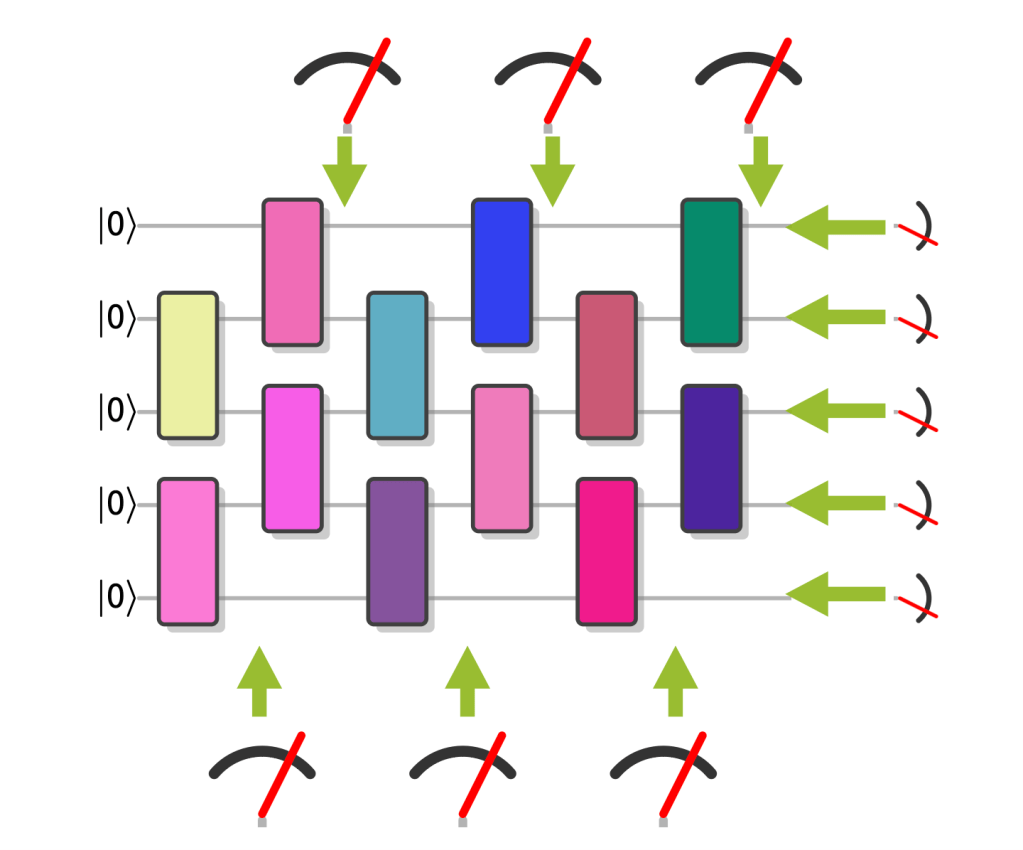
We can simulate closed timelike curves by subjecting a quantum system to a circuit of the type illustrated below. We read the diagram from bottom to top. Along this direction, time—as measured by a clock at rest with respect to the laboratory—progresses. Each vertical wire represents a qubit—a basic unit of quantum information, encoded in an atom or a photon or the like. Each horizontal slice of the diagram represents one instant. 

At the bottom of the diagram, the two vertical wires sprout from one curved wire. This feature signifies that the experimentalist prepares the qubits in an entangled state, represented by the symbol | \Psi_- \rangle. Farther up, the left-hand wire runs through a box. The box signifies that the corresponding qubit undergoes a transformation (for experts: a unitary evolution). 

At the top of the diagram, the vertical wires fuse again: the experimentalist measures whether the qubits are in the state they began in. The measurement is probabilistic; we (typically) can’t predict the outcome in advance, due to the uncertainty inherent in quantum physics. If the measurement yields the yes outcome, the experimentalist has simulated a closed timelike curve. If the no outcome results, the experimentalist should scrap the trial and try again.

So much for interpreting the diagram above as a quantum circuit. We can reinterpret the illustration as a closed timelike curve. You’ve probably guessed as much, comparing the circuit diagram to the depiction, farther above, of Colonel Next’s journey. According to the second interpretation, the loop represents one particle’s trajectory through spacetime. The bottom and top show the particle reversing chronological direction—resembling me as I flew to or from southern California.

Me in southern California in spring 2022. Photo courtesy of Justin Dressel.

How can we apply closed timelike curves in quantum metrology? In Fforde’s books, Colonel Next has a brother, named Mycroft, who’s an inventor.2 Suppose that Mycroft is studying how two particles interact (e.g., by an electric force). He wants to measure the interaction’s strength. Mycroft should prepare one particle—a sensor—and expose it to the second particle. He should wait for some time, then measure how much the interaction has altered the sensor’s configuration. The degree of alteration implies the interaction’s strength. The particles can be quantum, if Mycroft lives not merely in Sherlock Holmes’s world, but in a quantum-steampunk one.

But how should Mycroft prepare the sensor—in which quantum state? Certain initial states will enable the sensor to acquire ample information about the interaction; and others, no information. Mycroft can’t know which preparation will work best: the optimal preparation depends on the interaction, which he hasn’t measured yet. 

Mycroft, as drawn by Sydney Paget in the 1890s

Mycroft can overcome this dilemma via a strategy published by my collaborator David Arvidsson-Shukur, his recent student Aidan McConnell, and me. According to our protocol, Mycroft entangles the sensor with a third particle. He subjects the sensor to the interaction (coupling the sensor to particle #2) and measures the sensor. 

Then, Mycroft learns about the interaction—learns which state he should have prepared the sensor in earlier. He effectively teleports this state backward in time to the beginning-of-protocol sensor, using particle #3 (which began entangled with the sensor).3 Quantum teleportation is a decades-old information-processing task that relies on entanglement manipulation. The protocol can transmit quantum states over arbitrary distances—or, effectively, across time.

We can view Mycroft’s experiment in two ways. Using several particles, he manipulates entanglement to measure the interaction strength optimally (with the best possible precision). This process is mathematically equivalent to another. In the latter process, Mycroft uses only one sensor. It comes forward in time, reverses chronological direction (after Mycroft learns the optimal initial state’s form), backtracks to an earlier time (to when the sensing protocol began), and returns to progressing forward in time (informing Mycroft about the interaction).

Where I stayed in Stockholm. I swear, I’m not making this up.

In Sweden, I regarded my work with David and Aidan as a lark. But it’s led to an experiment, another experiment, and two papers set to debut this winter. I even pass as a quantum metrologist nowadays. Perhaps I should have anticipated the metamorphosis, as I should have anticipated the extra springtimes that erupted as I traveled between north and south. As the bard says, there’s a time for all things.

More Swedish wildflowers from June 2022

1In the sequel, Fforde adds a twist to Next’s closed timelike curve. I can’t speak for the twist’s plausibility or logic, but it makes for delightful reading, so I commend the novel to you.

2You might recall that Sherlock Holmes has a brother, named Mycroft, who’s an inventor. Why? In Fforde’s novel, an evil corporation pursues Mycroft, who’s built a device that can transport him into the world of a book. Mycroft uses the device to hide from the corporation in Sherlock Holmes’s backstory.

3Experts, Mycroft implements the effective teleportation as follows: He prepares a fourth particle in the ideal initial sensor state. Then, he performs a two-outcome entangling measurement on particles 3 and 4: he asks “Are particles 3 and 4 in the state in which particles 1 and 3 began?” If the measurement yields the yes outcome, Mycroft has effectively teleported the ideal sensor state backward in time. He’s also simulated a closed timelike curve. If the measurement yields the no outcome, Mycroft fails to measure the interaction optimally. Figure 1 in our paper synopsizes the protocol.

What distinguishes quantum from classical thermodynamics?

Should you require a model for an Oxford don in a play or novel, look no farther than Andrew Briggs. The emeritus professor of nanomaterials speaks with a southern-English accent as crisp as shortbread, exhibits manners to which etiquette influencer William Hanson could aspire, and can discourse about anything from Bantu to biblical Hebrew. I joined Andrew for lunch at St. Anne’s College, Oxford, this month.1 Over vegetable frittata, he asked me what unifying principle distinguishes quantum from classical thermodynamics.

With a thermodynamic colleague at the Oxford University Museum of Natural History

I’d approached quantum thermodynamics from nearly every angle I could think of. I’d marched through the thickets of derivations and plots; I’d journeyed from subfield to subfield; I’d gazed down upon the discipline as upon a landscape from a hot-air balloon. I’d even prepared a list of thermodynamic tasks enhanced by quantum phenomena: we can charge certain batteries at greater powers if we entangle them than if we don’t, entanglement can raise the amount of heat pumped out of a system by a refrigerator, etc. But Andrew’s question flummoxed me.

I bungled the answer. I toted out the aforementioned list, but it contained examples, not a unifying principle. The next day, I was sitting in an office borrowed from experimentalist Natalia Ares in New College, a Gothic confection founded during the late 1300s (as one should expect of a British college called “New”). Admiring the view of ancient stone walls, I realized how I should have responded the previous day.

View from a window near the office I borrowed in New College. If I could pack that office in a suitcase and carry it home, I would.

My answer begins with a blog post written in response to a quantum-thermodynamics question from a don at another venerable university: Yoram Alhassid. He asked, “What distinguishes quantum thermodynamics to quantum statistical mechanics?” You can read the full response here. Takeaways include thermodynamics’s operational flavor. When using an operational theory, we imagine agents who perform tasks, using given resources. For example, a thermodynamic agent may power a steamboat, given a hot gas and a cold gas. We calculate how effectively the agents can perform those tasks. For example, we compute heat engines’ efficiencies. If a thermodynamic agent can access quantum resources, I’ll call them “quantum thermodynamic.” If the agent can access only everyday resources, I’ll call them “classical thermodynamic.”

A quantum thermodynamic agent may access more resources than a classical thermodynamic agent can. The latter can leverage work (well-organized energy), free energy (the capacity to perform work), information, and more. A quantum agent may access not only those resources, but also entanglement (strong correlations between quantum particles), coherence (wavelike properties of quantum systems), squeezing (the ability to toy with quantum uncertainty as quantified by Heisenberg and others), and more. The quantum-thermodynamic agent may apply these resources as described in the list I rattled off at Andrew.

With Oxford experimentalist Natalia Ares in her lab

Yet quantum phenomena can impede a quantum agent in certain scenarios, despite assisting the agent in others. For example, coherence can reduce a quantum engine’s power. So can noncommutation. Everyday numbers commute under multiplication: 11 times 12 equals 12 times 11. Yet quantum physics features numbers that don’t commute so. This noncommutation underlies quantum uncertainty, quantum error correction, and much quantum thermodynamics blogged about ad nauseam on Quantum Frontiers. A quantum engine’s dynamics may involve noncommutation (technically, the Hamiltonian may contain terms that fail to commute with each other). This noncommutation—a fairly quantum phenomenon—can impede the engine similarly to friction. Furthermore, some quantum thermodynamic agents must fight decoherence, the leaking of quantum information from a quantum system into its environment. Decoherence needn’t worry any classical thermodynamic agent.

In short, quantum thermodynamic agents can benefit from more resources than classical thermodynamic agents can, but the quantum agents also face more threats. This principle might not encapsulate how all of quantum thermodynamics differs from its classical counterpart, but I think the principle summarizes much of the distinction. And at least I can posit such a principle. I didn’t have enough experience when I first authored a blog post about Oxford, in 2013. People say that Oxford never changes, but this quantum thermodynamic agent does.

In the University of Oxford Natural History Museum in 2013, 2017, and 2025. I’ve published nearly 150 Quantum Frontiers posts since taking the first photo!

1Oxford consists of colleges similarly to how neighborhoods form a suburb. Residents of multiple neighborhoods may work in the same dental office. Analogously, faculty from multiple colleges may work, and undergraduates from multiple colleges may major, in the same department.

A (quantum) complex legacy: Part trois

When I worked in Cambridge, Massachusetts, a friend reported that MIT’s postdoc association had asked its members how it could improve their lives. The friend confided his suggestion to me: throw more parties.1 This year grants his wish on a scale grander than any postdoc association could. The United Nations has designated 2025 as the International Year of Quantum Science and Technology (IYQ), as you’ve heard unless you live under a rock (or without media access—which, come to think of it, sounds not unappealing).

A metaphorical party cracker has been cracking since January. Governments, companies, and universities are trumpeting investments in quantum efforts. Institutions pulled out all the stops for World Quantum Day, which happens every April 14 but which scored a Google doodle this year. The American Physical Society (APS) suffused its Global Physics Summit in March with quantum science like a Bath & Body Works shop with the scent of Pink Pineapple Sunrise. At the summit, special symposia showcased quantum research, fellow blogger John Preskill dished about quantum-science history in a dinnertime speech, and a “quantum block party” took place one evening. I still couldn’t tell you what a quantum block party is, but this one involved glow sticks.

Google doodle from April 14, 2025

Attending the summit, I felt a satisfaction—an exultation, even—redolent of twelfth grade, when American teenagers summit the Mont Blanc of high school. It was the feeling that this year is our year. Pardon me while I hum “Time of your life.”2

Speakers and organizer of a Kavli Symposium, a special session dedicated to interdisciplinary quantum science, at the APS Global Physics Summit

Just before the summit, editors of the journal PRX Quantum released a special collection in honor of the IYQ.3 The collection showcases a range of advances, from chemistry to quantum error correction and from atoms to attosecond-length laser pulses. Collaborators and I contributed a paper about quantum complexity, a term that has as many meanings as companies have broadcast quantum news items within the past six months. But I’ve already published two Quantum Frontiers posts about complexity, and you surely study this blog as though it were the Bible, so we’re on the same page, right? 

Just joshing. 

Imagine you have a quantum computer that’s running a circuit. The computer consists of qubits, such as atoms or ions. They begin in a simple, “fresh” state, like a blank notebook. Post-circuit, they store quantum information, such as entanglement, as a notebook stores information post-semester. We say that the qubits are in some quantum state. The state’s quantum complexity is the least number of basic operations, such as quantum logic gates, needed to create that state—via the just-completed circuit or any other circuit.

Today’s quantum computers can’t create high-complexity states. The reason is, every quantum computer inhabits an environment that disturbs the qubits. Air molecules can bounce off them, for instance. Such disturbances corrupt the information stored in the qubits. Wait too long, and the environment will degrade too much of the information for the quantum computer to work. We call the threshold time the qubits’ lifetime, among more-obscure-sounding phrases. The lifetime limits the number of gates we can run per quantum circuit.

The ability to perform many quantum gates—to perform high-complexity operations—serves as a resource. Other quantities serve as resources, too, as you’ll know if you’re one of the three diehard Quantum Frontiers fans who’ve been reading this blog since 2014 (hi, Mom). Thermodynamic resources include work: coordinated energy that one can harness directly to perform a useful task, such as lifting a notebook or staying up late enough to find out what a quantum block party is. 

My collaborators: Jonas Haferkamp, Philippe Faist, Teja Kothakonda, Jens Eisert, and Anthony Munson (in an order of no significance here)

My collaborators and I showed that work trades off with complexity in information- and energy-processing tasks: the more quantum gates you can perform, the less work you have to spend on a task, and vice versa. Qubit reset exemplifies such tasks. Suppose you’ve filled a notebook with a calculation, you want to begin another calculation, and you have no more paper. You have to erase your notebook. Similarly, suppose you’ve completed a quantum computation and you want to run another quantum circuit. You have to reset your qubits to a fresh, simple state

Three methods suggest themselves. First, you can “uncompute,” reversing every quantum gate you performed.4 This strategy requires a long lifetime: the information imprinted on the qubits by a gate mustn’t leak into the environment before you’ve undone the gate. 

Second, you can do the quantum equivalent of wielding a Pink Pearl Paper Mate: you can rub the information out of your qubits, regardless of the circuit you just performed. Thermodynamicists inventively call this strategy erasure. It requires thermodynamic work, just as applying a Paper Mate to a notebook does. 

Third, you can

Suppose your qubits have finite lifetimes. You can undo as many gates as you have time to. Then, you can erase the rest of the qubits, spending work. How does complexity—your ability to perform many gates—trade off with work? My collaborators and I quantified the tradeoff in terms of an entropy we invented because the world didn’t have enough types of entropy.5

Complexity trades off with work not only in qubit reset, but also in data compression and likely other tasks. Quantum complexity, my collaborators and I showed, deserves a seat at the great soda fountain of quantum thermodynamics.

The great soda fountain of quantum thermodynamics

…as quantum information science deserves a seat at the great soda fountain of physics. When I embarked upon my PhD, faculty members advised me to undertake not only quantum-information research, but also some “real physics,” such as condensed matter. The latter would help convince physics departments that I was worth their money when I applied for faculty positions. By today, the tables have turned. A condensed-matter theorist I know has wound up an electrical-engineering professor because he calculates entanglement entropies.

So enjoy our year, fellow quantum scientists. Party like it’s 1925. Burnish those qubits—I hope they achieve the lifetimes of your life.

1Ten points if you can guess who the friend is.

2Whose official title, I didn’t realize until now, is “Good riddance.” My conception of graduation rituals has just turned a somersault. 

3PR stands for Physical Review, the brand of the journals published by the APS. The APS may have intended for the X to evoke exceptional, but I like to think it stands for something more exotic-sounding, like ex vita discedo, tanquam ex hospitio, non tanquam ex domo.

4Don’t ask me about the notebook analogue of uncomputing a quantum state. Explaining it would require another blog post.

5For more entropies inspired by quantum complexity, see this preprint. You might recognize two of the authors from earlier Quantum Frontiers posts if you’re one of the three…no, not even the three diehard Quantum Frontiers readers will recall; but trust me, two of the authors have received nods on this blog before.

The most steampunk qubit

I never imagined that an artist would update me about quantum-computing research.

Last year, steampunk artist Bruce Rosenbaum forwarded me a notification about a news article published in Science. The article reported on an experiment performed in physicist Yiwen Chu’s lab at ETH Zürich. The experimentalists had built a “mechanical qubit”: they’d stored a basic unit of quantum information in a mechanical device that vibrates like a drumhead. The article dubbed the device a “steampunk qubit.”

I was collaborating with Bruce on a quantum-steampunk sculpture, and he asked if we should incorporate the qubit into the design. Leave it for a later project, I advised. But why on God’s green Earth are you receiving email updates about quantum computing? 

My news feed sends me everything that says “steampunk,” he explained. So keeping a bead on steampunk can keep one up to date on quantum science and technology—as I’ve been preaching for years.

Other ideas displaced Chu’s qubit in my mind until I visited the University of California, Berkeley this January. Visiting Berkeley in January, one can’t help noticing—perhaps with a trace of smugness—the discrepancy between the temperature there and the temperature at home. And how better to celebrate a temperature difference than by studying a quantum-thermodynamics-style throwback to the 1800s?

One sun-drenched afternoon, I learned that one of my hosts had designed another steampunk qubit: Alp Sipahigil, an assistant professor of electrical engineering. He’d worked at Caltech as a postdoc around the time I’d finished my PhD there. We’d scarcely interacted, but I’d begun learning about his experiments in atomic, molecular, and optical physics then. Alp had learned about my work through Quantum Frontiers, as I discovered this January. I had no idea that he’d “met” me through the blog until he revealed as much to Berkeley’s physics department, when introducing the colloquium I was about to present.

Alp and collaborators proposed that a qubit could work as follows. It consists largely of a cantilever, which resembles a pendulum that bobs back and forth. The cantilever, being quantum, can have only certain amounts of energy. When the pendulum has a particular amount of energy, we say that the pendulum is in a particular energy level. 

One might hope to use two of the energy levels as a qubit: if the pendulum were in its lowest-energy level, the qubit would be in its 0 state; and the next-highest level would represent the 1 state. A bit—a basic unit of classical information—has 0 and 1 states. A qubit can be in a superposition of 0 and 1 states, and so the cantilever could be.

A flaw undermines this plan, though. Suppose we want to process the information stored in the cantilever—for example, to turn a 0 state into a 1 state. We’d inject quanta—little packets—of energy into the cantilever. Each quantum would contain an amount of energy equal to (the energy associated with the cantilever’s 1 state) – (the amount associated with the 0 state). This equality would ensure that the cantilever could accept the energy packets lobbed at it.

But the cantilever doesn’t have only two energy levels; it has loads. Worse, all the inter-level energy gaps equal each other. However much energy the cantilever consumes when hopping from level 0 to level 1, it consumes that much when hopping from level 1 to level 2. This pattern continues throughout the rest of the levels. So imagine starting the cantilever in its 0 level, then trying to boost the cantilever into its 1 level. We’d probably succeed; the cantilever would probably consume a quantum of energy. But nothing would stop the cantilever from gulping more quanta and rising to higher energy levels. The cantilever would cease to serve as a qubit.

We can avoid this problem, Alp’s team proposed, by placing an atomic-force microscope near the cantilever. An atomic force microscope maps out surfaces similarly to how a Braille user reads: by reaching out a hand and feeling. The microscope’s “hand” is a tip about ten nanometers across. So the microscope can feel surfaces far more fine-grained than a Braille user can. Bumps embossed on a page force a Braille user’s finger up and down. Similarly, the microscope’s tip bobs up and down due to forces exerted by the object being scanned. 

Imagine placing a microscope tip such that the cantilever swings toward it and then away. The cantilever and tip will exert forces on each other, especially when the cantilever swings close. This force changes the cantilever’s energy levels. Alp’s team chose the tip’s location, the cantilever’s length, and other parameters carefully. Under the chosen conditions, boosting the cantilever from energy level 1 to level 2 costs more energy than boosting from 0 to 1.

So imagine, again, preparing the cantilever in its 0 state and injecting energy quanta. The cantilever will gobble a quantum, rising to level 1. The cantilever will then remain there, as desired: to rise to level 2, the cantilever would have to gobble a larger energy quantum, which we haven’t provided.1

Will Alp build the mechanical qubit proposed by him and his collaborators? Yes, he confided, if he acquires a student nutty enough to try the experiment. For when he does—after the student has struggled through the project like a dirigible through a hurricane, but ultimately triumphed, and a journal is preparing to publish their magnum opus, and they’re brainstorming about artwork to represent their experiment on the journal’s cover—I know just the aesthetic to do the project justice.

1Chu’s team altered their cantilever’s energy levels using a superconducting qubit, rather than an atomic force microscope.

Quantum automata

Do you know when an engineer built the first artificial automaton—the first human-made machine that operated by itself, without external control mechanisms that altered the machine’s behavior over time as the machine undertook its mission?

The ancient Greek thinker Archytas of Tarentum reportedly created it about 2,300 years ago. Steam propelled his mechanical pigeon through the air.

For centuries, automata cropped up here and there as curiosities and entertainment. The wealthy exhibited automata to amuse and awe their peers and underlings. For instance, the French engineer Jacques de Vauconson built a mechanical duck that appeared to eat and then expel grains. The device earned the nickname the Digesting Duck…and the nickname the Defecating Duck.

Vauconson also invented a mechanical loom that helped foster the Industrial Revolution. During the 18th and 19th centuries, automata began to enable factories, which changed the face of civilization. We’ve inherited the upshots of that change. Nowadays, cars drive themselves, Roombas clean floors, and drones deliver packages.1 Automata have graduated from toys to practical tools.2

Rather, classical automata have. What of their quantum counterparts?

Scientists have designed autonomous quantum machines, and experimentalists have begun realizing them. The roster of such machines includes autonomous quantum engines, refrigerators, and clocks. Much of this research falls under the purview of quantum thermodynamics, due to the roles played by energy in these machines’ functioning: above, I defined an automaton as a machine free of time-dependent control (exerted by a user). Equivalently, according to a thermodynamicist mentality, we can define an automaton as a machine on which no user performs any work as the machine operates. Thermodynamic work is well-ordered energy that can be harnessed directly to perform a useful task. Often, instead of receiving work, an automaton receives access to a hot environment and a cold environment. Heat flows from the hot to the cold, and the automaton transforms some of the heat into work.

Quantum automata appeal to me because quantum thermodynamics has few practical applications, as I complained in my previous blog post. Quantum thermodynamics has helped illuminate the nature of the universe, and I laud such foundational insights. Yet we can progress beyond laudation by trying to harness those insights in applications. Some quantum thermal machines—quantum batteries, engines, etc.—can outperform their classical counterparts, according to certain metrics. But controlling those machines, and keeping them cold enough that they behave quantum mechanically, costs substantial resources. The machines cost more than they’re worth. Quantum automata, requiring little control, offer hope for practicality. 

To illustrate this hope, my group partnered with Simone Gasparinetti’s lab at Chalmer’s University in Sweden. The experimentalists created an autonomous quantum refrigerator from superconducting qubits. The quantum refrigerator can help reset, or “clear,” a quantum computer between calculations.

Artist’s conception of the autonomous-quantum-refrigerator chip. Credit: Chalmers University of Technology/Boid AB/NIST.

After we wrote the refrigerator paper, collaborators and I raised our heads and peered a little farther into the distance. What does building a useful autonomous quantum machine take, generally? Collaborators and I laid out guidelines in a “Key Issues Review” published in Reports in Progress on Physics last November.

We based our guidelines on DiVincenzo’s criteria for quantum computing. In 1996, David DiVincenzo published seven criteria that any platform, or setup, must meet to serve as a quantum computer. He cast five of the criteria as necessary and two criteria, related to information transmission, as optional. Similarly, our team provides ten criteria for building useful quantum automata. We regard eight of the criteria as necessary, at least typically. The final two, optional guidelines govern information transmission and machine transportation. 

Time-dependent external control and autonomy

DiVincenzo illustrated his criteria with multiple possible quantum-computing platforms, such as ions. Similarly, we illustrate our criteria in two ways. First, we show how different quantum automata—engines, clocks, quantum circuits, etc.—can satisfy the criteria. Second, we illustrate how quantum automata can consist of different platforms: ultracold atoms, superconducting qubits, molecules, and so on.

Nature has suggested some of these platforms. For example, our eyes contain autonomous quantum energy transducers called photoisomers, or molecular switches. Suppose that such a molecule absorbs a photon. The molecule may use the photon’s energy to switch configuration. This switching sets off chemical and neurological reactions that result in the impression of sight. So the quantum switch transduces energy from light into mechanical, chemical, and electric energy.

Photoisomer. (Image by Todd Cahill, from Quantum Steampunk.)

My favorite of our criteria ranks among the necessary conditions: every useful quantum automata must produce output worth the input. How one quantifies a machine’s worth and cost depends on the machine and on the user. For example, an agent using a quantum engine may care about the engine’s efficiency, power, or efficiency at maximum power. Costs can include the energy required to cool the engine to the quantum regime, as well as the control required to initialize the engine. The agent also chooses which value they regard as an acceptable threshold for the output produced per unit input. I like this criterion because it applies a broom to dust that we quantum thermodynamicists often hide under a rug: quantum thermal machines’ costs. Let’s begin building quantum engines that perform more work than they require to operate.

One might object that scientists and engineers are already sweating over nonautonomous quantum machines. Companies, governments, and universities are pouring billions of dollars into quantum computing. Building a full-scale quantum computer by hook or by crook, regardless of classical control, is costing enough. Eliminating time-dependent control sounds even tougher. Why bother?

Fellow Quantum Frontiers blogger John Preskill pointed out one answer, when I described my new research program to him in 2022: control systems are classical—large and hot. Consider superconducting qubits—tiny quantum circuits—printed on a squarish chip about the size of your hand. A control wire terminates on each qubit. The rest of the wire runs off the edge of the chip, extending to classical hardware standing nearby. One can fit only so many wires on the chip, so one can fit only so many qubits. Also, the wires, being classical, are hotter than the qubits should be. The wires can help decohere the circuits, introducing errors into the quantum information they store. The more we can free the qubits from external control—the more autonomy we can grant them—the better.

Besides, quantum automata exemplify quantum steampunk, as my coauthor Pauli Erker observed. I kicked myself after he did, because I’d missed the connection. The irony was so thick, you could have cut it with the retractible steel knife attached to a swashbuckling villain’s robotic arm. Only two years before, I’d read The Watchmaker of Filigree Street, by Natasha Pulley. The novel features a Londoner expatriate from Meiji Japan, named Mori, who builds clockwork devices. The most endearing is a pet-like octopus, called Katsu, who scrambles around Mori’s workshop and hoards socks. 

Does the world need a quantum version of Katsu? Not outside of quantum-steampunk fiction…yet. But a girl can dream. And quantum automata now have the opportunity to put quantum thermodynamics to work.

From tumblr

1And deliver pizzas. While visiting the University of Pittsburgh a few years ago, I was surprised to learn that the robots scurrying down the streets were serving hungry students.

2And minions of starving young scholars.

How writing a popular-science book led to a Nature Physics paper

Several people have asked me whether writing a popular-science book has fed back into my research. Nature Physics published my favorite illustration of the answer this January. Here’s the story behind the paper.

In late 2020, I was sitting by a window in my home office (AKA living room) in Cambridge, Massachusetts. I’d drafted 15 chapters of my book Quantum Steampunk. The epilogue, I’d decided, would outline opportunities for the future of quantum thermodynamics. So I had to come up with opportunities for the future of quantum thermodynamics. The rest of the book had related foundational insights provided by quantum thermodynamics about the universe’s nature. For instance, quantum thermodynamics had sharpened the second law of thermodynamics, which helps explain time’s arrow, into more-precise statements. Conventional thermodynamics had not only provided foundational insights, but also accompanied the Industrial Revolution, a paragon of practicality. Could quantum thermodynamics, too, offer practical upshots?

Quantum thermodynamicists had designed quantum engines, refrigerators, batteries, and ratchets. Some of these devices could outperform their classical counterparts, according to certain metrics. Experimentalists had even realized some of these devices. But the devices weren’t useful. For instance, a simple quantum engine consisted of one atom. I expected such an atom to produce one electronvolt of energy per engine cycle. (A light bulb emits about 1021 electronvolts of light per second.) Cooling the atom down and manipulating it would cost loads more energy. The engine wouldn’t earn its keep.

Autonomous quantum machines offered greater hope for practicality. By autonomous, I mean, not requiring time-dependent external control: nobody need twiddle knobs or push buttons to guide the machine through its operation. Such control requires work—organized, coordinated energy. Rather than receiving work, an autonomous machine accesses a cold environment and a hot environment. Heat—random, disorganized energy cheaper than work—flows from the hot to the cold. The machine transforms some of that heat into work to power itself. That is, the machine sources its own work from cheap heat in its surroundings. Some air conditioners operate according to this principle. So can some quantum machines—autonomous quantum machines.

Thermodynamicists had designed autonomous quantum engines and refrigerators. Trapped-ion experimentalists had realized one of the refrigerators, in a groundbreaking result. Still, the autonomous quantum refrigerator wasn’t practical. Keeping the ion cold and maintaining its quantum behavior required substantial work.

My community needed, I wrote in my epilogue, an analogue of solar panels in southern California. (I probably drafted the epilogue during a Boston winter, thinking wistfully of Pasadena.) If you built a solar panel in SoCal, you could sit back and reap the benefits all year. The panel would fulfill its mission without further effort from you. If you built a solar panel in Rochester, you’d have to scrape snow off of it. Also, the panel would provide energy only a few months per year. The cost might not outweigh the benefit. Quantum thermal machines resembled solar panels in Rochester, I wrote. We needed an analogue of SoCal: an appropriate environment. Most of it would be cold (unlike SoCal), so that maintaining a machine’s quantum nature would cost a user almost no extra energy. The setting should also contain a slightly warmer environment, so that net heat would flow. If you deposited an autonomous quantum machine in such a quantum SoCal, the machine would operate on its own.

Where could we find a quantum SoCal? I had no idea.

Sunny SoCal. (Specifically, the Huntington Gardens.)

A few months later, I received an email from quantum experimentalist Simone Gasparinetti. He was setting up a lab at Chalmers University in Sweden. What, he asked, did I see as opportunities for experimental quantum thermodynamics? We’d never met, but we agreed to Zoom. Quantum Steampunk on my mind, I described my desire for practicality. I described autonomous quantum machines. I described my yearning for a quantum SoCal.

I have it, Simone said.

Simone and his colleagues were building a quantum computer using superconducting qubits. The qubits fit on a chip about the size of my hand. To keep  the chip cold, the experimentalists put it in a dilution refrigerator. You’ve probably seen photos of dilution refrigerators from Google, IBM, and the like. The fridges tend to be cylindrical, gold-colored monstrosities from which wires stick out. (That is, they look steampunk.) You can easily develop the impression that the cylinder is a quantum computer, but it’s only the fridge.

Not a quantum computer

The fridge, Simone said, resembles an onion: it has multiple layers. Outer layers are warmer, and inner layers are colder. The quantum computer sits in the innermost layer, so that it behaves as quantum mechanically as possible. But sometimes, even the fridge doesn’t keep the computer cold enough.

Imagine that you’ve finished one quantum computation and you’re preparing for the next. The computer has written quantum information to certain qubits, as you’ve probably written on scrap paper while calculating something in a math class. To prepare for your next math assignment, given limited scrap paper, you’d erase your scrap paper. The quantum computer’s qubits need erasing similarly. Erasing, in this context, means cooling down even more than the dilution refrigerator can manage

Why not use an autonomous quantum refrigerator to cool the scrap-paper qubits?

I loved the idea, for three reasons. First, we could place the quantum refrigerator beside the quantum computer. The dilution refrigerator would already be cold, for the quantum computations’ sake. Therefore, we wouldn’t have to spend (almost any) extra work on keeping the quantum refrigerator cold. Second, Simone could connect the quantum refrigerator to an outer onion layer via a cable. Heat would flow from the warmer outer layer to the colder inner layer. From the heat, the quantum refrigerator could extract work. The quantum refrigerator would use that work to cool computational qubits—to erase quantum scrap paper. The quantum refrigerator would service the quantum computer. So, third, the quantum refrigerator would qualify as practical.

Over the next three years, we brought that vision to life. (By we, I mostly mean Simone’s group, as my group doesn’t have a lab.)

Artist’s conception of the autonomous-quantum-refrigerator chip. Credit: Chalmers University of Technology/Boid AB/NIST.

Postdoc Aamir Ali spearheaded the experiment. Then-master’s student Paul Jamet Suria and PhD student Claudia Castillo-Moreno assisted him. Maryland postdoc Jeffrey M. Epstein began simulating the superconducting qubits numerically, then passed the baton to PhD student José Antonio Marín Guzmán. 

The experiment provided a proof of principle: it demonstrated that the quantum refrigerator could operate. The experimentalists didn’t apply the quantum refrigerator in a quantum computation. Also, they didn’t connect the quantum refrigerator to an outer onion layer. Instead, they pumped warm photons to the quantum refrigerator via a cable. But even in such a stripped-down experiment, the quantum refrigerator outperformed my expectations. I thought it would barely lower the “scrap-paper” qubit’s temperature. But that qubit reached a temperature of 22 milliKelvin (mK). For comparison: if the qubit had merely sat in the dilution refrigerator, it would have reached a temperature of 45–70 mK. State-of-the-art protocols had lowered scrap-paper qubits’ temperatures to 40–49 mK. So our quantum refrigerator outperformed our competitors, through the lens of temperature. (Our quantum refrigerator cooled more slowly than they did, though.)

Simone, José Antonio, and I have followed up on our autonomous quantum refrigerator with a forward-looking review about useful autonomous quantum machines. Keep an eye out for a blog post about the review…and for what we hope grows into a subfield.

In summary, yes, publishing a popular-science book can benefit one’s research.

Ten lessons I learned from John Preskill

Last August, Toronto’s Centre for Quantum Information and Quantum Control (CQIQC) gave me 35 minutes to make fun of John Preskill in public. CQIQC was hosting its biannual conference, also called CQIQC, in Toronto. The conference features the awarding of the John Stewart Bell Prize for fundamental quantum physics. The prize derives its name for the thinker who transformed our understanding of entanglement. John received this year’s Bell Prize for identifying, with collaborators, how we can learn about quantum states from surprisingly few trials and measurements.

The organizers invited three Preskillites to present talks in John’s honor: Hoi-Kwong Lo, who’s helped steer quantum cryptography and communications; Daniel Gottesman, who’s helped lay the foundations of quantum error correction; and me. I believe that one of the most fitting ways to honor John is by sharing the most exciting physics you know of. I shared about quantum thermodynamics for (simple models of) nuclear physics, along with ten lessons I learned from John. You can watch the talk here and check out the paper, recently published in Physical Review Letters, for technicalities.

John has illustrated this lesson by wrestling with the black-hole-information paradox, including alongside Stephen Hawking. Quantum information theory has informed quantum thermodynamics, as Quantum Frontiers regulars know. Quantum thermodynamics is the study of work (coordinated energy that we can harness directly) and heat (the energy of random motion). Systems exchange heat with heat reservoirs—large, fixed-temperature systems. As I draft this blog post, for instance, I’m radiating heat into the frigid air in Montreal Trudeau Airport.

So much for quantum information. How about high-energy physics? I’ll include nuclear physics in the category, as many of my Europeans colleagues do. Much of nuclear physics and condensed matter involves gauge theories. A gauge theory is a model that contains more degrees of freedom than the physics it describes. Similarly, a friend’s description of the CN Tower could last twice as long as necessary, due to redundancies. Electrodynamics—the theory behind light bulbs—is a gauge theory. So is quantum chromodynamics, the theory of the strong force that holds together a nucleus’s constituents.

Every gauge theory obeys Gauss’s law. Gauss’s law interrelates the matter at a site to the gauge field around the site. For example, imagine a positive electric charge in empty space. An electric field—a gauge field—points away from the charge at every spot in space. Imagine a sphere that encloses the charge. How much of the electric field is exiting the sphere? The answer depends on the amount of charge inside, according to Gauss’s law.

Gauss’s law interrelates the matter at a site with the gauge field nearby…which is related to the matter at the next site…which is related to the gauge field farther away. So everything depends on everything else. So we can’t easily claim that over here are independent degrees of freedom that form a system of interest, while over there are independent degrees of freedom that form a heat reservoir. So how can we define the heat and work exchanged within a lattice gauge theory? If we can’t, we should start biting our nails: thermodynamics is the queen of the physical theories, a metatheory expected to govern all other theories. But how can we define the quantum thermodynamics of lattice gauge theories? My colleague Zohreh Davoudi and her group asked me this question.

I had the pleasure of addressing the question with five present and recent Marylanders…

…the mention of whom in my CQIQC talk invited…

I’m a millennial; social media took off with my generation. But I enjoy saying that my PhD advisor enjoys far more popularity on social media than I do.

How did we begin establishing a quantum thermodynamics for lattice gauge theories?

Someone who had a better idea than I, when I embarked upon this project, was my colleague Chris Jarzynski. So did Dvira Segal, a University of Toronto chemist and CQIQC’s director. So did everyone else who’d helped develop the toolkit of strong-coupling thermodynamics. I’d only heard of the toolkit, but I thought it sounded useful for lattice gauge theories, so I invited Chris to my conversations with Zohreh’s group.

I didn’t create this image for my talk, believe it or not. The picture already existed on the Internet, courtesy of this blog.

Strong-coupling thermodynamics concerns systems that interact strongly with reservoirs. System–reservoir interactions are weak, or encode little energy, throughout much of thermodynamics. For example, I exchange little energy with Montreal Trudeau’s air, relative to the amount of energy inside me. The reason is, I exchange energy only through my skin. My skin forms a small fraction of me because it forms my surface. My surface is much smaller than my volume, which is proportional to the energy inside me. So I couple to Montreal Trudeau’s air weakly.

My surface would be comparable to my volume if I were extremely small—say, a quantum particle. My interaction with the air would encode loads of energy—an amount comparable to the amount inside me. Should we count that interaction energy as part of my energy or as part of the air’s energy? Could we even say that I existed, and had a well-defined form, independently of that interaction energy? Strong-coupling thermodynamics provides a framework for answering these questions.

Kevin Kuns, a former Quantum Frontiers blogger, described how John explains physics through simple concepts, like a ball attached to a spring. John’s gentle, soothing voice resembles a snake charmer’s, Kevin wrote. John charms his listeners into returning to their textbooks and brushing up on basic physics.

Little is more basic than the first law of thermodynamics, synopsized as energy conservation. The first law governs how much a system’s internal energy changes during any process. The energy change equals the heat absorbed, plus the work absorbed, by the system. Every formulation of thermodynamics should obey the first law—including strong-coupling thermodynamics. 

Which lattice-gauge-theory processes should we study, armed with the toolkit of strong-coupling thermodynamics? My collaborators and I implicitly followed

and

We don’t want to irritate experimentalists by asking them to run difficult protocols. Tom Rosenbaum, on the left of the previous photograph, is a quantum experimentalist. He’s also the president of Caltech, so John has multiple reasons to want not to irritate him.

Quantum experimentalists have run quench protocols on many quantum simulators, or special-purpose quantum computers. During a quench protocol, one changes a feature of the system quickly. For example, many quantum systems consist of particles hopping across a landscape of hills and valleys. One might flatten a hill during a quench.

We focused on a three-step quench protocol: (1) Set the system up in its initial landscape. (2) Quickly change the landscape within a small region. (3) Let the system evolve under its natural dynamics for a long time. Step 2 should cost work. How can we define the amount of work performed? By following

John wrote a blog post about how the typical physicist is a one-trick pony: they know one narrow subject deeply. John prefers to know two subjects. He can apply insights from one field to the other. A two-trick pony can show that Gauss’s law behaves like a strong interaction—that lattice gauge theories are strongly coupled thermodynamic systems. Using strong-coupling thermodynamics, the two-trick pony can define the work (and heat) exchanged within a lattice gauge theory. 

An experimentalist can easily measure the amount of work performed,1 we expect, for two reasons. First, the experimentalist need measure only the small region where the landscape changed. Measuring the whole system would be tricky, because it’s so large and it can contain many particles. But an experimentalist can control the small region. Second, we proved an equation that should facilitate experimental measurements. The equation interrelates the work performed1 with a quantity that seems experimentally accessible.

My team applied our work definition to a lattice gauge theory in one spatial dimension—a theory restricted to living on a line, like a caterpillar on a thin rope. You can think of the matter as qubits2 and the gauge field as more qubits. The system looks identical if you flip it upside-down; that is, the theory has a \mathbb{Z}_2 symmetry. The system has two phases, analogous to the liquid and ice phases of H_2O. Which phase the system occupies depends on the chemical potential—the average amount of energy needed to add a particle to the system (while the system’s entropy, its volume, and more remain constant).

My coauthor Connor simulated the system numerically, calculating its behavior on a classical computer. During the simulated quench process, the system began in one phase (like H_2O beginning as water). The quench steered the system around within the phase (as though changing the water’s temperature) or across the phase transition (as though freezing the water). Connor computed the work performed during the quench.1 The amount of work changed dramatically when the quench started steering the system across the phase transition. 

Not only could we define the work exchanged within a lattice gauge theory, using strong-coupling quantum thermodynamics. Also, that work signaled a phase transition—a large-scale, qualitative behavior.

What future do my collaborators and I dream of for our work? First, we want for an experimentalist to measure the work1 spent on a lattice-gauge-theory system in a quantum simulation. Second, we should expand our definitions of quantum work and heat beyond sudden-quench processes. How much work and heat do particles exchange while scattering in particle accelerators, for instance? Third, we hope to identify other phase transitions and macroscopic phenomena using our work and heat definitions. Fourth—most broadly—we want to establish a quantum thermodynamics for lattice gauge theories.

Five years ago, I didn’t expect to be collaborating on lattice gauge theories inspired by nuclear physics. But this work is some of the most exciting I can think of to do. I hope you think it exciting, too. And, more importantly, I hope John thought it exciting in Toronto.

I was a student at Caltech during “One Entangled Evening,” the campus-wide celebration of Richard Feynman’s 100th birthday. So I watched John sing and dance onstage, exhibiting no fear of embarrassing himself. That observation seemed like an appropriate note on which to finish with my slides…and invite questions from the audience.

Congratulations on your Bell Prize, John.

1Really, the dissipated work.

2Really, hardcore bosons.

Finding Ed Jaynes’s ghost

You might have heard of the conundrum “What do you give the man who has everything?” I discovered a variation on it last October: how do you celebrate the man who studied (nearly) everything? Physicist Edwin Thompson Jaynes impacted disciplines from quantum information theory to biomedical imaging. I almost wrote “theoretical physicist,” instead of “physicist,” but a colleague insisted that Jaynes had a knack for electronics and helped design experiments, too. Jaynes worked at Washington University in St. Louis (WashU) from 1960 to 1992. I’d last visited the university in 2018, as a newly minted postdoc collaborating with WashU experimentalist Kater Murch. I’d scoured the campus for traces of Jaynes like a pilgrim seeking a saint’s forelock or humerus. The blog post “Chasing Ed Jaynes’s ghost” documents that hunt.

I found his ghost this October.

Kater and colleagues hosted the Jaynes Centennial Symposium on a brilliant autumn day when the campus’s trees were still contemplating shedding their leaves. The agenda featured researchers from across the sciences and engineering. We described how Jaynes’s legacy has informed 21st-century developments in quantum information theory, thermodynamics, biophysics, sensing, and computation. I spoke about quantum thermodynamics and information theory—specifically, incompatible conserved quantities, about which my research-group members and I have blogged many times.

Irfan Siddiqi spoke about quantum technologies. An experimentalist at the University of California, Berkeley, Irfan featured on Quantum Frontiers seven years ago. His lab specializes in superconducting qubits, tiny circuits in which current can flow forever, without dissipating. How can we measure a superconducting qubit? We stick the qubit in a box. Light bounces back and forth across the box. The light interacts with the qubit while traversing it, in accordance with the Jaynes–Cummings model. We can’t seal any box perfectly, so some light will leak out. That light carries off information about the qubit. We can capture the light using a photodetector to infer about the qubit’s state.

The first half of Jaynes–Cummings

Bill Bialek, too, spoke about inference. But Bill is a Princeton biophysicist, so fruit flies preoccupy him more than qubits do. A fruit fly metamorphoses from a maggot that hatches from an egg. As the maggot develops, its cells differentiate: some form a head, some form a tail, and so on. Yet all the cells contain the same genetic information. How can a head ever emerge, to differ from a tail? 

A fruit-fly mother, Bill revealed, injects molecules into an egg at certain locations. These molecules diffuse across the egg, triggering the synthesis of more molecules. The knock-on molecules’ concentrations can vary strongly across the egg: a maggot’s head cells contain molecules at certain concentrations, and the tail cells contain the same molecules at other concentrations.

At this point in Bill’s story, I was ready to take my hat off to biophysicists for answering the question above, which I’ll rephrase here: if we find that a certain cell belongs to a maggot’s tail, why does the cell belong to the tail? But I enjoyed even more how Bill turned the question on its head (pun perhaps intended): imagine that you’re a maggot cell. How can you tell where in the maggot you are, to ascertain how to differentiate? Nature asks this question (loosely speaking), whereas human observers ask Bill’s first question.

To answer the second question, Bill recalled which information a cell accesses. Suppose you know four molecules’ concentrations: c_1, c_2, c_3, and c_4. How accurately can you predict the cell’s location? That is, what probability does the cell have of sitting at some particular site, conditioned on the cs? That probability is large only at one site, biophysicists have found empirically. So a cell can accurately infer its position from its molecules’ concentrations.

I’m no biophysicist (despite minor evidence to the contrary), but I enjoyed Bill’s story as I enjoyed Irfan’s. Probabilities, information, and inference are abstract notions; yet they impact physical reality, from insects to quantum science. This tension between abstraction and concreteness arrested me when I first encountered entropy, in a ninth-grade biology lecture. The tension drew me into information theory and thermodynamics. These toolkits permeate biophysics as they permeate my disciplines. So, throughout the symposium, I spoke with engineers, medical-school researchers, biophysicists, thermodynamicists, and quantum scientists. They all struck me as my kind of people, despite our distribution across the intellectual landscape. Jaynes reasoned about distributions—probability distributions—and I expect he’d have approved of this one. The man who studied nearly everything deserves a celebration that illuminates nearly everything.

Happy 200th birthday, Carnot’s theorem!

In Kenneth Grahame’s 1908 novel The Wind in the Willows, a Mole meets a Water Rat who lives on a River. The Rat explains how the River permeates his life: “It’s brother and sister to me, and aunts, and company, and food and drink, and (naturally) washing.” As the River plays many roles in the Rat’s life, so does Carnot’s theorem play many roles in a thermodynamicist’s.

Nicolas Léonard Sadi Carnot lived in France during the turn of the 19th century. His father named him Sadi after the 13th-century Persian poet Saadi Shirazi. Said father led a colorful life himself,1 working as a mathematician, engineer, and military commander for and before the Napoleonic Empire. Sadi Carnot studied in Paris at the École Polytechnique, whose members populate a “Who’s Who” list of science and engineering. 

As Carnot grew up, the Industrial Revolution was humming. Steam engines were producing reliable energy on vast scales; factories were booming; and economies were transforming. France’s old enemy Britain enjoyed two advantages. One consisted of inventors: Englishmen Thomas Savery and Thomas Newcomen invented the steam engine. Scotsman James Watt then improved upon Newcomen’s design until rendering it practical. Second, northern Britain contained loads of coal that industrialists could mine to power her engines. France had less coal. So if you were a French engineer during Carnot’s lifetime, you should have cared about engines’ efficiencies—how effectively engines used fuel.2

Carnot proved a fundamental limitation on engines’ efficiencies. His theorem governs engines that draw energy from heat—rather than from, say, the motional energy of water cascading down a waterfall. In Carnot’s argument, a heat engine interacts with a cold environment and a hot environment. (Many car engines fall into this category: the hot environment is burning gasoline. The cold environment is the surrounding air into which the car dumps exhaust.) Heat flows from the hot environment to the cold. The engine siphons off some heat and converts it into work. Work is coordinated, well-organized energy that one can directly harness to perform a useful task, such as turning a turbine. In contrast, heat is the disordered energy of particles shuffling about randomly. Heat engines transform random heat into coordinated work.

In The Wind and the Willows, Toad drives motorcars likely powered by internal combustion, rather than by a steam engine of the sort that powered the Industrial Revolution.

An engine’s efficiency is the bang we get for our buck—the upshot we gain, compared to the cost we spend. Running an engine costs the heat that flows between the environments: the more heat flows, the more the hot environment cools, so the less effectively it can serve as a hot environment in the future. An analogous statement concerns the cold environment. So a heat engine’s efficiency is the work produced, divided by the heat spent.

Carnot upper-bounded the efficiency achievable by every heat engine of the sort described above. Let T_{\rm C} denote the cold environment’s temperature; and T_{\rm H}, the hot environment’s. The efficiency can’t exceed 1 - \frac{ T_{\rm C} }{ T_{\rm H} }. What a simple formula for such an extensive class of objects! Carnot’s theorem governs not only many car engines (Otto engines), but also the Stirling engine that competed with the steam engine, its cousin the Ericsson engine, and more.

In addition to generality and simplicity, Carnot’s bound boasts practical and fundamental significances. Capping engine efficiencies caps the output one can expect of a machine, factory, or economy. The cap also prevents engineers from wasting their time on daydreaming about more-efficient engines. 

More fundamentally than these applications, Carnot’s theorem encapsulates the second law of thermodynamics. The second law helps us understand why time flows in only one direction. And what’s deeper or more foundational than time’s arrow? People often cast the second law in terms of entropy, but many equivalent formulations express the law’s contents. The formulations share a flavor often synopsized with “You can’t win.” Just as we can’t grow younger, we can’t beat Carnot’s bound on engines. 

Video courtesy of FQxI

One might expect no engine to achieve the greatest efficiency imaginable: 1 - \frac{ T_{\rm C} }{ T_{\rm H} }, called the Carnot efficiency. This expectation is incorrect in one way and correct in another. Carnot did design an engine that could operate at his eponymous efficiency: an eponymous engine. A Carnot engine can manifest as the thermodynamicist’s favorite physical system: a gas in a box topped by a movable piston. The gas undergoes four strokes, or steps, to perform work. The strokes form a closed cycle, returning the gas to its initial conditions.3 

Steampunk artist Todd Cahill beautifully illustrated the Carnot cycle for my book. The gas performs useful work because a weight sits atop the piston. Pushing the piston upward, the gas lifts the weight.

The gas expands during stroke 1, pushing the piston and so outputting work. Maintaining contact with the hot environment, the gas remains at the temperature T_{\rm H}. The gas then disconnects from the hot environment. Yet the gas continues to expand throughout stroke 2, lifting the weight further. Forfeiting energy, the gas cools. It ends stroke 2 at the temperature T_{\rm C}.

The gas contacts the cold environment throughout stroke 3. The piston pushes on the gas, compressing it. At the end of the stroke, the gas disconnects from the cold environment. The piston continues compressing the gas throughout stroke 4, performing more work on the gas. This work warms the gas back up to T_{\rm H}.

In summary, Carnot’s engine begins hot, performs work, cools down, has work performed on it, and warms back up. The gas performs more work on the piston than the piston performs on it.

At what cost, if the engine operates at the Carnot efficiency? The engine mustn’t waste heat. One wastes heat by roiling up the gas unnecessarily—by expanding or compressing it too quickly. The gas must stay in equilibrium, a calm, quiescent state. One can keep the gas quiescent only by running the cycle infinitely slowly. The cycle will take an infinitely long time, outputting zero power (work per unit time). So one can achieve the perfect efficiency only in principle, not in practice, and only by sacrificing power. Again, you can’t win.

Efficiency trades off with power.

Carnot’s theorem may sound like the Eeyore of physics, all negativity and depression. But I view it as a companion and backdrop as rich, for thermodynamicists, as the River is for the Water Rat. Carnot’s theorem curbs diverse technologies in practical settings. It captures the second law, a foundational principle. The Carnot cycle provides intuition, serving as a simple example on which thermodynamicists try out new ideas, such as quantum engines. Carnot’s theorem also provides what physicists call a sanity check: whenever a researcher devises a new (for example, quantum) heat engine, they can confirm that the engine obeys Carnot’s theorem, to help confirm their proposal’s accuracy. Carnot’s theorem also serves as a school exercise and a historical tipping point: the theorem initiated the development of thermodynamics, which continues to this day. 

So Carnot’s theorem is practical and fundamental, pedagogical and cutting-edge—brother and sister, and aunts, and company, and food and drink. I just wouldn’t recommend trying to wash your socks in Carnot’s theorem.

1To a theoretical physicist, working as a mathematician and an engineer amounts to leading a colorful life.

2People other than Industrial Revolution–era French engineers should care, too.

3A cycle doesn’t return the hot and cold environments to their initial conditions, as explained above.

My favorite rocket scientist

Whenever someone protests, “I’m not a rocket scientist,” I think of my friend Jamie Rankin. Jamie is a researcher at Princeton University, and she showed me her lab this June. When I first met Jamie, she was testing instruments to be launched on NASA’s Parker Solar Probe. The spacecraft has approached closer to the sun than any of its predecessors. It took off in August 2018—fittingly, from my view, as I’d completed my PhD a few months earlier and met Jamie near the beginning of my PhD.

During my first term of Caltech courses, I noticed Jamie in one of my classes. She seemed sensible and approachable, so I invited her to check our answers against each other on homework assignments. Our homework checks evolved into studying together for qualifying exams—tests of basic physics knowledge, which serve as gateways to a PhD. The studying gave way to eating lunch together on weekends. After a quiet morning at my desk, I’d bring a sandwich to a shady patch of lawn in front of Caltech’s institute for chemical and biological research. (Pasadena lawns are suitable for eating on regardless of the season.) Jamie would regale me—as her token theorist friend—with tales of suiting up to use clean rooms; of puzzling out instrument breakages; and of working for the legendary Ed Stone, who’d headed NASA’s Jet Propulsion Laboratory (JPL).1

The Voyager probes were constructed at JPL during the 1970s. I’m guessing you’ve heard of Voyager, given how the project captured the public’s imagination. I heard about it on an educational audiotape when I was little. The probes sent us data about planets far out in our solar system. For instance, Voyager 2 was the first spacecraft to approach Neptune, as well as the first to approach four planets past Earth (Jupiter, Saturn, Uranus, and Neptune). But the probes’ mission still hasn’t ended. In 2012, Voyager 1 became the first human-made object to enter interstellar space. Both spacecrafts continue to transmit data. They also carry Golden Records, disks that encode sounds from Earth—a greeting to any intelligent aliens who find the probes.

Jamie published the first PhD thesis about data collected by Voyager. She now serves as Deputy Project Scientist for Voyager, despite her early-career status. The news didn’t surprise me much; I’d known for years how dependable and diligent she is.

A theorist intrudes on Jamie’s Princeton lab

As much as I appreciated those qualities in Jamie, though, what struck me more was her good-heartedness. In college, I found fellow undergrads to be interested and interesting, energetic and caring, open to deep conversations and self-evaluation—what one might expect of Dartmouth. At Caltech, I found grad students to be candid, generous, and open-hearted. Would you have expected as much from the tech school’s tech school—the distilled essence of the purification of concentrated Science? I didn’t. But I appreciated what I found, and Jamie epitomized it.

The back of the lab coat I borrowed

Jamie moved to Princeton after graduating. I’d moved to Harvard, and then I moved to NIST. We fell out of touch; the pandemic prevented her from attending my wedding, and we spoke maybe once a year. But, this June, I visited Princeton for the annual workshop of the Institute for Robust Quantum Simulation. We didn’t eat sandwiches on a lawn, but we ate dinner together, and she showed me around the lab she’d built. (I never did suit up for a clean-room tour at Caltech.)

In many ways, Jamie Rankin remains my favorite rocket scientist.


1Ed passed away between the drafting and publishing of this post. He oversaw my PhD class’s first-year seminar course. Each week, one faculty member would present to us about their research over pizza. Ed had landed the best teaching gig, I thought: continual learning about diverse, cutting-edge physics. So I associate Ed with intellectual breadth, curiosity, and the scent of baked cheese.