Can a game teach kids quantum mechanics?

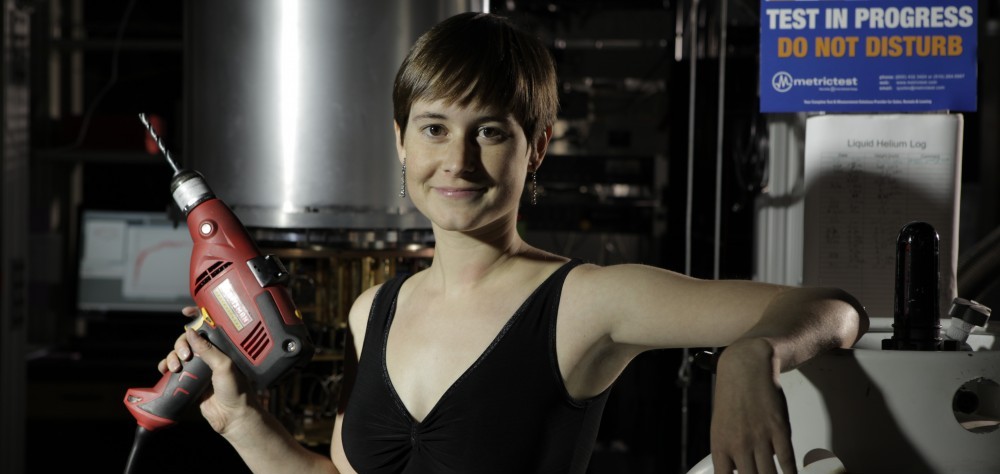
Five months ago, I received an email and then a phone call from Google’s Creative Lab Executive Producer, Lorraine Yurshansky. Lo, as she prefers to be called, is not your average thirty year-old. She has produced award-winning short films like Peter at the End (starring Napoleon Dynamite, aka Jon Heder), launched the wildly popular Maker Camp on Google+ and had time to run a couple of New York marathons as a warm-up to all of that. So why was she interested in talking to a quantum physicist?

You may remember reading about Google’s recent collaboration with NASA and D-Wave, on using NASA’s supercomputing facilities along with a D-Wave Two machine to solve optimization problems relevant to both Google (Glass, for example) and NASA (analysis of massive data sets). It was natural for Google, then, to want to promote this new collaboration through a short video about quantum computers. The video appeared last week on Google’s YouTube channel:

This is a very exciting collaboration in my view. Google has opened its doors to quantum computation and this has some powerful consequences. And it is all because of D-Wave. But, let me put my perspective in context, before Scott Aaronson unleashes the hounds of BQP on me.

Two years ago, together with Science magazine’s 2010 Breakthrough of the Year winner, Aaron O’ Connell, we decided to ask Google Ventures for $10,000,000 dollars to start a quantum computing company based on technology Aaron had developed as a graduate student at John Martini’s group at UCSB. The idea we pitched was that a hand-picked team of top experimentalists and theorists from around the world, would prototype new designs to achieve longer coherence times and greater connectivity between superconducting qubits, faster than in any academic environment. Google didn’t bite. At the time, I thought the reason behind the rejection was this: Google wants a real quantum computer now, not just a 10 year plan of how to make one based on superconducting X-mon qubits that may or may not work.

I was partially wrong. The reason for the rejection was not a lack of proof that our efforts would pay off eventually – it was a lack of any prototype on which Google could run algorithms relevant to their work. In other words, Aaron and I didn’t have something that Google could use right-away. But D-Wave did and Google was already dating D-Wave One for at least three years, before marrying D-Wave Two this May. Quantum computation has much to offer Google, so I am excited to see this relationship blossom (whether it be D-Wave or Pivit Inc that builds the first quantum computer). Which brings me back to that phone call five months ago…

Lorraine: Hi Spiro. Have you heard of Google’s collaboration with NASA on the new Quantum Artificial Intelligence Lab?

Me: Yes. It is all over the news!

Lo: Indeed. Can you help us design a mod for Minecraft to get kids excited about quantum mechanics and quantum computers?

Me: Minecraft? What is Minecraft? Is it like Warcraft or Starcraft?

Lo: (Omg, he doesn’t know Minecraft!?! How old is this guy?) Ahh, yeah, it is a game where you build cool structures by mining different kinds of blocks in this sandbox world. It is popular with kids.

Me: Oh, okay. Let me check out the game and see what I can come up with.

After looking at the game I realized three things:
1. The game has a fan base in the tens of millions.
2. There is an annual convention (Minecon) devoted to this game alone.
3. I had no idea how to incorporate quantum mechanics within Minecraft.

Lo and I decided that it would be better to bring some outside help, if we were to design a new mod for Minecraft. Enter E-Line Media and TeacherGaming, two companies dedicated to making games which focus on balancing the educational aspect with gameplay (which influences how addictive the game is). Over the next three months, producers, writers, game designers and coder-extraordinaire Dan200, came together to create a mod for Minecraft. But, we quickly came to a crossroads: Make a quantum simulator based on Dan200’s popular ComputerCraft mod, or focus on gameplay and a high-level representation of quantum mechanics within Minecraft?

The answer was not so easy at first, especially because I kept pushing for more authenticity (I asked Dan200 to create Hadamard and CNOT gates, but thankfully he and Scot Bayless – a legend in the gaming world – ignored me.) In the end, I would like to think that we went with the best of both worlds, given the time constraints we were operating under (a group of us are attending Minecon 2013 to showcase the new mod in two weeks) and the young audience we are trying to engage. For example, we decided that to prepare a pair of entangled qubits within Minecraft, you would use the Essence of Entanglement, an object crafted using the Essence of Superposition (Hadamard gate, yay!) and Quantum Dust placed in a CNOT configuration on a crafting table (don’t ask for more details). And when it came to Quantum Teleportation within the game, two entangled quantum computers would need to be placed at different parts of the world, each one with four surrounding pylons representing an encoding/decoding mechanism. Of course, on top of each pylon made of obsidian (and its far-away partner), you would need to place a crystal, as the required classical side-channel. As an authorized quantum mechanic, I allowed myself to bend quantum mechanics, but I could not bring myself to mess with Special Relativity.

As the mod launched two days ago, I am not sure how successful it will be. All I know is that the team behind its development is full of superstars, dedicated to making sure that John Preskill wins this bet (50 years from now):

The plan for the future is to upload a variety of posts and educational resources on qcraft.org discussing the science behind the high-level concepts presented within the game, at a level that middle-schoolers can appreciate. So, if you play Minecraft (or you have kids over the age of 10), download qCraft now and start building. It’s a free addition to Minecraft.

The cost and yield of moving from (quantum) state to (quantum) state

The countdown had begun.

In ten days, I’d move from Florida, where I’d spent the summer with family, to Caltech. Unfolded boxes leaned against my dresser, and suitcases yawned on the floor. I was working on a paper. Even if I’d turned around from my desk, I wouldn’t have seen the stacked books and folded sheets. I’d have seen Lorenz curves, because I’d drawn Lorenz curves all week, and the curves seemed imprinted on my eyeballs.

Using Lorenz curves, we illustrate how much we know about a quantum state. Say you have an electron, you’ll measure it using a magnet, and you can’t predict any measurement’s outcome. Whether you orient the magnet up-and-down, left-to-right, etc., you haven’t a clue what number you’ll read out. We represent this electron’s state by a straight line from (0, 0) to (1, 1).

Uniform_state

Say you know the electron’s state. Say you know that, if you orient the magnet up-and-down, you’ll read out +1. This state, we call “pure.” We represent it by a tented curve.

Pure_state

The more you know about a state, the more the state’s Lorenz curve deviates from the straight line.

Arbitrary_state

If Curve A fails to dip below Curve B, we know at least as much about State A as about State B. We can transform State A into State B by manipulating and/or discarding information.

Conversion_yield_part_1_arrow

By the time I’d drawn those figures, I’d listed the items that needed packing. A coauthor had moved from North America to Europe during the same time. If he could hop continents without impeding the paper, I could hop states. I unzipped the suitcases, packed a box, and returned to my desk.

Say Curve A dips below Curve B. We know too little about State A to transform it into State B. But we might combine State A with a state we know lots about. The latter state, C, might be pure. We have so much information about A + C, the amalgam can turn into B.

Yet more conversion costs Yet-more-conversion-costs-part-2

What’s the least amount of information we need about C to ensure that A + C can turn into B? That number, we call the “cost of transforming State A into State B.”

We call it that usually. But late in the evening, after I’d miscalculated two transformation costs and deleted four curves, days before my flight, I didn’t type the cost’s name into emails to coauthors. I typed “the cost of turning A into B” or “the cost of moving from state to state.”
Continue reading

The million dollar conjecture you’ve never heard of…

Curating a blog like this one and writing about imaginary stuff like Fermat’s Lost Theorem means that you get the occasional comment of the form: I have a really short proof of a famous open problem in math. Can you check it for me? Usually, the answer is no. But, about a week ago, a reader of the blog that had caught an omission in a proof contained within one of my previous posts, asked me to do just that: Check out a short proof of Beal’s Conjecture. Many of you probably haven’t heard of billionaire Mr. Beal and his $1,000,000 conjecture, so here it is:

Let a,b,c and x,y,z > 2 be positive integers satisfying a^x+b^y=c^z. Then, gcd(a,b,c) > 1; that is, the numbers a,b,c have a common factor.

After reading the “short proof” of the conjecture, I realized that this was a pretty cool conjecture! Also, the short proof was wrong, though the ideas within were non-trivial. But, partial progress had been made by others, so I thought I would take a crack at it on the 10 hour flight from Athens to Philadelphia. In particular, I convinced myself that if I could prove the conjecture for all even exponents x,y,z, then I could claim half the prize. Well, I didn’t quite get there, but I made some progress using knowledge found in these two blog posts: Redemption: Part I and Fermat’s Lost Theorem. In particular, one can show that the conjecture holds true for x=y=2n and z = 2k, for n \ge 3, k \ge 1. Moreover, the general case of even exponents can be reduced to the case of x=y=p \ge 3 and y=z=q \ge 3, for p,q primes. Which makes one wonder if the general case has a similar reduction, where two of the three exponents can be assumed equal.

The proof is pretty trivial, since most of the heavy lifting is done by Fermat’s Last Theorem (which itself has a rather elegant, short proof I wanted to post in the margins – alas, WordPress has a no-writing-on-margins policy). Moreover, it turns out that the general case of even exponents follows from a combination of results obtained by others over the past two decades (see the Partial Results section of the Wikipedia article on the conjecture linked above – in particular, the (n,n,2) case). So why am I even bothering to write about my efforts? Because it’s math! And math equals magic. Also, in case this proof is not known and in the off chance that some of the ideas can be used in the general case. Okay, here we go…

Proof. The idea is to assume that the numbers a,b,c have no common factor and then reach a contradiction. We begin by noting that a^{2m}+b^{2n}=c^{2k} is equivalent to (a^m)^2+(b^n)^2=(c^k)^2. In other words, the triplet (a^m,b^n,c^k) is a Pythagorean triple (sides of a right triangle), so we must have a^m=2rs, b^n=r^2-s^2, c^k =r^2+s^2, for some positive integers r,s with no common factors (otherwise, our assumption that a,b,c have no common factor would be violated). There are two cases to consider now:

Case I: r is even. This implies that 2r=a_0^m and s=a_1^m, where a=a_0\cdot a_1 and a_0,a_1 have no factors in common. Moreover, since b^n=r^2-s^2=(r+s)(r-s) and r,s have no common factors, then r+s,r-s have no common factors either (why?) Hence, r+s = b_0^n, r-s=b_1^n, where b=b_0\cdot b_1 and b_0,b_1 have no factors in common. But, a_0^m = 2r = (r+s)+(r-s)=b_0^n+b_1^n, implying that a_0^m=b_0^n+b_1^n, where b_0,b_1,a_0 have no common factors.

Case II: s is even. This implies that 2s=a_1^m and r=a_0^m, where a=a_0\cdot a_1 and a_0,a_1 have no factors in common. As in Case I, r+s = b_0^n, r-s=b_1^n, where b=b_0\cdot b_1 and b_0,b_1 have no factors in common. But, a_1^m = 2s = (r+s)-(r-s)=b_0^n-b_1^n, implying that a_1^m+b_1^n=b_0^n, where b_0,b_1,a_1 have no common factors.

We have shown, then, that if Beal’s conjecture holds for the exponents (x,y,z)=(n,n,m) and (x,y,z)=(m,n,n), then it holds for (x,y,z)=(2m,2n,2k), for arbitrary k \ge 1. As it turns out, when m=n, Beal’s conjecture becomes Fermat’s Last Theorem, implying that the conjecture holds for all exponents (x,y,z)=(2n,2n,2k), with n\ge 3 and k\ge 1.

Open Problem: Are there any solutions to a^p+b^p= c\cdot (a+b)^q, for a,b,c positive integers and primes p,q\ge 3?

PS: If you find a mistake in the proof above, please let everyone know in the comments. I would really appreciate it!

The complementarity (not incompatibility) of reason and rhyme

Shortly after learning of the Institute for Quantum Information and Matter, I learned of its poetry.

I’d been eating lunch with a fellow QI student at the Perimeter Institute for Theoretical Physics. Perimeter’s faculty includes Daniel Gottesman, who earned his PhD at what became Caltech’s IQIM. Perhaps as Daniel passed our table, I wondered whether a liberal-arts enthusiast like me could fit in at Caltech.

“Have you seen Daniel Gottesman’s website?” my friend replied. “He’s written a sonnet.”

Quill

He could have written equations with that quill.

Digesting this news with my chicken wrap, I found the website after lunch. The sonnet concerned quantum error correction, the fixing of mistakes made during computations by quantum systems. After reading Daniel’s sonnet, I found John Preskill’s verses about Daniel. Then I found more verses of John’s.

To my Perimeter friend: You win. I’ll fit in, no doubt.

Exhibit A: the latest edition of The Quantum Times, the newsletter for the American Physical Society’s QI group. On page 10, my enthusiasm for QI bubbles over into verse. Don’t worry if you haven’t heard all the terms in the poem. Consider them guidebook entries, landmarks to visit during a Wikipedia trek.

If you know the jargon, listen to it with a newcomer’s ear. Does anyone other than me empathize with frustrated lattices? Or describe speeches accidentally as “monotonic” instead of as “monotonous”? Hearing jargon outside its natural habitat highlights how not to explain research to nonexperts. Examining names for mathematical objects can reveal properties that we never realized those objects had. Inviting us to poke fun at ourselves, the confrontation of jargon sprinkles whimsy onto the meringue of physics.

No matter your familiarity with physics or poetry: Enjoy. And fifty points if you persuade Physical Review Letters to publish this poem’s sequel.

Quantum information

By Nicole Yunger Halpern

If “CHSH” rings a bell,
you know QI’s fared, lately, well.
Such promise does this field portend!
In Neumark fashion, let’s extend
this quantum-information spring:
dilation, growth, this taking wing.

We span the space of physics types
from spin to hypersurface hype,
from neutron-beam experiment
to Bohm and Einstein’s discontent,
from records of a photon’s path
to algebra and other math
that’s more abstract and less applied—
of platforms’ details, purified.

We function as a refuge, too,
if lattices can frustrate you.
If gravity has got your goat,
momentum cutoffs cut your throat:
Forget regimes renormalized;
our states are (mostly) unit-sized.
Velocities stay mostly fixed;
results, at worst, look somewhat mixed.

Though factions I do not condone,
the action that most stirs my bones
is more a spook than Popov ghosts; 1
more at-a-distance, less quark-close.

This field’s a tot—cacophonous—
like cosine, not monotonous.
Cacophony enlivens thought:
We’ve learned from noise what discord’s not.

So take a chance on wave collapse;
enthuse about the CP maps;
in place of “part” and “piece,” say “bit”;
employ, as yardstick, Hilbert-Schmidt;
choose quantum as your nesting place,
of all the fields in physics space.

1 With apologies to Ludvig Faddeev.

The Most Awesome Animation About Quantum Computers You Will Ever See

by Jorge Cham

You might think the title is a little exaggerated, but if there’s one thing I’ve learned from Theoretical Physicists so far, it’s to be bold with my conjectures about reality.

Welcome to the second installment of our series of animations about Quantum Information! After an auspicious start describing doing the impossible, this week we take a step back to talk in general terms about what makes the Quantum World different and how these differences can be used to build Quantum Computers.

In this video, I interviewed John Preskill and Spiros Michalakis. John is the co-Director of the Institute for Quantum Information and Matter. He’s known for many things, including making (and winning) bets with Stephen Hawking. Spiros hails from Greece, and probably never thought he’d see himself drawn in a Faustian devil outfit in the name of science (although, he’s so motivated about outreach, he’d probably do it).

img_faust

In preparation to make this video, I thought I’d do what any serious writer would do to exhaustively research a complex topic like this: read the Wikipedia page and call it a day. But then, while visiting the local library with my son, I stumbled upon a small section of books about Quantum Physics aimed at a general audience.

I thought, “Great! I’ll read these books and learn that way!” When I opened the books, though, they were mostly all text. I’m not against text, but when you’re a busy* cartoonist on a deadline trying to learn one of the most complex topics humans have ever devised, a few figures would help. On the other hand, fewer graphics mean more job security for busy cartoonists, so I can’t really complain. (*=Not really).

img_god

In particular, I started to read “The Quantum Story: A History in 40 Moments” by Jim Baggott. First, telling a story in 40 moments sounds a lot like telling a story with comics, and second, I thought it would be great to learn about these concepts from the point of view of how they came up with them. So, I eagerly opened the book and here is what it says in the Preface:

“Nobody really understands how Quantum Theory actually works.”

“Niels Bohr claimed that anybody who is not shocked by the theory has not understood it… Richard Feynman went further: he claimed that nobody understands it.”

One page in, and it’s already telling me to give up.

It’s a fascinating read, I highly recommend the book. Baggott makes the claim that,

“The reality of Scientific Endeavor is profoundly messy, often illogical, deeply emotional, and driven by the individual personalities involved as they sleepwalk their way to a temporary scientific truth.”

I’m glad this history was recorded. I hope in a way that these videos help record a quantum of the developing story, as we humans try to create pockets of quantum weirdness that can scale up. As John says in the video, it is very exciting.

Now, if you’ll excuse me, I need to sleepwalk back to bed.

img_leaking

Watch the second installment of this series:

Jorge Cham is the creator of Piled Higher and Deeper (www.phdcomics.com).

CREDITS:

Featuring: John Preskill and Spiros Michalakis

Produced in Partnership with the Institute for Quantum Information and Matter (http://iqim.caltech.edu) at Caltech with funding provided by the National Science Foundation.

Animation Assistance: Meg Rosenburg
Transcription: Noel Dilworth

Steampunk quantum

A dark-haired man leans over a marble balustrade. In the ballroom below, his assistants tinker with animatronic elephants that trumpet and with potions for improving black-and-white photographs. The man is an inventor near the turn of the 20th century. Cape swirling about him, he watches technology wed fantasy.

Welcome to the steampunk genre. A stew of science fiction and Victorianism, steampunk has invaded literature, film, and the Wall Street Journal. A few years after James Watt improved the steam engine, protagonists build animatronics, clone cats, and time-travel. At sci-fi conventions, top hats and blast goggles distinguish steampunkers from superheroes.

Photo

The closest the author has come to dressing steampunk.

I’ve never read steampunk other than H. G. Wells’s The Time Machine—and other than the scene recapped above. The scene features in The Wolsenberg Clock, a novel by Canadian poet Jay Ruzesky. The novel caught my eye at an Ontario library.

In Ontario, I began researching the intersection of QI with thermodynamics. Thermodynamics is the study of energy, efficiency, and entropy. Entropy quantifies uncertainty about a system’s small-scale properties, given large-scale properties. Consider a room of air molecules. Knowing that the room has a temperature of 75°F, you don’t know whether some molecule is skimming the floor, poking you in the eye, or elsewhere. Ambiguities in molecules’ positions and momenta endow the gas with entropy. Whereas entropy suggests lack of control, work is energy that accomplishes tasks.
Continue reading

Surviving in Extreme Conditions.

Sometimes in order to do one thing thoroughly you have to first master many other things, even those which may seem very unrelated to your focus. In the end, everything weaves itself together very elegantly and you find yourself wondering how you got through such an incredible sequence of coincidences to where you are now.

I am a rising first-year PhD student in Astrophysics at Caltech. I just completed my Bachelor’s in Physics also from Caltech last June. My Caltech journey has already led me to a number of unexpected places. New in Astrophysics, I am very excited to see as many observatories, labs and manufacturing locations as I can. I just moved out of the dorms and into the first place that is my very own home (which means I pay my own rent now). All of my windows have a very clear view of the radio tower-adorned Mt. Wilson.

This morning I woke up and looked at the Mt. Wilson horizon and decided to drive up there. I left my morning ballet class early to make time for the drive. The road to the observatory is not simple. HWY 2 is a pretty serious mountain road and accidents happen on it regularly. This is the first thing: to have access to observatories, I need to be able to drive there safely and reliably.

Fortunately I love driving, especially athletic mountain driving, so I am looking for almost any excuse to drive to JPL, Mt. Wilson, and so on. I’ll just stop, by saying that driving is a hobby for me and I see it as a sport, a science, and an art.

The first portion of the 2 is like any normal mountain road with speeding locals, terrifying cyclists and daredevil motorcyclists. The views become more and more breathtaking as you gain elevation, but the driver really shouldn’t be getting any of these views except for the portion that fits into the car’s field of view. The road is demanding, with turns and hills, all along a steep and curving mountainside. However, this part is a piece of cake compared to the second portion.

The turnoff to the observatory itself opens onto a less-maintained road speckled with enthusiastic hikers and with nicely sharp 6-inch pebbles scattered around the road. As much as I was enjoying taking smooth turns and avoiding the brakes, I went very slow on this section to drive around the random rocks on the road. I finally got to the top where I could take in the view in peace.

The first thing visitors see is the Cosmic Cafe. It has a balcony going all around the cafe with a fascinating view when there is no smog or fog. Last April, Caltech had its undergraduate student Formal here. We dined at this cafe and had a dance platform nearby. Driving up here, I could not help thinking how risky this was: 11 high-rise buses took a large portion of the Caltech undergraduate student body up to the top of this mountain in fog so dense we could barely see the bus ahead of us. The bus drivers were saints.

Hiking or running shoes are the best shoes to wear here, so I cannot imagine how we came here in suits, dress shoes, tight dresses, and merciless heels. Well, Caltech students have many talents. Second thing: being an active person in the Tech community takes you to some curious places on interesting occasions.

PAZ0101

Some Caltech undergraduates on Mt. Wilson (I’m purple).

I parked at the first available lot, right in front of the cafe and near some large radio towers. When trying to lock my car, I had some trouble. I have an electronic key which operates as a remote outside the car. The car would not react to my key and would not lock. I tried a few more times and finally it locked. I figured the battery in the key was dying, but that didn’t seem right. If any battery were dying, it would be the battery in the spare key that I am not using.
Continue reading

This single-shot life

The night before defending my Masters thesis, I ran out of shampoo. I ran out late enough that I wouldn’t defend from beneath a mop like Jack Sparrow’s; but, belonging to the Luxuriant Flowing-Hair Club for Scientists (technically, if not officially), I’d have to visit Shopper’s Drug Mart.

Image

The author’s unofficially Luxuriant Flowing Scientist Hair

Before visiting Shopper’s Drug Mart, I had to defend my thesis. The thesis, as explained elsewhere, concerns epsilons, the mathematical equivalents of seed pearls. The thesis also concerns single-shot information theory.

Ordinary information theory emerged in 1948, midwifed by American engineer Claude E. Shannon. Shannon calculated how efficiently we can pack information into symbols when encoding long messages. Consider encoding this article in the fewest possible symbols. Because “the” appears many times, you might represent “the” by one symbol. Longer strings of symbols suit misfits like “luxuriant” and “oobleck.” The longer the article, the fewer encoding symbols you need per encoded word. The encoding-to-encoded ratio decreases, toward a number called the Shannon entropy, as the message grows infinitely long.

Claude Shannon

We don’t send infinitely long messages, excepting teenagers during phone conversations. How efficiently can we encode just one article or sentence? The answer involves single-shot information theory, or—to those stuffing long messages into the shortest possible emails to busy colleagues—“1-shot info.” Pioneered within the past few years, single-shot theory concerns short messages and single trials, the Twitter to Shannon’s epic. Like articles, quantum states can form messages. Hence single-shot theory blended with quantum information in my thesis.

Continue reading

We are all Wilsonians now

Ken Wilson

Ken Wilson

Ken Wilson passed away on June 15 at age 77. He changed how we think about physics.

Renormalization theory, first formulated systematically by Freeman Dyson in 1949, cured the flaws of quantum electrodynamics and turned it into a precise computational tool. But the subject seemed magical and mysterious. Many physicists, Dirac prominently among them, questioned whether renormalization rests on a sound foundation.

Wilson changed that.

The renormalization group concept arose in an extraordinary paper by Gell-Mann and Low in 1954. It was embraced by Soviet physicists like Bogoliubov and Landau, and invoked by Landau to challenge the consistency of quantum electrodynamics. But it was an abstruse and inaccessible topic, as is well illustrated by the baffling discussion at the very end of the two-volume textbook by Bjorken and Drell.

Wilson changed that, too.

Ken Wilson turned renormalization upside down. Dyson and others had worried about the “ultraviolet divergences” occurring in Feynman diagrams. They introduced an artificial cutoff on integrations over the momenta of virtual particles, then tried to show that all the dependence on the cutoff can be eliminated by expressing the results of computations in terms of experimentally accessible quantities. It required great combinatoric agility to show this trick works in electrodynamics. In other theories, notably including general relativity, it doesn’t work.

Wilson adopted an alternative viewpoint. Take the short-distance cutoff seriously, he said, regarding it as part of the physical formulation of the field theory. Now ask what physics looks like at distances much larger than the cutoff. Wilson imagined letting the short-distance cutoff grow, while simultaneously adjusting the theory to preserve its low-energy predictions. This procedure sounds complicated, but Wilson discovered something wonderful — for the purpose of computing low-energy processes the theory becomes remarkably simple, completely characterized by just a few (renormalized) parameters. One recovers Dyson’s results plus much more, while also acquiring a rich and visually arresting physical picture of what is going on.

When I started graduate school in 1975, Wilson, not yet 40, was already a legend. Even Sidney Coleman, for me the paragon of razor sharp intellect, seemed to regard Wilson with awe. (They had been contemporaries at Caltech, both students of Murray Gell-Mann.) It enhanced the legend that Wilson had been notoriously slow to publish. He spent years pondering the foundations of quantum field theory before finally unleashing a torrent of revolutionary papers in the early 70s. Cornell had the wisdom to grant tenure despite Wilson’s unusually low productivity during the 60s.

As a student, I spent countless hours struggling through Wilson’s great papers, some of which were quite difficult. One introduced me to the operator product expansion, which became a workhorse of high-energy scattering theory and the foundation of conformal field theory. Another considered all the possible ways that renormalization group fixed points could control the high-energy behavior of the strong interactions. Conspicuously missing from the discussion was what turned out to be the correct idea — asymptotic freedom. Wilson had not overlooked this possibility; instead he “proved” it to be impossible. The proof contains a subtle error. Wilson analyzed charge renormalization invoking both Lorentz covariance and positivity of the Hilbert space metric, forgetting that gauge theories admit no gauge choice with both properties. Even Ken Wilson made mistakes.

Wilson also formulated the strong-coupling expansion of lattice gauge theory, and soon after pioneered the Euclidean Monte Carlo method for computing the quantitative non-perturbative predictions of quantum chromodynamics, which remains today an extremely active and successful program. But of the papers by Wilson I read while in graduate school, the most exciting by far was this one about the renormalization group. Toward the end of the paper Wilson discussed how to formulate the notion of the “continuum limit” of a field theory with a cutoff. Removing the short-distance cutoff is equivalent to taking the limit in which the correlation length (the inverse of the renormalized mass) is infinitely long compared to the cutoff — the continuum limit is a second-order phase transition. Wilson had finally found the right answer to the decades-old question, “What is quantum field theory?” And after reading his paper, I knew the answer, too! This Wilsonian viewpoint led to further deep insights mentioned in the paper, for example that an interacting self-coupled scalar field theory is unlikely to exist (i.e. have a continuum limit) in four spacetime dimensions.

Wilson’s mastery of quantum field theory led him to another crucial insight in the 1970s which has profoundly influenced physics in the decades since — he denigrated elementary scalar fields as unnatural. I learned about this powerful idea from an inspiring 1979 paper not by Wilson, but by Lenny Susskind. That paper includes a telltale acknowledgment: “I would like to thank K. Wilson for explaining the reasons why scalar fields require unnatural adjustments of bare constants.”

Susskind, channeling Wilson, clearly explains a glaring flaw in the standard model of particle physics — ensuring that the Higgs boson mass is much lighter than the Planck (i.e., cutoff) scale requires an exquisitely careful tuning of the theory’s bare parameters. Susskind proposed to banish the Higgs boson in favor of Technicolor, a new strong interaction responsible for breaking the electroweak gauge symmetry, an idea I found compelling at the time. Technicolor fell into disfavor because it turned out to be hard to build fully realistic models, but Wilson’s complaint about elementary scalars continued to drive the quest for new physics beyond the standard model, and in particular bolstered the hope that low-energy supersymmetry (which eases the fine tuning problem) will be discovered at the Large Hadron Collider. Both dark energy (another fine tuning problem) and the absence so far of new physics beyond the HIggs boson at the LHC are prompting some soul searching about whether naturalness is really a reliable criterion for evaluating success in physical theories. Could Wilson have steered us wrong?

Wilson’s great legacy is that we now regard nearly every quantum field theory as an effective field theory. We don’t demand or expect that the theory will continue working at arbitrarily short distances. At some stage it will break down and be replaced by a more fundamental description. This viewpoint is now so deeply ingrained in how we do physics that today’s students may be surprised to hear it was not always so. More than anyone else, we have Ken Wilson to thank for this indispensable wisdom. Few ideas have changed physics so much.

Don’t sweat the epsilons…and it’s all epsilons

I’d come to Barnes and Noble to study and to submerse in the bustle. I needed reminding that humans other than those on my history exam existed. When I ran out of tea and of names to review, I stood, stretched, and browsed the shelves. A blue-bound book caught my eye: Don’t Sweat the Small Stuff…and it’s all small stuff.

Richard Carlson wrote that book for people like me. We have packing lists, grocery lists, and laundry lists of to-do lists. We transcribe lectures. We try to rederive equations that we should just use. Call us “detail-oriented”; call us “conscientious”; we’re boring as toast, and we have earlier bedtimes. When urged to relax, we try. We might not succeed, but we try hard.

For example, I do physics instead of math. Mathematicians agonize over what-ifs: “What if this bit of the fraction reaches one while that bit goes negative and the other goes loop-the-loop? We’d be dividing by zero!” Divisions by zero atom-bomb calculations. Since dividing by a tiny number amounts to multiplying by a large number, dividing by zero amounts to multiplying by infinity. While mathematicians chew their nails over infinities, physicists often assume we needn’t. We use math to represent physical systems like pendulums and ponytails.1 Ponytails have properties, like lacking infinite masses, that don’t smack of the apocalypse. Since those properties don’t, neither does the math that represents those properties. To justify assumptions that our math “behaves nicely,” we use the jargon, “the field goes to zero at the boundary,” “the coupling’s renormalized,” and “it worked last time.”

I tried not to sweat the small stuff. I tried to shrug off the question marks at calculations’ edges. Sometimes, I succeeded. Then I began a Masters thesis about epsilons.

Self-help for calculus addicts.

In many physics problems, the Greek letter epsilon (ε) means “-ish.” The butcher sold you epsilon-close to a pound of beef? He tipped the scale a tad in your favor. Your temperature dropped from 103 to epsilon-close to normal? Stay in bed this afternoon, and you should recover by tomorrow.

For half a year, I’ve used epsilons to describe transformations between quantum states. To visualize the transformations, say you have a fistful of coins. Each coin consists of gold and aluminum. The portion of the coin that’s gold varies from coin to coin. I want a differently-sized fistful of coins, each with a certain gold content. After melting down your fistful, can you cast the fistful I want? Can you cast a fistful that’s epsilon-close to the fistful I want? I calculated answers to those questions, after substituting “quantum states” for “fistfuls” and a property called “purity” for “gold.”2

You might expect epsilon-close conversions to require less effort than exact conversions: Butchers weigh out approximately a pound of beef more quickly than they weigh a pound. But epsilon-close math requires more effort than exact math. Introducing epsilons into calculations, you introduce another number to keep track of. As that number approaches zero, approximate conversions become exact. If that number approaches zero while in a denominator, you atom-bomb calculations with infinities. The infinities remind me of geysers in a water park of quantum theory.

Have you visited a water park where geysers erupt every few minutes? Have you found a geyser head that looks dead, and crouched to check it? Epsilons resemble dead-looking geyser heads. Just as geyser heads rise only inches from the ground, epsilons have values close to zero. Say you’ve divided by epsilon, and you’re lowering its value to naught. Hitch up your swimsuit, lower your head, and squint at the faucet. Farther you crouch, and farther, till SPLAT! Water shoots up your left nostril.

Infinities have been shooting up my left nostril for months.

Rocking back on your heels, you need a towel. Dividing by an epsilon that approaches zero, I need an advisor. An advisor who knows mounds of calculus, who corrects without crushing, and who doesn’t mind my bombarding him with questions once a week. I have one, thank goodness—an advisor, not a towel.3 I wouldn’t trade him for fifty fistfuls of gold coins.

Towel in hand, I tiptoed through the water park of epsilons. I learned how quickly geysers erupt, where they appear, and how to disable some. I learned about smoothed distributions, limits superior, and Asymptotic Equipartition Properties. Though soaked after crossing the park, I survived. I submitted my thesis last week. And I have the right—should I find the chutzpah—to toss off the word “epsilonification” like a spelling-bee champ.

Had I not sweated the epsilons, I wouldn’t have finished the thesis. Should I discard Richard Carlson’s advice? I can’t say, having returned to my history review instead of reading his book. But I don’t view epsilons as troubles to sweat or not. Why not view epsilons as geysers in the water park of quantum theory? Who doesn’t work up a sweat in a park? But I wouldn’t rather leave. And maybe—if enough geysers shoot up our left nostrils—we’ll learn a smidgeon about Old Faithful.

1 I’m not kidding about ponytails.

2 Quantum whizzes: I explored a resource theory like that of pure bipartite entanglement (e.g., http://arxiv.org/abs/quant-ph/9811053). Instead of entanglement or gold, nonuniformity (distance from the maximally mixed state) is a scarce resource. The uniform (maximally mixed state) has no worth, like aluminum. This “resource theory of nonuniformity” models thermodynamic systems whose Hamiltonians are trivial (H = 0).

3 Actually, I have two advisors, and I’m grateful for both. But one helped cure my epsilons. N.B. I have not begun working at Caltech.


